Beyond Lipinski's Rule of Five: Navigating the bRo5 Chemical Space for Modern Drug Discovery
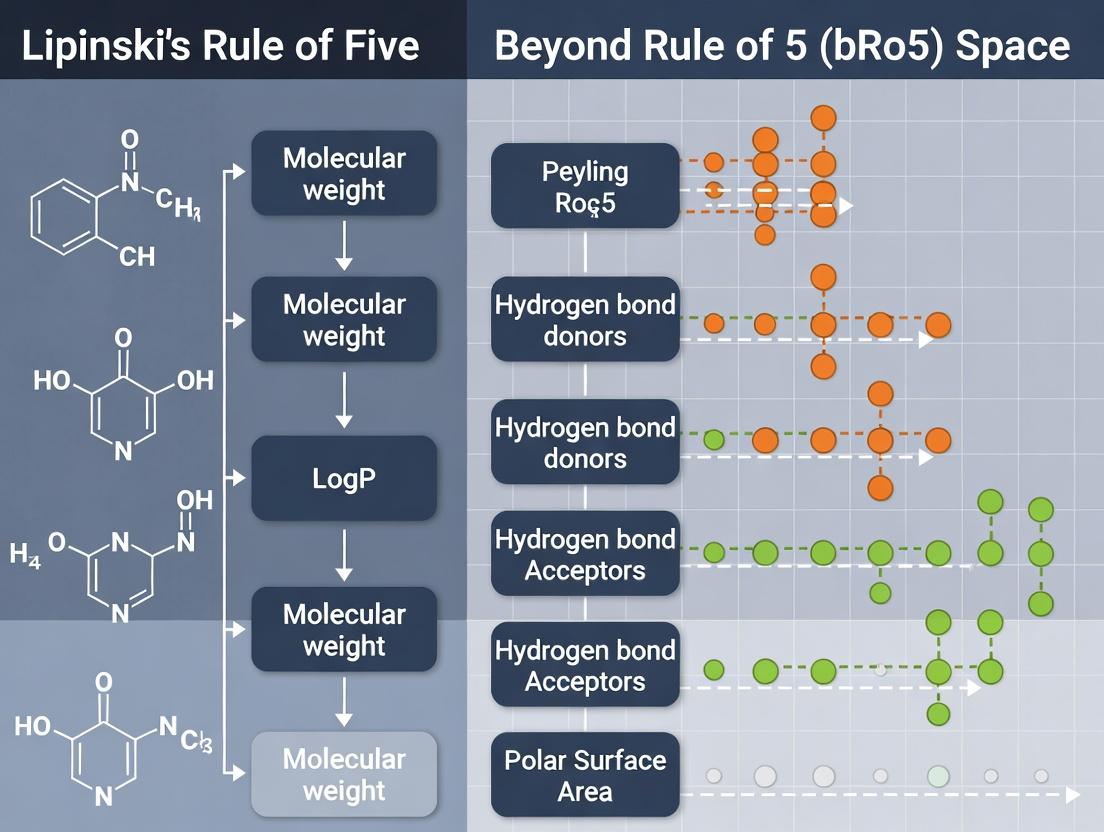
This article provides a comprehensive guide to the evolution, application, and current state-of-the-art for drug design beyond Lipinski's Rule of Five (bRo5).
Beyond Lipinski's Rule of Five: Navigating the bRo5 Chemical Space for Modern Drug Discovery
Abstract
This article provides a comprehensive guide to the evolution, application, and current state-of-the-art for drug design beyond Lipinski's Rule of Five (bRo5). Targeted at researchers and drug development professionals, it covers the foundational principles and limitations of Ro5, explores modern methodologies for designing and optimizing bRo5 compounds, addresses key challenges like poor permeability and solubility, and validates success through case studies of approved drugs and advanced computational tools. The synthesis offers a strategic roadmap for exploiting the vast, untapped potential of the bRo5 space to target previously 'undruggable' biological targets.
The Genesis and Limitations of Lipinski's Rule of Five: Why We Had to Look Beyond
The "Rule of Five" (Ro5), articulated by Christopher A. Lipinski in 1997, emerged from a retrospective analysis of compounds in the World Drug Index. It established a foundational framework for predicting the likelihood of a molecule demonstrating acceptable oral bioavailability. The rule serves as a pragmatic filter in early drug discovery, prioritizing compounds with physicochemical properties aligned with passive absorption. However, the exploration of novel therapeutic targets, particularly in areas like protein-protein interactions, has necessitated venturing into the Beyond Rule of 5 (bRo5) chemical space. This involves designing larger, more complex molecules that violate one or more of the original rules while often employing active transport mechanisms. Understanding the original four rules and their quantitative rationale is therefore critical for intelligently navigating both Ro5-compliant and bRo5 drug discovery.
The Original Four Rules: Data and Rationale
The rules are defined by four simple-to-calculate physicochemical parameters.
Table 1: The Original Four Rules of Lipinski
| Rule Number | Parameter | Threshold | Rationale & Experimental Basis |
|---|---|---|---|
| 1 | Molecular Weight (MW) | ≤ 500 Da | Higher MW correlates with decreased passive diffusion through lipid bilayers and aqueous pores. Empirical analysis showed a sharp drop in oral bioavailability above this approximate threshold. |
| 2 | Lipophilicity (calculated Log P, typically CLogP) | ≤ 5 | Optimal log P (typically 1-3) ensures sufficient solubility in the gut and permeability through the lipid membrane. A CLogP >5 indicates high hydrophobicity, leading to poor aqueous solubility and increased metabolic clearance. Measured via shake-flask or chromatographic methods (e.g., HPLC log k'). |
| 3 | Hydrogen Bond Donors (HBD) | ≤ 5 | The sum of NH and OH groups. Excessive HBDs increase desolvation energy and form strong interactions with water, hindering passage through the lipophilic core of the cell membrane. |
| 4 | Hydrogen Bond Acceptors (HBA) | ≤ 10 | The sum of N and O atoms. Similar to HBDs, excessive HBAs increase polarity and hydration, reducing membrane permeability. |
Note: The "Rule of Five" name derives from the multiples of five in the thresholds (500, 5, 5, 10).
Detailed Experimental Protocols for Key Measurements
Protocol 3.1: Determination of Partition Coefficient (Log P)
Objective: To experimentally measure the distribution of a compound between octanol and water, defining its lipophilicity. Materials: 1-Octanol (HPLC grade), aqueous buffer (typically phosphate-buffered saline, pH 7.4), compound of interest, HPLC system with UV/Vis detector. Procedure:
- Pre-saturation: Saturate octanol with buffer and buffer with octanol by mixing equal volumes in a separatory funnel for 24 hours. Allow phases to separate; use each phase for the respective solvent in the experiment.
- Partitioning: Dissolve the test compound in a known volume (e.g., 1 mL) of the pre-saturated octanol or buffer phase (depending on solubility). Mix with an equal volume of the complementary pre-saturated phase in a sealed vial.
- Equilibration: Vortex mix vigorously for 1 minute, then shake on a rotary mixer for 24 hours at constant temperature (25°C).
- Separation: Centrifuge the mixture to achieve complete phase separation.
- Quantification: Carefully separate the two phases. Dilute each phase appropriately and quantify the concentration of the compound in each phase using a validated HPLC-UV method with external calibration standards.
- Calculation: Log P = log₁₀ (Concentration in octanol / Concentration in buffer).
Protocol 3.2: Assessment of Passive Membrane Permeability (PAMPA)
Objective: To predict passive transcellular permeability using a non-cell-based artificial membrane. Materials: PAMPA plate (donor and acceptor compartments), PVDF filter coated with lecithin in dodecane (membrane), pH 7.4 buffer, compound solution, UV plate reader or LC-MS. Procedure:
- Acceptor Plate Preparation: Fill the acceptor wells with 300 µL of pH 7.4 buffer (with 5% DMSO to match donor).
- Membrane & Donor Plate Assembly: Impregnate the filter with membrane lipid solution. Place it onto the acceptor plate. Fill the donor wells with 150 µL of test compound solution (50-100 µM in pH 7.4 buffer).
- Incubation: Carefully place the donor plate on top, creating a "sandwich." Incubate at room temperature for 4-6 hours without agitation.
- Sampling: Disassemble the plates. Quantify the compound concentration in both donor and acceptor compartments at time zero (t₀) and after incubation (t₆) using UV spectroscopy or LC-MS.
- Calculation: Determine the apparent permeability, Papp (cm/s): Papp = { -ln(1 - [Drug]acceptor / [Drug]equilibrium) } * (V / (A * t)), where V is donor volume, A is membrane area, and t is time.
Visualizations
Diagram 1: Ro5 Rule Evaluation Workflow
Diagram 2: Permeability vs. Property Relationships
The Scientist's Toolkit: Key Research Reagent Solutions
Table 2: Essential Materials for Ro5 and Permeability Studies
| Item | Function/Description | Example Vendor/Product |
|---|---|---|
| 1-Octanol (HPLC Grade) | Organic phase for the gold-standard log P measurement. Must be pre-saturated with aqueous buffer to ensure valid results. | MilliporeSigma (34887) |
| Pre-coated PAMPA Plates | Ready-to-use multiwell plates with artificial lipid membranes for high-throughput permeability screening. | Corning Gentest Pre-coated PAMPA Plate System |
| Phosphate Buffered Saline (PBS), pH 7.4 | Standard isotonic aqueous buffer for physiological solubility and partitioning studies. | Gibco DPBS |
| Caco-2 Cell Line | Human colon adenocarcinoma cell line forming differentiated monolayers, the industry standard model for predicting intestinal drug absorption (active+passive). | ATCC HTB-37 |
| Chromatographic Log D Columns | HPLC columns (e.g., Immobilized Artificial Membrane) for rapid, high-throughput estimation of lipophilicity (log k' as proxy for log P/log D). | Regis Technologies IAM.PC.DD2 Column |
| In Silico Prediction Software | Software suites for calculating Ro5 parameters (MW, CLogP, HBD, HBA) and ADME properties from molecular structure. | Schrödinger Suite (QikProp), OpenEye (FILTER), MOE |
| LC-MS/MS System | Essential for quantifying compound concentrations in complex matrices (e.g., from PAMPA, Caco-2 assays) with high sensitivity and specificity. | SCIEX Triple Quad systems, Agilent 6470 series |
The pursuit of oral bioavailability remains a central challenge in drug discovery. Lipinski's Rule of Five (Ro5) has served as a foundational heuristic for over two decades, guiding medicinal chemists in the design of molecules with a higher probability of acceptable oral absorption. Its core principles—molecular weight <500 Da, LogP <5, hydrogen bond donors <5, and hydrogen bond acceptors <10—act as a critical filter in early-stage screening to prioritize compounds likely to succeed in preclinical development.
However, the landscape is evolving. Research into the "beyond Rule of 5" (bRo5) chemical space—encompassing macrocycles, peptides, and other complex modalities—has expanded the therapeutic horizon to targets previously considered "undruggable." This whitepaper examines the enduring role of the Ro5 as an essential, but not absolute, early-stage filter, positioned within the broader context of modern multiparameter optimization and bRo5 research. It provides a technical guide for its informed application.
The Quantitative Framework of the Ro5 and Its Evolution
The Ro5 is a probabilistic filter, not a rule. Violations increase the risk of poor absorption or permeability. The following table summarizes the core criteria and their physicochemical rationale.
Table 1: Core Lipinski's Rule of Five Criteria and Rationale
| Parameter | Threshold | Physicochemical Rationale | Primary ADME Impact |
|---|---|---|---|
| Molecular Weight (MW) | ≤ 500 Da | Larger molecules have decreased passive diffusion across lipid bilayers. | Passive intestinal permeability |
| Calculated LogP (cLogP) | ≤ 5 | High lipophilicity reduces aqueous solubility, increasing metabolic clearance risk. | Solubility, permeability, metabolism |
| Hydrogen Bond Donors (HBD) | ≤ 5 | Excessive H-bonding capacity reduces membrane permeation via desolvation energy cost. | Passive permeability |
| Hydrogen Bond Acceptors (HBA) | ≤ 10 | Excessive H-bonding capacity reduces membrane permeation via desolvation energy cost. | Passive permeability |
The application of the Ro5 has been refined by subsequent rules and metrics, forming a more nuanced toolkit.
Table 2: Complementary Rules and Metrics to the Ro5
| Rule/Metric | Key Criteria | Primary Focus |
|---|---|---|
| Veber/Drug Efficiency | Polar Surface Area (TPSA) ≤ 140 Ų, Rotatable Bonds ≤ 10 | Oral bioavailability (combining permeability & solubility) |
| Egan "Brain Penetrator" | TPSA ≤ 130 Ų, WLogP > 1 and < 6.5 | Blood-Brain Barrier permeability |
| PAINS Filters | Structural alerts for assay interference | Compound promiscuity, false positives |
| GSK 4/400 | cLogP < 4, MW < 400 | Improved candidate quality & safety |
| Lovering "Escape from Flatland" | Fsp³ > 0.42 | Saturation, improved solubility & developability |
Experimental Protocols for Key Ro5-Related Assays
High-Throughput Kinetic Solubility (HTS) Assay
Purpose: To determine the thermodynamic solubility of compounds in aqueous buffer. Protocol:
- Prepare a 10 mM stock solution of the test compound in DMSO.
- Dilute the stock 1:100 in pH 7.4 phosphate-buffered saline (PBS) to a final nominal concentration of 100 µM. Final DMSO concentration is 1%.
- Shake the plate at 25°C for 24 hours.
- Filter the suspension using a 96-well filter plate (e.g., 0.45 µm PVDF membrane).
- Quantify the concentration of compound in the filtrate using UV spectrophotometry (e.g., CLND) or LC-MS/MS.
- Data Interpretation: Solubility < 10 µM is considered low and may signal formulation challenges.
Parallel Artificial Membrane Permeability Assay (PAMPA)
Purpose: To predict passive transcellular permeability. Protocol:
- Prepare a lipid-infused artificial membrane on a 96-well filter plate by coating with a solution of lecithin (e.g., 2% w/v phosphatidylcholine in dodecane).
- Add a pH 7.4 PBS solution of the test compound (e.g., 100 µM) to the donor plate.
- Fill the acceptor plate with pH 7.4 PBS.
- Assemble the sandwich and incubate undisturbed at 25°C for 4-16 hours.
- Analyze compound concentration in both donor and acceptor compartments by LC-MS.
- Calculate effective permeability (Pe). Typical Classification: Pe < 1.0 x 10⁻⁶ cm/s (low permeability), > 1.0 x 10⁻⁵ cm/s (high permeability).
Caco-2 Cell Monolayer Permeability Assay
Purpose: To model active and passive intestinal epithelial transport, including efflux. Protocol:
- Culture Caco-2 cells on a 24-well transwell insert until a confluent monolayer forms (21 days). Confirm integrity via transepithelial electrical resistance (TEER > 300 Ω·cm²).
- Add test compound (e.g., 10 µM in HBSS, pH 7.4) to either the apical (A) or basolateral (B) compartment.
- Incubate at 37°C with 5% CO₂. Sample from the opposite compartment at timed intervals (e.g., 30, 60, 90, 120 min).
- Analyze samples by LC-MS/MS.
- Calculate apparent permeability (Papp) in both directions (A→B and B→A).
- Data Interpretation: A Papp (A→B) > 1 x 10⁻⁶ cm/s suggests good permeability. An efflux ratio (B→A / A→B) > 2.5 indicates potential P-glycoprotein (P-gp) substrate activity.
Visualizing the Decision Pathway in Early-Stage Screening
Title: Early-Stage Screening Decision Pathway
Key Mechanisms Influencing Oral Bioavailability
Oral bioavailability (F) is the product of fraction absorbed (Fa), fraction escaping gut metabolism (Fg), and fraction escaping hepatic first-pass metabolism (Fh). The Ro5 primarily addresses Fa via passive permeability.
Title: Key Determinants of Oral Bioavailability
The Scientist's Toolkit: Key Research Reagent Solutions
Table 3: Essential Materials for Ro5 and ADME Screening
| Reagent/Material | Supplier Examples | Function in Experiments |
|---|---|---|
| Caco-2 Cell Line | ATCC, ECACC | Gold-standard in vitro model of human intestinal permeability and efflux transport. |
| PAMPA Lipid | pION, MilliporeSigma | Pre-coated plates or lipid solutions (e.g., GIT-0, BLM) for artificial membrane permeability assays. |
| Human Liver Microsomes (HLM) | Corning, XenoTech | Essential for assessing Phase I metabolic stability (CYP450-mediated). |
| Recombinant CYP450 Enzymes | BD Biosciences, Thermo Fisher | Isozyme-specific reaction phenotyping to identify major metabolic pathways. |
| MDCKII-MDR1 Cells | NIH, academic sources | Cell line overexpressing human P-glycoprotein for definitive efflux transporter studies. |
| Phosphatidylcholine (Lecithin) | Avanti Polar Lipids, Sigma | Key lipid for preparing biomimetic membranes in solubility/permeability assays. |
| Simulated Intestinal Fluids (FaSSIF/FeSSIF) | Biorelevant.com | Biorelevant media for predicting solubility in the fasted/fed state of the GI tract. |
| LC-MS/MS Systems | Sciex, Waters, Agilent | Quantitative bioanalysis for concentration determination in all in vitro and in vivo ADME samples. |
The Rule of Five remains an indispensable, computationally inexpensive filter in early-stage screening. Its primary utility is in prioritizing synthetic efforts and compound acquisition for targets expected to be amenable to Ro5-compliant chemical space. However, within the thesis of modern drug discovery, it must be viewed as the starting point of a multiparameter optimization process. The exploration of bRo5 space, enabled by advanced formulation technologies and a deeper understanding of active transport mechanisms, requires a more flexible application of the rules. The contemporary approach integrates the Ro5's insights with advanced predictive models and early experimental ADME data to guide the intelligent design of both small molecules and complex modalities, ultimately expanding the universe of druggable targets.
The enduring influence of Lipinski's Rule of Five (Ro5) has historically guided medicinal chemistry toward "drug-like" chemical space, characterized by properties conducive to oral bioavailability. However, a significant and growing segment of modern drug discovery—particularly for high-value, challenging targets—resides in the beyond Rule of 5 (bRo5) chemical space. This whitepaper delineates the specific target classes and biological mechanisms that are fundamentally inaccessible to Ro5-compliant molecules, thereby justifying the exploration of bRo5 space within a broader research thesis.
Quantitative Landscape of Inaccessible Target Classes
The limitations of Ro5-compliant compounds stem from their inherent physicochemical constraints—primarily molecular weight (MW < 500), lipophilicity (cLogP < 5), and hydrogen bond count (HBD < 5, HBA < 10). These properties restrict the molecular surface area and complexity required for modulating specific, often extensive, biological interfaces.
Table 1: Target Classes Inaccessible to Ro5-Compliant Molecules
| Target Class | Key Biological Function | Required Molecular Interaction (Incompatible with Ro5) | Typical bRo5 Compound MW (Da) |
|---|---|---|---|
| Protein-Protein Interactions (PPIs) | Mediate intracellular signaling, immune response, apoptosis | Disruption of large, flat, and featureless interfaces (1,500-3,000 Ų) | 600-1,200 |
| Transcription Factors (DNA-binding) | Gene expression regulation | Deep, polar groove binding in major/minor DNA grooves; stabilization of complex quaternary structures | 650-900 |
| RNA (Structured) | Viral replication, splicing, translation | Recognition of complex 3D folds, bulges, and internal loops; charge complementarity for polyanionic backbone | 600-1,000 |
| Phosphatases & E3 Ubiquitin Ligases | Signal termination, protein degradation | Engaging shallow, charged active sites (e.g., PTP1B catalytic site) | 550-850 |
| Oligomeric Ion Channels | Neuronal signaling, cellular homeostasis | Allosteric modulation requiring multi-domain engagement across subunits | 600-900 |
Mechanistic Basis for Inaccessibility: Detailed Analysis
Protein-Protein Interactions (PPIs)
PPI interfaces are typically large (1,500–3,000 Ų), flat, and lack deep pockets. Ro5 compounds lack the necessary topological complexity and surface area to effectively compete with native protein partners. Effective inhibitors often require a "hot spot" coverage strategy involving multiple, discontinuous contact points.
Title: bRo5 vs Ro5 Molecule Interaction with a PPI Interface
Structured RNA Targets
RNA targets, such as riboswitches or viral RNA elements, present unique challenges. Their recognition requires molecules that can adopt conformations complementary to complex RNA folds, often involving extended surfaces with specific hydrogen-bonding patterns. Ro5 molecules lack the necessary polar functionality and conformational flexibility.
Experimental Protocols for Validating bRo5 Target Engagement
Surface Plasmon Resonance (SPR) for PPI Inhibition
Protocol: This assay quantifies the binding kinetics of large, bRo5 compounds to PPI interfaces.
- Chip Preparation: Immobilize one recombinant protein partner on a CM5 sensor chip via amine coupling to achieve ~5,000-10,000 Response Units (RU).
- Analyte Preparation: Serially dilute the bRo5 compound (typically 0.1 nM to 10 µM) in running buffer (e.g., HBS-EP+). Include DMSO concentration matched (<1%).
- Binding Kinetics: Inject analyte over the chip surface for 180s (association phase), followed by buffer-only for 300s (dissociation phase) at a flow rate of 30 µL/min.
- Data Analysis: Fit sensorgrams globally to a 1:1 binding model using evaluation software (e.g., Biacore T200 Evaluation Software) to determine ka (association rate), kd (dissociation rate), and KD (equilibrium dissociation constant).
- Control: Include a known Ro5-compliant fragment library screen to demonstrate negligible binding.
Isothermal Titration Calorimetry (ITC) for RNA-Ligand Interactions
Protocol: ITC directly measures the heat change upon binding, ideal for characterizing entropically driven bRo5 compound binding to RNA.
- Sample Preparation: Dialyze both the purified structured RNA (e.g., 50 µM) and the bRo5 ligand (500 µM) into identical buffer (e.g., 10 mM potassium phosphate, 50 mM KCl, pH 6.8). Degas all samples.
- Experiment Setup: Load the RNA solution into the sample cell (1.4 mL). Fill the syringe with the ligand solution.
- Titration: Perform 19 injections of 2 µL of ligand into RNA, with 150s spacing between injections. Stir at 750 rpm at 25°C.
- Data Analysis: Integrate heat peaks, subtract dilution heats, and fit the binding isotherm to a single-site binding model to obtain ΔH (enthalpy), ΔS (entropy), and the binding stoichiometry (N).
Table 2: Key Research Reagent Solutions
| Reagent/Material | Function in Protocol | Key Consideration for bRo5 Research |
|---|---|---|
| CM5 Sensor Chip (SPR) | Covalent immobilization of protein target for interaction analysis. | High binding capacity needed for large analyte complexes. |
| HBS-EP+ Buffer (10x) | Running buffer for SPR; reduces non-specific binding. | Must contain additives (e.g., CHAPS) to maintain solubility of bRo5 compounds. |
| Dialysis Cassette (3.5 kDa MWCO) | Buffer exchange for ITC samples to ensure perfect chemical match. | Must have MWCO larger than the bRo5 compound but smaller than the RNA/protein. |
| Recombinant Protein (≥95% pure) | Target for SPR and biochemical assays. | Requires functional validation (e.g., native folding, activity assay). |
| Chemically Synthesized RNA | Target for ITC and other biophysical studies. | Must be refolded using precise thermal annealing protocol to ensure correct structure. |
The bRo5 Chemical Space: A Strategic Imperative
Overcoming the limitations of Ro5 is not merely an exercise in chemistry but a strategic necessity for drugging critical target classes. The exploration of bRo5 space, guided by advanced design principles like molecular chameleonicity for cell permeability, represents the frontier of modern therapeutics for oncology, neurology, and infectious diseases.
Title: Strategic Logic for bRo5 Space Exploration
The continued research into bRo5 chemical space is therefore not an abandonment of foundational principles but an essential evolution to address the most compelling and biologically validated targets in human disease.
Lipinski's Rule of Five (Ro5), established in 1997, has long served as a heuristic guide for the likelihood of a compound being an orally active drug in humans. It describes molecular properties related to absorption and permeability: molecular weight (MW) < 500 Da, calculated LogP (cLogP) < 5, hydrogen bond donors (HBD) < 5, and hydrogen bond acceptors (HBA) < 10. However, the exploration of novel, challenging target classes—particularly protein-protein interactions (PPIs)—has necessitated a deliberate departure from these guidelines, giving rise to the "beyond Rule of 5" (bRo5) chemical space. This whitepaper provides an in-depth technical guide to the core strategies—PPI inhibitors, macrocycles, and PROTACs—that define this expansion, supported by current data and experimental protocols.
Quantitative Landscape of bRo5 Space
The following tables summarize key physicochemical and ADMET property comparisons between Ro5 and bRo5 compounds, based on recent analyses of clinical and pre-clinical candidates.
Table 1: Physicochemical Property Comparison (Ro5 vs. bRo5 Compounds)
| Property | Ro5 Space (Typical Oral Drugs) | bRo5 Space (PPI Inhibitors) | bRo5 Space (Macrocycles) | bRo5 Space (PROTACs) |
|---|---|---|---|---|
| Molecular Weight (Da) | 200-500 | 500-800 | 600-1200 | 700-1100 |
| cLogP | 1-4 | 2-6 | 2-8 | 1-5 |
| HBD Count | 0-3 | 2-7 | 2-8 | 2-10 |
| HBA Count | 2-9 | 5-15 | 6-20 | 10-25 |
| Polar Surface Area (Ų) | 40-120 | 100-250 | 120-300 | 200-350 |
| Rotatable Bonds | <10 | 5-15 | 5-20 | 10-25 |
| Chiral Centers | 0-2 | 2-6 | 3-10 | 3-12 |
Table 2: ADMET and Developability Profile Trends
| Parameter | Ro5 Compounds | bRo5 Compounds | Key Challenges & Mitigations |
|---|---|---|---|
| Oral Bioavailability (%) | Typically >30% | Variable (1-30%) | Low solubility, high efflux. Use of formulation tech (nanosizing, lipid-based). |
| Membrane Permeability (PAMPA, 10⁻⁶ cm/s) | >2.0 | 0.1-1.5 | Conformational shielding of polarity, cell-penetrating peptides. |
| Aqueous Solubility (μg/mL) | Often >50 | Often <10 (<5 for PROTACs) | Salt formation, amorphous solid dispersions, prodrugs. |
| Plasma Protein Binding (%) | Moderate to High | Very High (>95% common) | Impacts free fraction and efficacy; requires careful PK/PD modeling. |
| Metabolic Stability (t₁/₂) | Generally favorable | Often shorter (high CYP3A4 substrate) | Structural optimization to reduce soft spots, use of CYP inhibitors. |
| Efflux Ratio (MDR1) | Low to Moderate | Often High (>5) | Co-administration of efflux pump inhibitors, targeted delivery. |
Targeting Protein-Protein Interactions (PPIs)
PPIs involve large, flat, and often featureless interfaces (1500-3000 Ų), making them historically "undruggable" with small molecules. bRo5 molecules address this through extended surface area and strategic topology.
Key Experimental Protocol: Surface Plasmon Resonance (SPR) for PPI Inhibitor Characterization
Objective: To determine the binding kinetics (association rate kₐ, dissociation rate k_d) and affinity (K_D) of a bRo5 PPI inhibitor to its target protein.
Protocol:
- Immobilization: A recombinant target protein is covalently immobilized on a CMS sensor chip via amine coupling in HBS-EP+ buffer (10 mM HEPES, 150 mM NaCl, 3 mM EDTA, 0.05% v/v Surfactant P20, pH 7.4). Aim for a ligand density of 50-100 Response Units (RU) to minimize mass-transfer effects.
- Sample Preparation: Serially dilute the bRo5 inhibitor in running buffer (same as above, plus 1% DMSO). A typical concentration range is 0.1 nM to 1 μM.
- Binding Analysis: Inject samples over the target and reference flow cells at a flow rate of 30 μL/min for an association phase of 120 seconds, followed by a dissociation phase of 300 seconds.
- Regeneration: Regenerate the surface with a 30-second pulse of 10 mM glycine-HCl, pH 2.0.
- Data Processing: Double-reference the sensorgrams (reference cell and blank buffer subtraction). Fit the data to a 1:1 binding model using the Biacore Evaluation Software to extract kₐ, k_d, and K_D (K_D = k_d/kₐ).
Macrocycles as bRo5 Therapeutics
Macrocycles (compounds containing a ring of 12 or more atoms) bridge the size gap between small molecules and biologics. Their constrained conformation reduces the entropic penalty of binding, enabling high-affinity engagement of challenging targets.
Key Experimental Protocol: Synthesis via Ring-Closing Metathesis (RCM)
Objective: To construct the macrocyclic core of a bRo5 compound.
Protocol:
- Linear Precursor Synthesis: Synthesize a linear peptide or peptidomimetic precursor containing terminal olefin moieties (e.g., allylglycine residues) via solid-phase peptide synthesis (SPPS) on a Rink amide resin.
- Cleavage & Purification: Cleave the linear precursor from the resin using a TFA cocktail (95% TFA, 2.5% H₂O, 2.5% TIPS). Purify by reverse-phase HPLC.
- Macrocyclization: Dissolve the linear precursor in dry, degassed DCM (1 mM concentration). Add Grubbs' 2nd generation catalyst (5-10 mol%). Stir under nitrogen atmosphere at 40°C for 4-16 hours.
- Reaction Quenching: Add ethyl vinyl ether (0.5 mL) to quench the catalyst. Stir for 30 minutes.
- Purification: Concentrate the reaction mixture under reduced pressure. Purify the macrocyclic product via preparative HPLC. Confirm structure by LC-MS and NMR.
PROteolysis TArgeting Chimeras (PROTACs)
PROTACs are heterobifunctional molecules that recruit an E3 ubiquitin ligase to a target protein of interest (POI), inducing its ubiquitination and subsequent degradation by the proteasome. They represent the ultimate bRo5 modality, acting catalytically and targeting proteins devoid of functional pockets.
Key Experimental Protocol: Cellular Target Degradation Assay (Western Blot)
Objective: To demonstrate and quantify PROTAC-mediated degradation of the target protein in cells.
Protocol:
- Cell Seeding & Treatment: Seed appropriate cells (e.g., HEK293, MCF7) expressing the POI in 6-well plates. At 70% confluence, treat cells with a dose range of PROTAC (e.g., 1 nM to 10 μM) or DMSO control for 6-24 hours.
- Cell Lysis: Harvest cells, wash with PBS, and lyse in RIPA buffer (150 mM NaCl, 1% Triton X-100, 0.5% sodium deoxycholate, 0.1% SDS, 50 mM Tris, pH 8.0) supplemented with protease and phosphatase inhibitors.
- Protein Quantification: Determine lysate concentration using a BCA assay.
- Western Blot: Load 20-30 μg of protein per lane on an SDS-PAGE gel. Transfer to a PVDF membrane. Block with 5% non-fat milk in TBST.
- Immunoblotting: Probe with primary antibodies against the POI and a loading control (e.g., GAPDH, β-actin) overnight at 4°C. Use HRP-conjugated secondary antibodies and chemiluminescent substrate for detection.
- Quantification: Image bands using a chemiluminescence imager. Quantify band intensity (POI normalized to loading control) and plot % POI remaining vs. log[PROTAC] to determine DC₅₀ (half-maximal degradation concentration).
Visualizing bRo5 Concepts and Workflows
Diagram Title: Evolution from Ro5 to bRo5 Chemical Space
Diagram Title: PROTAC Mechanism of Action
The Scientist's Toolkit: Key Research Reagent Solutions
Table 3: Essential Materials for bRo5 Research
| Item / Reagent | Function in bRo5 Research | Example Product / Vendor |
|---|---|---|
| SPR Instrument & Chips | Label-free kinetic analysis of bRo5 molecule binding to large targets. | Biacore 8K series, Series S CMS chips (Cytiva). |
| Grubbs' 2nd Gen Catalyst | Key reagent for Ring-Closing Metathesis (RCM) macrocyclization. | (Precious metal organometallic, e.g., Sigma-Aldrich). |
| E3 Ligase Ligands | Critical building blocks for PROTAC synthesis (recruitment warheads). | VHL ligand VH-032, CRBN ligand Pomalidomide (MedChemExpress). |
| Proteasome Inhibitor (Control) | Positive control for PROTAC degradation assays; confirms proteasome-dependent mechanism. | MG-132 (Carfilzomib) (Selleckchem). |
| MDR1/BCRP Substrates | To assess efflux liability of bRo5 compounds in cell assays. | Digoxin (MDR1), Mitoxantrone (BCRP). |
| PAMPA Plate System | High-throughput assessment of passive membrane permeability for bRo5 compounds. | PAMPA Explorer System (pION). |
| Chiral HPLC/UPLC Columns | For separation and purity analysis of complex bRo5 molecules with multiple chiral centers. | Daicel CHIRALPAK/CHIRALCEL columns (Waters). |
| Lipid-Based Formulations | For in vivo dosing of poorly soluble bRo5 compounds to assess oral exposure. | Captisol, Labrafil, Gelucire (Gattefossé). |
Key Molecular Properties that Define the bRo5 Chemical Space
The "Rule of Five" (Ro5), formulated by Christopher Lipinski, has long served as a heuristic to guide the development of orally bioavailable small-molecule drugs. It defines thresholds for molecular weight (MW < 500 Da), lipophilicity (clogP < 5), hydrogen bond donors (HBD < 5), and hydrogen bond acceptors (HBA < 10). However, the exploration of novel therapeutic targets, particularly protein-protein interactions (PPIs), has necessitated the design of larger, more complex molecules that lie beyond these rules—the "beyond Rule of 5" (bRo5) chemical space. This whitepaper details the key molecular properties that define this space, framing the discussion within the ongoing evolution of drug discovery paradigms from strict Ro5 adherence to the strategic exploitation of bRo5 opportunities.
Core Molecular Properties Defining bRo5 Space
The transition to bRo5 compounds involves a shift in property ranges. These molecules are characterized by increased size, complexity, and polarity, which present unique challenges and opportunities for cell permeability and oral bioavailability.
Table 1: Quantitative Property Ranges for Ro5 vs. bRo5 Chemical Space
| Molecular Property | Ro5 Space (Typical Range) | bRo5 Space (Defining Range) | Key Implications |
|---|---|---|---|
| Molecular Weight (MW) | ≤ 500 Da | 500 – 2000+ Da | Increased potential for PPI inhibition; challenges for passive diffusion. |
| Calculated LogP (clogP) | < 5 | Often > 5, but can vary widely. | High lipophilicity can drive membrane permeability but also poor solubility. |
| Hydrogen Bond Donors (HBD) | ≤ 5 | > 5 | Increased polarity and potential for solvation, reducing passive permeability. |
| Hydrogen Bond Acceptors (HBA) | ≤ 10 | > 10 | Similar to HBDs, increases polarity and molecular complexity. |
| Topological Polar Surface Area (TPSA) | ≤ 140 Ų | 140 – 250+ Ų | Correlates with HBD/HBA; high TPSA generally negatively impacts passive permeability. |
| Number of Rotatable Bonds (NRot) | ≤ 10 | 10 – 35+ | High flexibility can hinder conformational adaptation for membrane permeation. |
| Chameleonicity | Not typically required | Often essential | Ability to adopt different conformations in apolar (membrane) vs. polar (aqueous) environments to balance permeability and solubility. |
Critical Concept: Molecular Chameleonicity
A defining feature of successful bRo5 drugs (e.g., cyclosporine A, macrolides) is "chameleonicity"—the ability to mask polarity dynamically. This involves intramolecular hydrogen bonding (IMHB) and conformational flexibility, allowing the molecule to present a more lipophilic exterior for membrane permeation and a more polar exterior for aqueous solubility.
Diagram 1: Chameleonic Conformational Switching
Experimental Protocols for Characterizing bRo5 Properties
Assessing Passive Membrane Permeability: PAMPA
The Parallel Artificial Membrane Permeability Assay (PAMPA) is a high-throughput, cell-free method to model passive transcellular permeability.
Protocol:
- Prepare donor plate: Add compound solution (typically 50-100 µM in pH 7.4 buffer) to the donor well.
- Prepare acceptor plate: Fill acceptor well with pH 7.4 buffer (sink condition).
- Form lipid membrane: Coat a hydrophobic filter with a lipid solution (e.g., lecithin in dodecane) and place it between donor and acceptor compartments.
- Incubate: Allow diffusion for 4-18 hours at room temperature under agitation.
- Quantify: Analyze compound concentration in donor and acceptor compartments using UV plate reader or LC-MS/MS.
- Calculate: Determine effective permeability (Pe) using the equation: ( Pe = -\ln(1 - C{acceptor}/C{equilibrium}) / (A \times (1/Vd + 1/V_a) \times t) ), where A is filter area, V is volume, and t is time.
Evaluating Cell-Based Permeability and Efflux: Caco-2/MDCK Assays
These assays use monolayers of mammalian cells to model intestinal absorption, including active transport and efflux mechanisms.
Protocol:
- Culture cells: Grow Caco-2 or MDCK cells on semi-permeable transwell inserts until they form a confluent, differentiated monolayer (21 days for Caco-2).
- Validate monolayer integrity: Measure transepithelial electrical resistance (TEER > 300 Ω·cm²).
- Dose compound: Add test compound to the apical (A) chamber for A-to-B permeability (Papp A-B) or basolateral (B) chamber for B-to-A (Papp B-A). Include controls (e.g., high-permeability metoprolol, low-permeability atenolol).
- Incubate: Typically 1-2 hours at 37°C, 5% CO₂.
- Sample: Collect samples from both chambers.
- Analyze & Calculate: Quantify by LC-MS/MS. Calculate apparent permeability ( P{app} = (dQ/dt) / (A \times C0) ), where dQ/dt is transport rate, A is membrane area, and C₀ is initial donor concentration. Calculate efflux ratio: ( P{app (B-A)} / P{app (A-B)} ). A ratio >2 suggests active efflux (e.g., by P-glycoprotein).
Measuring Intramolecular Hydrogen Bonding (IMHB): NMR Spectroscopy
NMR titration is a key method for detecting IMHB by observing changes in proton chemical shifts with solvent polarity.
Protocol (Solvent Perturbation Assay):
- Prepare stock solutions: Dissolve the bRo5 compound in deuterated DMSO (polar, H-bond accepting solvent).
- Acquire reference spectrum: Record ¹H NMR spectrum in DMSO-d6.
- Titrate with apolar solvent: Incrementally add aliquots of deuterated chloroform or carbon tetrachloride (aprotic, low polarity solvents) to the NMR tube.
- Monitor chemical shifts: After each addition, record the ¹H NMR spectrum. Focus on protons involved in potential IMHB (e.g., amide NH, hydroxyl OH).
- Analyze: Plot chemical shift (δ in ppm) versus solvent composition. Protons engaged in strong, persistent IMHB show minimal shift changes ("shielding") as solvent polarity decreases. Protons exposed to solvent show large upfield or downfield shifts.
Visualization of bRo5 Drug Discovery Workflow
Diagram 2: bRo5 Lead Optimization Workflow
The Scientist's Toolkit: Key Research Reagent Solutions
Table 2: Essential Materials for bRo5 Property Characterization
| Item / Reagent | Function in bRo5 Research |
|---|---|
| PAMPA Lipid System (e.g., 2% Lecithin in Dodecane) | Forms the artificial lipid bilayer for high-throughput passive permeability screening. |
| Caco-2 Human Colorectal Adenocarcinoma Cell Line | Gold-standard cellular model for predicting intestinal absorption and efflux transport. |
| Transwell Permeable Supports (polycarbonate membrane, 0.4 µm pore) | Physical supports for growing confluent cell monolayers for permeability assays. |
| LC-MS/MS Grade Solvents & Buffers | Essential for accurate quantification of compounds from permeability and solubility assays. |
| Deuterated NMR Solvents (DMSO-d6, CDCl3, CCl4-d) | Used in solvent perturbation assays to probe intramolecular hydrogen bonding (IMHB). |
| Recombinant P-glycoprotein (MDR1) | Used in ATPase or calcein-AM inhibition assays to specifically assess efflux pump interaction. |
| Biomimetic Chromatography Columns (e.g., IAM, HSA) | Immobilized Artificial Membrane (IAM) or Human Serum Albumin (HSA) columns to estimate membrane partitioning and protein binding. |
| pH-Metric Solubility Assay Kit | Enables high-throughput measurement of equilibrium solubility across physiological pH range. |
Design Principles and Strategies for Successful bRo5 Compound Development
The exploration of chemical space beyond the Rule of 5 (bRo5) is critical for targeting intractable disease classes, particularly protein-protein interactions and challenging enzymes. This whitepaper provides an in-depth technical guide to the evolving molecular property guidelines governing this chemotherapeutic frontier. Framed within the broader thesis of moving past Lipinski's seminal rules, we detail permissible ranges for key physicochemical parameters, synthesize contemporary experimental protocols, and furnish essential toolkits for researchers navigating this complex landscape.
Lipinski's Rule of Five (Ro5) established foundational guidelines for oral druglikeness, focusing on properties like molecular weight (MW) < 500 and LogP < 5. The bRo5 space intentionally violates these rules to access novel biology, necessitating a new, more nuanced framework for molecular design. This guide charts the permissible, yet non-linear, relationships between properties such as molecular weight, polarity, conformational flexibility, and membrane permeability in this extended space.
Quantitative Property Guidelines for bRo5 Space
Current research indicates that bRo5 compounds can achieve cell permeability and oral bioavailability through specific molecular design strategies that balance larger size with maintained lipophilic efficiency. The following tables summarize the updated quantitative guidelines.
Table 1: Core Physicochemical Property Ranges for bRo5 Compounds
| Property | Traditional Ro5 Limit | bRo5 Permissible Range | Key Consideration |
|---|---|---|---|
| Molecular Weight (MW) | ≤ 500 Da | 500 - 1200 Da | Permeability can be maintained up to ~1kDa with controlled flexibility. |
| cLogP | ≤ 5 | 0 - 8 | Optimal range is narrower (2-6); high LogP harms solubility. |
| Hydrogen Bond Donors (HBD) | ≤ 5 | ≤ 7 | Total polar surface area (TPSA) and intramolecular H-bonding are more critical. |
| Hydrogen Bond Acceptors (HBA) | ≤ 10 | ≤ 15 | |
| Topological Polar Surface Area (TPSA) | ≤ 140 Ų | 100 - 250 Ų | Permeability windows exist even >140 Ų with molecular chameleonicity. |
| Rotatable Bonds (NRot) | ≤ 10 | 5 - 25 | Excessive flexibility reduces permeability; a "sweet spot" exists. |
| Chameleonicity | Not considered | Critical | Ability to switch between polar and apolar conformations. |
Table 2: Advanced Descriptors & Their Impact
| Descriptor | Target/Threshold | Functional Implication |
|---|---|---|
| Lipophilic Ligand Efficiency (LLE) | >5 | Maintains potency while managing lipophilicity. |
| % sp³ Hybridized Carbons (Fsp³) | >0.35 | Increases solubility and success in development. |
| Number of Stereocenters | Can be high (≥5) | Increases specificity but complicates synthesis. |
| Macrocycle Ring Size | 12-18+ members | Stabilizes bioactive conformation; size impacts permeability. |
Experimental Protocols for Characterizing bRo5 Molecules
Protocol: Assessing Passive Membrane Permeability (PAMPA)
Objective: Measure intrinsic passive permeability of bRo5 compounds. Materials: See Scientist's Toolkit (Section 5). Method:
- Plate Preparation: Add 200 µL of donor solution (compound in PBS pH 7.4) to the donor plate. Fill the acceptor plate wells with 300 µL of PBS pH 7.4 with 5% DMSO.
- Membrane Assembly: Place the hydrophobic filter plate (impregnated with lipid) on the acceptor plate. Carefully layer the donor plate on top.
- Incubation: Incubate the assembled sandwich plate for 4-6 hours at 25°C under gentle agitation.
- Quantification: Disassemble plates. Analyze compound concentration in both donor and acceptor compartments using LC-MS/MS.
- Calculation: Calculate effective permeability (Pₑ in cm/s) using the standard equation, accounting for membrane area and incubation time.
Protocol: Conformational Analysis via NMR (Chameleonicity)
Objective: Determine the compound's ability to adopt different conformations in solvents of varying polarity. Method:
- Sample Preparation: Prepare identical concentration samples (~1-5 mM) of the bRo5 compound in at least three solvents: D₂O (polar), CDCl₃ (non-polar), and d₆-DMSO (intermediate).
- NMR Acquisition: Record ¹H NMR spectra for each sample at a constant temperature (e.g., 298K). For key compounds, perform 2D ROESY experiments to confirm intramolecular hydrogen bonds (IMHBs) in non-polar solvents.
- Analysis: Compare chemical shifts (δ), particularly for amide NH protons, across solvents. A significant upfield shift (≥1 ppm) for NH in CDCl₃ vs. D₂O indicates formation of IMHBs (a "closed," less polar conformation). Minimal shift suggests rigidity or lack of chameleonicity.
Visualizing Pathways and Workflows
Diagram 1: bRo5 Design & Optimization Logic
Title: bRo5 Compound Optimization Workflow
Diagram 2: Intramolecular H-Bonding Impact on Permeability
Title: Chameleonicity-Driven Membrane Permeation
The Scientist's Toolkit: Key Research Reagent Solutions
Table 3: Essential Materials for bRo5 Characterization
| Item | Function/Benefit | Example/Supplier |
|---|---|---|
| PAMPA Plate System | High-throughput measurement of passive permeability. | Corning Gentest, pION PAMPA Explorer. |
| Caco-2 Cell Line | Model for transcellular permeability & efflux. | ATCC HTB-37. |
| Artificial Membrane Lipids | Mimic intestinal membrane for PAMPA. | Porcine Brain Lipid Extract (Avanti). |
| Deuterated NMR Solvents | For conformational analysis in varied environments. | D₂O, d₆-DMSO, CDCl₃ (Cambridge Isotopes). |
| LC-MS/MS System | Quantification of compounds in permeability & stability assays. | Agilent, Sciex, Waters systems. |
| Chromatography Media for Purification | Purification of complex, high-MW bRo5 compounds. | Sephadex LH-20, C18 reverse-phase resin. |
| Crystallography Reagents | Screening for macrocycle/peptide structure. | Hampton Research screens. |
| SPR/Biacore Chips | Label-free measurement of binding kinetics for high-MW binders. | Cytiva Series S sensor chips. |
Strategic Use of Molecular Flexibility and Intramolecular Hydrogen Bonds
The exploration of chemical space beyond Lipinski's Rule of Five (bRo5) has become a pivotal frontier in modern drug discovery, targeting historically "undruggable" protein classes such as protein-protein interfaces and allosteric sites. Successful navigation of this space requires a sophisticated understanding of molecular properties that govern cell permeability, solubility, and target engagement. Among these, the strategic manipulation of molecular flexibility and the design of intramolecular hydrogen bonds (IMHBs) have emerged as critical tools for optimizing the oral bioavailability of large, complex molecules. This guide details the core principles, experimental methodologies, and data interpretation strategies for leveraging these properties in bRo5 drug design.
Core Principles: Flexibility and IMHBs in bRo5 Space
Molecular Flexibility
In bRo5 space, molecules often possess high molecular weight (>500 Da) and numerous rotatable bonds. Excessive flexibility can lead to a high polar surface area (PSA) exposed to solvent, hindering passive diffusion across lipid membranes. The concept of conformational shielding is employed, whereby a molecule is designed to adopt a compact, "closed" conformation in apolar environments (e.g., the gut lumen, cell membrane), minimizing its apparent PSA.
Key Metric: Chameleonicity This is the ability of a molecule to adopt different conformations in different environments. It is quantified by measuring properties like PSA and 3D-PSA in different solvent states (e.g., calculated for vacuum/low-dielectric vs. water/high-dielectric environments). A significant reduction (>20 Ų) in 3D-PSA between polar and apolar states is indicative of strong chameleonicity.
Intramolecular Hydrogen Bonds (IMHBs)
IMHBs form when hydrogen bond donors (HBDs) and acceptors (HBAs) within the same molecule interact, effectively "masking" polar groups from the solvent. This is a primary mechanism for achieving conformational shielding. The strength and prevalence of an IMHB are influenced by ring size, planarity, and the chemical nature of the donor and acceptor.
Key Metric: IMHB Prevalence Defined as the percentage of time a specific IMHB is formed in a simulated ensemble or measured experimentally. A prevalence >50% in an apolar environment is generally considered significant for permeability enhancement.
Table 1: Impact of Design Strategies on bRo5 Compound Properties
| Compound Series | MW (Da) | cLogP | HBD | HBA | Rotatable Bonds | 3D-PSA in Water (Ų) | 3D-PSA in Chloroform (Ų) | ΔPSA (Ų) | Papp (Caco-2) (10⁻⁶ cm/s) | IMHB Prevalence (%) |
|---|---|---|---|---|---|---|---|---|---|---|
| Linear Peptide (Control) | 650 | 2.1 | 5 | 8 | 15 | 185 | 180 | 5 | 0.5 | <10 |
| Cyclized Analog | 648 | 3.5 | 4 | 7 | 10 | 175 | 125 | 50 | 8.2 | 75 (N-H...O=C) |
| Macrocylic with IMHB | 720 | 4.0 | 3 | 9 | 8 | 165 | 95 | 70 | 15.5 | 95 (O-H...N) |
Table 2: Experimental Techniques for Characterizing Flexibility & IMHBs
| Technique | Measured Parameter | Utility in bRo5 Design | Sample Requirement | Typical Experiment Duration |
|---|---|---|---|---|
| NMR Spectroscopy (ROESY, NOE) | Interatomic distances, conformation population | Direct observation of IMHBs and preferred conformations in different solvents. | 5-10 mg, high purity | 12-48 hours per solvent |
| Molecular Dynamics (MD) Simulation | Conformational ensemble, free energy landscape, IMHB lifetime | Predicts chameleonicity and identifies key IMHBs for design. | In silico | 24-72 hours (computational) |
| Caco-2 Permeability Assay | Apparent permeability (Papp) | Functional readout of passive diffusion, correlates with shielding. | 10-100 µM compound | 2-3 hours + LC-MS analysis |
| Chromatographic LogD7.4 | Lipophilicity at pH 7.4 | Indicates overall membrane partitioning tendency. | Low µg scale | 1 hour |
| FTIR Spectroscopy | Hydrogen bond stretching frequencies | Confirms IMHB formation and estimates strength. | ~1 mg | 30 minutes |
Detailed Experimental Protocols
Protocol: NMR Determination of IMHB Prevalence and Conformation
Objective: To quantify the population of a specific IMHB in deuterated chloroform (CDCl₃) and dimethyl sulfoxide (DMSO-d₆).
Materials:
- High-field NMR spectrometer (≥400 MHz)
- Deuterated solvents (CDCl₃, DMSO-d₆)
- 3 mm NMR tube
- Target compound (≥95% purity, ~2 mg)
Procedure:
- Sample Preparation: Dissolve 2 mg of the compound in 0.6 mL of CDCl₃. Acquire full suite of ¹H, ¹³C, COSY, and ROESY/NOESY spectra at 298 K.
- Temperature Coefficient (Δδ/ΔT):
- Record ¹H NMR spectra in DMSO-d₆ at 5 K intervals from 298 K to 328 K.
- Plot the chemical shift (δ) of potential amide/amine N-H or O-H protons versus temperature.
- Interpretation: A low Δδ/ΔT (< 4 ppb/K) suggests the proton is involved in an IMHB, as its chemical shift is less sensitive to solvent dissociation upon heating.
- Solvent Titration:
- Start with a sample in CDCl₃. Add aliquots of DMSO-d₆ (0, 5, 10, 20, 50 mol equivalent).
- Monitor the chemical shift of key protons. Protons involved in strong IMHBs show minimal shift upon addition of a competitive H-bond acceptor solvent like DMSO.
- ROESY/NOESY Analysis: Identify through-space correlations between donor and acceptor atoms of the proposed IMHB, confirming spatial proximity.
Protocol: Molecular Dynamics Simulation for Chameleonicity Prediction
Objective: To compute the 3D-PSA distributions of a compound in explicit water and chloroform solvents.
Software: GROMACS, AMBER, or Schrodinger's Desmond. Force Field: OPLS3e or GAFF2.
- System Preparation: Build the compound's 3D structure. Parameterize it using the chosen force field. Solvate it in a cubic box of ~5000 TIP3P water molecules or ~300 CHCl₃ molecules. Add ions to neutralize.
- Simulation Run: Energy minimize the system. Equilibrate for 1 ns in NVT and NPT ensembles. Run a production simulation for 100 ns in the NPT ensemble at 300 K and 1 bar, saving coordinates every 100 ps.
- Trajectory Analysis:
- Use the
gmx sasatool (GROMACS) or equivalent to calculate the solvent-accessible surface area (SASA) for polar atoms (N, O, H attached to N/O) for each saved frame. - This SASA is the 3D-PSA.
- Generate histograms of 3D-PSA for the two solvent trajectories.
- Key Output: Mean 3D-PSA in water vs. chloroform and the ΔPSA (PSAwater - PSAchloroform). A large ΔPSA indicates high chameleonicity.
- Use the
Visualization of Core Concepts
Title: Mechanism of Conformational Shielding for Permeability
Title: Workflow for Optimizing bRo5 Compounds
The Scientist's Toolkit: Research Reagent Solutions
Table 3: Essential Materials for bRo5 Conformational Analysis
| Item | Function & Relevance | Example Product/Catalog |
|---|---|---|
| Deuterated Chloroform (CDCl₃) | Apolar NMR solvent for assessing IMHB strength in membrane-like environments. Essential for solvent titration experiments. | Merck, 151823-1ML |
| Deuterated DMSO (DMSO-d₆) | Polar, H-bond competing NMR solvent. Used in temperature coefficient studies to identify solvent-shielded protons. | Cambridge Isotope, DLM-10-10x0.75 |
| Simulated Intestinal Fluid (FaSSIF) | Biorelevant medium for solubility and permeability (e.g., PAMPA) assays. Predicts performance in the human small intestine. | Biorelevant.com, FaSSIF/FeSSIF Powder |
| Caco-2 Cell Line | Standard in vitro model of human intestinal permeability. Critical for measuring apparent permeability (Papp). | ATCC, HTB-37 |
| High-Performance Computing Cluster | Runs long-timescale (100+ ns) molecular dynamics simulations in explicit solvent to assess conformational ensembles. | Local HPC or Cloud (AWS, Azure) |
| OPLS3e or OPLS4 Force Field | Highly accurate molecular mechanics force field for small molecule parameterization in MD, crucial for predicting correct conformations. | Schrodinger Suite |
| Chromatographic HILIC Column | Analyzes polar bRo5 compounds by HPLC/UPLC for logD determination and purity assessment. | Waters, ACQUITY UPLC BEH HILIC Column |
The seminal work of Lipinski (Lipinski's Rule of Five) established a foundational framework for predicting oral bioavailability based on passive diffusion. The rules—molecular weight <500, LogP <5, hydrogen bond donors <5, and hydrogen bond acceptors <10—define "drug-like" chemical space. However, the pursuit of novel therapeutics targeting intracellular protein-protein interactions, nucleic acids, and complex allosteric sites has necessitated venturing into the beyond Rule of 5 (bRo5) space. This domain includes macrocycles, peptides, proteolysis-targeting chimeras (PROTACs), and other large, complex molecules. For these compounds, passive diffusion is often insufficient, and permeability must be actively "designed in" through sophisticated molecular engineering that exploits endogenous transport mechanisms.
This guide provides a technical roadmap for designing cell-permeable compounds in the bRo5 space, focusing on active transport and endocytic pathways, supported by current experimental data and methodologies.
Beyond Passive Diffusion: Mechanisms of Cellular Uptake
Quantitative Landscape of bRo5 Permeability
Recent studies categorize the permeability mechanisms for bRo5 molecules, with uptake efficiency heavily dependent on specific physicochemical properties.
Table 1: Permeability Mechanisms and Associated Molecular Properties
| Mechanism | Typical MW Range | Key Property Drivers | Example Molecule Classes |
|---|---|---|---|
| Passive Transcellular (Limited) | <700 | Optimized LogD, low PSA, intramolecular H-bonding | Cyclic peptides, minimized scaffolds |
| Active Influx Transport | 500-2000 | Specific substrate motifs for SLC transporters | Peptide prodrugs, nucleoside analogs |
| Endocytosis | >700 | Cationic, amphipathic, or ligand-decorated | CPPs, antibody-drug conjugates, PROTACs |
| Membrane Disruption | Variable | Highly cationic and amphipathic | Antimicrobial peptides (non-specific) |
Key Transport Pathways: A Systems View
Diagram 1: Cellular Uptake Pathways for bRo5 Compounds
Strategic Design for Active Transport and Endocytic Uptake
Engineering Substrates for Solute Carrier (SLC) Transporters
SLCs are a vast family of >400 transporters that facilitate the cellular uptake of nutrients and metabolites. Designing compounds as substrates for highly expressed transporters (e.g., PEPTI, OATPs) is a powerful strategy.
Experimental Protocol 1: Identifying SLC Transporter Involvement
- Objective: Determine if compound uptake is mediated by a specific SLC transporter.
- Method:
- Cell Model: Use transfected cell lines overexpressing the transporter of interest (e.g., HEK293-hPEPT1) vs. wild-type controls.
- Inhibition Assay: Incubate cells with test compound in the presence and absence of a known, high-affinity inhibitor of the transporter (e.g., GlySar for PEPTI).
- Saturation/Kinetics: Perform concentration-dependent uptake studies to calculate Km and Vmax.
- Analytical Quantification: Use LC-MS/MS to quantify intracellular compound concentration at designated time points (e.g., 5, 15, 30 mins). Normalize to total protein.
- Data Interpretation: A significant reduction in uptake in inhibited or non-transfected cells, coupled with saturable kinetics, indicates transporter-mediated uptake.
Designing for Endocytic Uptake and Endosomal Escape
For large molecules (>1000 Da), endocytosis becomes the dominant entry route. The critical challenge is subsequent endosomal escape into the cytosol.
Table 2: Endocytic Pathways and Design Cues
| Pathway | Key Machinery | Design Cue for Targeting | Cytosolic Delivery Efficiency |
|---|---|---|---|
| Clathrin-Mediated | Clathrin, dynamin, AP2 | Transferrin, folate, specific peptides | Low (Poor escape from early endosomes) |
| Caveolae-Mediated | Caveolin-1, dynamin | Albumin, cholera toxin B | Moderate (Proximity to ER/Golgi) |
| Macropinocytosis | Actin, Rac1, Pak1 | Cationic/amphipathic structures (CPPs) | Variable (Escape from macropinosomes) |
| Direct Translocation | N/A | Highly amphipathic, cationic (e.g., CPPs) | High (Bypasses endosomes) |
Experimental Protocol 2: Quantifying Endosomal Escape Efficiency
- Objective: Measure the fraction of an endocytosed compound that reaches the cytosol.
- Method:
- Dual-Labeled Assay: Employ a fluorescence-quenching assay. Use a compound labeled with a pH-sensitive fluorophore (e.g., FITC, quenched in acidic endosomes) and a pH-insensitive fluorophore (e.g., TAMRA) as a control for total uptake.
- Live-Cell Imaging: Treat cells (e.g., HeLa or U-2 OS) and incubate for 2-4 hours. Use confocal microscopy with controlled intracellular pH.
- Quantitative Analysis: Calculate the ratio of pH-sensitive to pH-insensitive fluorescence intensity in the cytosol (region of interest excluding endosomal puncta). A higher ratio indicates successful endosomal escape.
- Validation: Co-localization studies with endosomal markers (e.g., EEA1, Rab5, Rab7, LAMP1) track intracellular trafficking.
Diagram 2: Endosomal Trafficking and Escape Routes
The Scientist's Toolkit: Research Reagent Solutions
Table 3: Essential Reagents for Permeability Studies
| Item (Supplier Examples) | Function in Experiment |
|---|---|
| Caco-2/HT29-MTX Cell Lines (ATCC, ECACC) | Standard in vitro model for predicting passive transcellular permeability and efflux. |
| MDCK-II Transfected Cells (e.g., MDCK-hPEPT1) | Engineered cell lines for studying specific SLC transporter activity. |
| Fluorescent Endocytic Probes (Thermo Fisher, Sigma) | Dextrans (various sizes), Transferrin-Alexa conjugates to map and validate endocytic pathways. |
| Endosomal/Lysosomal Markers (Abcam, Cell Signaling Tech.) | Antibodies against EEA1, Rab5, Rab7, LAMP1 for co-localization studies via immunofluorescence. |
| pH-Sensitive Fluorophores (Invitrogen, Lumiprobe) | pHrodo, FITC, LysoTracker for monitoring pH changes and endosomal escape. |
| Broad-Spectrum Endocytosis Inhibitors | Dynasore (dynamin), Chlorpromazine (clathrin), Methyl-β-cyclodextrin (caveolae), EIPA (macropinocytosis) for mechanistic studies. |
| LC-MS/MS Systems (Sciex, Waters, Agilent) | Gold-standard for quantitative, label-free measurement of intracellular and transmembrane compound concentrations. |
| Live-Cell Imaging Systems (PerkinElmer, Zeiss, Nikon) | Confocal microscopes with environmental chambers for real-time tracking of fluorescent compounds. |
Achieving cell permeability for bRo5 molecules requires a paradigm shift from passive property optimization to the deliberate design of substrate-specificity (for SLCs) or context-dependent behavior (for endosomal escape). Success hinges on integrating advanced computational modeling of transporter interfaces and membrane interactions with rigorous experimental validation using the protocols and tools outlined. The future of drug design in this space lies in the intelligent hijacking of endogenous cellular transport machinery.
Formulation and Prodrug Strategies to Enhance Oral Bioavailability
The oral route remains the preferred pathway for drug administration, yet achieving sufficient bioavailability is a persistent challenge, particularly for compounds that fall outside the physicochemical boundaries defined by Lipinski's Rule of Five (Ro5). The Ro5 predicts poor absorption or permeation when a molecule violates more than one criterion: molecular weight >500 Da, LogP >5, hydrogen bond donors >5, and hydrogen bond acceptors >10. Modern drug discovery, however, increasingly targets complex biological interactions, leading to a proliferation of molecules in the "beyond Rule of 5" (bRo5) space. These compounds, including macrocycles, peptides, and natural products, often possess molecular weights >500 Da, high polar surface areas, and excessive rotatable bonds, which severely compromise passive intestinal permeability and oral bioavailability.
This whitepaper explores advanced formulation and prodrug strategies as critical enablers for the oral delivery of both Ro5-compliant and bRo5 compounds. Formulation approaches seek to modulate the drug's microenvironment, while prodrug strategies temporally modify the drug's chemical structure to overcome specific pharmacokinetic barriers.
Core Barriers to Oral Bioavailability
1. Solubility/Dissolution: The rate and extent of drug dissolution in gastrointestinal (GI) fluids, described by the Noyes-Whitney equation, is a primary limiting step for poorly water-soluble compounds (BCS Class II and IV).
2. Permeability: The ability of a drug to traverse the intestinal epithelium via passive transcellular diffusion, paracellular transport, or active carrier-mediated pathways.
3. First-Pass Metabolism: Pre-systemic elimination by cytochrome P450 enzymes (notably CYP3A4) in the gut wall and liver.
4. Efflux Transport: Active secretion back into the gut lumen by transporters like P-glycoprotein (P-gp).
Table 1: Impact of Molecular Properties on Oral Bioavailability Parameters
| Property | Ro5-Compliant Range | bRo5 Typical Range | Primary Bioavailability Impact |
|---|---|---|---|
| Molecular Weight (Da) | ≤500 | 500 - 2000+ | Permeability (passive diffusion ↓), Solubility ↓ |
| cLogP | <5 | Variable, often <0 or >7 | Low: Permeability ↓; High: Solubility ↓ |
| Topological Polar Surface Area (Ų) | ≤140 | >140 (up to 250+) | Permeability (passive diffusion ↓), Solubility ↑ |
| Hydrogen Bond Donors | ≤5 | Often >5 | Permeability ↓, Solubility ↑ |
| Rotatable Bonds | ≤10 | Often >10 | Conformational flexibility, Permeability ↓ |
Table 2: Common Formulation Strategies & Their Target Limitations
| Strategy | Typical Drug Load (%) | Key Excipients/Technologies | Target Limitation | Bioavailability Increase (Typical Range) |
|---|---|---|---|---|
| Lipid-Based Systems | 5 - 40 | Medium-chain triglycerides, surfactants, co-solvents | Low solubility, dissolution rate | 2 - 10 fold |
| Amorphous Solid Dispersions | 10 - 50 | Polymers (HPMC-AS, PVP-VA), hot-melt extrusion, spray drying | Low solubility, crystalline stability | 5 - 50 fold |
| Nanocrystal Suspensions | 5 - 30 | Stabilizers (HPC, PVP), wet milling, high-pressure homogenization | Low dissolution rate/surface area | 2 - 5 fold |
| Cyclodextrin Complexation | 5 - 20 | Sulfobutylether-β-cyclodextrin (SBE-β-CD), HP-β-CD | Low aqueous solubility | 1.5 - 4 fold |
| Self-Emulsifying Drug Delivery Systems (SEDDS) | 5 - 30 | Oils, non-ionic surfactants, co-surfactants | Low solubility, precipitation in GI tract | 3 - 15 fold |
Prodrug Strategies: Chemical Solutions to Pharmacokinetic Problems
Prodrugs are bioreversible derivatives designed to improve membrane permeability, solubility, or metabolic stability. The active drug is regenerated in vivo via enzymatic or chemical hydrolysis.
Table 3: Common Prodrug Moieties and Their Applications
| Prodrug Type | Target Functional Group | Pro-Moiety Example | Mechanism of Activation | Primary Goal |
|---|---|---|---|---|
| Ester | -COOH, -OH | Alkyl/acyl esters, carbonate esters | Esterases (serum, liver, gut) | Increase lipophilicity, mask polar charges |
| Phosphate | -OH | Phosphate, phosphonate | Alkaline phosphatase (intestinal) | Increase aqueous solubility for dissolution |
| Peptide | -COOH, -NH₂ | Amino acid conjugates | Peptidases (e.g., valacyclovir to acyclovir) | Utilize active transport pathways (PEPT1) |
| Targeted (e.g., Colon) | -OH, -NH₂ | Azo-bond, glycosides | Bacterial enzymes (colon-specific) | Site-specific delivery, reduce gastric degradation |
Experimental Protocols
Protocol 1: In Vitro Parallel Artificial Membrane Permeability Assay (PAMPA) for Passive Permeability Screening Objective: To predict passive transcellular permeability of parent drugs and prodrug candidates. Methodology:
- Prepare a 96-well microtiter plate with a donor plate and an acceptor plate separated by a polyvinylidene fluoride (PVDF) membrane.
- The membrane is coated with a 2% (w/v) solution of lecithin in dodecane to mimic the lipid bilayer.
- Add a solution of the test compound (typically 100 µM in pH 6.5 or 7.4 buffer) to the donor wells (200 µL).
- Fill the acceptor wells with blank buffer (pH 7.4, 200 µL).
- Assemble the sandwich plate and incubate at 25°C for 4-6 hours under gentle agitation.
- Quantify the drug concentration in both donor and acceptor compartments post-incubation using HPLC-UV or LC-MS/MS.
- Calculate the effective permeability (Pₑ in cm/s): Pₑ = -ln(1 - Cₐ/Cₑq) / [A × (1/V_d + 1/V_a) × t], where Cₐ is acceptor concentration, Cₑq is equilibrium concentration, A is membrane area, V is volume, and t is time.
Protocol 2: Preparation and Characterization of Spray-Dried Amorphous Solid Dispersions (SDD) Objective: To enhance the dissolution rate and apparent solubility of a poorly soluble drug. Methodology:
- Solution Preparation: Dissolve the drug and polymer (e.g., HPMC-AS at a 1:2 or 1:3 drug:polymer ratio) in a common organic solvent (e.g., acetone, methanol, or dichloromethane).
- Spray Drying: Feed the solution into a spray dryer (e.g., Buchi Mini B-290) at a controlled feed rate (e.g., 3-5 mL/min). Set the inlet temperature (e.g., 80-100°C), outlet temperature (40-60°C), and aspirator rate (100%) to achieve rapid solvent evaporation and formation of amorphous particles.
- Characterization:
- Differential Scanning Calorimetry (DSC): Confirm the absence of a crystalline melting peak.
- X-Ray Powder Diffraction (XRPD): Verify the amorphous "halo" pattern.
- Dissolution Testing: Perform a non-sink dissolution test in simulated gastric or intestinal fluid (e.g., 500 mL, pH 6.8, 50 rpm). Sample at intervals and assay by HPLC to compare the supersaturation profile against crystalline drug.
Protocol 3: Synthesis and In Vitro Evaluation of an Ester Prodrug Objective: To synthesize a lipophilic prodrug to enhance permeability. Methodology (Example for a carboxylic acid drug):
- Synthesis: React the drug (1 eq) with an acyl chloride (1.2 eq) in anhydrous dichloromethane (DCM) in the presence of a base like triethylamine (2 eq) or DMAP (catalytic). Stir at room temperature under nitrogen for 4-12 hours. Monitor by TLC. Quench with water, extract with DCM, wash organic layers, dry over anhydrous Na₂SO₄, and purify by silica gel chromatography.
- LogP Determination: Measure the octanol-water partition coefficient experimentally. Shake the compound between pre-saturated n-octanol and water/buffer phases for 24h. Centrifuge and quantify the concentration in each phase by HPLC. LogP = log₁₀(Concoctanol/Concwater).
- Chemical Stability: Incubate the prodrug in buffers across a pH range (1.2, 6.5, 7.4) at 37°C. Sample over time and quantify remaining prodrug and released parent drug by HPLC.
- Enzymatic Activation: Incubate the prodrug (e.g., 10 µM) in human or rat plasma (diluted 1:1 with pH 7.4 buffer) at 37°C. Sample at intervals, precipitate proteins with acetonitrile, and analyze by LC-MS/MS for prodrug depletion and parent drug formation. Calculate half-life.
Visualizations
Title: Primary Barriers on Oral Drug Absorption Pathway
Title: Prodrug Strategy to Enhance Permeability
The Scientist's Toolkit: Research Reagent Solutions
Table 4: Essential Materials for Formulation & Prodrug Research
| Item / Reagent | Supplier Examples | Primary Function in Research |
|---|---|---|
| Sulfobutylether-β-Cyclodextrin (SBE-β-CD) | LigandChem, Cyclolab | Solubilizing agent for forming inclusion complexes with lipophilic drugs, enhancing aqueous solubility. |
| HPMC-AS (Hydroxypropyl Methylcellulose Acetate Succinate) | Shin-Etsu, Dow | pH-dependent polymer for amorphous solid dispersions; prevents precipitation in intestine. |
| Labrafil M 2125 CS (Linoleoyl polyoxyl-6 glycerides) | Gattefossé | Lipid-based excipient for SEDDS formulations; aids in self-emulsification and solubilization. |
| Caco-2 Cell Line | ATCC, ECACC | Human colon adenocarcinoma cell line for in vitro model of intestinal permeability & active transport/efflux. |
| Human Liver Microsomes (HLM) | Corning, Xenotech | Pooled subcellular fraction containing CYP450 enzymes for in vitro first-pass metabolism studies. |
| Dulbecco's Modified Eagle Medium (DMEM) | Gibco, Sigma | Cell culture medium for maintaining Caco-2 and other cell lines during permeability assays. |
| Porcine Pancreatic Esterase | Sigma-Aldrich | Enzyme preparation used for in vitro hydrolysis studies of ester prodrugs. |
| Simulated Intestinal Fluid (FaSSIF/FeSSIF) | Biorelevant.com | Biorelevant media mimicking fasted/fed state intestinal fluid for predictive dissolution testing. |
| Transwell Permeable Supports | Corning | Polycarbonate membrane inserts for culturing cell monolayers (e.g., Caco-2) for transport studies. |
| LC-MS/MS System (e.g., SCIEX Triple Quad) | SCIEX, Agilent, Waters | Gold-standard analytical instrument for quantifying drugs, prodrugs, and metabolites in complex biological matrices. |
The evolution of drug discovery beyond Lipinski's Rule of Five (bRo5) has opened new frontiers for targeting intractable disease mechanisms, particularly protein-protein interactions (PPIs). Traditional small molecules often fail to disrupt these large, flat interfaces, while biologics like peptides suffer from poor oral bioavailability and metabolic instability. This case study examines the rational design trajectory from linear peptides to orally bioavailable macrocycles—a premier class of bRo5 therapeutics that blend the specificity of biologics with the drug-like properties of small molecules.
Macrocycles, typically defined as compounds containing a ring of 12 or more atoms, occupy a unique chemical space. They can adopt preorganized conformations that enhance binding affinity and selectivity while displaying improved passive permeability and metabolic stability compared to their linear precursors. This guide details the technical principles, design strategies, and experimental protocols underpinning this transformative approach.
Design Principles: Translating Peptides to Macrocycles
The design process involves systematic modification of a bioactive peptide hit identified via phage display, mRNA display, or native peptide ligands.
Key Structural Modifications:
- Cyclization: Linking termini or side chains to reduce conformational entropy upon binding and proteolytic cleavage sites.
- N-Methylation: Scanning amide bonds with N-methyl amino acids to shield from proteases, reduce hydrogen-bond donor count, and modulate permeability.
- Stapling: Using olefin metathesis or other chemistry to link side chains, stabilizing α-helical structures.
- Non-Canonical Amino Acids: Incorporating D-amino acids, β-amino acids, or other scaffolds to improve stability and properties.
Experimental Protocols & Data Presentation
Protocol 1: In Vitro Permeability Assay (PAMPA & Caco-2)
- Objective: Measure passive transcellular permeability.
- Method:
- Prepare donor plate: Compound in pH 7.4 PBS buffer.
- Prepare acceptor plate: pH 7.4 PBS buffer (PAMPA) or basolateral compartment (Caco-2).
- For PAMPA, add a lipid-octanol mixture to a PVDF filter membrane. For Caco-2, use confluent, differentiated monolayers on transwell inserts.
- Incubate at 37°C for 2-4 hours (PAMPA) or 2 hours (Caco-2) with agitation.
- Quantify compound concentration in acceptor and donor wells via LC-MS/MS.
- Calculate apparent permeability (Papp):
Papp = (dQ/dt) / (A * C0), where dQ/dt is flux rate, A is membrane area, and C0 is initial donor concentration.
Protocol 2: Metabolic Stability in Liver Microsomes
- Objective: Assess susceptibility to Phase I oxidative metabolism.
- Method:
- Incubate test compound (1 µM) with liver microsomes (0.5 mg/mL protein), NADPH-regenerating system in phosphate buffer (pH 7.4) at 37°C.
- At time points (0, 5, 15, 30, 60 min), remove aliquots and quench with cold acetonitrile.
- Centrifuge, analyze supernatant by LC-MS/MS to determine parent compound remaining.
- Calculate half-life (t1/2) and intrinsic clearance (CLint).
Summary of Quantitative Data:
Table 1: Property Evolution from Linear Peptide to Optimized Macrocycles
| Compound | MW (Da) | cLogP | HBD | HBA | PSA (Ų) | Papp (10⁻⁶ cm/s) | Microsomal CLint (µL/min/mg) | PPB (% bound) |
|---|---|---|---|---|---|---|---|---|
| Linear Peptide | 1250 | -2.1 | 10 | 18 | 250 | <0.1 | >500 | 45 |
| Cyclized Peptide | 1220 | -1.5 | 9 | 17 | 210 | 0.5 | 300 | 60 |
| N-Methylated Macrocycle | 1245 | 0.8 | 4 | 16 | 140 | 5.2 | 50 | 85 |
| Optimized Oral Macrocycle | 1150 | 2.5 | 3 | 12 | 90 | 15.8 | 15 | 92 |
Table 2: Pharmacokinetic Parameters in Preclinical Species (Rat)
| Compound | F (%) | Tmax (h) | Cmax (ng/mL) | t1/2 (h) | Vdss (L/kg) |
|---|---|---|---|---|---|
| Linear Peptide (IV) | - | - | - | 0.5 | 0.3 |
| Linear Peptide (PO) | <1 | - | - | - | - |
| Optimized Oral Macrocycle (PO) | 25 | 2.0 | 850 | 6.5 | 1.2 |
Visualizing Design Pathways & Workflows
Design Pathway for Oral Macrocycles
Macrocycle Design & Screening Workflow
The Scientist's Toolkit: Key Research Reagent Solutions
| Item | Function & Role in Design |
|---|---|
| Fmoc-Protected N-Me-Amino Acids | Building blocks for solid-phase synthesis to systematically reduce H-bond donors and improve permeability. |
| Rink Amide MBHA Resin | A common solid support for peptide synthesis, yielding C-terminal amides, often critical for macrocycle bioactivity. |
| HATU/DIPEA | Coupling reagents for amide bond formation under SPPS conditions, especially effective for sterically hindered N-methylated amino acids. |
| Grubbs Catalyst (2nd Gen) | Ruthenium catalyst for ring-closing metathesis (RCM), used in staple formation to rigidify α-helical peptides. |
| Artificial Membrane Plates (PAMPA) | High-throughput tool for measuring passive permeability of compounds in early development. |
| Pooled Liver Microsomes (Human/Rat) | Enzymatic system for rapid in vitro assessment of Phase I metabolic stability. |
| Caco-2 Cell Line | Human colorectal adenocarcinoma cells that differentiate into intestinal epithelium, used for modeling oral absorption. |
| Surface Plasmon Resonance (SPR) Chip (e.g., CM5) | Sensor chip for label-free, real-time measurement of macrocycle binding kinetics (KA, KD) to immobilized targets. |
Overcoming the bRo5 Hurdles: Tackling Permeability, Solubility, and ADME Challenges
Within contemporary drug discovery, particularly in the expansive realm beyond Lipinski’s Rule of Five (bRo5), accurately diagnosing the underlying cause of poor exposure is a fundamental challenge. The interrelated nature of permeability, solubility, and metabolism often obscures the primary liability. This guide provides a technical framework for deconvoluting these factors, contextualized within the evolving thesis of bRo5 space research, where traditional Rule of Five assumptions are systematically violated to target intractable protein-protein interactions and other challenging modalities.
The bRo5 Context and the Diagnostic Triad
Lipinski's Rule of Five predicts poor absorption or permeability when a molecule exceeds certain thresholds (MW >500, LogP >5, HBD >5, HBA >10). bRo5 compounds—often characterized by high molecular weight (>500 Da), high flexibility, and numerous rotatable bonds—routinely defy these rules yet can become orally bioavailable drugs. In this space, the interplay of solubility, permeability, and metabolism becomes more complex. Key principles include:
- Permeability: Shifts from transcellular passive diffusion to potential paracellular or active transport pathways.
- Solubility: Often the primary limiting factor due to large, hydrophobic surface areas.
- Metabolism: Altered susceptibility to oxidative metabolism (CYP450) but potential for peptidic cleavage or conjugation.
A structured diagnostic approach is required to isolate the root cause.
Quantitative Data Landscape
Table 1: Typical Benchmark Ranges for Key ADME Parameters
| Parameter | Rule of 5 Ideal Range | bRo5 Acceptable Range | Common Assay |
|---|---|---|---|
| Passive Permeability (Papp, 10⁻⁶ cm/s) | >10 (High) | 0.1 - 10 (Low to Moderate) | Caco-2, MDCK |
| Aqueous Solubility (pH 7.4) | >100 µM | 1 - 100 µM (often formulation-dependent) | Kinetic/ Thermodynamic Solubility |
| Microsomal Clearance (HLM/RLM, mL/min/kg) | <15 (Low) | Highly variable; often lower intrinsic CL | Metabolic Stability Incubation |
| Molecular Weight (Da) | <500 | 500 - 1200+ | - |
| Chrom. LogD (pH 7.4) | <5 | 0 - 8 (broad range) | Shake-Flask/ULC |
Table 2: Experimental Outcomes and Probable Root Cause Interpretation
| Experimental Outcome Pattern | Probable Root Cause | Supporting Evidence |
|---|---|---|
| Low flux in permeability assay, high solubility, low metabolic CL | Poor Permeability | Papp < 1 x 10⁻⁶ cm/s. No improvement with solubilizing agents. |
| High permeability, low recovery/sink condition failure, low metabolic CL | Poor Solubility / Precipitation | Low dissolved concentration in donor compartment. Microscopic precipitation observed. |
| High permeability, high solubility, rapid substrate depletion | High Metabolic Clearance | Short half-life in microsomal/hepatocyte assays. Identification of major metabolites. |
| Low flux, low solubility, moderate metabolic CL | Multifactorial (Solubility-Limited Permeability) | Flux increases with solubilizing agents (e.g., surfactants). |
Experimental Protocols for Root Cause Analysis
Protocol 1: Deconvolution of Solubility-Limited Permeability (Caco-2)
Objective: Determine if low apparent permeability (Papp) is due to intrinsic membrane passage or dissolution rate limitation. Method:
- Perform standard Caco-2 assay (e.g., 24-well inserts, 21-day culture, TEER >300 Ω*cm²).
- Prepare donor solutions at a concentration exceeding thermodynamic solubility using a co-solvent (e.g., 1% DMSO), and also at a concentration below solubility in fasted-state simulated intestinal fluid (FaSSIF).
- Measure Papp (A-B) over 2 hours, analyzing both donor and receiver compartments by LC-MS/MS.
- Monitor donor concentration over time. A significant drop suggests precipitation. Interpretation: If Papp is significantly higher in FaSSIF vs. supersaturated DMSO solution, solubility is rate-limiting.
Protocol 2: Parallel Artificial Membrane Permeability Assay (PAMPA) for Intrinsic Passive Permeability
Objective: Assess intrinsic passive transcellular permeability independent of active transport or efflux. Method:
- Use a phospholipid membrane (e.g., POPC in dodecane) on a 96-well filter plate.
- Add test compound (≤10 µM in pH 7.4 buffer to ensure full solubility) to donor plate.
- Fill acceptor plate with pH 7.4 buffer.
- Sandwich plates and incubate 4-16 hours under inert atmosphere.
- Quantify compound in both compartments by UV or LC-MS.
- Calculate effective permeability (Pe). Interpretation: Pe (PAMPA) < 0.1 x 10⁻⁶ cm/s indicates very low intrinsic passive permeability, a core challenge in bRo5.
Protocol 3: Metabolic Stability Phenotyping
Objective: Identify the primary route of clearance and relative contribution of permeability/solubility. Method:
- Incubate test compound (1 µM) with pooled human liver microsomes (0.5 mg/mL) +/- NADPH cofactor.
- At time points (0, 5, 15, 30, 60 min), quench with cold acetonitrile.
- Analyze parent compound depletion by LC-MS/MS to calculate in vitro half-life (t₁/₂) and intrinsic clearance (CLint).
- Parallel: Perform identical incubation in suspended cryopreserved human hepatocytes (1 million cells/mL) to incorporate phase II metabolism and cellular uptake. Interpretation: Rapid depletion in microsomes (+NADPH) suggests Phase I oxidative metabolism. Rapid depletion only in hepatocytes may suggest Phase II conjugation or transporter-mediated uptake.
Visualizing Pathways and Workflows
Title: Diagnostic Workflow for Exposure Root Cause
Title: Key Levers Influencing bRo5 Oral Exposure
The Scientist's Toolkit: Research Reagent Solutions
Table 3: Essential Materials for ADME Root-Cause Diagnostics
| Reagent / Material | Function & Rationale | Example Vendor/Product |
|---|---|---|
| Caco-2 Cell Line (HTB-37) | Gold-standard in vitro model of intestinal permeability, expressing transporters. Enables Papp & efflux ratio (ER) determination. | ATCC |
| PAMPA Plate System | High-throughput, cell-free assessment of intrinsic passive transcellular permeability. Decouples permeability from active transport. | Corning Gentest, pION |
| Pooled Human Liver Microsomes (pHLM) | Contains major CYP450 enzymes for Phase I metabolic stability screening and reaction phenotyping. | Xenotech, Corning |
| Cryopreserved Human Hepatocytes | Intact cellular system incorporating Phase I/II metabolism, transporters, and cofactors. More physiologically relevant than microsomes. | BioIVT, Lonza |
| FaSSIF/FeSSIF Powder | Biorelevant media simulating fasted/fed state intestinal fluid. Critical for assessing in vivo solubility and solubility-limited permeability. | Biorelevant.com |
| LC-MS/MS System (Triple Quad) | Essential for sensitive, specific quantification of parent drug and metabolite concentrations in complex in vitro matrices. | Sciex, Waters, Agilent |
| HDAC Inhibitors (e.g., Sodium Butyrate) | Used in Caco-2 culture to enhance differentiation and expression of key transporters (e.g., P-gp). | Sigma-Aldrich |
Advanced In Vitro Models for Predicting bRo5 Permeability (e.g., PAMPA, Caco-2, MDCK)
The exploration of chemical space beyond Lipinski's Rule of 5 (bRo5) has become a critical frontier in modern drug discovery, targeting intractable diseases through modalities like peptides, macrocycles, PROTACs, and natural products. These molecules often violate one or more of Lipinski's rules (MW > 500, LogP > 5, HBD > 5, HBA > 10), presenting unique challenges for oral bioavailability, with passive intestinal permeability being a primary bottleneck. Accurate prediction of permeability for bRo5 compounds requires advanced in vitro models that extend beyond traditional assays. This guide provides an in-depth analysis of three cornerstone permeability models—PAMPA, Caco-2, and MDCK—detailing their application, optimization, and interpretation for bRo5 therapeutics.
Core In Vitro Permeability Models: Principles and Applications
Parallel Artificial Membrane Permeability Assay (PAMPA)
PAMPA is a high-throughput, non-cell-based model that measures passive transcellular permeability. It employs an artificial lipid membrane immobilized on a filter, separating donor and acceptor compartments.
Key Protocol for bRo5 Optimization:
- Membrane Composition: For bRo5 compounds, the standard phosphatidylcholine (PC) membrane is often insufficient. A "Double-Sink" PAMPA variant is recommended:
- Prepare a lipid solution of 2% (w/v) Dioleoylphosphatidylcholine (DOPC) in dodecane, supplemented with 1% (w/v) cholesterol to increase membrane rigidity and mimic the hydrophobic core.
- Impregnate a hydrophobic PVDF filter (pore size 0.45 µm) with the lipid solution.
- Assay Conditions: Use a Double-Sink condition in both compartments to maintain sink condition for highly lipophilic bRo5 compounds.
- Donor Well (pH 5.5 or 6.5): 0.25 M phosphate buffer with 5% (v/v) DMSO (for compound solubility) and 1% (v/v) Triton X-100 as a chemical sink.
- Acceptor Well (pH 7.4): 0.25 M phosphate buffer with 5% (v/v) DMSO.
- Incubation: Add compound solution to donor plate. Assemble sandwich and incubate at 25°C for 4-18 hours (extended for slow-diffusing large molecules).
- Analysis: Quantify compound in both compartments via LC-MS/MS. Calculate effective permeability (Pe ) using the equation accounting for membrane retention (critical for lipophilic bRo5 compounds).
Caco-2 Cell Monolayer Model
The human colorectal adenocarcinoma (Caco-2) cell line, upon differentiation, forms a polarized monolayer with tight junctions and expresses various transporters (e.g., P-gp, BCRP), making it a gold standard for assessing combined passive and active transport.
Key Protocol for bRo5 Adaptation:
- Cell Culture: Seed Caco-2 cells at high density (~100,000 cells/cm²) on collagen-coated Transwell filters (3.0 µm pore). Culture for 21-28 days, with medium changes every 2-3 days. Monitor Transepithelial Electrical Resistance (TEER) > 300 Ω·cm² and Lucifer Yellow permeability to confirm monolayer integrity.
- Transport Study: For bRo5 compounds, pre-warm and pre-equilibrate HBSS-HEPES transport buffer (pH 7.4 on both sides for passive transport studies).
- Bidirectional Assay: Perform apical-to-basolateral (A-B) and basolateral-to-apical (B-A) transport at 1-10 µM compound concentration. Include inhibitor controls (e.g., 10 µM GF120918 for P-gp) to delineate efflux.
- Sample Collection: Take samples from the acceptor compartment at 30, 60, 90, and 120 minutes. Maintain sink condition (<10% transported).
- Data Calculation:
- Calculate Apparent Permeability (Papp ):
P_app = (dQ/dt) / (A * C_0), where dQ/dt is the transport rate, A is the filter area, and C_0 is the initial donor concentration. - Calculate Efflux Ratio (ER):
ER = P_app(B-A) / P_app(A-B). An ER > 2 suggests active efflux.
- Calculate Apparent Permeability (Papp ):
Madin-Darby Canine Kidney (MDCK) Cell Model
MDCK cells, particularly the low-passage MDCK type I or the MDR1-transfected MDCK-MDR1 line, form tighter, more consistent monolayers in shorter culture times (3-7 days) than Caco-2 cells. They are ideal for high-throughput transporter studies.
Key Protocol:
- Model Selection: Use parental MDCK for passive diffusion screening. Use MDCK-MDR1 (or MDCK-BCRP) for definitive P-gp/BCRP-mediated efflux assessment of bRo5 substrates.
- Monolayer Preparation: Seed cells at ~50,000 cells/cm² on Transwell filters. Culture for 5-7 days until TEER > 100 Ω·cm².
- Permeability Assay: Follow a similar bidirectional protocol as Caco-2, but with a shorter incubation period (typically 60-90 minutes). The use of serum-free medium is standard.
- Analysis: Calculate Papp and ER as for Caco-2. The tighter junctions reduce paracellular "leak," providing a clearer signal for transcellular passive and active transport.
Table 1: Technical Specifications and Application Scope of Key Permeability Models
| Parameter | PAMPA (Double-Sink) | Caco-2 | MDCK / MDCK-MDR1 |
|---|---|---|---|
| Model Type | Artificial Membrane | Human Intestinal Epithelial | Canine Kidney Epithelial |
| Culture Time | Minutes (setup) | 21-28 days | 5-7 days |
| Primary Measure | Passive Transcellular Permeability | Passive + Active Transport (Influx/Efflux) | Passive + Specific Transporter Efflux |
| Key Transporters | None | P-gp, BCRP, PepT1, etc. (Endogenous) | Primarily P-gp (in MDR1-transfected line) |
| TEER (Ω·cm²) | Not Applicable | > 300 | > 100 |
| Typical Incubation | 4-18 hours | 90-120 minutes | 60-90 minutes |
| Throughput | Very High (96- or 384-well) | Medium | High |
| Best for bRo5 | Initial rank-ordering of passive diffusion potential | Comprehensive ADME assessment, incl. complex efflux | High-throughput, specific efflux interaction screening |
Table 2: Interpretation Guidelines for Permeability Data in bRo5 Context
| Model | Papp or Pe (x10⁻⁶ cm/s) | Efflux Ratio (ER) | Interpretation for bRo5 Compounds |
|---|---|---|---|
| PAMPA | High: > 5.0Moderate: 1.0 - 5.0Low: < 1.0 | N/A | Indicates intrinsic passive transcellular potential. Low values suggest significant formulation/challenges. |
| Caco-2/MDCK | High: > 10.0Moderate: 1.0 - 10.0Low: < 1.0 | < 2 | Suggests passive diffusion dominates. Permeability may still be limited by molecular size/desolvation. |
| Caco-2/MDCK | Any value | ≥ 2 | Indicates active efflux. For bRo5 compounds, this can be severe. Requires medicinal chemistry mitigation. |
The Scientist's Toolkit: Research Reagent Solutions
Table 3: Essential Materials for Advanced Permeability Assays
| Item | Function & Application | Example Vendor/Product |
|---|---|---|
| Transwell Permeable Supports | Polyester or polycarbonate membrane inserts for growing cell monolayers; critical for Caco-2/MDCK assays. | Corning, 0.4 µm or 3.0 µm pore |
| Dioleoylphosphatidylcholine (DOPC) | Synthetic phospholipid for creating consistent, reproducible artificial membranes in PAMPA, especially for bRo5 compounds. | Avanti Polar Lipids |
| Cholesterol | Membrane additive for PAMPA to modulate fluidity and better mimic the biophysical properties of real cell membranes. | Sigma-Aldrich |
| GF120918 (Elacridar) | Potent, dual inhibitor of P-glycoprotein (P-gp) and BCRP; used in transport assays to confirm efflux involvement. | Tocris Bioscience |
| LC-MS/MS System | Gold-standard analytical instrument for quantifying low concentrations of diverse bRo5 compounds in permeability samples. | Sciex Triple Quad, Agilent Q-TOF |
| Transepithelial Electrical Resistance (TEER) Meter | Measures monolayer integrity and tight junction formation in Caco-2 and MDCK cultures before assays. | World Precision Instruments EVOM2 |
| MDCK-MDR1 (NCI-ADR-RES) | Stably transfected cell line overexpressing human P-gp, essential for definitive efflux studies. | ATCC or Solvo Biotechnology |
| HBSS-HEPES Buffer (10x) | Standard, physiologically relevant salt solution for transport assays, maintaining pH and osmolarity. | Thermo Fisher Scientific |
Workflow and Data Interpretation Visualizations
Title: bRo5 Permeability Screening Strategy Workflow
Title: Key Permeation Pathways Across Epithelial Monolayers
Advanced in vitro models like optimized PAMPA, Caco-2, and MDCK provide indispensable, complementary tools for de-risking the development of bRo5 therapeutics. A tiered strategy—starting with high-throughput PAMPA for passive diffusion ranking, followed by MDCK-MDR1 for efflux screening, and culminating in comprehensive Caco-2 studies—offers an efficient path to understanding and optimizing bRo5 permeability. Future directions involve integrating these models with organ-on-a-chip systems that incorporate flow, shear stress, and mucus layers, and leveraging machine learning to correlate in vitro permeability data with complex in vivo outcomes for these challenging yet promising molecular modalities.
Computational Tools and Alerts for bRo5 ADMET Risk Assessment
The evolution of drug discovery beyond Lipinski's Rule of 5 (bRo5) has expanded the druggable space to include challenging targets, such as protein-protein interactions and intracellular targets. This shift necessitates a paradigm change in ADMET (Absorption, Distribution, Metabolism, Excretion, and Toxicity) assessment. While Ro5 compounds typically exhibit favorable passive permeability and solubility, bRo5 molecules (often characterized by high molecular weight >500 Da, high lipophilicity, >5 H-bond donors, >10 H-bond acceptors) present unique risks. This whitepaper, framed within broader bRo5 research, details modern computational tools and structural alerts designed to predict and mitigate these risks early in the discovery pipeline.
Core ADMET Challenges in bRo5 Space
bRo5 compounds face distinct pharmacokinetic and physicochemical hurdles.
Table 1: Key ADMET Challenges for bRo5 Molecules
| ADMET Property | Traditional Ro5 Space | bRo5 Space Challenge | Primary Consequence |
|---|---|---|---|
| Permeability | Dominated by passive transcellular diffusion. | Reliance on endocytosis, efflux susceptibility, paracellular route limited. | Low/unpredictable cellular uptake, poor oral absorption. |
| Solubility | Often adequate for standard assays. | Often very low due to high hydrophobicity and crystal lattice energy. | Poor bioavailability, erratic assay results. |
| Metabolic Stability | Focus on CYP450-mediated oxidation. | Potential for novel metabolic pathways, hydrolysis, conjugate cleavage. | Unpredictable clearance, potential for reactive metabolites. |
| Distribution | Often correlates with lipophilicity. | Potential for lysosomal trapping, restricted tissue penetration. | Off-target accumulation, reduced efficacy. |
| Toxicity | Well-defined structural alerts (e.g., PAINS). | New mechanisms: phospholipidosis, lysosomotropism, macrocycle-specific toxicities. | Late-stage attrition. |
Computational Tools for Prediction and Analysis
Physicochemical Property and Permeability Predictors
These tools calculate descriptors critical for bRo5 behavior.
Experimental Protocol for In Silico Descriptor Calculation:
- Input Preparation: Generate a validated, energy-minimized 3D molecular structure (e.g., SDF, MOL2 format).
- Tool Execution: Run the structure through dedicated software (see Table 2). Use default settings for standard descriptors (e.g., LogP, TPSA, MW).
- Specialized bRo5 Analysis: For permeability, calculate metrics like Effective Permeability (Pₑff) via the Chemically Advanced Template Search (CATS) model or use SwissADME's BOILED-Egg model for brain and intestinal permeation prediction.
- Output Interpretation: Compare calculated values (e.g., LogD7.4 >4, TPSA >250 Ų) against known bRo5 thresholds to flag potential risks.
Table 2: Key Computational Tools for bRo5 ADMET Property Prediction
| Tool Name | Type/Access | Key bRo5-Relevant Outputs | Primary Use Case |
|---|---|---|---|
| SwissADME | Free Web Tool | TPSA, LogP/LogD, BOILED-Egg, bioavailability radar, synthetic accessibility. | Rapid initial profiling and property radar assessment. |
| Molinspiration | Free Web & Suite | miLogP, TPSA, Rule of 5 violations, drug-likeness score. | Quick calculation of fundamental descriptors. |
| ADMET Predictor (Simulations Plus) | Commercial Software | Multi-mechanism Pₑff, solubility, volume of distribution, CYP inhibition. | Comprehensive, mechanism-informed ADMET profiling. |
| StarDrop (Optibrium) | Commercial Software | Probabilistic models for permeability, solubility, metabolic lability. | Integrated design and prioritization with uncertainty estimates. |
| Volsurf+ (Molecular Discovery) | Commercial Software | 3D molecular field descriptors for membrane permeation, solubility, distribution. | Modeling interaction with biological surfaces. |
Metabolism and Toxicity Predictors with Structural Alerts
These tools identify potential metabolic soft spots and toxicophores.
Experimental Protocol for Metabolic Site Prediction:
- Structure Submission: Input the optimized 3D structure into a metabolism predictor.
- Model Selection: Choose relevant models (e.g., human CYP3A4, Phase II conjugation).
- Analysis: Identify atoms with high probability of metabolism (e.g., via in silico metabolite generation). For toxicity, run a structural alert screen.
- Mitigation Strategy: If a key toxophore is identified (e.g., aniline in bRo5 context), plan bioisosteric replacement or scaffold modification.
Table 3: Tools for Metabolism, Toxicity, and Structural Alerts
| Tool/Alert Set | Focus | Key bRo5 Relevance |
|---|---|---|
| Meteor Nexus (Lhasa Ltd) | Knowledge-based metabolism prediction. | Predicts novel pathways relevant to large, complex molecules. |
| STopTox (University of Michigan) | In silico toxicity prediction server. | Identifies potential for idiosyncratic toxicity risks. |
| bRo5-Specific Alerts (Emerging) | Lysosomotropism, phospholipidosis. | Flags high pKa (>8) amines and cationic amphiphilic structures common in bRo5 space. |
| FAF-Drugs4 (Free Web Tool) | Filtering and alerting platform. | Includes PAINS and other alert filters, useful for screening large virtual libraries. |
Visualization of bRo5 ADMET Risk Assessment Workflow
Title: bRo5 ADMET Computational Assessment Workflow
The Scientist's Toolkit: Key Research Reagent Solutions
Table 4: Essential Materials for Experimental bRo5 ADMET Validation
| Reagent/Kit | Provider Examples | Function in bRo5 Context |
|---|---|---|
| PAMPA (Parallel Artificial Membrane Permeability Assay) Plates | pION, Corning | Measures passive permeability; low-throughput but valuable for correlating with in silico Pₑff for bRo5 compounds. |
| Caco-2 or MDCK Cell Lines | ATCC, Sigma-Aldrich | Cell-based models for assessing active transport and efflux (e.g., P-gp) critical for bRo5 molecules. |
| Biologically Relevant Lipids (e.g., POPC, Cholesterol) | Avanti Polar Lipids | For creating more complex membrane models (e.g., PAMPA-BLM) to better simulate endocytic uptake. |
| Human Liver Microsomes (HLM) / S9 Fractions | Corning, Xenotech | For in vitro metabolic stability assays to validate in silico metabolism predictions. |
| Lysotracker Dyes | Thermo Fisher Scientific | Fluorescent probes to experimentally assess lysosomal accumulation, a key risk for cationic bRo5 compounds. |
| Phospholipidosis Assay Kits (e.g., HCS LipidTOX) | Thermo Fisher Scientific | High-content screening kits to detect phospholipid accumulation in cells, a common bRo5 toxicity. |
| Chromatin-Associated Chemical Precipitation (ChAC) Kits | Active Motif | For investigating potential epigenetic off-target effects of bRo5 compounds designed to bind large surface areas. |
Navigating the bRo5 chemical space requires a sophisticated, computationally-driven approach to ADMET risk assessment. By leveraging modern in silico tools for permeability, solubility, metabolism, and toxicity prediction—augmented by specific structural alerts for bRo5-specific risks—researchers can de-prioritize problematic chemotypes earlier. Integrating these computational alerts with targeted experimental validation using specialized reagents creates a robust framework for advancing promising bRo5 candidates while mitigating late-stage attrition, ultimately fulfilling the promise of beyond-Rule-of-5 drug discovery.
Within modern drug discovery, the optimization of lipophilicity and molecular weight (MW) is a critical balancing act. Framed by Lipinski's Rule of Five (Ro5) and the expanding exploration of beyond Rule of 5 (bRo5) chemical space, this guide provides a technical deep-dive into strategies for identifying the "sweet spot" for these parameters. The Ro5, which predicts poor absorption or permeation when certain thresholds (MW >500, calculated LogP (cLogP) >5, among others) are exceeded, has long guided oral drug design. However, the successful development of therapeutics for complex targets (e.g., protein-protein interactions) often requires venturing into bRo5 space (MW >500 Da, cLogP >5, hydrogen bond donors >5, acceptors >10), demanding a more nuanced understanding of molecular property optimization.
Core Principles and Quantitative Landscape
The Evolution from Ro5 to bRo5
The pursuit of orally bioavailable bRo5 molecules has refined our understanding of property relationships. Key insights include the role of molecular chameleonicity (the ability to shield polarity in apolar environments) and the importance of balancing hydrophobicity with other descriptors like hydrogen bond count and molecular flexibility.
Table 1: Property Correlations with Oral Bioavailability & Permeability
| Property | Ro5 Ideal Range | bRo5 Compensatory Strategies | Key Impact |
|---|---|---|---|
| Molecular Weight (Da) | <500 | Can extend to ~700-1000 with careful design | Impacts passive diffusion, solubility, and metabolic clearance. |
| Calculated LogP/D | 1-3 (LogP) | Often >5, but requires monitoring | High LogP drives permeability but harms solubility and increases promiscuity/toxicity risk. |
| Hydrogen Bond Count | HBD ≤5, HBA ≤10 | Can exceed with intramolecular H-bonding | Total polar surface area (TPSA) and H-bond count are critical for permeability. |
| Rotatable Bonds | ≤10 | May be higher; rigidity often introduced | Flexibility impacts conformation and the ability to adopt chameleonic properties. |
Table 2: Experimental Descriptors for Lipophilicity Measurement
| Method | Output | Key Application | Technical Note |
|---|---|---|---|
| Chromatographic LogD (e.g., Immobilized Artificial Membrane) | Logk' / LogD_(IAM) | Mimics passive diffusion through cellular membranes. | High-throughput; correlates with cell-based permeability assays. |
| Shake-Flask LogD | LogD at specified pH (often 7.4) | Gold standard for direct partition coefficient measurement. | Low-throughput, requires accurate analytical quantification (e.g., HPLC-UV). |
| Surface Activity/PAMPA | Permeability Coefficient (P_e) | Assesses passive transcellular permeability in a non-cell-based system. | Useful for early-stage, high-throughput screening of permeability. |
Experimental Protocols
Protocol 1: Determination of LogD7.4via Shake-Flask Method
This protocol determines the distribution coefficient of a compound between 1-octanol and aqueous buffer at pH 7.4.
Materials:
- Compound of interest (pure, solid).
- 1-Octanol (HPLC grade).
- Phosphate Buffered Saline (PBS, 0.01 M, pH 7.4).
- Centrifuge tubes (glass, with PTFE-lined caps).
- Thermostated shaking water bath.
- HPLC system with UV detection.
Procedure:
- Pre-saturation: Saturate PBS with 1-octanol and 1-octanol with PBS by mixing equal volumes overnight. Separate phases before use.
- Solution Preparation: Prepare a stock solution of the test compound in pre-saturated octanol or PBS. Target a concentration where quantification is reliable and below saturation.
- Equilibration: Combine 1.5 mL of the octanol phase and 1.5 mL of the aqueous phase in a centrifuge tube. Vortex vigorously for 1 minute, then shake in a water bath at 25°C for 1 hour.
- Phase Separation: Centrifuge at 3000 rpm for 5 minutes to achieve complete phase separation.
- Quantification: Carefully sample each phase. Dilute as necessary and analyze the concentration in each phase using a validated HPLC-UV method.
- Calculation: LogD7.4 = Log10([Compound]octanol / [Compound]aqueous).
Protocol 2: High-Throughput Chromatographic LogD Estimation
This method uses reverse-phase HPLC to estimate lipophilicity.
Materials:
- HPLC system with a C18 column (e.g., 5µm, 4.6 x 150 mm).
- Mobile Phase A: 0.1% Formic acid in water.
- Mobile Phase B: 0.1% Formic acid in acetonitrile.
- Standard compounds with known LogP values (e.g., toluene, nitrobenzene, acetophenone).
Procedure:
- System Calibration: Inject a series of standard compounds. Record their retention times (tR). Plot known LogP vs. log(k'), where k' = (tR - t0)/t0 (t_0 is column dead time).
- Sample Analysis: Inject the test compound under identical chromatographic conditions (isocratic or gradient). Calculate its log(k').
- Interpolation: Use the calibration curve to interpolate the estimated LogP/LogD value for the test compound.
Visualizing the Optimization Workflow and bRo5 Permeation
Diagram 1: bRo5 Molecule Optimization Workflow
Diagram 2: Chameleonic Permeation of bRo5 Compounds
The Scientist's Toolkit: Key Research Reagent Solutions
Table 3: Essential Materials for Property Optimization Studies
| Item | Function & Application | Key Consideration |
|---|---|---|
| Pre-saturated 1-Octanol/PBS | For shake-flask LogD, ensures equilibrium isn't shifted by mutual phase dissolution. | Must be prepared fresh daily for highest accuracy. |
| Immobilized Artificial Membrane (IAM) HPLC Columns | Chromatographic surfaces mimicking phospholipid bilayers for high-throughput permeability prediction. | Different column chemistries (e.g., IAM.PC.DD2) model different membrane interactions. |
| PAMPA Plate Assays | Non-cell-based, high-throughput passive permeability screening. | Lipid composition (e.g., brain, gut) can be tailored to the biological barrier of interest. |
| Caco-2 Cell Line | Human colorectal adenocarcinoma cell line forming differentiated monolayers; gold standard for predicting intestinal absorption. | Requires lengthy culture (21 days) to fully differentiate. |
| ChromLogD/Pi Standard Kit | A set of compounds with precisely measured LogP/D values for HPLC method calibration. | Essential for ensuring inter-laboratory reproducibility of chromatographic methods. |
| Molecular Dynamics Simulation Software | To study conformational dynamics and intramolecular H-bonding (chameleonicity) in simulated membrane/water environments. | Computationally intensive; requires expert setup and analysis. |
Mitigating Efflux and Stability Issues in the bRo5 Regime
The exploration of chemical space "Beyond the Rule of 5" (bRo5) is a critical frontier in modern drug discovery, targeting intractable diseases through modulation of protein-protein interactions, challenging enzymes, and non-standard targets. Lipinski's Rule of Five (Ro5)—predicting poor absorption or permeation when molecular weight >500, LogP >5, hydrogen bond donors >5, and hydrogen bond acceptors >10—has served as a useful heuristic for orally bioavailable drugs. However, many validated targets, particularly in oncology, immunology, and infectious diseases, require compounds that violate these rules. These bRo5 molecules often exhibit poor passive permeability, are substrates for efflux pumps (notably P-glycoprotein, P-gp), and suffer from compound instability, leading to low oral bioavailability and high attrition rates. This whitepaper provides a technical guide to the mechanistic underpinnings and experimental strategies for mitigating these key challenges.
Core Challenges: Efflux and Stability in bRo5 Space
Efflux Pump Susceptibility
Efflux transporters, primarily from the ATP-binding cassette (ABC) family, actively pump substrates out of cells, reducing intracellular concentration and oral absorption. P-gp (ABCB1) is the most prominent offender for bRo5 compounds due to its broad substrate specificity, often recognizing large, amphiphathic molecules.
Key Quantitative Data on Efflux Impact:
Table 1: Representative Impact of P-gp Efflux on bRo5 Compound Pharmacokinetics
| Compound Class | MW (Da) | cLogP | P-gp Efflux Ratio (B-A/A-B) | Resulting Oral Bioavailability (%) | Mitigation Strategy Applied |
|---|---|---|---|---|---|
| Macrocyclic Protease Inhibitor | 750 | 4.8 | 45 (High) | <5 | Structural rigidification, logD optimization |
| PROTAC Degrader | 950 | 2.5 | 22 (High) | ~2 | Linker shortening, passive permeability enhancers |
| Cyclic Peptide (Oral candidate) | 1200 | 1.8 | 8 (Moderate) | 15-20 | N-methylation, intramolecular H-bonding |
| Natural Product Derivative | 650 | 5.5 | 30 (High) | <10 | Strategic halogenation, prodrug approach |
Molecular Stability Challenges
bRo5 compounds face unique stability issues:
- Chemical Instability: Susceptibility to hydrolysis, oxidative metabolism, and intramolecular reactions due to strained conformations.
- Conformational Flexibility: Excessive rotatable bonds (>10) can lead to poor target binding and increased metabolic clearance.
- Solubility-Limited Absorption: High molecular weight and hydrophobicity often lead to poor aqueous solubility.
Experimental Protocols for Characterization
Protocol: Parallel Artificial Membrane Permeability Assay (PAMPA) with Efflux Transporter Overexpression
Purpose: To decouple passive membrane permeability from active efflux. Method:
- Cell Line Preparation: Use MDCK-II cells stably transfected with human MDR1 (P-gp) and the parental line.
- Assay Plate Setup: Seed cells on 96-well Transwell plates at 200,000 cells/well. Culture for 3 days to form confluent monolayers (TEER >300 Ω·cm²).
- Dosing: Add test compound (5 µM in HBSS pH 7.4) to the donor compartment (apical for A-B, basolateral for B-A).
- Inhibition Control: Include a well with a known P-gp inhibitor (e.g., 10 µM zosuquidar) in both compartments.
- Sampling: At 60, 120, and 180 minutes, sample 50 µL from the acceptor compartment and replace with fresh buffer.
- LC-MS/MS Analysis: Quantify compound concentration. Calculate apparent permeability (Papp) and the efflux ratio: ER = (Papp B-A) / (Papp A-B). An ER >2.5 suggests active efflux.
Protocol: Assessment of Conformational Stability via NMR and Computational Analysis
Purpose: To identify stable, pre-organized conformers that favor membrane permeation. Method:
- Sample Preparation: Dissolve compound in a membrane-mimetic solvent (e.g., d3-methanol / CDCl3 1:1) at ~5 mM.
- NMR Acquisition: Conduct a suite of experiments at 298K and 310K:
- 1H-1H ROESY: Identify intramolecular through-space interactions.
- Variable Temperature (VT) NMR: Monitor chemical shift changes to identify conformational exchange.
- Pulsed Field Gradient (PFG) NMR: Estimate hydrodynamic radius.
- Computational Modeling: Perform molecular dynamics (MD) simulations (e.g., 100 ns in explicit lipid bilayer) to identify dominant conformations and their free energy landscape. Correlate compact, low-polar-surface-area (PSA) conformers with higher PAMPA permeability.
Strategic Mitigation Approaches
Molecular Design to Circumvent Efflux
- Reducing Flexibility & PSA: Introduce macrocycles, N-methylation of amide bonds, or intramolecular hydrogen bonds (e.g., serine sidechain to backbone) to shield polarity and adopt "chameleonic" properties (changing conformation to mask polarity in membrane).
- Strategic Stereochemistry: Optimize chiral centers to disrupt P-gp substrate recognition while maintaining target affinity.
- Prodrug Strategies: Employ ester, phosphate, or peptide-based promoeities that are cleaved after absorption to regenerate the active parent.
Enhancing Metabolic and Chemical Stability
- Isosteric Replacement: Swap labile esters for amides or heterocycles.
- Blocking Metabolic Soft Spots: Based on metabolite ID studies, introduce deuterium, fluorine, or minor steric blocks at sites of oxidative metabolism.
- Formulation Approaches: Use lipid-based delivery systems (e.g., SNEDDS) to enhance solubility and lymphatic uptake, bypassing first-pass metabolism.
Key Signaling Pathways in Efflux Regulation
Diagram Title: PXR-Mediated Upregulation of P-gp Efflux
Experimental Workflow for bRo5 Compound Optimization
Diagram Title: Iterative Optimization Workflow for bRo5 Leads
The Scientist's Toolkit: Research Reagent Solutions
Table 2: Essential Research Reagents and Materials for bRo5 Studies
| Item | Function & Relevance | Example/Supplier |
|---|---|---|
| MDR1-MDCK II Cells | Polarized canine kidney cells overexpressing human P-gp. Gold standard for assessing transporter-mediated efflux. | Merck Millipore, #MDR1-MDCK |
| Caco-2 Cells | Human colorectal adenocarcinoma cell line expressing endogenous efflux transporters. Models intestinal absorption. | ATCC, #HTB-37 |
| P-gp Inhibitor (Selective) | Chemosensitizer to confirm P-gp involvement in cellular efflux. | Zosuquidar (LY335979), Tocris #4801 |
| Biomimetic Membranes (PAMPA) | Artificial phospholipid membranes for high-throughput passive permeability screening. | Corning Gentest Pre-coated PAMPA Plate System |
| Stable Isotope Solvents for NMR | Essential for conformational analysis in membrane-like environments. | d3-Methanol, CDCl3 (Cambridge Isotope Labs) |
| SPR/Liposome Chips | Surface plasmon resonance chips with immobilized liposomes to measure membrane binding kinetics. | Cytiva Biacore L1 Sensor Chip |
| LC-MS/MS System | Quantification of low-dose compounds in complex biological matrices for ADME studies. | SCIEX Triple Quad 6500+ |
| Molecular Dynamics Software | Simulate compound behavior in lipid bilayers to guide design. | Desmond (D. E. Shaw Research), GROMACS |
| Lipid-Based Formulation Kits | Screen solubility and absorption enhancement via lipid delivery. | Lipid-Based Formulation Screening Kit (Sigma-Aldrich) |
Navigating the bRo5 chemical space requires a paradigm shift from Ro5-centric thinking. Success hinges on a deep understanding of the interplay between molecular conformation, passive permeability, and active efflux. By employing an integrated strategy combining advanced in vitro models, biophysical conformation analysis, and rational molecular design focused on rigidity and chameleonicity, researchers can mitigate the formidable challenges of efflux and instability. This enables the realization of orally bioavailable drugs for previously "undruggable" targets, pushing the boundaries of therapeutic innovation.
bRo5 in Action: Validating Success Through Approved Drugs and Predictive Tools
Lipinski's Rule of Five (Ro5) has long served as a heuristic to identify drug-like molecules with a high probability of oral bioavailability. It stipulates that an orally active compound should have: molecular weight (MW) < 500, clogP < 5, hydrogen bond donors (HBD) < 5, and hydrogen bond acceptors (HBA) < 10. The "beyond Rule of 5" (bRo5) chemical space encompasses molecules that violate two or more of these rules. This guide analyzes three landmark bRo5 drugs—Cyclosporine, Tacrolimus (FK506), and Venetoclax—that have achieved clinical success, defying traditional paradigms and illuminating strategies for oral delivery of large, complex molecules.
Quantitative Profiling of bRo5 Drugs
Table 1: Physicochemical Properties and Ro5 Violations
| Drug (Brand) | MW (Da) | clogP | HBD | HBA | Ro5 Violations (Count) | Indication | Target |
|---|---|---|---|---|---|---|---|
| Cyclosporine A (Sandimmune) | 1202.6 | 2.9 | 5 | 12 | 2 (MW, HBA) | Immunosuppressant | Cyclophilin A / Calcineurin |
| Tacrolimus (Prograf) | 804.0 | 3.0 | 3 | 8 | 1 (MW) | Immunosuppressant | FKBP12 / Calcineurin |
| Venetoclax (Venclexta) | 868.4 | 7.7 | 3 | 8 | 2 (MW, clogP) | CLL, AML | BCL-2 Protein |
Table 2: Pharmacokinetic and Formulation Strategies
| Drug | Oral Bioavailability (%) | Key Formulation/Strategy | Primary Transporter Interaction |
|---|---|---|---|
| Cyclosporine A | ~30% (variable) | Lipid-based formulations (e.g., Sandimmune Neoral microemulsion) | P-glycoprotein (P-gp) substrate |
| Tacrolimus | ~25% (variable) | Solid dispersions, sustained-release tablets | P-gp substrate |
| Venetoclax | ~5-10% (dose-dependent) | pH-dependent solubility, step-up dosing to manage TLS | P-gp substrate/ inhibitor |
Mechanisms of Action & Experimental Protocols
Cyclosporine & Tacrolimus: Calcineurin Inhibition Pathway
Diagram Title: Immunophilin-Drug Complex Inhibits Calcineurin
Experimental Protocol: Calcineurin Phosphatase Activity Assay
- Objective: To measure the inhibition of calcineurin phosphatase activity by Cyclosporine-Cyclophilin or Tacrolimus-FKBP12 complexes.
- Reagents: Recombinant human calcineurin, cyclophilin A (or FKBP12), drug, RII phosphopeptide substrate, Malachite Green reagent.
- Procedure:
- Pre-incubate calcineurin with the pre-formed drug-immunophilin complex (or vehicle) in assay buffer (e.g., 20 mM HEPES, pH 7.4, 100 mM NaCl, 6 mM MgCl₂, 0.5 mM DTT, 0.1 mg/mL BSA, 0.5 mM CaCl₂, 0.1 μM calmodulin) for 15-30 min at 25°C.
- Initiate the reaction by adding the RII phosphopeptide substrate.
- Incubate at 30°C for 10-30 minutes.
- Terminate the reaction with Malachite Green solution (containing ammonium molybdate).
- Measure absorbance at 620-650 nm after color development (15 min). Phosphate release is proportional to absorbance.
- Calculate % inhibition and IC₅₀ values using non-linear regression analysis of dose-response data.
Venetoclax: BCL-2 Inhibition and Apoptosis
Diagram Title: Venetoclax Inhibits BCL-2 to Trigger Apoptosis
Experimental Protocol: Cellular Apoptosis Assay via Flow Cytometry
- Objective: To quantify Venetoclax-induced apoptosis in B-cell leukemia/lymphoma cell lines (e.g., RS4;11).
- Reagents: Annexin V-FITC, Propidium Iodide (PI), binding buffer, cell culture medium, Venetoclax (serial dilutions in DMSO).
- Procedure:
- Seed cells in 24-well plates. After 24 hours, treat with a concentration range of Venetoclax (e.g., 1 nM - 1 µM) and vehicle control (DMSO). Incubate for 24-48 hours.
- Harvest cells (including floating cells), wash with PBS.
- Resuspend ~1x10⁵ cells in 100 µL of Annexin V binding buffer.
- Add Annexin V-FITC and PI (per manufacturer's instructions). Incubate for 15 min at room temperature in the dark.
- Add 400 µL of binding buffer and analyze immediately by flow cytometry.
- Gating: Quadrant analysis: Annexin V⁻/PI⁻ (viable), Annexin V⁺/PI⁻ (early apoptotic), Annexin V⁺/PI⁺ (late apoptotic/necrotic). Calculate total apoptotic cells (%) as the sum of early and late apoptotic populations.
The Scientist's Toolkit: Key Research Reagents & Materials
Table 3: Essential Research Reagents for bRo5 Drug Studies
| Reagent / Material | Function in Research | Example Application |
|---|---|---|
| Recombinant Human Immunophilins (Cyclophilin A, FKBP12) | To form the functional inhibitory complex with the drug for in vitro target (calcineurin) assays. | Calcineurin phosphatase activity inhibition assays. |
| Phosphopeptide Substrate (RII) | A specific calcineurin substrate for colorimetric/fluorimetric phosphatase activity measurement. | Quantifying calcineurin activity in the presence of CsA/FK506 complexes. |
| Malachite Green Phosphate Assay Kit | Sensitive colorimetric detection of inorganic phosphate released by phosphatase activity. | Endpoint measurement in calcineurin assays. |
| Fluorescently-labeled Annexin V (e.g., FITC conjugate) | Binds to phosphatidylserine exposed on the outer leaflet of the plasma membrane during early apoptosis. | Flow cytometry-based apoptosis detection for Venetoclax studies. |
| P-glycoprotein (P-gp) Substrate Assay Kits (e.g., Calcein-AM based) | To determine if a bRo5 compound is a P-gp substrate or inhibitor, critical for ADME prediction. | Assessing transporter-mediated efflux of Cyclosporine, Tacrolimus, Venetoclax. |
| Caco-2 Cell Line | Model of human intestinal permeability; predicts oral absorption and efflux transporter effects. | Permeability studies for bRo5 drug candidates. |
| Artificial Membrane Permeability Assay (PAMPA) | High-throughput, non-cell-based model for passive transcellular permeability screening. | Early-stage assessment of passive diffusion potential for bRo5 molecules. |
| Simulated Intestinal Fluids (FaSSIF/FeSSIF) | Biorelevant media to assess drug solubility under conditions mimicking the human gastrointestinal tract. | Evaluating formulation strategies for low-solubility bRo5 drugs like Venetoclax. |
The success of Cyclosporine, Tacrolimus, and Venetoclax demonstrates that oral delivery is achievable for bRo5 molecules through specific enabling strategies. Cyclosporine and Tacrolimus utilize intracellular receptor-mediated delivery to high-affinity targets. Venetoclax employs rigid, planar architectures and formulation optimization to overcome high lipophilicity and low solubility. Common themes include: 1) Structural rigidity reducing the entropic penalty of binding, 2) Specific, high-affinity target engagement overcoming permeability limitations, and 3) Advanced formulation technologies (lipid-based, amorphous solid dispersions) to enhance solubility and absorption. These drugs serve as archetypes, guiding the rational design of new therapeutics in the expansive bRo5 chemical space.
This whitepaper provides an in-depth comparative analysis of drugs adhering to Lipinski's Rule of Five (Ro5) and those operating beyond it (bRo5), framed within the ongoing expansion of chemical space for modern drug discovery. The Ro5, a heuristic to predict oral bioavailability, has guided drug development for decades. However, the successful pursuit of challenging targets, particularly in oncology, immunology, and anti-infective therapy, has necessitated the exploration of bRo5 chemical space. This analysis contrasts the fundamental properties, target profiles, and experimental considerations for these two distinct classes of drug-like molecules.
Core Property Comparison: Ro5 vs. bRo5
The following table summarizes the quantitative differences in key physicochemical properties between typical Ro5 and bRo5 compounds.
Table 1: Comparative Physicochemical and ADMET Properties
| Property | Rule of Five (Ro5) Space | Beyond Rule of Five (bRo5) Space |
|---|---|---|
| Molecular Weight (Da) | ≤ 500 | > 500 (Often 500-1000+) |
| cLogP | ≤ 5 | Often >5, but can be optimized via other parameters |
| Hydrogen Bond Donors (HBD) | ≤ 5 | > 5 |
| Hydrogen Bond Acceptors (HBA) | ≤ 10 | > 10 |
| Polar Surface Area (Ų) | Typically ≤ 140 | Often > 140 (Can be up to ~250 for oral drugs) |
| Rotatable Bonds | ≤ 10 | Often > 10 |
| Chiral Centers | Fewer | More prevalent |
| Dominant Molecular Shape | More "flat"/2D-like | Often 3D, macrocyclic, or fused ring systems |
| Primary Oral Absorption Pathway | Passive transcellular diffusion | Often involves active transport or endocytosis |
| Solubility Challenge | Lipophilicity-driven | High molecular weight & complexity-driven |
| Metabolic Stability | CYP450 metabolism common | May be substrates for efflux pumps (P-gp), proteolytic degradation |
Target Profile and Therapeutic Area Analysis
The divergence in properties dictates engagement with fundamentally different biological targets.
Table 2: Comparative Target and Therapeutic Profiles
| Aspect | Rule of Five (Ro5) Drugs | Beyond Rule of Five (bRo5) Drugs |
|---|---|---|
| Target Class | Enzymes, GPCRs, ion channels | Protein-Protein Interactions (PPIs), nucleic acids, complex enzymes |
| Binding Site | Deep, defined pockets (e.g., active sites) | Large, shallow, often featureless interfaces |
| Binding Mode | Orthosteric inhibition/activation | Allosteric inhibition, molecular glues, interfacial disruption |
| Key Therapeutic Areas | Metabolic, CNS, cardiovascular, some antivirals | Oncology, immunology, anti-infectives (esp. macrocyclic antibiotics), neglected diseases |
| Example Targets | Kinases, serine proteases, dopamine receptors | Bcl-2, MDM2/p53, Keap1/Nrf2, ribosomes, viral capsids |
| Typical Potency (IC50/Ki) | nM to pM range | Can be less potent (µM to nM) due to challenging binding sites |
Experimental Protocols & Methodologies
Protocol for Assessing Membrane Permeability (PAMPA vs. Cell-Based)
Objective: To differentiate passive diffusion (Ro5) from potential carrier-mediated or endocytic uptake (bRo5).
- PAMPA (Parallel Artificial Membrane Permeability Assay):
- Prepare a donor plate with compound in pH 7.4 buffer.
- Use a PVDF filter coated with a lipid/oil mixture (e.g., lecithin in dodecane) as the artificial membrane.
- Place an acceptor plate with pH 7.4 buffer beneath the membrane.
- Incubate for 4-16 hours under controlled conditions.
- Quantify compound in both compartments via LC-MS/MS.
- Interpretation: High PAMPA permeability suggests passive diffusion (Ro5-like). Low PAMPA permeability suggests a bRo5 compound that may require an alternative uptake mechanism.
- Caco-2/ MDCK Cell Monolayer Assay:
- Culture intestinal epithelial cells (Caco-2) on transwell filters until full differentiation and tight junction formation (21 days).
- Apply compound apically (A) and basolaterally (B).
- Measure apparent permeability (Papp) in both directions (A-to-B and B-to-A).
- Calculate Efflux Ratio (ER) = Papp(B-to-A) / Papp(A-to-B).
- Interpretation: High Papp(A-to-B) with low ER suggests good passive permeability (Ro5). Low Papp(A-to-B) with high ER (>2.5) suggests efflux pump substrate (common for bRo5). Moderate Papp with low ER may indicate active uptake.
Protocol for Identifying Uptake Mechanism (bRo5 Focus)
Objective: To confirm if cellular internalization is energy-dependent or transporter-mediated.
- Energy Depletion Study: Pre-treat cells with sodium azide (10 mM) and 2-deoxy-D-glucose (50 mM) for 1 hour to deplete ATP.
- Inhibitor Studies: Co-incubate compound with inhibitors of key pathways:
- Endocytosis: Chlorpromazine (clathrin-mediated), genistein (caveolae-mediated), methyl-β-cyclodextrin (lipid raft disruption).
- Transporters: Specific chemical inhibitors or excess natural substrate for suspected transporter (e.g., biotin for SMVT).
- Temperature Dependence: Incubate cells at 4°C (inhibits all active processes) vs. 37°C.
- Apply the test compound under these conditions for a defined period (e.g., 2 hours).
- Wash cells extensively, lyse, and quantify intracellular compound concentration via LC-MS/MS.
- Interpretation: Significant reduction in uptake at 4°C or with energy depletion/ specific inhibitors confirms an active, non-passive uptake mechanism characteristic of many bRo5 compounds.
Visualizations
Diagram 1: Decision Flow for Ro5/bRo5 Classification
Diagram 2: Key Pathways for bRo5 Compound Cellular Uptake
The Scientist's Toolkit: Essential Research Reagents & Materials
Table 3: Key Reagent Solutions for Ro5/bRo5 Property Characterization
| Item | Function/Brief Explanation | Primary Application |
|---|---|---|
| PAMPA Lipid Solution | Lecithin in dodecane or other inert solvent. Forms the artificial membrane to model passive transcellular diffusion. | Initial, high-throughput permeability screening. |
| Differentiated Caco-2 Cells | Human colorectal adenocarcinoma cell line that spontaneously differentiates into enterocyte-like monolayers with tight junctions. | Gold-standard assay for predicting intestinal absorption and efflux. |
| ATP Depletion Cocktail | Sodium azide (inhibits cytochrome c oxidase) + 2-Deoxy-D-glucose (competitive inhibitor of glycolysis). | Confirms energy-dependence of cellular uptake. |
| Endocytosis Inhibitors | Chlorpromazine (clathrin), Genistein (caveolae), Methyl-β-cyclodextrin (lipid rafts). | Mechanistic studies to identify specific endocytic pathways for bRo5 compounds. |
| LC-MS/MS System | Liquid Chromatography coupled to tandem Mass Spectrometry. Enables highly sensitive and specific quantification of compounds in complex matrices (buffer, cell lysate, plasma). | Essential for all quantitative ADMET assays (permeability, uptake, stability). |
| Chiral Stationary Phase Columns | HPLC columns designed to separate enantiomers (e.g., amylose- or cellulose-based). | Critical for analyzing and purifying bRo5 compounds with multiple chiral centers. |
| Recombinant Efflux Transporters | e.g., P-glycoprotein (P-gp), BCRP, expressed in cell membranes (e.g., Vesicular Transport Assay kits). | Direct assessment of a compound's potential to be effluxed, a major challenge for bRo5 molecules. |
Evaluating Modern Computational Platforms for bRo5 Property Prediction
The exploration of chemical space beyond Lipinski's Rule of Five (bRo5) has become a critical frontier in modern drug discovery, particularly for targeting challenging protein classes like protein-protein interactions, ion channels, and intracellular targets. While the original Rule of Five provided a useful heuristic for oral bioavailability of small molecules, many contemporary therapeutic modalities—including peptides, macrocycles, PROTACs, and molecular glues—intentionally violate these rules. This whitepaper evaluates modern computational platforms specifically designed to predict the properties, viability, and developability of bRo5 compounds. It is framed within the broader thesis that successful navigation of bRo5 chemical space requires a paradigm shift from simple rule-based filtering to sophisticated, physics-aware, and data-driven prediction tools.
Core Computational Approaches for bRo5 Prediction
The prediction of bRo5 compound properties relies on several complementary computational methodologies.
Molecular Dynamics (MD) Simulations
MD simulations model the time-dependent physical movement of atoms and molecules, crucial for understanding the conformational flexibility of large, flexible bRo5 molecules.
- Key Platforms: AMBER, GROMACS, NAMD, Desmond.
- Application: Predicting membrane permeability of cyclic peptides, assessing conformational stability of macrocycles in solvent, and simulating binding kinetics.
Free Energy Perturbation (FEP) & Alchemical Methods
These methods calculate relative binding free energies between related compounds with high accuracy, informing structure-activity relationships in lead optimization.
- Key Platforms: Schrödinger FEP+, OpenFE, SOMD.
- Application: Optimizing potency and selectivity of bRo5 inhibitors where enthalpic contributions are complex.
Machine Learning (ML) & Deep Learning (DL) Models
ML/DL models learn from existing datasets of bRo5 compounds to predict properties like permeability, solubility, and metabolic stability.
- Key Platforms: Chemprop, DeepChem, commercially available suites from Schrödinger, OpenEye, and BIOVIA.
- Application: High-throughput virtual screening and early-stage property profiling.
Enhanced Sampling Methods
Techniques like Metadynamics and Replica Exchange MD accelerate the sampling of rare events, such as transmembrane permeation.
- Key Platforms: PLUMED (plugin for MD engines), HTMD.
- Application: Mapping the energy landscape for passive membrane diffusion of cyclic peptides.
Coarse-Grained Modeling
Reduces computational cost by grouping atoms into "beads," enabling simulation of larger systems or longer timescales.
- Key Platforms: MARTINI force field (with GROMACS), PLUM.
- Application: Studying interaction of large, flexible drug candidates with lipid bilayers.
Quantitative Platform Comparison
Table 1: Comparison of Modern Computational Platforms for bRo5 Prediction
| Platform Category | Specific Tool/Software | Core Strength | Typical Timescale | Key bRo5 Application | Primary Limitation |
|---|---|---|---|---|---|
| All-Atom MD | GROMACS (Open Source) | High performance, customizability | Hours to weeks | Conformational analysis, solvation | Requires expert setup, system-specific parameters |
| All-Atom MD | Desmond (Schrödinger) | User-friendly GUI, integrated workflows | Hours to weeks | Membrane permeability simulation | Commercial cost |
| FEP | FEP+ (Schrödinger) | High accuracy ΔΔG prediction | Days | Lead optimization of macrocycles | Requires close congeneric series, commercial cost |
| FEP | OpenFE (Open Source) | Open standard, Python-based | Days | Community-driven method development | Less mature workflow automation |
| ML/DL | Chemprop (Open Source) | State-of-art graph neural networks | Minutes | Property prediction from 2D structure | Dependent on training data quality/quantity |
| ML/DL | Orion (BIOVIA) | ADME-focused models, pipeline automation | Minutes | Early-stage developability scoring | Commercial cost, black-box models |
| Enhanced Sampling | PLUMED (Open Source) | Versatile, many methods implemented | Days | Calculating permeation rates/mechanisms | Steep learning curve, method selection critical |
| Coarse-Grained | MARTINI (w/ GROMACS) | Large system/long time simulation | Days to weeks | Peptide-membrane interaction studies | Loss of atomic detail, parameterization challenge |
Table 2: Reported Predictive Performance for Key bRo5 Properties (Representative Studies)
| Predicted Property | Computational Method | Platform Used | Reported Metric (Test Set) | Key Dataset/System |
|---|---|---|---|---|
| Passive Membrane Permeability (Papp) | Machine Learning (Random Forest) | Chemprop + RDKit | R² = 0.73 | Curated dataset of 200+ cyclic peptides (Caco-2/MDCK) |
| Macrocycle Solubility | Free Energy Perturbation | FEP+ (Schrödinger) | RMSE = 0.7 logS units | 50 macrocyclic derivatives in explicit solvent |
| Intestinal Absorption | Coarse-Grained MD | MARTINI force field | Qualitative translocation mechanism | Model lipid bilayer with cyclic peptide drug |
| ChromLogD7.4 | Deep Learning (CNN) | DeepChem | MAE = 0.4 log units | Open-source ChEMBL measurements |
| Plasma Protein Binding | QSPR Modeling | BIOVIA Pipeline Pilot | Accuracy ~80% | Proprietary in-house dataset |
Detailed Experimental Protocols (Cited from Recent Literature)
Protocol 4.1: Predicting Cyclic Peptide Permeability using MD and Metadynamics
This protocol is adapted from recent studies on simulating transmembrane diffusion.
System Preparation:
- Obtain or generate a 3D structure of the cyclic peptide. Optimize geometry using quantum mechanics (e.g., Gaussian at the HF/3-21G* level).
- Embed the peptide in a pre-equilibrated, hydrated phospholipid bilayer (e.g., POPC) using Packmol or the
gmx insert-moleculetool. Ensure a minimum of 30 Å of water on each side of the bilayer. - Neutralize the system with ions (e.g., 0.15 M NaCl) and energy-minimize using steepest descent.
Equilibration MD:
- Perform a multi-stage equilibration under NVT and NPT ensembles (typically 310 K, 1 bar) with positional restraints gradually released from the lipid heads and the peptide. Total equilibration time: ≥100 ns. Use the CHARMM36 or Slipids force field for lipids and CHARMM36m or AMBER ff19SB for the peptide.
Enhanced Sampling with PLUMED:
- Define a Collective Variable (CV) representing the position of the peptide's center of mass along the bilayer normal (z-axis).
- Set up a Well-Tempered Metadynamics simulation using PLUMED. Add Gaussian hills (height 1.0 kJ/mol, width 0.2 Å, deposition every 500 steps) to bias the CV.
- Run the simulation until the free energy surface along the CV converges (typically 500 ns to 1 µs). Monitor the diffusion of other relevant CVs (e.g., peptide rotation, internal H-bonds).
Analysis:
- Use
plumed sum_hillsto reconstruct the 1D Potential of Mean Force (PMF) for translocation. - The barrier height from the PMF (ΔG‡) can be qualitatively correlated with permeability rank. Calculate the permeation rate constant using a simplified model: k ≈ (1/2) * ν * exp(-ΔG‡ / kBT), where ν is an attempt frequency.
- Use
Protocol 4.2: Building a Machine Learning Model for bRo5 Solubility Prediction
Data Curation:
- Compile a dataset of bRo5 compounds (e.g., molecular weight >500 Da, >5 H-bond donors/acceptors) with measured aqueous solubility (logS). Sources include ChEMBL, PubChem, and proprietary data.
- Apply rigorous data cleaning: remove duplicates, standardize units, curate by measurement method, and handle salts.
Descriptor Generation & Featurization:
- Generate molecular descriptors using RDKit (e.g., topological, constitutional, ECFP4/Morgan fingerprints).
- For graph-based models (e.g., Chemprop), convert SMILES strings directly into molecular graphs with atom and bond features.
Model Training & Validation:
- Split data 80/10/10 into training, validation, and hold-out test sets using stratified sampling based on solubility bins.
- Train a Gradient Boosting model (e.g., XGBoost) or a Graph Neural Network (GNN). Use the validation set for hyperparameter optimization (e.g., via Bayesian optimization).
- Employ 5-fold cross-validation on the training set to assess model stability.
Evaluation & Deployment:
- Evaluate the final model on the untouched hold-out test set. Report key metrics: R², Root Mean Square Error (RMSE), and Mean Absolute Error (MAE).
- Deploy the model as a Python script or web service for virtual screening. Include applicability domain analysis (e.g., using leverage) to flag unreliable predictions.
Visualizations
Title: Integrated Computational Workflow for bRo5 Molecules
Title: Key Steps in Passive Membrane Permeation for bRo5 Compounds
The Scientist's Toolkit: Key Research Reagent Solutions
Table 3: Essential Materials & Reagents for bRo5 Computational-Experimental Validation
| Item | Function in bRo5 Research | Example Product/Supplier |
|---|---|---|
| Artificial Membrane Lipids | For experimental permeability assays (PAMPA) to validate computational predictions. Different lipid compositions mimic specific barriers. | POPE:POPS (7:3) mix for blood-brain barrier PAMPA. Avanti Polar Lipids. |
| LC-MS/MS Grade Solvents | Essential for analytical quantification of bRo5 compounds in solubility, permeability, and stability assays due to low concentrations and complex matrices. | Acetonitrile & Methanol (Optima LC/MS). Fisher Chemical. |
| Stable Isotope-Labeled Internal Standards | Critical for accurate and precise bioanalytical method development when measuring bRo5 drug candidates in plasma or tissue homogenates. | Custom Synthesized ¹³C/¹⁵N-labeled peptides. Sigma-Aldrich, WuXi AppTec. |
| Human Liver Microsomes (HLM)/S9 Fraction | Experimental assessment of metabolic stability (CLint) to ground-truth ML predictions. | Pooled HLM (50-donor). Corning Life Sciences, XenoTech. |
| Immobilized Artificial Membrane (IAM) HPLC Columns | Chromatographic measurement of phospholipid binding, used to generate data for correlating with computed membrane affinity. | Regis IAM.PC.DD2 Columns. Regis Technologies. |
| Caco-2/HT29-MTX Cell Lines | Gold-standard in vitro model for experimental intestinal permeability assessment. Validation endpoint for MD permeability simulations. | Caco-2 (HTB-37). ATCC. |
| Chemical Desiccants for Solid-State Studies | Maintaining stability of bRo5 compound solids for experimental solubility and crystallization studies. | Molecular Sieves (3Å). Sigma-Aldrich. |
| High-Performance Computing (HPC) Cloud Credits | Necessary computational resource for running extensive MD, FEP, or DL training jobs. | AWS EC2 (P4d instances), Google Cloud TPUs, Microsoft Azure HBv3. |
The Role of AI/ML in Navigating and Prioritizing bRo5 Chemical Libraries
The Rule of Five (Ro5), formulated by Christopher Lipinski, established a foundational heuristic for predicting oral bioavailability in small-molecule drug discovery. Compounds violating more than one of the rules (molecular weight <500, LogP <5, hydrogen bond donors <5, hydrogen bond acceptors <10) were considered less likely to become orally active drugs. However, the exploration of challenging targets, such as protein-protein interactions (PPIs), has necessitated venturing into chemical space beyond Ro5 (bRo5). bRo5 compounds, often characterized by higher molecular weight (>500 Da), increased polar surface area, greater rotatable bond count, and macrocyclic or chimeric structures, present unique opportunities but also significant challenges for navigation and prioritization.
Traditional High-Throughput Screening (HTS) and medicinal chemistry approaches are poorly suited for the vast, complex, and sparsely populated bRo5 chemical space. This whitepaper details how Artificial Intelligence (AI) and Machine Learning (ML) are becoming indispensable tools for rationally exploring, designing, and prioritizing compounds in this frontier, ultimately enabling the development of novel therapeutics for previously "undruggable" targets.
Core AI/ML Methodologies for bRo5 Space
Predictive Modeling for bRo5-Specific Properties
AI models are trained to predict ADMET (Absorption, Distribution, Metabolism, Excretion, Toxicity) and physicochemical properties critical for bRo5 candidate success, moving beyond simple Ro5 compliance.
Key Predictive Tasks:
- Membrane Permeability: Predicting passive and active transport across complex cellular membranes, crucial for compounds with low logD.
- Solubility & Aggregation: Forecasting aqueous solubility and propensity for non-specific aggregation, common pitfalls for large, lipophilic molecules.
- Molecular Chameleicity: Identifying compounds capable of conformational shifting to adopt more permeable, "closed" forms in membrane environments versus "open" forms for target binding.
- Synthetic Accessibility: Estimating the feasibility of synthesizing complex macrocycles or peptides.
Diagram: AI/ML Workflow for bRo5 Property Prediction
Generative AI forDe NovobRo5 Design
Generative models create novel, synthetically accessible chemical structures within the bRo5 space that are optimized for specific target profiles.
Approaches:
- Variational Autoencoders (VAEs) & Generative Adversarial Networks (GANs): Learn a compressed representation (latent space) of known bRo5 molecules and generate novel analogs.
- Reinforcement Learning (RL): An agent learns to generate molecules by receiving rewards for achieving desired property profiles (e.g., high target affinity, predicted permeability).
- Transformers (Chemical Language Models): Treat molecular SMILES strings as a language and generate novel sequences (molecules) based on learned patterns from large datasets.
Diagram: Generative AI Cycle for bRo5 Molecule Design
Quantitative Data on AI/ML Impact in bRo5 Research
Table 1: Performance Comparison of ML Models for Predicting bRo5 Permeability (Caco-2/MDCK)
| Model Architecture | Dataset Size (Compounds) | Key Descriptors/Features | Reported Accuracy / AUC-ROC | Key Advantage for bRo5 |
|---|---|---|---|---|
| Random Forest | ~2,000 | 2D/3D MOE descriptors, H-bond counts | 0.82-0.85 | Handles non-linear relationships, interpretable |
| Graph Neural Network (GNN) | ~5,000 | Molecular graph (atoms, bonds) | 0.88-0.91 | Learns directly from structure; no manual descriptors |
| Message Passing Neural Net (MPNN) | ~8,000 | Enhanced molecular graph with spatial info | 0.90-0.93 | Captures intramolecular interactions critical for macrocycles |
| 3D-CNN | ~1,500 | Voxelized 3D electron density maps | 0.85-0.88 | Accounts for conformational flexibility and shape |
Table 2: Output of a Generative AI Model for a PPI Target
| Generated Library Size | Ro5 Violations (Avg.) | Predicted Target Affinity (pIC50 > 7) | Predicted Permeability (Papp > 10^-6 cm/s) | Synthetic Accessibility Score (SAscore < 3) |
|---|---|---|---|---|
| 10,000 | 2.4 | 22% | 15% | 65% |
| After AI Filtering | 2.4 | 100% | 100% | 89% |
| Top 50 Prioritized Candidates | 2.1 | > 8.5 | > 15 x 10^-6 | < 2.5 |
Experimental Protocols for Validating AI Predictions in bRo5 Space
Protocol 1: Validating Predicted Permeability for bRo5 Compounds
- Objective: Experimentally confirm AI-model predictions of cellular permeability for novel bRo5 macrocycles.
- Method: Caco-2 Monolayer Assay.
- Cell Culture: Seed Caco-2 cells at high density on polycarbonate membrane inserts (0.4 µm pore) in 24-well plates. Culture for 21-28 days to allow full differentiation and tight junction formation. Monitor transepithelial electrical resistance (TEER > 300 Ω·cm²).
- Compound Preparation: Prepare test compounds (prioritized by AI) at 10 µM in HBSS (Hanks' Balanced Salt Solution) with 0.01% DMSO. Include control compounds (e.g., high permeability Metoprolol, low permeability Atenolol).
- Assay Run: Add compound solution to the apical (A) chamber. Collect samples from the basolateral (B) chamber at 60, 120, and 180 minutes. Replace with fresh HBSS each time.
- LC-MS/MS Analysis: Quantify compound concentration in all samples using Liquid Chromatography with tandem Mass Spectrometry.
- Calculation: Determine apparent permeability (Papp) = (dQ/dt) / (A * C0), where dQ/dt is the flux rate, A is the membrane area, and C0 is the initial donor concentration.
- AI Integration: Compare experimental Papp values with model predictions to iteratively retrain and improve the AI.
Protocol 2: Assessing Conformational Dynamics (Chameleicity)
- Objective: Validate AI-predicted "chameleon" behavior using NMR spectroscopy.
- Method: NMR Solvent Titration in Membrane-Mimicking Environments.
- Sample Preparation: Dissolve the bRo5 compound in deuterated DMSO (representing "interior" conformation). Prepare deuterated dodecylphosphocholine (DPC) micelle solution in D2O (membrane-mimic).
- Titration: Gradually titrate the micelle solution into the compound/DMSO sample while acquiring 1H-2D NOESY or ROESY spectra at each step.
- Analysis: Monitor key intramolecular Nuclear Overhauser Effect (NOE) correlations. A shift from intra-molecular NOEs (characteristic of a "closed," permeable conformation in DMSO) to inter-molecular NOEs with DPC protons (indicative of an "open," membrane-bound conformation) provides direct evidence of conformational adaptation.
- Computational Integration: Use the NMR-derived constraints (distance, dihedral) to guide and validate molecular dynamics (MD) simulations, which in turn feed AI models with high-quality 3D conformational data.
The Scientist's Toolkit: Essential Research Reagent Solutions
Table 3: Key Reagents and Materials for bRo5 AI/ML Validation Experiments
| Item | Function/Benefit | Example/Notes |
|---|---|---|
| Polarized Cell Monolayer Kits | Standardized in vitro permeability assessment. | Caco-2 or MDCK II Ready-to-Use kits (e.g., from Corning or Merck). Reduce assay setup time and variability. |
| Deuterated Membrane Mimics | For NMR studies of conformation in lipid environments. | D38-DPC, DMPC-d54 liposomes. Essential for probing "chameleonic" properties. |
| SPR/Biacore Chips | Label-free kinetics for large molecule/target interactions common in bRo5. | Carboxymethylated dextran (CM5) or lipid-based chips for immobilizing membrane proteins or partner proteins in PPIs. |
| Chemical Space Libraries | Curated, diverse physical libraries for model training and HTS validation. | Enamine REAL bRo5, Macrocyclic, and Covalent libraries. Provide tangible compounds for testing AI-generated designs. |
| Cloud ML Platforms | Pre-configured environments for building and training complex AI models. | Google Cloud Vertex AI, AWS SageMaker, Azure Machine Learning. Offer scalable compute for GNNs and Transformers. |
| Open-Source Cheminformatics Suites | For generating descriptors, fingerprints, and processing chemical data. | RDKit, Open Babel. Fundamental for feature engineering in custom ML pipelines. |
The discovery of Lipinski's Rule of Five (Ro5) provided a foundational heuristic for predicting oral bioavailability in small-molecule drug candidates. However, the increasing focus on challenging targets, such as protein-protein interactions, has necessitated the exploration of chemical space beyond these traditional boundaries—the Beyond Rule of 5 (bRo5) space. This technical guide analyzes the success metrics of bRo5 drug candidates, focusing on clinical approval rates and pipeline composition. The central thesis posits that while bRo5 compounds present unique pharmacokinetic challenges, strategic molecular design and advanced formulation technologies are enabling their progression into approved therapeutics.
Quantitative Analysis of bRo5 Clinical Success Rates
Recent analyses (2023-2024) of drug approval databases reveal a significant shift in the pharmaceutical landscape.
Table 1: FDA-Approved Drugs by Ro5 Classification (2018-2023)
| Year | Total NME Approvals | Ro5-Compliant (%) | bRo5 Candidates (%) | bRo5 as Macrocyclics (%) | bRo5 as Other (Peptidic, Chimeric) (%) |
|---|---|---|---|---|---|
| 2018 | 59 | 78.0 | 22.0 | 8.5 | 13.5 |
| 2019 | 48 | 77.1 | 22.9 | 10.4 | 12.5 |
| 2020 | 53 | 75.5 | 24.5 | 11.3 | 13.2 |
| 2021 | 50 | 74.0 | 26.0 | 12.0 | 14.0 |
| 2022 | 37 | 73.0 | 27.0 | 13.5 | 13.5 |
| 2023 | 55 | 70.9 | 29.1 | 14.5 | 14.6 |
Table 2: Clinical Phase Transition Probabilities for bRo5 vs. Ro5 Compounds (2024 Analysis)
| Development Phase | Ro5-Compliant Transition Probability (%) | bRo5 Candidate Transition Probability (%) | Key Attrition Factor for bRo5 |
|---|---|---|---|
| Phase I → II | 62.1 | 58.3 | PK/ADME (45%) |
| Phase II → III | 32.4 | 28.7 | Efficacy (50%) / Toxicity (30%) |
| Phase III → NDA/BLA | 60.5 | 55.2 | Manufacturing/CMC (35%) |
| Overall Approval Rate | 9.6% | 7.8% |
Current Pipeline Analysis: Therapeutic Areas and Modalities
A live search of clinical trial registries (ClinicalTrials.gov) and company pipelines indicates oncology and infectious diseases dominate the bRo5 pipeline.
Table 3: Active bRo5 Candidates in Clinical Development (2024)
| Therapeutic Area | Phase I | Phase II | Phase III | Predominant Modality | Example Target |
|---|---|---|---|---|---|
| Oncology | 85 | 62 | 28 | Macrocyclic Kinase Inhibitors, PROTACs | KRAS G12C, BTK |
| Infectious Diseases | 32 | 21 | 15 | Macrocyclic Antimicrobial Peptides | SARS-CoV-2 Mpro, HIV Integrase |
| Metabolic | 18 | 12 | 8 | Peptide-GLP-1 Analogs, Chimeric Molecules | GLP-1R, FXR |
| Immunology | 25 | 19 | 10 | Cyclic Peptides, Bicyclic Compounds | IL-17, JAK1 |
Key Experimental Protocols for bRo5 Candidate Profiling
Protocol: Assessing Membrane Permeability for bRo5 Compounds (PAMPA & Caco-2)
Objective: To determine the passive transcellular permeability of bRo5 candidates, which often have low intrinsic permeability. Methodology:
- Parallel Artificial Membrane Permeability Assay (PAMPA):
- Prepare a 2% (w/v) lecithin solution in dodecane.
- Add 150 µL to a 96-well filter plate to form the artificial lipid membrane.
- Add candidate compound (5-50 µM) in PBS pH 7.4 to the donor plate.
- Assemble acceptor plate (PBS pH 7.4 with 5% DMSO) and incubate at 25°C for 4-16 hours.
- Quantify compound in donor and acceptor wells via LC-MS/MS.
- Calculate effective permeability (Pe) using the equation: Pe = -VD * ln(1-CA/Ceq) / (A * t), where VD is donor volume, CA is acceptor concentration, Ceq is equilibrium concentration, A is membrane area, and t is time.
- Caco-2 Cell Monolayer Assay:
- Culture Caco-2 cells on collagen-coated Transwell inserts for 21-28 days until TEER > 300 Ω*cm².
- Add compound to apical (A) or basolateral (B) compartment in HBSS-HEPES transport buffer.
- Sample from the opposite compartment at 30, 60, 90, and 120 minutes.
- Analyze samples by LC-MS/MS. Calculate apparent permeability (Papp) = (dQ/dt) / (A * C0), where dQ/dt is transport rate, A is membrane area, C0 is initial concentration.
- Determine efflux ratio: Papp(B→A) / Papp(A→B). Ratios >2 suggest active efflux.
Protocol: In Vivo Pharmacokinetic Study for bRo5 Candidates (Rodent)
Objective: To characterize absorption, distribution, metabolism, and excretion (ADME) profiles. Methodology:
- Formulation: Prepare compound in a suitable vehicle (e.g., 10% Solutol HS-15, 5% DMSO, 85% saline for IV; 0.5% methylcellulose for PO).
- Dosing: Administer to male Sprague-Dawley rats (n=3 per route) via intravenous (IV, 1 mg/kg) and oral (PO, 5 mg/kg) routes.
- Sample Collection: Collect serial blood samples (~0.2 mL) via a jugular vein catheter at pre-dose, 0.083 (IV only), 0.25, 0.5, 1, 2, 4, 8, 12, and 24 hours post-dose. Centrifuge to obtain plasma.
- Bioanalysis: Quantify parent compound and major metabolites using a validated LC-MS/MS method.
- Non-Compartmental Analysis (NCA): Using Phoenix WinNonlin, calculate key PK parameters: AUC0-∞, Cmax, Tmax, t1/2, Vdss, CL, and oral bioavailability (F%) = (AUCPO/DosePO) / (AUCIV/DoseIV) * 100.
Protocol: Confirming Target Engagement for a bRo5 Protein-Protein Interaction Inhibitor (Cellular Thermal Shift Assay - CETSA)
Objective: To demonstrate direct binding and stabilization of the target protein by the bRo5 compound in a cellular context. Methodology:
- Treat cultured HEK293 cells expressing the target protein with 10 µM bRo5 compound or DMSO control for 2 hours.
- Harvest cells, wash with PBS, and resuspend in PBS with protease inhibitors.
- Aliquot cell suspensions into PCR tubes and heat at a gradient of temperatures (e.g., 37°C to 67°C in 3°C increments) for 3 minutes in a thermal cycler.
- Freeze-thaw samples in liquid nitrogen and a 25°C water bath (3 cycles). Centrifuge at 20,000 x g for 20 min at 4°C.
- Collect supernatant (soluble fraction) and analyze target protein levels via quantitative Western blot.
- Plot remaining soluble protein fraction vs. temperature. Calculate the compound-induced shift in melting temperature (ΔTm), confirming target engagement.
Visualizing bRo5 Development Pathways and Key Mechanisms
Diagram 1: bRo5 Candidate Development Workflow
Title: bRo5 Drug Candidate Development Workflow
Diagram 2: Key Mechanisms for bRo5 Cellular Uptake
Title: Cellular Uptake Pathways for bRo5 Molecules
The Scientist's Toolkit: Key Research Reagent Solutions
Table 4: Essential Reagents and Tools for bRo5 Research
| Item / Reagent | Vendor Examples | Function in bRo5 Research |
|---|---|---|
| Artificial Membrane for Permeability | Corning Gentest Pre-coated PAMPA Plate, Avanti Polar Lipids (specific lipid mixtures) | Standardizes passive permeability measurement, critical for predicting absorption potential. |
| Caco-2 Cell Line | ATCC (HTB-37), Sigma-Aldrich | Gold-standard cell model for predicting intestinal absorption and efflux transporter effects. |
| LC-MS/MS System | Waters Xevo TQ-XS, Sciex Triple Quad 7500, Agilent 6495C | Enables sensitive quantification of bRo5 compounds and metabolites in complex biological matrices. |
| SPR Biosensor Chips (SA, CM5, L1) | Cytiva Series S Sensor Chips | Surface plasmon resonance for measuring binding kinetics (ka, kd, KD) to immobilized protein targets. |
| PROTAC VH-298 (Control) | MedChemExpress (HY-110,075), Tocris (6742) | Benchmark bRo5 molecule (VHL ligand) for validating ternary complex formation and degradation assays. |
| Stapled Peptide Synthesis Kit | Peptides International (Custom), AAPPTec Fmoc-amino acids with olefinic side chains | Provides reagents for ring-closing metathesis to stabilize α-helical peptides. |
| CycloLab Cyclodextrins (HP-β-CD, SBE-β-CD) | Sigma-Aldrich, CycloLab Ltd. | Solubilizing agents for in vitro and in vivo formulation of poorly soluble bRo5 compounds. |
| Human Liver Microsomes (HLM) & S9 Fraction | Corning Gentest, XenoTech | Critical for assessing Phase I and II metabolic stability and identifying major metabolites. |
| MDCKII-hMDR1 Cell Line | NIH/NCI (Developmental Therapeutics Program) | Engineered cell line to specifically assess P-glycoprotein (MDR1) mediated efflux, a major hurdle for bRo5 drugs. |
| Phoenix WinNonlin Software | Certara | Industry standard for performing non-compartmental pharmacokinetic analysis of in vivo data. |
The data demonstrates a clear and growing trend: bRo5 candidates constitute nearly 30% of recent NME approvals, with macrocycles leading the charge. While their overall clinical approval rate lags slightly behind Ro5-compliant molecules, this gap is narrowing due to improved design principles targeting conformational flexibility and intramolecular hydrogen bonding. Success in the bRo5 space is contingent on front-loading ADMET challenges, employing sophisticated experimental protocols, and leveraging enabling formulation technologies. The future pipeline is rich with bRo5 modalities, particularly in oncology, promising a new generation of drugs for previously "undruggable" targets.
Conclusion
The journey beyond Lipinski's Rule of Five represents a paradigm shift in drug discovery, moving from a restrictive filter to an expansive design philosophy. Success in the bRo5 space requires a nuanced understanding of the complex interplay between molecular properties, sophisticated design strategies to engineer cell permeability, and advanced tools to troubleshoot ADME challenges. As validated by a growing number of approved therapies for challenging targets, mastering the bRo5 realm is no longer optional but essential for pioneering new therapeutic modalities. The future lies in integrating advanced predictive computational models, AI-driven design, and robust experimental data to systematically explore this frontier, unlocking treatments for diseases once considered intractable and fundamentally advancing biomedical research.