Decoding Allostery: A Comprehensive Guide to Measuring Allosteric Effects on Ligand Affinity
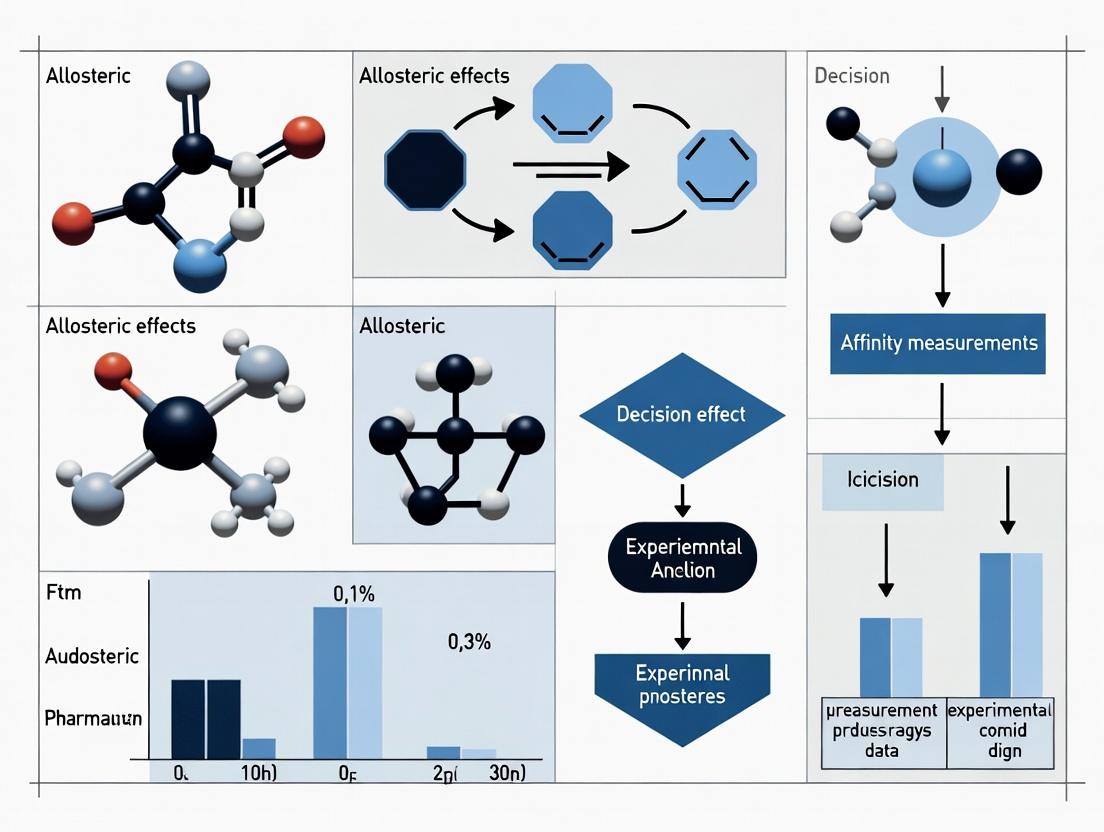
This article provides a detailed exploration of the methodologies, challenges, and best practices for accurately quantifying the effects of allosteric modulators on ligand-receptor affinity.
Decoding Allostery: A Comprehensive Guide to Measuring Allosteric Effects on Ligand Affinity
Abstract
This article provides a detailed exploration of the methodologies, challenges, and best practices for accurately quantifying the effects of allosteric modulators on ligand-receptor affinity. Aimed at researchers and drug developers, it covers foundational principles, key experimental techniques (e.g., SPR, ITC, functional assays), troubleshooting common pitfalls in data interpretation, and strategies for validating and comparing allosteric mechanisms. The guide synthesizes current knowledge to empower the rational design and characterization of novel allosteric therapeutics.
Allostery 101: Unraveling the Core Concepts of Long-Distance Affinity Modulation
Technical Support Center: Troubleshooting Allosteric Affinity Measurements
FAQs & Troubleshooting Guides
Q1: In my SPR assay for an allosteric modulator, the binding kinetics are clearly biphasic, suggesting a conformational selection mechanism. However, my data fits poorly to a simple 1:1 Langmuir model. How should I proceed with analysis? A: Biphasic kinetics are a hallmark of complex binding mechanisms like those described by the Extended Allosteric Model (EAM). A simple model is insufficient. Proceed as follows:
- Re-fit your data using a two-state conformational selection model (MWC framework) or a more general EAM-linked model that includes both conformational change and induced fit.
- Protocol for EAM-Based SPR Analysis:
- Surface Preparation: Immobilize the target protein (e.g., a GPCR or enzyme) via amine coupling to a CM5 chip. Achieve a low density (50-100 RU) to minimize mass transport effects.
- Ligand Injection: Inject a concentration series of your allosteric modulator (6-8 concentrations, 3-fold dilutions) at a high flow rate (50-100 µL/min).
- Data Fitting: In the evaluation software (e.g., Biacore Evaluation Software, Scrubber), fit the sensorgrams globally using the built-in "Conformational Change" or "Heterogeneous Ligand" model. Alternatively, export data and fit in a tool like KinITC or custom scripts using equations for the EAM.
- Key Parameters to Extract:
k_a1(association rate for initial complex),k_d1(dissociation rate for initial complex),k_f(forward isomerization rate),k_r(reverse isomerization rate). The equilibrium allosteric constant (α) can be derived from these rates.
Q2: When performing a radioligand binding displacement experiment with an allosteric modulator, I observe a "ceiling effect" where the modulator cannot fully displace the orthosteric radioligand. What does this mean, and how do I quantify the effect? A: This plateau is diagnostic of a saturating allosteric effect and is a key prediction of the Allosteric Two-State Model (a simplification of the EAM). It indicates the modulator binds exclusively to one receptor conformation (e.g., the active state) and does not bind to the conformation to which the orthosteric probe is bound. Quantify it using an allosteric ternary complex model.
- Protocol:
- Conduct a competitive binding assay with a fixed, sub-saturating concentration of radioligand (e.g.,
[L] = Kd) and varying concentrations of your allosteric modulator (A). - Include a standard orthosteric competitive inhibitor curve for comparison.
- Fit the data to the following equation to derive the allosteric parameters:
Y = Bottom + (Top - Bottom) / (1 + 10^(Log[A] - Log(EC50)))WhereTopandBottomare the upper and lower asymptotes. TheBottomplateau represents the fractional occupancy at saturating allosteric modulator. - The cooperativity factor (α) is calculated as:
α = (Bottom * (Kd/[L] + 1)) / (1 - Bottom)
- Conduct a competitive binding assay with a fixed, sub-saturating concentration of radioligand (e.g.,
Q3: My ITC data for an allosteric protein-inhibitor interaction shows a clear, sigmoidal-shaped heat change curve. Is this indicative of cooperativity, and which model (MWC vs. EAM) best explains it? A: A sigmoidal heat change curve in ITC is a strong indicator of positive cooperativity between binding sites. The Monod-Wyman-Changeux (MWC) model is the classic framework for explaining this in multimeric proteins.
- Protocol for MWC-Based ITC Analysis:
- Experiment: Perform an ITC titration of the allosteric ligand into the protein solution (e.g., a tetrameric enzyme). Use a sufficient number of injections (20-30) to define the curve shape.
- Data Analysis: Do not use the standard "One Set of Sites" model. Fit the integrated heat data to the MWC model equation for a concerted, symmetric oligomer:
ΔQ(i) = V0 * ΔH_bind * ( (1+α*[L]/K_R)^i * (1+[L]/K_R)^(n-i) * L0 * c^i ) / ( (1+[L]/K_R)^n + L0*(1+α*[L]/K_R)^n )(with appropriate summation) Simpler: Use software like SEDPHAT or Origin with MWC fitting plugins, which implement this model directly. - Key Fitted Parameters:
K_R(affinity for the R state),α(ratio of affinities T vs. R state),L0(equilibrium constant between T and R states in the absence of ligand),n(number of sites).
Quantitative Data Summary: Key Allosteric Model Parameters
| Model | Core Parameters | Physical Meaning | Typical Experimental Method | Range/Example Value |
|---|---|---|---|---|
| MWC | L0 = [T]/[R] |
Pre-existing TR equilibrium constant | ITC (sigmoidal curve), Enzyme Kinetics | L0 = 10^3 to 10^6 |
c = K_R / K_T |
Ratio of ligand affinities for R vs T state | Radioligand Binding (displacement) | c = 0.001 (pos. coop.) to 1000 (neg. coop.) |
|
n |
Number of identical protomers | Size Exclusion Chromatography, X-ray | n = 2 (dimer) to 4+ (tetramer) |
|
| EAM | K_A, K_B |
Microscopic affinity constants for each site | SPR (multi-phase kinetics) | Varies by ligand (nM to µM) |
α |
Cooperativity factor | Radioligand Binding (ceiling effect) | α > 1 (pos.), α < 1 (neg.), α = 1 (neutral) |
|
ξ |
Probe-dependence parameter | Compare assays with different probes | Unique to each A-B-L triad |
Research Reagent Solutions Toolkit
| Reagent / Material | Function in Allosteric Research |
|---|---|
| Biacore Series S CM5 Chip | Gold-standard sensor chip for SPR; carboxymethyl dextran surface for covalent immobilization of target proteins to study binding kinetics. |
| ³H-Naltrindole | Radiolabeled orthosteric antagonist for delta-opioid receptor studies; common probe for detecting allosteric modulator "ceiling effects" in binding assays. |
| D-2-Hydroxyglutarate | Oncometabolite and classic allosteric inhibitor of histone demethylases; used as a positive control in studies of metabolic enzyme allostery. |
| Maltose-Binding Protein (MBP) Fusions | Solubility tags for membrane proteins (e.g., GPCRs); crucial for obtaining sufficient protein for ITC or SPR studies of allosteric modulators. |
| TCEP (Tris(2-carboxyethyl)phosphine) | Reducing agent used in buffer preparation to maintain cysteine residues in reduced state, critical for proteins with allosteric disulfide bonds. |
| Protease Inhibitor Cocktail (cOmplete, EDTA-free) | Essential for maintaining integrity of purified proteins during long ITC or SPR runs, preventing cleavage that alters allosteric networks. |
| β,γ-Methylene-ATP | Non-hydrolyzable ATP analog; used in studies of allosteric ATP-binding sites (e.g., in kinases or molecular chaperones) to trap conformational states. |
| Cholesteryl Hemisuccinate (CHS) | Lipid additive used in purification buffers for stabilizing GPCRs and other membrane proteins in a native-like, allosterically competent conformation. |
Visualizations
Title: MWC Model: Concerted Transition Between States
Title: Extended Allosteric Model (EAM) Ternary Complex
Title: Decision Workflow for Allosteric Model Selection
Technical Support Center
Troubleshooting Guide: Common Issues in Allosteric Affinity & Efficacy Experiments
FAQ 1: Why is my radioligand binding assay showing a biphasic or shallow competition curve when testing an allosteric modulator?
- Answer: This is a classic signature of allosteric interaction, not a technical error. Orthosteric competitors typically produce steep, monophasic curves. A biphasic or shallow curve suggests the modulator is altering the affinity of the radioligand non-competitively. Troubleshooting Steps:
- Verify Model Fit: Ensure your data analysis software is fitting the data to an allosteric model (e.g., the Allosteric Ternary Complex Model) and not just a simple one-site competition model. Incorrect model selection is the most common analysis error.
- Check for Negative Cooperativity: A shallow curve can indicate negative cooperativity (β < 1). Re-fit your data allowing the cooperativity factor (αβ or simply β) to be less than 1.
- Control for Assay Conditions: Confirm that the shallow curve is not due to ligand depletion, non-equilibrium conditions, or protein instability. Repeat the experiment with shorter/longer incubation times.
FAQ 2: In my functional assay (e.g., cAMP, calcium flux), the allosteric modulator alone shows no efficacy but drastically alters the orthosteric agonist's EC50 and Emax. How do I interpret this?
- Answer: You have identified a "pure" allosteric modulator that modulates affinity and/or efficacy. This is a key finding.
- Shift in EC50 with unchanged Emax: The modulator is altering the orthosteric agonist's affinity (binding) but not its intrinsic efficacy (ability to activate the receptor). This is a change in potency.
- Change in Emax: The modulator is altering the orthosteric agonist's intrinsic efficacy. An increase in Emax indicates positive cooperativity for efficacy (positive allosteric modulator, PAM). A decrease indicates negative cooperativity (negative allosteric modulator, NAM).
- Action Plan: Quantify these effects using an Operational Model of Allosterism to derive Log(τ) for efficacy and Log(αβ) for affinity.
FAQ 3: My allosteric modulator appears to have inconsistent effects between binding assays and functional assays. Why?
- Answer: Disconnects between binding and function are common in allostery and highlight probe dependence.
- Probe Dependence: The modulator's effect is specific to the orthosteric ligand used. Test with multiple orthosteric agonists/antagonists.
- Signal Pathway Bias: The allosteric modulator may stabilize receptor conformations that preferentially couple to specific signaling pathways (e.g., G-protein vs. β-arrestin). The functional assay you chose may only read out one pathway.
- System Bias: The assay systems may have different receptor expression levels or coupling machinery (e.g., different Gα subunits). Solution: Perform your experiments in the same cellular background and compare multiple functional readouts.
Key Methodological Protocols
Protocol 1: Determining Allosteric Modulator Affinity (pKb) and Cooperativity (Log αβ) via Schild Analysis This method is used when an allosteric modulator causes a parallel shift in an agonist concentration-response curve without affecting Emax.
- Generate Agonist CRC: Create a full concentration-response curve (CRC) for the orthosteric agonist in the absence of modulator.
- Repeat with Modulator: Generate CRCs for the same agonist in the presence of at least three different, fixed concentrations of the allosteric modulator.
- Schild Plot: For each modulator concentration [B], calculate the dose ratio (DR) = (EC50 of agonist in presence of [B]) / (EC50 of agonist alone).
- Analysis: Plot log(DR - 1) vs. log[B]. The X-intercept is the estimated pKb (negative log of the modulator's dissociation constant). A slope not equal to 1 suggests allosteric interaction. The magnitude of the shift at saturating modulator concentrations informs the cooperativity factor αβ.
Protocol 2: Quantifying Effects on Agonist Efficacy (Log τ) Using the Operational Model of Allosterism This protocol quantifies changes in both agonist affinity and efficacy.
- Experimental Data: Obtain full agonist CRCs in the absence and presence of multiple concentrations of the allosteric modulator. Data should include changes in both EC50 and Emax.
- Global Nonlinear Regression: Fit the complete family of curves simultaneously to the Operational Model of Allosterism equation (see Leach et al., Br J Pharmacol. 2007).
- Parameter Estimation: The model will derive key system-independent parameters: Log(τ) for the agonist's efficacy, Log(Kb) for the modulator's affinity, and Log(αβ) for the cooperativity between agonist and modulator.
- Interpretation: Log(αβ) > 0 indicates positive binding cooperativity; Log(αβ) < 0 indicates negative binding cooperativity. A change in the fitted Log(τ) value indicates the modulator alters agonist efficacy.
Table 1: Example Allosteric Modulator Data from a cAMP Functional Assay (GPCR)
| Modulator | Agonist | Agonist pEC50 (Control) | Agonist pEC50 (+Modulator) | Emax (% Control) | Calculated Log(αβ) | Class |
|---|---|---|---|---|---|---|
| PAM-A | ACh | 6.8 ± 0.1 | 7.5 ± 0.1 | 102 ± 3 | +0.7 | Pure PAM-Affinity |
| PAM-B | ACh | 6.8 ± 0.1 | 7.2 ± 0.1 | 135 ± 5 | +0.4 | PAM-Activity |
| NAM-X | ACh | 6.8 ± 0.1 | 6.1 ± 0.1 | 65 ± 4 | -0.7 | NAM |
Table 2: Comparison of Analytical Models for Allosteric Data
| Model | Best Used For | Key Output Parameters | Limitations |
|---|---|---|---|
| Allosteric Ternary Complex | Radioligand Binding | Kb (modulator affinity), α (cooperativity) | Assumes equilibrium, no efficacy component. |
| Operational Model of Allosterism | Functional Assays | Kb, αβ (binding cooperativity), τ (efficacy) | More complex, requires high-quality full CRCs. |
| Schild Analysis | Functional Assays (parallel shifts) | Apparent pKb, slope factor | Requires modulator to not alter Emax; slope ≠1 indicates allostery. |
Experimental Visualizations
Diagram 1: Allosteric Modulator Effects on Agonist CRC
Diagram 2: Allosteric Ternary Complex Model Binding Workflow
The Scientist's Toolkit: Research Reagent Solutions
| Item | Function in Allosteric Research | Example/Supplier (for illustration) |
|---|---|---|
| Cell Line with Target Receptor | Provides a consistent, overexpressed system for functional assays. | CHO cells stably expressing human M1 mAChR (ATCC). |
| Tag-Specific Antibody | For detecting epitope-tagged (e.g., FLAG, HA) receptors in binding/ trafficking studies. | Anti-FLAG M2 Antibody (Sigma-Aldrich). |
| Tag-Labeled Orthosteric Probe | A fluorescent or biotinylated orthosteric ligand for direct binding studies. | Bodipy-TMR-X-ANTAGONIST (Tocris). |
| Pathway-Specific Assay Kit | Measures specific downstream signals (cAMP, IP1, β-arrestin recruitment). | HTRF cAMP Gs Dynamic Kit (Cisbio). |
| Reference Allosteric Modulator | A well-characterized tool compound for validating assay performance. | PNU-120596 (α7 nAChR PAM) from R&D Systems. |
| Allosteric Radioligand | A high-affinity, selective radiolabeled allosteric probe for direct binding site characterization. | [³H]LY2456302 (KOR NAM) available for research. |
Troubleshooting Guides & FAQs
FAQ 1: My measured Kd value from an ITC experiment is significantly different from my SPR result. Which one should I trust, and what could be the cause?
- Answer: Discrepancies are common due to different physical principles. Isothermal Titration Calorimetry (ITC) measures heat change from binding, reporting the true thermodynamic Kd. Surface Plasmon Resonance (SPR) measures mass change, reporting an apparent Kd that can be influenced by surface immobilization (e.g., one binding site being blocked). Trust ITC for solution-phase thermodynamics. For SPR, ensure ligand immobilization does not affect the binding site and use a multi-cycle kinetics analysis to verify.
FAQ 2: I am fitting my saturation binding data and get a Hill coefficient (nH) > 1.5. Does this definitively prove positive cooperativity?
- Answer: Not definitively. A high Hill coefficient suggests positive cooperativity, but alternative scenarios can produce nH > 1. For example, ligand binding to a mixture of receptor states (e.g., different oligomerization states) or nonspecific binding can artifactually inflate nH. To confirm cooperativity, perform experiments that directly probe site-site interactions, such as mutating one putative allosteric site and measuring its effect on the orthosteric site's affinity.
FAQ 3: How do I experimentally distinguish between the α (affinity) and β (efficacy) components of cooperativity in a functional assay?
- Answer: You need to combine radioligand binding assays with functional (e.g., cAMP, calcium flux) assays. First, measure the Kd of a tracer orthosteric ligand in the absence and presence of your allosteric modulator in a binding assay. The ratio (Kdabsent / Kdpresent) gives the α value. Then, in a functional assay, measure the modulator's effect on the orthosteric agonist's EC50 and maximal response (Emax). The shift in EC50 provides an operational estimate of α, while the change in Emax (if any) reflects the β component.
FAQ 4: My allosteric modulator shows probe dependence—it works with one orthosteric ligand but not another. How do I troubleshoot this?
- Answer: Probe dependence is a hallmark of allosteric modulation. First, verify the binding sites: ensure both orthosteric ligands bind to the same site via competition binding. If confirmed, the modulator likely stabilizes a receptor conformation that differentially affects the binding or signaling efficacy of the two probes. Troubleshoot by (1) testing the modulator across a broader concentration range of the ineffective probe, and (2) using a functional assay that reports on a different downstream pathway to see if signaling bias is involved.
Table 1: Interpretation Guide for Cooperativity Parameters
| Parameter | Value Range | Thermodynamic/Functional Meaning | Experimental Implication |
|---|---|---|---|
| α (Affinity Cooperativity) | α > 1 | Positive cooperativity (increased orthosteric ligand affinity) | Leftward shift of orthosteric agonist concentration-response curve. |
| α = 1 | Neutral cooperativity (no change in affinity) | No shift in EC50; pure efficacy modulation possible. | |
| 0 < α < 1 | Negative cooperativity (decreased affinity) | Rightward shift of orthosteric agonist curve. | |
| α = 0 | Competitive antagonism | Surmountable blockade, Schild analysis applicable. | |
| β (Efficacy Cooperativity) | β > 1 | Positive efficacy modulation | Increase in orthosteric agonist's maximal response (Emax). |
| β = 1 | Neutral efficacy modulation | No change in Emax. | |
| 0 < β < 1 | Negative efficacy modulation | Decrease in Emax (partial antagonism). | |
| β = 0 | Silent allostery (binding but no function) | Binds but causes no functional change; may block other allosterics. | |
| Hill Coefficient (nH) | nH = 1 | Non-cooperative, hyperbolic binding | Fits to Michaelis-Menten/Langmuir isotherm. |
| nH > 1 | Positive cooperativity | Steeper binding curve. Suggests multiple interacting sites. | |
| nH < 1 | Negative cooperativity or site heterogeneity | Shallower binding curve. Requires further investigation. |
Table 2: Comparative Techniques for Measuring Allosteric Parameters
| Technique | Measures Directly | Best For Determining | Key Artifact to Troubleshoot |
|---|---|---|---|
| Isothermal Titration Calorimetry (ITC) | ΔH, ΔS, Kd, stoichiometry (N) | Thermodynamic Kd in solution. | Heat dilution effects; ligand/protein solubility. |
| Surface Plasmon Resonance (SPR) | kon, koff, apparent Kd | Binding kinetics of allosteric interaction. | Mass transport limitation; nonspecific surface binding. |
| Radioligand Binding Displacement | IC50, Ki, apparent α | Affinity cooperativity (α) via Schild-like analysis. | Ligand depletion; radioligand instability. |
| Functional Dose-Response (e.g., TR-FRET) | EC50, Emax, potency shift | Operational α and β in a cellular context. | Signal window/assay dynamic range; receptor reserve. |
Experimental Protocols
Protocol 1: Determining α and β via Dual-Point Functional Assay Objective: Quantify affinity (α) and efficacy (β) cooperativity of an allosteric modulator.
- Cell Preparation: Seed cells expressing the target GPCR in a 384-well plate.
- Orthosteric Agonist Curve (Control): Generate a 10-point concentration-response curve for the orthosteric agonist in assay buffer alone. Incubate for appropriate time (e.g., 30 min).
- Orthosteric Agonist Curve (+ Modulator): Repeat Step 2 in the presence of a fixed, saturating concentration of the allosteric modulator.
- Signal Detection: Use a HTRF-based cAMP or IP1 accumulation kit according to manufacturer instructions. Read plate on a compatible microplate reader.
- Data Analysis:
- Fit both curves to a 4-parameter logistic equation.
- Calculate α' (operational affinity cooperativity) as: α' = (EC50control / EC50modulator).
- Calculate β by comparing the Top (Emax) values: β = (Topmodulator / Topcontrol).
- Note: α' approximates α but can be conflated with β effects in systems with receptor reserve.
Protocol 2: Assessing Cooperativity via Radioligand Binding Objective: Measure the direct effect of an allosteric modulator on orthosteric ligand affinity (α).
- Membrane Preparation: Prepare cell membranes containing the target receptor.
- Saturation Binding: In a 96-well plate, incubate a constant concentration of membranes with increasing concentrations of a radiolabeled orthosteric ligand ([3H]-ligand) in the absence and presence of a fixed concentration of allosteric modulator. Include wells for nonspecific binding (with excess cold ligand). Incubate to equilibrium.
- Separation & Detection: Harvest membranes onto GF/B filter plates using a cell harvester. Dry, add scintillant, and count on a microbeta counter.
- Data Analysis:
- Subtract nonspecific from total binding to get specific binding.
- Fit specific binding data to a one-site binding (hyperbolic) or Hill equation model.
- The ratio Kdabsence / Kdpresence gives the α value for that concentration of modulator.
Visualizations
Title: Allosteric Ternary Complex Model
Title: Experimental Workflow for Allosteric Parameters
The Scientist's Toolkit: Research Reagent Solutions
Table 3: Essential Reagents for Allosteric Studies
| Reagent / Material | Function in Experiment | Key Consideration |
|---|---|---|
| Tag-Lite HTRF GPCR Assay Kits | Enables label-free measurement of ligand binding (Kd, α) and proximal signaling (cAMP, β-arrestin) in live cells. | Choose epitope tag (SNAP, CLIP) compatible with your receptor construct. |
| BacMam or Lentiviral Expression Systems | For consistent, tunable expression of wild-type or mutant GPCRs in mammalian cells. | Critical to avoid receptor overexpression that masks allosteric effects. |
| PathHunter or Tango GPCR Assay Platform | Designed to measure β-arrestin recruitment, specifically profiling the β (efficacy) component. | Provides a distinct signaling fingerprint from G-protein assays. |
| Selective Orthosteric Probes (Agonist & Antagonist) | Well-characterized tool compounds for defining the primary binding site. Essential for probe-dependence tests. | High affinity and selectivity are required for clean baselines. |
| Cryo-EM Grade Detergents (e.g., GDN, LMNG) | For solubilizing and stabilizing receptor-ligand complexes for structural validation of allosteric sites. | Screening different detergents is often necessary for optimal stability. |
| Reference Allosteric Modulators (e.g., PAM, NAM) | Well-published positive/negative allosteric modulators for the target class. Serve as essential positive controls. | Validates assay sensitivity and provides a benchmark for novel compounds. |
Troubleshooting & FAQs for Allosteric Effects & Affinity Measurements
Q1: In a radioligand binding assay, my allosteric modulator shows no displacement of the orthosteric radioligand, even at high concentrations. Does this mean it is inactive?
A: Not necessarily. This is a common observation and a key experimental distinction. Pure allosteric modulators do not compete for the orthosteric binding site. Their binding is spatially distinct and can coexist with the orthosteric ligand. The lack of displacement confirms its allosteric nature. To assess activity, perform functional assays (e.g., cAMP, calcium flux) or saturation binding experiments in the presence of the modulator to observe its effect on the orthosteric ligand's affinity (KD) and/or signal.
Q2: My allosteric modulator's concentration-response curve in a functional assay is unusually shallow or bell-shaped. What could cause this, and how should I analyze it?
A: Shallow or bell-shaped curves are hallmarks of allosteric pharmacology.
- Shallow curves (Hill coefficient <1) often indicate probe dependence—the modulator's effect differs based on the orthosteric ligand used—or negative cooperativity that is not complete.
- Bell-shaped curves can indicate positive cooperativity at low concentrations followed by inhibition of receptor function at high concentrations (often via a different, non-specific effect).
Analysis: Use an allosteric operational model for data fitting. Do not force a standard four-parameter logistic (4PL) fit. Report the logαβ (cooperativity factor) and pKB (modulator's binding affinity).
Q3: When measuring affinity (pKi) for an allosteric modulator via an indirect functional method, my values are inconsistent across different assay systems or orthosteric agonists. Why?
A: This is the core concept of probe dependence. An allosteric modulator's observed affinity and cooperativity are not absolute receptor properties; they are a tripartite interaction between the receptor, the modulator, and the orthosteric ligand (the "probe"). The modulator's effect is contingent on the chemical structure and efficacy of the orthosteric probe. This is a feature, not a bug.
Solution: Always report the allosteric modulator's affinity (pKB) and cooperativity (logα or logαβ) in the context of the specific orthosteric probe and signaling pathway used. Use the same experimental setup for comparative studies.
Q4: How do I conclusively prove a novel compound is an allosteric modulator and not a weak orthosteric competitor?
A: A combination of binding and functional experiments is required. Key diagnostic tests include:
- Saturation Binding with Modulator: Challenge the receptor with increasing concentrations of an orthosteric radioligand in the absence and presence of a fixed concentration of your test compound. An allosteric modulator will alter the radioligand's observed KD but not the Bmax (maximal binding). An orthosteric competitor will not change the KD but will reduce the apparent Bmax if not fully washed out.
- Association/Dissociation Kinetic Studies: An allosteric modulator will alter the association and/or dissociation rates of an orthosteric radioligand. This is a gold-standard proof.
- Schild Regression Analysis: For an orthosteric antagonist, Schild analysis yields a linear plot with a slope of 1. Allosteric modulators typically produce nonlinear Schild regressions with slopes ≠ 1.
Experimental Protocols
Protocol 1: Saturation Binding to Diagnose Allosteric Modulation
Objective: To determine if a compound modulates the affinity (KD) of an orthosteric radioligand without competing for its binding site.
Materials:
- Membrane preparation expressing the target GPCR.
- Orthosteric radioligand (e.g., [³H]NMS for muscarinic receptors).
- Test compound (putative allosteric modulator).
- Assay buffer (e.g., HEPES/Krebs).
- GF/B filter plates and harvester for separation.
- Scintillation cocktail and counter.
Method:
- Prepare a 12-point concentration series of the orthosteric radioligand (e.g., from 0.01 x KD to 10 x KD).
- Set up three assay conditions for each radioligand concentration: Total Binding (T), Non-Specific Binding (NSB) (with saturating unlabeled orthosteric ligand), and Test Condition (with a fixed, saturating concentration of the allosteric modulator).
- Incubate membranes, radioligand, and ligands for equilibrium (determined kinetically) at appropriate temperature.
- Terminate reaction by rapid vacuum filtration over GF/B filters, followed by washes with ice-cold buffer.
- Dry filters, add scintillation fluid, and count.
- Analysis: For each condition (T, NSB, Test), plot specific binding (T - NSB) vs. radioligand concentration. Fit data to a one-site saturation binding model. Compare the KD and Bmax values from the control (T) curve to the test curve. An allosteric modulator will shift the KD but yield the same Bmax.
Protocol 2: Determining Allosteric Modulator Affinity (pKB) & Cooperativity (logα) in a Functional Assay
Objective: To quantify the binding affinity and magnitude/direction of cooperativity of an allosteric modulator for its site.
Materials:
- Cell line expressing the target receptor.
- Orthosteric agonist (the "probe").
- Test allosteric modulator.
- Functional assay kit (e.g., cAMP assay, IP1 assay, Ca²⁺ dye).
- Microplate reader.
Method (cAMP assay example for Gi-coupled receptor):
- Generate an orthosteric agonist concentration-response curve (CRC) in the absence of modulator (control CRC).
- Generate at least three orthosteric agonist CRCs in the presence of different, fixed concentrations of the allosteric modulator (e.g., low, medium, high).
- Perform experiments in parallel to minimize inter-assay variability.
- Analysis: Fit the pooled data to an allosteric operational model (e.g., in GraphPad Prism using "Allosteric EC50 shift" or custom equation). The model will estimate:
- pKB: The negative log of the allosteric modulator's equilibrium dissociation constant for its site.
- logα (or αβ): The cooperativity factor. logα = 0 (no cooperativity), >0 (positive cooperativity), <0 (negative cooperativity).
- The model accounts for potential modulation of both affinity and efficacy.
Data Presentation
Table 1: Diagnostic Signatures in Key Experiments
| Experiment | Orthosteric Antagonist Result | Allosteric Modulator Result | Interpretation |
|---|---|---|---|
| Saturation Binding | ↓ Apparent Bmax, KD unchanged | KD shifted, Bmax unchanged | Bmax change indicates occupancy of orthosteric site. |
| Kinetic Binding | No change in kₒff or kₒn | Alters kₒff and/or kₒn (τ modulation) | Altered kinetics are a hallmark of allosteric interaction. |
| Functional Schild | Linear plot, slope = 1 | Nonlinear plot, slope ≠ 1 | Deviation from linearity indicates non-competitive interaction. |
| Probe Dependence | Consistent pA₂ across probes | pKB/logα vary with orthosteric probe | Effect is contingent on the specific orthosteric partner. |
Table 2: Quantitative Analysis of Modulator X at M₂ Muscarinic Receptor
| Orthosteric Probe | Modulator X pKB (SEM) | logα (SEM) | Effect on Probe Affinity (Fold ΔKD) |
|---|---|---|---|
| Acetylcholine | 7.2 (±0.1) | +1.5 (±0.2) | 30-fold increase |
| N-methylscopolamine | 6.9 (±0.2) | -0.8 (±0.1) | 6-fold decrease |
| Carbachol | 7.1 (±0.1) | 0.0 (±0.3) | No change |
Visualizations
Allosteric vs Orthosteric Binding Site Relationship
Workflow for Characterizing Allosteric Modulators
The Scientist's Toolkit: Key Research Reagent Solutions
| Reagent / Material | Function in Allosteric Research |
|---|---|
| Bitopic/Photolabile Probes | Orthosteric radioligands with extended motifs or photo-crosslinkers to probe allosteric site proximity and detect ternary complexes. |
| Fluorescent Tracers (SNAP/SNAP-tag compatible) | Enable real-time, homogenous binding assays (e.g., TR-FRET) to measure binding kinetics and displacement in living cells. |
| β-Arrestin Recruitment Assays | Pathway-specific functional readout critical for detecting biased allosteric modulation (e.g., favoring arrestin over G-protein signaling). |
| Positive Allosteric Modulator (PAM) Standard | A well-characterized PAM for your target (e.g., BQCA for M₁ mAChR) serves as a critical positive control in binding and functional assays. |
| Allosteric Operational Model Software Scripts | Pre-validated scripts for data analysis platforms (e.g., Prism, R) that correctly fit complex allosteric data to estimate pKB and logα. |
| Nanobody/Single-Domain Antibodies | Used as tool compounds to stabilize specific receptor conformations and study the structural basis of allosteric modulation. |
Technical Support Center: Troubleshooting Allosteric Affinity Measurements
Troubleshooting Guides
Issue 1: Inconsistent EC50/IC50 Values in Functional Assays with Allosteric Modulators
- Problem: Significant variability in potency estimates between assay runs.
- Root Cause: Failure to reach equilibrium. Allosteric modulators often have slower binding kinetics than orthosteric ligands.
- Solution: Extend pre-incubation times. Perform a kinetic experiment to determine the time required for signal stabilization before adding the orthosteric probe. For G protein-coupled receptors (GPCRs), consider using a GTP shift assay to confirm allosteric modulation versus direct competition.
Issue 2: Lack of Saturation in Radioligand Binding Displacement Curves
- Problem: An allosteric modulator fails to fully displace a radiolabeled orthosteric ligand, even at high concentrations, resulting in a plateau below 100% displacement.
- Root Cause: This is a classic signature of allosteric interaction. The modulator does not compete for the orthosteric site but reduces the orthosteric ligand's affinity via a cooperative interaction.
- Solution: Analyze data using an allosteric ternary complex model (e.g., the "Allosteric EC50" and "Cooperativity Factor (α)" model). Do not force a fit to a standard one-site competitive binding equation. The residual binding at infinite modulator concentration reflects the limit of the negative cooperativity.
Issue 3: Probe-Dependent Effects Leading to Contradictory Results
- Problem: An allosteric modulator potentiates the effect of Agonist A but inhibits or has no effect on Agonist B at the same receptor.
- Root Cause: Probe dependence is a fundamental property of allosteric modulators. The magnitude and direction of cooperativity (α) are unique to each orthosteric ligand-probe pair.
- Solution: Characterize the modulator with multiple orthosteric probes (agonists and antagonists) to map its pharmacological profile. This is not an artifact but a key selectivity feature that should be reported.
Issue 4: Signal Window Compression in Positive Allosteric Modulator (PAM) Assays
- Problem: High concentrations of a PAM cause a decrease in the potentiated response, creating a "bell-shaped" concentration-response curve.
- Root Cause: This may indicate "PAM-agonist" activity, where the modulator itself possesses intrinsic efficacy at high occupancy. Alternatively, it could be due to receptor desensitization/trafficking effects triggered by the potentiated response.
- Solution: Run the modulator in the absence of orthosteric agonist to test for intrinsic efficacy. Use kinetic assays or pathway-biased assays (e.g., β-arrestin vs. cAMP) to dissect differential signaling effects.
Frequently Asked Questions (FAQs)
Q1: How do we definitively prove a compound is allosteric and not simply a weak orthosteric competitor? A: Use a Schild or Cheng-Prusoff analysis with a range of orthosteric radioligand concentrations. An allosteric modulator will alter the orthosteric ligand's apparent affinity (KD) but not its maximal binding capacity (Bmax). A competitive inhibitor will not change the KD but will reduce the apparent Bmax. A non-competitive orthosteric inhibitor will reduce Bmax without changing KD.
Q2: What is the "Cooperativity Factor (α)" and how is it interpreted? A: The cooperativity factor (α) quantifies the magnitude and direction of the allosteric interaction. α > 1 indicates positive cooperativity (affinity enhancement). α = 1 indicates neutral cooperativity (no effect). α < 1 indicates negative cooperativity (affinity reduction). α = 0 defines a non-competitive antagonist. It is a logarithmic parameter; an α of 0.01 is equivalent in magnitude but opposite in direction to an α of 100.
Q3: Why is measuring binding kinetics particularly important for allosteric drugs? A: Allosteric modulators can exhibit strong subtype selectivity driven by differences in binding kinetics (residence time) rather than affinity alone. A long residence time can translate to prolonged efficacy and a potentially superior safety profile. Use assays like association/dissociation kinetic binding studies or surface plasmon resonance (SPR) to determine kon and koff.
Q4: Our allosteric modulator works in a recombinant cell line but not in a native tissue system. Why? A: Allosteric effects are highly sensitive to receptor stoichiometry, membrane composition, and the presence of accessory proteins (e.g., receptor activity-modifying proteins). The native environment may lack a necessary coupling protein or have a different receptor density that alters the cooperative interaction. Validate findings in more physiologically relevant systems as early as possible.
Table 1: Comparison of Orthosteric vs. Allosteric Drug Properties
| Property | Orthosteric Drug | Allosteric Drug | Advantage for Allostery |
|---|---|---|---|
| Subtype Selectivity | Often low (conserved active site) | High (less conserved remote sites) | Reduced off-target toxicity |
| Signal Modulation | Full agonist/antagonist | Tunable (partial to full modulation) | Preserves physiological signaling patterns |
| Saturable Efficacy | No (max effect at full occupancy) | Yes (probe dependence & ceiling effect) | Built-in safety ceiling |
| Co-adminstration | Not possible (competition) | Possible (with orthosteric drugs) | Enables combination therapy |
Table 2: Common Assays for Allosteric Modulator Characterization
| Assay Type | What It Measures | Key Output Parameters | Notes |
|---|---|---|---|
| Radioligand Binding (Saturation) | Affinity of orthosteric probe | KD (equilibrium dissociation constant) | Perform in absence/presence of modulator |
| Radioligand Binding (Competition) | Modulator cooperativity | log(α), pIC50 (allosteric) | Fit to allosteric model; report % displacement at plateau |
| Functional Dose-Response (PAM/NAM) | Modulator potency & efficacy | pEC50, Emax, fold-shift of orthosteric agonist curve | Defines functional cooperativity (β) |
| Kinetic Binding (Association) | Binding onset rate | kon, observed rate (kobs) | Reveals if modulator alters orthosteric ligand kinetics |
| GTPγS Binding / cAMP Accumulation | Functional G-protein activation | Emax, EC50 | For GPCRs; assesses pathway-specific modulation |
Experimental Protocols
Protocol 1: Determining Allosteric Modulation Parameters via Radioligand Binding
- Objective: To quantify the affinity (pKB) of an allosteric modulator and its cooperativity factor (α) with an orthosteric radioligand.
- Materials: Membrane preparation expressing target receptor, Radioligand (e.g., [3H] antagonist), Allosteric modulator (serial dilutions), Assay buffer, GF/B filter plates, Scintillation cocktail.
- Method:
- Equilibrium Binding: Incubate membranes with a fixed, sub-saturating concentration of radioligand (≈ its KD) and a 10-point concentration range of the allosteric modulator (e.g., 10^-11 to 10^-4 M) for a time sufficient to reach equilibrium (often 60-90 min at room temp).
- Non-Specific Binding: Include control wells with an excess of unlabeled orthosteric ligand (e.g., 10 µM) to define non-specific binding (NSB).
- Termination: Rapidly filter contents through GF/B filter plates using a harvester to separate bound from free radioligand. Wash filters 3x with ice-cold buffer.
- Detection: Dry filters, add scintillation fluid, and count on a microplate scintillation counter.
- Data Analysis: Fit the modulator's displacement curve to the following allosteric model using non-linear regression:
Y = Bottom + (Top - Bottom) / (1 + 10^(X - logIC50))WhereTopis the binding in absence of modulator andBottomis the plateau of residual binding. Calculate the cooperativity factor:α = [Radioligand]/KD_radioligand * (IC50 / ([Radioligand] - IC50)). The modulator's pKB is derived from the fitted logIC50 when [Radioligand] = KD.
Protocol 2: Functional Characterization of a GPCR PAM in a cAMP Assay
- Objective: To measure the potentiation of an orthosteric agonist's response by a PAM and determine the PAM's functional potency (pEC50).
- Materials: Cells expressing the target GPCR (Gs-coupled), Forskolin (adenylyl cyclase activator), Orthosteric agonist (EC20 concentration), PAM test compound (serial dilutions), cAMP detection kit (e.g., HTRF, ELISA).
- Method:
- Cell Preparation: Seed cells in an assay-compatible plate and culture overnight.
- Stimulation: Prepare a master mix containing an EC20 concentration of orthosteric agonist (pre-determined in a separate experiment) and forskolin (at a low, submaximal concentration to provide a signal baseline). Add this mix to cells simultaneously with the serial dilutions of the PAM.
- Incubation: Incubate for a precisely timed period (e.g., 30 min at 37°C) appropriate for cAMP accumulation.
- Detection: Lyse cells and detect cAMP levels according to the kit's protocol (e.g., using HTRF antibodies).
- Data Analysis: Normalize data: 0% = response with orthosteric agonist EC20 alone; 100% = maximal response to a full orthosteric agonist. Fit the PAM concentration-response data to a sigmoidal dose-response (variable slope) equation to obtain its pEC50 and Emax (% potentiation).
Visualizations
Diagram 1: Allosteric vs Orthosteric Receptor Modulation
Diagram 2: Key Experimental Workflow for Allosteric Modulator Screening
The Scientist's Toolkit: Research Reagent Solutions
Table 3: Essential Materials for Allosteric Research
| Item | Function & Relevance to Allostery |
|---|---|
| Truly Orthosteric Radioligand | A high-affinity, well-characterized ligand for the orthosteric site. Essential as the "probe" in binding experiments to measure cooperativity (α). |
| Cell Line with Tunable Receptor Density | Recombinant cell lines (e.g., HEK293, CHO) allowing controlled receptor expression. Critical as allosteric effects can be sensitive to receptor density (protean agonism). |
| Pathway-Selective Functional Assay Kits | e.g., cAMP, IP1, β-arrestin recruitment, ERK phosphorylation. Necessary to detect probe- and pathway-dependent effects of allosteric modulators. |
| Kinetic Binding Platform | e.g., Homogeneous Time-Resolved Fluorescence (HTRF) binding kits or equipment for Surface Plasmon Resonance (SPR). Measures kon/koff, key for understanding modulator residence time. |
| Allosteric-Targeted Compound Libraries | Specialized libraries enriched for chemotypes known to bind protein-protein interfaces or regulatory sites, increasing hit rates for allosteric screens. |
| Software for Allosteric Model Fitting | Pharmacological analysis software (e.g., GraphPad Prism with custom equations, ReceptorFit) capable of fitting data to complex allosteric/ternary complex models. |
The Experimental Toolbox: Best Practices for Measuring Allosteric Affinity Shifts
Technical Support Center
FAQs & Troubleshooting Guides
Q1: My SPR sensorgram shows high non-specific binding, obscuring the specific signal. What are the primary causes and solutions? A: Common causes include a dirty sensor chip, inappropriate immobilization chemistry, or high analyte hydrophobicity. Troubleshoot by: 1) Regenerating the chip with a series of short, sharp pulses (e.g., 10-50 mM NaOH, 10 mM Glycine pH 2.0), 2) Using a different coupling chemistry (e.g., switch from amine to streptavidin-biotin), 3) Adding a low concentration of a mild detergent (e.g., 0.005% P20) or carrier protein to the running buffer, and 4) Implementing a reference flow cell with a non-relevant protein.
Q2: In my ITC experiment, the binding isotherm is too weak (low enthalpy change) and the data is noisy. How can I improve the signal? A: This often indicates low binding affinity or poor solubility. Ensure: 1) The ligand and analyte are in identical buffers (perform thorough dialysis or buffer exchange), 2) Concentrations are optimized. For suspected weak binding (Kd > 100 µM), increase cell concentration significantly. 3) Degas all solutions to prevent bubbles. 4) For allosteric modulators, consider if you are measuring a direct but very weak interaction; a functional assay may be more appropriate.
Q3: My FP assay has a very low signal window (low mP change). What steps can I take? A: A low signal window compromises sensitivity. Check: 1) Tracer Quality: Ensure the fluorescent tracer is pure and has a high fluorescence intensity. 2) Protein Activity: Use a fresh, active protein preparation. 3) Tracer Concentration: Optimize the tracer concentration to be near its Kd for the receptor. 4) Filter Plates: Use plates specifically designed to reduce background fluorescence. 5) Incubation Time: Ensure the binding reaction has reached equilibrium.
Q4: For Ca2+ flux assays, my positive control works, but my test compound shows no signal. Does this rule out binding? A: No. This is a critical point in allosteric research. A lack of functional response in a Ca2+ flux assay does not rule out binding. The compound may be: 1) A neutral antagonist that binds but elicits no response, 2) An allosteric modulator whose effect is only visible in the presence of the orthosteric agonist (run a co-application experiment), or 3) Binding to a non-functional site. A direct binding method (e.g., SPR) is required to confirm target engagement.
Q5: In cAMP assays, I observe high variability between replicates. What are the key sources of this variability? A: Key sources include: 1) Cell Number Variation: Ensure consistent cell seeding and lysis. Use a cell counter. 2) Incubation Time & Temperature: Pre-warm assay buffers and use a heated incubator for stimulation steps. 3) Forskolin Concentration (for Gi-coupled receptors): Titrate forskolin to find the optimal EC80 concentration for your cell line. 4) Lysis Efficiency: Use a compatible lysis buffer with the detection kit and shake plates sufficiently.
Data Presentation
Table 1: Comparison of Biophysical vs. Functional Assay Characteristics
| Parameter | SPR | ITC | FP | Ca2+ Flux | cAMP Assay |
|---|---|---|---|---|---|
| Primary Output | Binding kinetics (ka, kd) & affinity (KD) | Thermodynamics (ΔH, ΔG, ΔS) & affinity (KD) | Affinity (KD, Ki) & binding quantification | Functional efficacy (EC50, IC50) & potency | Functional efficacy (EC50, IC50) & potency |
| Throughput | Medium | Low | High | High | High |
| Label Required? | One molecule immobilized | No | Fluorescent tracer | Dye-loaded cells | Antibody/ELISA-based |
| Key Advantage | Real-time, label-free kinetics | Label-free, full thermodynamics | Homogeneous, high-throughput | Fast, real-time functional readout | Versatile for Gs/Gi pathways |
| Limitation for Allostery | May miss conformational change | Requires significant enthalpy change | Tracer competition may not reflect allostery | Indirect measure; may miss silent binders | Indirect measure; signal amplification can mask nuances |
Table 2: Troubleshooting Summary: Expected vs. Problematic Results
| Assay | Expected Result | Problematic Result | Likely Cause |
|---|---|---|---|
| SPR | Clean sigmoidal binding curve, stable baseline. | High RU drift, non-specific binding. | Dirty chip, buffer mismatch, aggregate formation. |
| ITC | S-shaped titration curve with clean peaks. | Flat, featureless isotherm. | Weak affinity, buffer mismatch, inactive protein. |
| FP | High mP change upon binding (>50-100 mP). | Low total signal (<20 mP change). | Poor tracer, inactive protein, incorrect concentrations. |
| Ca2+ Flux | Rapid peak signal upon agonist addition. | No response despite live cells. | Wrong receptor coupling, compound toxicity, dye loading issue. |
| cAMP | Dose-dependent increase (Gs) or decrease (Gi). | High background, noisy data. | Inconsistent cell lysis, suboptimal forskolin titration. |
Experimental Protocols
Protocol 1: SPR for Detecting Allosteric Modulator Binding
- Chip Preparation: Immobilize the purified target protein onto a CM5 chip via amine coupling to achieve 5-10 kRU response.
- Ligand Preparation: Serially dilute the orthosteric ligand (agonist/antagonist) and the putative allosteric modulator in HBS-EP+ buffer.
- Co-Injection Experiment:
- First, inject the orthosteric ligand alone (60 sec contact time) over the protein and reference surfaces.
- In a separate cycle, pre-mix the allosteric modulator with the orthosteric ligand and inject the mixture.
- Compare the binding response (RUmax) and kinetics of the orthosteric ligand alone vs. in the presence of the modulator. An altered RUmax or kinetics suggests an allosteric interaction.
- Regeneration: Use a mild regeneration buffer (e.g., 10 mM Glycine, pH 2.5) to remove bound ligands without denaturing the protein.
Protocol 2: Functional cAMP Assay for Gi-Coupled GPCRs
- Cell Seeding: Seed cells expressing the Gi-coupled GPCR into a 384-well plate and culture for 24 hours.
- Stimulation: Prepare compound dilutions in stimulation buffer containing a phosphodiesterase inhibitor (e.g., IBMX) and an EC80 concentration of forskolin.
- Cell Treatment: Remove cell media and add compound/forskolin solution. Incubate at 37°C for 30 minutes.
- Detection: Lyse cells using the provided lysis buffer. Detect cAMP levels using a HTRF or AlphaLISA cAMP detection kit according to the manufacturer's instructions. A decrease in signal (vs. forskolin alone) indicates Gi activation.
Mandatory Visualization
Allosteric Modulation and Measurement Pathways
SPR Co-Injection Workflow for Allostery
The Scientist's Toolkit
Research Reagent Solutions for Allosteric Studies
| Reagent / Material | Function in Experiment |
|---|---|
| Biacore Series S Sensor Chip CM5 | Gold surface with carboxymethylated dextran for covalent immobilization of proteins via amine, thiol, or other chemistries. |
| HTRF cAMP Dynamic 2 Assay Kit | Homogeneous Time-Resolved Fluorescence kit for sensitive, no-wash detection of intracellular cAMP levels in Gi/Gs GPCR assays. |
| Fluo-4 AM Calcium-Sensitive Dye | Cell-permeable dye that becomes fluorescent upon binding intracellular Ca2+, used in FLIPR or plate reader-based Ca2+ flux assays. |
| TAMRA-Labeled Peptide Tracer | Fluorescently labeled peptide used as a tracer in FP assays for kinases, proteases, or protein-protein interactions. |
| Microcal ITC Disposable Cells & Syringes | Precision-made components for the ITC instrument to ensure accurate measurement of heat changes during titration. |
| CHO-K1 Cells Expressing Target GPCR | A standardized, robust mammalian cell line engineered to consistently express the receptor of interest for functional assays. |
| DMSO, Molecular Biology Grade | High-purity solvent for compound storage and dilution, critical to avoid cytotoxicity and assay interference. |
| HBS-EP+ Buffer (10x) | Standard SPR running buffer (HEPES, NaCl, EDTA, Surfactant P20) for maintaining protein stability and minimizing non-specific binding. |
Troubleshooting Guides & FAQs
Q1: My saturation binding curve in the presence of the allosteric modulator is not reaching a clear plateau, even at high radioligand concentrations. What could be wrong? A: This often indicates insufficient incubation time to reach equilibrium. Allosteric modulators can slow the association/dissociation kinetics of the orthosteric radioligand. Solution: Perform a kinetic association experiment to determine the time required to reach equilibrium in both the absence and presence of the modulator. Incubate all tubes for the longest required time (often 3-4 times the longest t½).
Q2: The competition binding curve with an orthosteric inhibitor is shifted by the allosteric modulator, but the curve is shallower (lower Hill slope). How should I interpret this? A: A Hill slope (nH) significantly less than 1.0 suggests the allosteric modulator is not behaving in a purely competitive manner and may be inducing a heterogeneous receptor population (e.g., different affinity states). Solution: Analyze the data using an allosteric competition model (e.g., the Allosteric Ternary Complex Model). Do not force the Hill slope to 1.0. The deviation itself is key data.
Q3: I observe high non-specific binding in my filtration assays when using the allosteric modulator at high concentrations. A: This is common if the modulator is lipophilic. Solution: 1) Titrate the concentration of the detergent (e.g., Polyethylenimine) used to pre-soak the filter plates to reduce non-specific binding. 2) Validate results using a centrifugation-binding method as an alternative to filtration. 3) Ensure the washing buffer is ice-cold and perform washes rapidly and consistently.
Q4: How do I distinguish between a negative allosteric modulator (NAM) and a non-competitive antagonist in a competition binding experiment? A: A classical non-competitive antagonist will reduce the Bmax without affecting the Kd of the radioligand in a saturation experiment. A NAM will increase the apparent Kd of the radioligand (right-shift the saturation curve) but may also potentially alter Bmax if it affects the assay's ability to detect all receptor states. The key is to perform a full saturation binding experiment +/- the modulator.
Q5: My calculated log(α) value (cooperativity factor) from the allosteric model fitting is highly variable between experiments. A: This parameter is sensitive to accurate determination of the radioligand Kd and the competitor's affinity (KB). Solution: 1) Ensure the Kd for your radioligand is determined from a saturation experiment on the same batch of membranes/cells on the same day. 2) Run a full saturation experiment (to get Bmax and Kd) and a full competition curve (to get pKB and log(α)) in a single experiment. 3) Use global curve fitting across multiple experiments to constrain shared parameters (like Kd).
Experimental Protocols
Protocol 1: Saturation Binding with an Allosteric Modulator
Objective: Determine the effect of a fixed concentration of an allosteric modulator on the affinity (Kd) and density (Bmax) of an orthosteric radioligand.
Methodology:
- Prepare membrane homogenates from expressing cells or tissue.
- In duplicate or triplicate, set up tubes containing:
- Fixed concentration of modulator (or vehicle).
- Increasing concentrations of radioligand (e.g., 8-12 concentrations, spanning 0.1x to 10x the expected Kd).
- A parallel set of tubes with a high concentration of an unlabeled orthosteric antagonist to define non-specific binding.
- Add membrane preparation to start the reaction. Incubate to equilibrium (determined from kinetics experiments).
- Terminate binding by rapid filtration through GF/B filters pre-soaked in 0.3% PEI.
- Wash filters with ice-cold buffer, dry, and measure bound radioactivity via scintillation counting.
- Data Analysis: Fit total and non-specific binding data separately. Specific binding = Total - Non-specific. Fit the specific binding data to a one-site saturation binding model:
Y = Bmax * X / (Kd + X). Perform fits for data in the absence and presence of the modulator separately and compare Kd and Bmax values.
Protocol 2: Allosteric Competition Binding Experiment
Objective: Determine the affinity (KB) and cooperativity (α) of an allosteric modulator against a fixed concentration of orthosteric radioligand.
Methodology:
- Set up assay tubes in duplicate/triplicate containing:
- A fixed, near-Kd concentration of the orthosteric radioligand (typically [L] = Kd).
- Increasing concentrations of the allosteric modulator (e.g., 11-point half-log dilution series).
- A set of tubes with a high concentration of orthosteric ligand for non-specific binding.
- Add membrane preparation. Incubate to equilibrium.
- Terminate, filter, wash, and count as in Protocol 1.
- Data Analysis: Fit the normalized specific binding data to an allosteric ternary complex model for competition:
Y = Bottom + (Top-Bottom) / (1 + (10^X / (10^logKB)) * (1 + ([L]/Kd) / (1 + (α*[L]/Kd)) ) )Where X is the log of the modulator concentration, [L] is fixed radioligand concentration, Kd is from your saturation experiment, and α is the cooperativity factor (α>1 = positive cooperativity; α<1 = negative cooperativity; α=1 = neutral/no effect).
Diagrams
Saturation Binding Experimental Workflow
Allosteric vs Orthosteric Binding Concepts
Data Presentation
Table 1: Expected Effects in Saturation Binding Experiments
| Agent Type | Effect on Radioligand Kd | Effect on Receptor Bmax | Interpretation |
|---|---|---|---|
| Orthosteric Competitor | Increased | No Change | Competitive Inhibition |
| Non-competitive Antagonist | No Change | Decreased | Reduces binding sites |
| Negative Allosteric Modulator (NAM) | Increased | May decrease* | Reduces affinity of radioligand |
| Positive Allosteric Modulator (PAM) | Decreased | No Change | Increases affinity of radioligand |
*Apparent Bmax decrease can occur if the NAM prevents binding to a subset of receptors under assay conditions.
Table 2: Key Parameters from Allosteric Competition Binding Analysis
| Parameter | Symbol | Typical Range | Interpretation |
|---|---|---|---|
| Allosteric Modulator Affinity | logKB or pKB | 4-10 (nM-pM) | Affinity of the modulator for its allosteric site in the absence of orthosteric ligand. |
| Cooperativity Factor | α | 0.001 - 1000 | Magnitude and direction of allosteric effect. α < 1: Negative cooperativity (NAM). α > 1: Positive cooperativity (PAM). α = 1: Neutral (no effect). |
| Log(Cooperativity) | log(α) | -3 to +3 | Logarithmic measure. log(α)=0 means no cooperativity. |
The Scientist's Toolkit: Research Reagent Solutions
| Item | Function & Importance |
|---|---|
| Cell Membranes (expressing target receptor) | Source of the protein of interest. Must be prepared consistently to ensure receptor stability and G-protein coupling state. |
| High-Affinity Radioligand (³H or ¹²⁵I-labeled) | The orthosteric probe used to monitor receptor binding. Must have high specific activity and known Kd. |
| Unlabeled Orthosteric Reference Ligand | Used to define non-specific binding at a high concentration (typically 100-1000 x Ki). |
| Allosteric Modulator of Interest | The test compound. Prepare a high-concentration stock in DMSO, then serially dilute in assay buffer, keeping final DMSO constant (≤1%). |
| Wash Buffer (Ice-cold) | Typically 50mM Tris-HCl, pH 7.4. The low temperature halts binding kinetics during filtration. |
| GF/B Filter Plates & Harvesting System | For rapid separation of bound from free radioligand. Pre-soaking in 0.3% PEI reduces filter binding of lipophilic compounds. |
| Scintillation Cocktail & Counter | For detecting beta-emission (³H) or gamma-emission (¹²⁵I) from the bound radioligand. |
| Curve-Fitting Software (e.g., GraphPad Prism) | Essential for non-linear regression analysis using appropriate allosteric binding models to derive Kd, Bmax, KB, and α. |
Technical Support Center
FAQs & Troubleshooting Guides
Q1: What does a cooperativity factor (α) of less than 1 indicate in my binding isotherm analysis, and is this a common experimental error? A: An α < 1 indicates positive cooperativity, where binding of the first ligand enhances the affinity for subsequent ligands. This is a legitimate result, not necessarily an error. However, ensure your data fitting uses an appropriate model (e.g., Adair-Klotz). Common errors that can artifactually skew α include incorrect ligand concentration determination or the presence of non-specific binding. Re-measure your stock concentrations via absorbance (using the correct extinction coefficient) and include a non-specific binding control in your assay (e.g., a large excess of unlabeled competitor).
Q2: When fitting data to the Hill equation, my Hill coefficient (nH) is not integer. What does this mean, and how does it relate to α? A: A non-integer nH is standard for real-world systems. The Hill coefficient is an empirical measure of cooperativity steepness, while α is a mechanistic parameter from a specific model (like the two-site sequential binding model). nH ≠ 1 suggests cooperativity (nH > 1: positive; nH < 1: negative), but it does not directly equal α. To derive α, you must fit your full binding isotherm to a model that explicitly includes it, not just the Hill transformation. Use a global fit of data across all ligand concentrations.
Q3: My binding data is exceptionally scattered at low ligand concentrations, making the initial slope hard to define. How can I improve data quality for accurate α calculation? A: Scatter at low [Ligand] often indicates signal-to-noise issues. Implement these protocol adjustments:
- Increase receptor concentration to just below your estimated Kd, but ensure it remains << Kd to maintain binding equilibrium conditions.
- Extend incubation time to ensure equilibrium is truly reached, especially for the first binding event.
- Switch to a more sensitive detection method (e.g., from fluorescence anisotropy to surface plasmon resonance (SPR) if possible).
- Increase replicate number (n≥5) for these critical low-concentration points.
Q4: Can I quantify α from a competition binding experiment instead of a direct binding isotherm? A: Yes, but with caution. You can perform competition experiments at multiple fixed concentrations of an allosteric modulator. Global fitting of these displacement curves to an allosteric ternary complex model yields both the affinity of the modulator and the cooperativity factor (α), which dictates how the modulator alters the orthosteric ligand's affinity. This is common in GPCR research. Ensure your model correctly distinguishes between affinity (Kd) and efficacy (β) if signaling output is measured.
Key Data Tables
Table 1: Interpretation of Cooperativity Parameters
| Parameter | Value Range | Thermodynamic Meaning | Implication for Binding Curve Shape |
|---|---|---|---|
| Cooperativity Factor (α) | α = 1 | No cooperativity. Independent sites. | Standard hyperbolic isotherm. |
| α > 1 | Negative Cooperativity. Binding of 1st ligand reduces affinity for 2nd. | Shallower curve, broader sigmoidicity. | |
| α < 1 | Positive Cooperativity. Binding of 1st ligand increases affinity for 2nd. | Steeper curve, more pronounced sigmoid shape. | |
| Hill Coefficient (nH) | nH = 1 | Non-cooperative or negative cooperativity. | Hyperbolic. |
| nH > 1 | Positive cooperativity. | Sigmoidal, steepness increases with nH. | |
| nH < 1 | Negative cooperativity or binding site heterogeneity. | Shallow, more gradual slope. |
Table 2: Troubleshooting Guide for Aberrant α Values
| Symptom | Possible Cause | Diagnostic Experiment | Solution |
|---|---|---|---|
| α value varies wildly between replicates. | Assay not at equilibrium. | Perform time-course at low and high [Ligand]. | Standardize and extend incubation time. |
| α consistently equals 1 (no cooperativity) in a known cooperative system. | Receptor concentration too high (>Kd). | Repeat experiment with a 10x lower receptor concentration. | Ensure [Receptor] << Kd, especially for the first binding event. |
| Fitted α is physically impossible (e.g., negative). | Incorrect model or poor initial parameter guesses. | Fit data to a simpler model (e.g., one-site) first. | Constrain fitting parameters to plausible ranges; use global fitting. |
| Large confidence interval for α. | Insufficient data points in the critical transition region. | Redesign ligand dilution series to be dense around ~0.1xKd and ~10xKd. | Add more data points in the sigmoidal transition region of the curve. |
Experimental Protocols
Protocol 1: Determining α via Direct Saturation Binding with a Radioligand Objective: To obtain a binding isotherm for a homodimeric protein and fit the data to a two-site sequential binding model to extract α.
- Prepare Reagents: Dilute purified receptor (confirmed dimer) in assay buffer. Create a serial dilution of labeled high-affinity ligand (Hot Ligand) covering 0.1x to 100x the estimated Kd.
- Set Up Binding Reactions: In a 96-well plate, mix a fixed, low concentration of receptor (≤0.1 x Kd) with each concentration of Hot Ligand in triplicate. Include wells for total binding (receptor + hot ligand) and non-specific binding (receptor + hot ligand + 1000x excess unlabeled ligand).
- Incubate: Seal plate and incubate to equilibrium (determined by preliminary time course, e.g., 90 min at room temp).
- Separation & Detection: Rapidly filter contents onto glass fiber filter plates (pre-soaked in 0.3% PEI for 30 min to reduce nonspecific binding). Wash 3x with ice-cold buffer. Dry filters, add scintillation cocktail, and count in a microplate beta counter.
- Data Analysis: Subtract NSB from total binding to get specific binding. Fit specific binding (Y) vs. free ligand concentration [L] to the equation for a dimer with identical sites:
Y/Bmax = ( ( [L]/Kd ) + ( α * ( [L]/Kd )^2 ) ) / ( 1 + 2*( [L]/Kd ) + ( α * ( [L]/Kd )^2 ) )where Kd is the intrinsic dissociation constant for a single site, and α is the cooperativity factor.
Protocol 2: Quantifying α via Allosteric Modulator Competition (Functional Assay) Objective: To determine the cooperativity factor α between an orthosteric agonist and an allosteric modulator in a cell-based signaling assay.
- Cell Preparation: Seed cells expressing the target receptor (e.g., GPCR) in a 384-well assay plate.
- Dose-Response Matrix: Prepare a 2D serial dilution: one dimension is the orthosteric agonist (11 concentrations), the other is the allosteric modulator (e.g., 4 concentrations: 0, low, medium, high). Add cells to the compound matrix.
- Signal Measurement: Incubate as required and measure the functional response (e.g., Ca2+ flux, cAMP accumulation). Include reference agonist control (max signal) and vehicle control (basal signal).
- Data Analysis: Normalize data to % of maximal agonist response. Globally fit all curves to the Allosteric Operational Model:
Response = Emax * ( τA * [A] * Kb + τB * [B] * Ka + τAB * α * [A][B] )^n / ( [A]*Kb + [B]*Ka + α*[A][B] + Ka*Kb + ( τA * [A] * Kb + τB * [B] * Ka + τAB * α * [A][B] + 1 )^n )(Where [A] and Ka are orthosteric ligand concentration and affinity, [B] and Kb are allosteric ligand concentration and affinity, τ is efficacy, α is the cooperativity factor, n is the transducer slope). This fitting yields the estimate of α.
Diagrams
Diagram 1: Two-Site Sequential Binding Model & α
Diagram 2: Workflow for Cooperativity Analysis from Binding Data
The Scientist's Toolkit: Research Reagent Solutions
| Item | Function in Cooperativity Studies |
|---|---|
| Purified, Tagged Receptor (Dimer/Multimer) | Essential for controlled in vitro binding studies. Tags allow immobilization for SPR or pull-down assays. Must be validated as native oligomer. |
| High-Affinity, High-Specific Activity Radioligand (e.g., ³H, ¹²⁵I) | Provides a sensitive and direct measure of ligand occupancy at very low receptor concentrations, critical for defining the first binding event. |
| Unlabeled Competitor (Cold Ligand) | Used to define non-specific binding in radioligand assays and as the orthosteric probe in competition experiments with allosteric modulators. |
| Allosteric Modulator Tool Compound | A well-characterized chemical probe to perturb the system and quantify cooperativity (α) between distinct binding sites. |
| Fluorescent Dye-Labeled Ligand | Enables solution-based binding measurements (e.g., fluorescence anisotropy, FRET) without a separation step, useful for rapid equilibrium determination. |
| Polyethylenimine (PEI) 0.3% Solution | Pre-soak for filter plates to reduce anionic binding of proteins/ligands, dramatically lowering non-specific background in filtration assays. |
| Reference Agonist/Antagonist | A standardized control compound with known efficacy and affinity to calibrate functional assay windows and normalize data across experiments. |
| Global Curve Fitting Software (e.g., Prism, GraFit) | Software capable of globally fitting complex, multi-parameter equations (e.g., allosteric models) to full datasets to extract robust α estimates with confidence intervals. |
Technical Support Center: Troubleshooting Allosteric Modulator Assays
FAQs & Troubleshooting Guides
Q1: Our radioligand binding assay for a GPCR PAM shows unexpectedly high nonspecific binding, obscuring the allosteric shift. What are the primary causes and solutions? A: High nonspecific binding often stems from ligand or membrane preparation issues.
- Cause: Lipophilic tracer compounds, excessive membrane protein concentration, or inappropriate filter type (e.g., wrong material for peptide ligands).
- Solution: Optimize membrane protein concentration (typically 5-20 µg/well). Use polyethylenimine (PEI, 0.1-0.3%) to pretreat glass fiber filters. Validate with a negative control membrane (e.g., from untransfected cells). Consider switching to a fluorescent or scintillation proximity assay (SPA) format to eliminate filtration steps.
Q2: In our kinetic assay to measure SAM effects on kinase conformation, the signal window collapses over time. How can we stabilize the assay? A: This indicates compound instability, target degradation, or assay component interference.
- Cause: DMSO sensitivity, oxidation of cysteine residues in the kinase's allosteric pocket, or ADP/ATP depletion.
- Solution: Keep final DMSO concentration consistent and ≤1%. Include reducing agents (e.g., TCEP, 0.5-1 mM) and stabilizing agents like BSA (0.1%) in the assay buffer. Use an ATP-regeneration system (e.g., phosphoenolpyruvate/pyruvate kinase) for long-run kinetic measurements. Prepare fresh modulator stocks weekly.
Q3: We are unable to distinguish a true NAM from a non-competitive orthosteric inhibitor in our functional cAMP accumulation assay. What control experiments are critical? A: The key is to test for saturability and probe-dependence of the inhibitory effect.
- Cause: Lack of experiments varying orthosteric agonist concentration in the presence of fixed modulator concentrations.
- Solution: Perform a full agonist concentration-response curve at multiple, fixed concentrations of the putative NAM. A true NAM will depress the maximal response (Emax) and may shift the EC50. Then, perform a Schild regression analysis; a non-linear Schild plot is indicative of an allosteric interaction. Include a reference orthosteric antagonist (e.g., atropine for muscarinic receptors) as a control.
Q4: Our TR-FRET assay for detecting kinase SAM-induced dimerization yields poor Z'-factor. What optimization steps should we prioritize? A: Poor Z' indicates high variance or low signal dynamic range.
- Cause: Inconsistent pipetting of FRET probes, suboptimal labeling efficiency of the kinase, or plate reader instability.
- Solution:
- Titrate both donor- and acceptor-labeled proteins to find the ratio maximizing FRET signal.
- Ensure labeling efficiency >80% via mass spectrometry.
- Use a low-volume, black, flat-bottom plate to reduce signal crosstalk.
- Extend signal integration time on the reader to improve photon count.
- Include a positive control (known dimerizing agent) and negative control (unlabeled protein) on every plate.
Q5: When fitting data to the Allosteric Ternary Complex Model, the cooperativity factor (αβ) estimate has an extremely wide confidence interval. What experimental design flaw might cause this? A: Wide CIs indicate insufficient information in the data to constrain the model parameter.
- Cause: Testing an insufficient range of orthosteric and allosteric ligand concentrations, particularly near their respective Kd values.
- Solution: Design a matrix experiment where both orthosteric agonist and allosteric modulator are titrated in a full 2D concentration series. Ensure concentrations span from well below to well above their estimated Kd/EC50 values (e.g., from 0.1x to 10x Kd). Use at least 8-10 data points per concentration curve. Global fitting of the entire 2D dataset will yield robust parameter estimates.
Table 1: Representative Affinity & Cooperativity Parameters for Clinical-Stage Allosteric Modulators
| Target (Class) | Modulator Name | Type | Reported pKi/pEC50 | Cooperativity Factor (αβ) | Experimental Method | Reference (Year) |
|---|---|---|---|---|---|---|
| mGluR5 (GPCR) | Mavoglurant | NAM | 7.8 (pKB) | ~0.05 (Inhibition) | [³H]MPEP binding & Ca²⁺ mobilization | Lindemann et al., 2011 |
| CCR5 (GPCR) | Cenicriviroc | NAM | 8.2 (pIC50) | Not Applicable (Insurmountable) | [¹²⁵I]CCL3 binding & β-arrestin recruitment | Tan et al., 2013 |
| Akt1 (Kinase) | MK-2206 | SAM (Allo-inhibitor) | 8.1 (pIC50) | N/A (Non-ATP competitive) | FRET-based phosphorylation assay | Hirai et al., 2010 |
| B-Raf (Kinase) | Vemurafenib | SAM (Inhibitor) | 7.6 (pIC50) | N/A (Promotes inactive dimer) | Time-resolved BRET dimerization assay | Yao et al., 2019 |
Table 2: Common Assay Formats for Characterizing Allosteric Modulators
| Assay Type | Primary Readout | Throughput | Key Parameter Measured | Optimal for Modulator Type |
|---|---|---|---|---|
| Radioligand Binding (Saturation) | Disintegrations per minute (DPM) | Medium | Allosteric ligand affinity (KB), binding cooperativity (α) | PAMs, NAMs, SAMs |
| Functional (cAMP, Ca²⁺, β-arrestin) | Luminescence, Fluorescence | High | Efficacy cooperativity (αβ), functional KB | PAMs, NAMs |
| Kinetic (Association/Dissociation) | Time-resolved signal | Low | Association (kon) & dissociation (koff) rates | PAMs, NAMs |
| TR-FRET / BRET (Dimerization) | FRET/BRET Ratio | Medium-High | Protein-protein interaction (PPI) modulation | SAMs (Kinases, GPCRs) |
| HDX Mass Spectrometry | Deuterium Uptake | Low | Conformational change mapping | All Types (Mechanistic) |
Experimental Protocols
Protocol 1: Orthosteric Probe Dependence Assay for GPCR PAMs/NAMs (Functional Format) Objective: To determine the cooperativity factor (αβ) between an allosteric modulator and an orthosteric agonist. Reagents: See "Scientist's Toolkit" below. Procedure:
- Prepare assay buffer (HBSS + 5 mM HEPES + 0.1% BSA, pH 7.4).
- Seed cells expressing the target GPCR in a 384-well plate (10,000 cells/well) and culture overnight.
- Serially dilute the orthosteric agonist (e.g., 10 µM to 0.1 nM, 8 concentrations) in a separate plate.
- Serially dilute the allosteric modulator (e.g., 100 µM to 1 nM, 6 concentrations) in another plate.
- Using a liquid handler, transfer 5 µL of each modulator concentration to the cell plate, creating a matrix. Include control wells with buffer only (max signal) and a saturating concentration of inverse agonist (min signal).
- Add 5 µL of each orthosteric agonist concentration to the corresponding wells.
- Incubate for 30 min at 37°C to allow equilibrium.
- Following manufacturer's instructions, add 10 µL of detection mix (e.g., cAMP-Glo or Calcium 4 dye).
- Incubate for the recommended time (typically 30-60 min) and read luminescence/fluorescence on a plate reader.
- Data Analysis: Fit the 2D data matrix to an allosteric operational model using global nonlinear regression software (e.g., GraphPad Prism) to estimate the modulator's logKB, cooperativity factor (logαβ), and orthosteric agonist's logKA.
Protocol 2: TR-FRET Assay for Kinase Dimerization SAMs Objective: To quantify the effect of a SAM on the dimerization state of a target kinase. Reagents: See "Scientist's Toolkit" below. Procedure:
- Protein Labeling: Label purified kinase (e.g., B-Raf) with LanthaScreen Terbium (Tb) anti-His antibody (donor) and fluorescein-labeled ATP-competitive tracer (acceptor) according to kit instructions.
- Prepare assay buffer (50 mM HEPES, pH 7.5, 10 mM MgCl₂, 1 mM DTT, 0.01% Brij-35).
- In a low-volume 384-well plate, add 10 µL of assay buffer containing the labeled kinase complex (final concentration 5 nM).
- Add 1 µL of SAM compound (in DMSO) from a serial dilution series. Include DMSO-only wells as a negative control (no dimerization change) and a known stabilizing agent as a positive control.
- Centrifuge the plate briefly and incubate at room temperature for 2 hours to reach equilibrium.
- Read the plate on a TR-FRET compatible reader (e.g., PerkinElmer EnVision). Use a 340 nm excitation filter, and measure emission at 495 nm (Tb donor) and 520 nm (fluorescein acceptor) with appropriate delay times.
- Calculate the TR-FRET ratio: (Acceptor Emission at 520 nm / Donor Emission at 495 nm) x 10⁴.
- Data Analysis: Plot the TR-FRET ratio against compound concentration. Fit to a 4-parameter logistic equation to determine the EC50 for dimerization modulation. A decrease in ratio indicates disruption, an increase indicates stabilization.
Pathway & Workflow Visualizations
Title: GPCR Allosteric Modulation Signaling Pathway
Title: Allosteric Modulator Characterization Workflow
The Scientist's Toolkit
Table 3: Essential Research Reagents for Allosteric Modulator Characterization
| Reagent / Material | Function & Role in Experiments | Example Product / Vendor |
|---|---|---|
| Cell Line with Target Expression | Provides the biological system expressing the GPCR or kinase of interest at physiological or controlled levels. | HEK293T, CHO-K1 stably transfected cell lines. |
| Orthosteric Radioligand | High-affinity, labeled probe to measure direct binding and displacement in saturation/competition assays. | [³H]NMS (muscarinic), [¹²⁵I]CCL3 (CCR5). PerkinElmer, Revvity. |
| Fluorescent/Sensitive Tracers | Non-radioactive probes for binding (FP, TR-FRET) or functional assays (cAMP, Ca²⁺). | Fluorescein-ATPγS (Kinases), Calcium 4 dye. Thermo Fisher, Cisbio. |
| Allosteric Operational Model Fitting Software | Essential for extracting accurate affinity (KB) and cooperativity (α, αβ) parameters from complex datasets. | GraphPad Prism (Allosteric EC80 shift model), REVO (R package). |
| TR-FRET-Compatible Labeled Proteins/Antibodies | Enable proximity-based assays for dimerization, conformation, or binding (e.g., Tag-lite, LanthaScreen). | Terbium (Tb)-anti-His Ab, GFP-nanobody. Cisbio, Thermo Fisher. |
| ATP-Regeneration System | Maintains constant [ATP] in kinetic kinase assays, preventing signal drift. | Phosphoenolpyruvate, Pyruvate Kinase. Sigma-Aldrich. |
| Positive & Negative Control Modulators | Validates assay performance and provides reference points for compound activity. | Known PAM/NAM/SAM for the target (e.g., MK-2206 for Akt). |
Technical Support Center: Troubleshooting Allosteric Pathway Mapping
Thesis Context: This support center provides targeted solutions for experimental challenges encountered when applying NMR, HDX-MS, and Cryo-EM to map allosteric pathways. The guidance is framed within the critical need for robust experimental data to inform and validate affinity measurements of allosteric modulators in drug discovery.
Frequently Asked Questions (FAQs)
Q1: In our NMR allosteric studies, we observe poor chemical shift perturbations (CSPs) upon ligand binding at the putative allosteric site. What could be the cause? A1: Weak or absent CSPs can result from:
- Insufficient Protein-Ligand Ratio: Ensure your ligand is in significant excess (typically 10-20 fold) to achieve full saturation, especially for weak binders (mM to high µM Kd).
- Fast Exchange Regime: If binding is in fast exchange on the NMR timescale, CSPs are averaged and may be small. Confirm by titrating ligand and observing progressive shifting of peaks.
- No Conformational Change: The ligand may be binding without inducing a detectable conformational change in the protein backbone. Consider side-chain probes (methyl-TROSY) or alternative techniques like HDX-MS.
- Incorrect Site: The ligand may not be binding to the intended allosteric pocket. Validate with a competition assay using an orthosteric ligand.
Q2: During HDX-MS experiments for pathway mapping, we get low deuterium uptake across the entire protein, making differential analysis difficult. How do we resolve this? A2: Low uptake often points to suboptimal exchange conditions:
- pH Check: The HDX reaction must be performed at pD 7.0 (pH 7.4 uncorrected). Use precise pD meters and buffers (e.g., phosphate).
- Quenching Efficiency: Ensure your quench solution (low pH, low temperature) is rapidly and thoroughly mixed. The final pH must be ≤ 2.5 and temperature ≤ 0°C to minimize back-exchange.
- Back-Exchange Control: Even with perfect quenching, back-exchange during LC/MS can be high. Minimize this by using pepsin-based digestion at 0°C, chilled autosamplers, and fast, low-temperature chromatographic separations.
Q3: In Cryo-EM analysis of an allosterically modulated protein complex, we achieve high resolution globally but the region of interest (allosteric site) remains poorly resolved. What steps can we take? A3: Local disorder is common in allosteric proteins. To address this:
- Focused 3D Classification: Perform 3D classification without alignment (skip alignment) focused on a mask around the dynamic region to separate heterogeneous conformational states.
- Ligand Stabilization: Optimize ligand concentration and incubation conditions. Consider using covalent analogs or crosslinking to stabilize the allosteric conformation prior to vitrification.
- Composite Map Generation: If multiple states are identified, refine each separately to generate composite maps that reveal the conformational continuum.
Q4: How do we correlate slow conformational dynamics from NMR with fast dynamics from HDX-MS to build a cohesive allosteric model? A4: Integrate data through a timescale-aware framework:
- Map HDX protection factors (reporting on µs-min dynamics) onto the protein structure.
- Overlay NMR-derived order parameters (S²) for fast (ps-ns) dynamics and CSPs/relaxation dispersion data for slower (µs-ms) dynamics.
- Regions that show correlated changes across multiple timescales upon allosteric ligand binding are strong candidates for key allosteric pathway residues.
Troubleshooting Guides
Issue: Excessive Back-Exchange in HDX-MS Compromising Data Quality
| Symptom | Possible Cause | Solution |
|---|---|---|
| Low maximum deuterium uptake (<70%) | Incomplete quenching, warm LC system | Verify quench pH/temp; pre-chill LC solvents & column to 0°C. |
| Decreasing uptake with longer labeling time | High back-exchange during analysis | Shorten LC gradient; use desalting traps; reduce tubing length. |
| Poor reproducibility | Manual timing inconsistencies | Automate labeling/quench steps with a robotic liquid handler. |
Issue: Cryo-EM Sample Preparation Yielding Heterogeneous or Sparse Particles
| Symptom | Possible Cause | Solution |
|---|---|---|
| Empty ice or sparse particles | Protein denaturation at air-water interface | Optimize blotting time; use surfactants (e.g., 0.01% CHAPSO); try graphene oxide grids. |
| Preferred particle orientation | Grid surface properties bias orientation | Test different grid types (Au vs Cu), hydrophilicity treatments, or add fiducials. |
| Multiple conformational states | Functional heterogeneity in sample | Apply biochemical constraints (e.g., non-hydrolyzable ATP analogs, saturating ligand). |
Detailed Experimental Protocols
Protocol 1: NMR Chemical Shift Perturbation (CSP) Titration for Allosteric Site Mapping
- Sample Preparation: Prepare uniformly ¹⁵N-labeled protein in NMR buffer (e.g., 20 mM phosphate, 50 mM NaCl, pH 6.8, 90% H₂O/10% D₂O). Ligand stock is prepared in identical buffer or DMSO-d6 (<5% final).
- Titration: Start with protein-only sample (e.g., 200 µL of 100 µM). Acquire a reference 2D ¹H-¹⁵N HSQC spectrum.
- Data Collection: Add aliquots of ligand stock directly to the NMR tube. After each addition, mix gently, allow 5 min for equilibration, and acquire a new 2D ¹H-¹⁵N HSQC. Continue until no further CSPs are observed (full saturation).
- Analysis: Process spectra. Assign peaks. Calculate CSP for each residue: Δδ = √((ΔδH)² + (ΔδN/5)²). Residues with Δδ > mean + 1σ are considered significantly perturbed. Fit titration data to obtain Kd.
Protocol 2: HDX-MS Workflow for Mapping Allosteric Conformational Changes
- Labeling: Dilute protein (from stock) 10-fold into D₂O-based buffer (pD 7.0) containing ligand or apo control. Incubate at 25°C for various times (e.g., 10s, 1min, 10min, 1h).
- Quenching: At each time point, mix 50 µL labeling reaction with 50 µL quench buffer (0.1 M phosphate, 0.5 M TCEP, pH 2.2, 0°C).
- Digestion & Separation: Immediately inject quenched sample onto an online digestion system (immobilized pepsin column at 2°C). Digest peptides are trapped and separated by UPLC (C8 column, 5 min gradient, 0°C).
- Mass Analysis: Use a high-resolution mass spectrometer (Q-TOF or Orbitrap) in positive ion mode. Identify peptides via MS/MS of undeuterated control.
- Data Processing: Use dedicated software (e.g., HDExaminer, DynamX) to calculate deuterium uptake for each peptide at each time point. Significant differences (≥0.5 Da, ≥5%) between ligand-bound and apo states indicate allosteric changes.
Visualizations
Diagram 1: Integrated Allosteric Pathway Mapping Workflow
Diagram 2: HDX-MS Experimental Timeline
The Scientist's Toolkit: Key Research Reagent Solutions
| Reagent / Material | Function in Allosteric Studies |
|---|---|
| Isotopically Labeled Media (¹⁵N, ¹³C, ²H) | Enables NMR resonance assignment and detection of subtle conformational changes in proteins. |
| Perdeuterated Detergents (e.g., DPC-d38, LMNG-d) | Essential for solution NMR studies of membrane proteins in micelles, reducing background signals. |
| Ultra-pure D₂O (99.9%+) | Solvent for HDX-MS labeling; purity is critical for accurate deuteration level measurement. |
| Immobilized Pepsin Column | Provides rapid, reproducible, and cold digestion for HDX-MS to minimize back-exchange. |
| Cryo-EM Grids (Au 300 R1.2/1.3) | Gold grids reduce background noise and improve particle alignment compared to copper. |
| Graphene Oxide Coated Grids | Can reduce air-water interface denaturation, improving particle distribution for membrane proteins. |
| Non-hydrolyzable Nucleotide Analogs (e.g., AMP-PNP) | Stabilizes specific allosteric states of ATPases/G-proteins for structural studies. |
| Biolayer Interferometry (BLI) or SPR Chips | For validating allosteric modulators' binding affinity and kinetics in a label-free format. |
Navigating Pitfalls: Overcoming Challenges in Allosteric Affinity Quantification
Troubleshooting Guides & FAQs
Q1: Why does my estimated KD from a competition binding assay change dramatically when I use a different fluorescent or radioactive probe?
A: This is a classic artifact of Probe Dependence in allosteric systems. In a simple competitive system, different probes should yield the same KD for the unlabeled inhibitor. However, if the ligand binds allosterically, the probe and the inhibitor each have their own affinity for their distinct sites, and the observed inhibition is mediated through a conformational change. The measured apparent KD of your inhibitor will depend on the affinity and signaling properties (e.g., efficacy) of the probe used.
- Troubleshooting Step: Perform the same competition experiment with at least two structurally distinct probes. If the calculated inhibitor KD values differ significantly (e.g., >10-fold), it is strong evidence for an allosteric mechanism and probe-dependent artifact.
- Protocol: To test for probe dependence:
- Prepare serial dilutions of your test inhibitor.
- Set up parallel binding reactions with a fixed, near-KD concentration of Probe A and Probe B.
- Measure residual probe binding (e.g., fluorescence polarization, radioactivity) for each inhibitor concentration with each probe.
- Fit data to a standard four-parameter logistic curve and compare the calculated IC50/KD values.
Q2: My dose-response data shows a sharp "plateau" at high ligand concentrations, making the curve fit unreliable. What's happening?
A: This is likely Signal Saturation. Your detection system (e.g., plate reader, scintillation counter) has a maximum achievable signal. When the biological response or binding exceeds this limit, the data is truncated, creating an artificial plateau that distorts the fitted EC50/IC50 and Hill slope.
- Troubleshooting Step: Reduce the amount of receptor/cell input or the concentration of the detecting probe. The top plateau of your curve should be within the linear range of your instrument.
- Protocol: To establish a linear signal range:
- Perform a signal saturation experiment without inhibitor.
- Serially dilute your receptor/cell sample across the plate.
- Add a fixed, saturating concentration of your probe/agonist.
- Measure the signal. The "linear range" is where the signal increases proportionally with receptor/cell dilution. Use a receptor concentration within this range for all assays.
Q3: My assay shows very little response window between baseline and maximum stimulation, making it hard to detect inhibition or enhancement. What can I do?
A: You are experiencing Ceiling or Floor Effects. In functional assays (e.g., calcium flux, cAMP), a strong basal signal (floor) or a maximal system response (ceiling) compresses the dynamic range. This inflates the error of mid-point measurements and can hide partial agonist/antagonist effects.
- Troubleshooting Step (Ceiling): If the system is too easily maximized, reduce the concentration of the stimulating agonist or the expression level of the receptor.
- Troubleshooting Step (Floor): If the basal signal is too high, optimize wash steps, use an antagonist to lower basal activity, or switch to a more sensitive detection method with lower background.
- Protocol: To optimize dynamic range:
- Run a positive control (full agonist) and a negative control (full antagonist/inactive system) on every plate.
- The Z'-factor (>0.5 is excellent) should be calculated: Z' = 1 - [ (3σpositive + 3σnegative) / |μpositive - μnegative| ].
- Systematically vary agonist concentration and receptor expression to maximize the difference (μpositive - μnegative) while minimizing the standard deviations (σ).
Data Presentation
Table 1: Impact of Common Artifacts on Allosteric Affinity Measurements
| Artifact | Primary Effect | Key Signature in Data | Consequence for Allosteric Research |
|---|---|---|---|
| Probe Dependence | Alters calculated inhibitor KD | Different probes yield different IC50 values for the same inhibitor. | Misclassification of mechanism; inaccurate estimation of cooperativity (α) and β values. |
| Signal Saturation | Truncates upper asymptote | Sharp, flat plateau at high concentrations; poor curve fit. | Underestimation of ligand efficacy (τ) and top of curve (Emax); erroneous IC50/EC50. |
| Ceiling/Floor Effect | Compresses dynamic range | Low signal-to-noise ratio; minimal window between Min and Max. | Inability to detect modulatory effects; increased error in pIC50/pEC50; false negatives. |
Experimental Protocols
Protocol: Orthogonal Probe Competition Assay to Detect Allosteric Artifacts
Objective: To identify probe-dependent artifacts and confirm allosteric modulation. Materials: See "Research Reagent Solutions" below. Method:
- Plate Preparation: Seed cells expressing the target GPCR in a 96-well assay plate.
- Probe & Inhibitor Addition:
- Prepare a 10-point, 1:3 serial dilution of the test allosteric modulator in assay buffer.
- To column 1-10, add 25µL of each dilution. Add buffer only to column 11 (positive control, 100% signal) and column 12 (negative control, 0% signal).
- Probe Addition:
- Prepare two separate probe solutions at their respective predetermined KD concentrations.
- Add 25µL of Probe A solution to wells in Rows A-D.
- Add 25µL of Probe B solution to wells in Rows E-H.
- Incubation: Seal plate, protect from light, and incubate for 60-90 minutes at room temperature.
- Signal Detection: Measure probe signal according to detection method (e.g., read fluorescence polarization for tagged probes).
- Data Analysis:
- Normalize data: 100% = average of positive control wells (probe only), 0% = average of negative control wells (excess cold ligand).
- Fit normalized data from each probe set to a 4-parameter logistic (4PL) model:
Y = Bottom + (Top-Bottom)/(1+10^((LogIC50-X)*HillSlope)) - Compare the LogIC50 values for the inhibitor from the Probe A vs. Probe B curves. A significant difference indicates probe dependence.
Mandatory Visualization
Diagram 1: Probe Dependence Artifact Mechanism
Diagram 2: Artifact Troubleshooting Workflow
The Scientist's Toolkit
Table 2: Research Reagent Solutions for Allosteric Assays
| Item | Function in Context | Key Consideration |
|---|---|---|
| Fluorescent Orthosteric Probes (e.g., BODIPY-TMR-CGP-12177 for β-AR) | Serve as the detectable tracer whose binding is modulated. | Critical: Use at least two with different chemotypes to test for probe dependence. |
| Tagged Reference Agonists/Antagonists | Used in saturation binding to define non-specific binding and total receptor count (Bmax). | High specific activity and affinity are required for accurate Bmax determination. |
| Cell Line with Tunable Receptor Expression (Inducible or transient) | Allows control over receptor density to avoid signal saturation or ceiling effects. | Enables optimization of the assay window (Z'-factor). |
| Allosteric Model-Fitting Software (e.g., GraphPad Prism with Allosteric EC80 model) | To correctly analyze data and derive allosteric parameters (logα, logβ, pKB). | Must move beyond simple competitive inhibition models. |
| Homogeneous Time-Resolved FRET (HTRF) Reagents | For detecting conformational changes or protein-protein interactions in allosteric signaling. | Useful for probing specific pathway activation (e.g., cAMP, β-arrestin). |
Troubleshooting Guides & FAQs
Q1: My assay shows very high signal at low analyte concentrations, which then decreases as concentration increases. What is happening? A1: You are likely observing the High-Dose Hook Effect, common in sandwich immunoassays. It occurs when extremely high analyte concentrations saturate both capture and detection antibodies, preventing the formation of the necessary "sandwich" complex. This leads to a false-low signal.
- Resolution: Dilute your sample and re-run the assay. Always run samples at multiple dilutions to identify this effect.
Q2: My binding curve is biphasic or sigmoidal, not a simple hyperbola. Does this invalidate my affinity measurement? A2: Not necessarily. Within the context of allosteric effects research, such curves are often meaningful. A biphasic curve can indicate negative cooperativity, while a sigmoidal curve is a hallmark of positive cooperativity in multivalent receptors.
- Resolution: Do not force a 1:1 binding model. Use models that account for cooperativity (e.g., Hill model, two-site binding). Ensure your experimental design (e.g., ligand concentration range) is sufficient to define all phases of the curve.
Q3: I suspect allosteric modulators are interfering with my affinity measurements. How can I confirm and account for this? A3: Allosteric modulators alter binding affinity non-competitively by binding at a distal site.
- Resolution: Perform experiments titrating the primary ligand both in the absence and presence of fixed concentrations of the suspected modulator. A change in the apparent KD without a change in the maximal binding (Bmax) is indicative of an allosteric effect.
Q4: How can I distinguish assay-specific "hooks" from true biological cooperativity? A4: This requires orthogonal methods.
- Resolution:
- Method Variation: Test using a label-free method (e.g., SPR, ITC) in addition to your labeled assay.
- Sample Dilution: A hook effect from assay limitations will disappear upon sample dilution. True cooperativity is a sample property and will persist.
- Control Experiment: Use a non-cooperative reference ligand or system under identical conditions.
Experimental Protocols for Key Investigations
Protocol 1: Diagnosing the High-Dose Hook Effect
Objective: To identify and resolve a hook effect artifact in a sandwich ELISA. Materials: See "Research Reagent Solutions" table. Method:
- Prepare the target analyte in a dilution series spanning at least 6 orders of magnitude (e.g., from 0.1 pg/mL to 100 µg/mL).
- Run the standard sandwich ELISA protocol for all dilutions in duplicate.
- Plot signal (Absorbance/RLU) vs. analyte concentration on a log-linear scale.
- Identification: A curve that peaks and then declines at high concentrations confirms the hook effect.
- Resolution: Take the undiluted sample and create a series of 10-fold dilutions (e.g., 1:10, 1:100, 1:1000) in assay buffer. Re-assay. The correct concentration will be consistent across dilutions that fall on the ascending (linear) part of the curve.
Protocol 2: Characterizing Allosteric Modulation of Binding Affinity
Objective: To measure the effect of an allosteric modulator on the equilibrium dissociation constant (KD) of a ligand-receptor pair. Method:
- Immobilize the purified receptor on an SPR biosensor chip.
- Prepare a dilution series of the primary ligand in running buffer.
- Prepare identical dilution series of the primary ligand in running buffer containing three fixed concentrations of the allosteric modulator (e.g., 0.1x, 1x, and 10x its suspected EC50/Ki).
- Flow each ligand solution (with/without modulator) over the receptor surface in random order, with regeneration steps between cycles.
- Fit the equilibrium binding responses (RU) vs. ligand concentration to a steady-state affinity model for each modulator condition.
- Compare the fitted KD and Bmax values across conditions. An allosteric modulator will shift the KD without altering the theoretical Bmax.
Table 1: Distinguishing Hook Effect from Cooperativity
| Feature | High-Dose Hook Effect (Assay Artifact) | Positive Cooperativity (Biological Phenomenon) |
|---|---|---|
| Cause | Antibody saturation in sandwich assays. | Conformational change in multivalent receptor upon first ligand binding. |
| Curve Shape | Signal rises, peaks, then falls. | Sigmoidal (S-shaped) rise. |
| Dependence on Sample Dilution | Disappears with dilution; readings converge. | Persists with dilution; shape is maintained. |
| Model for Analysis | Artifact to be eliminated. | Hill or Adair equation. |
| Typical Assay | Sandwich ELISA, lateral flow. | Direct binding (SPR, ITC), enzyme kinetics. |
Table 2: Impact of Allosteric Modulator Type on Binding Parameters
| Modulator Type | Effect on Primary Ligand's Apparent KD | Effect on Bmax | Typical Binding Curve Shift |
|---|---|---|---|
| Positive Allosteric Modulator (PAM) | Decreases (Higher Affinity) | No change | Leftward shift |
| Negative Allosteric Modulator (NAM) | Increases (Lower Affinity) | No change | Rightward shift |
| Allosteric Agonist | May vary | Increases (New activity) | Increased baseline & possible shift |
Visualizations
Title: Mechanism of the High-Dose Hook Effect in Sandwich Assays
Title: Allosteric Modulation of Receptor-Ligand Binding
The Scientist's Toolkit: Research Reagent Solutions
| Item | Function in Context | Key Consideration |
|---|---|---|
| Label-Free Biosensors (SPR, BLI) | Measure binding kinetics & affinity in real-time without labels, reducing artifacts. | Crucial for studying allosteric effects without fluorescent tag interference. |
| High-Affinity, Monoclonal Antibodies | Capture and detection reagents for immunoassays. | High affinity reduces but does not eliminate hook effect; pairing with non-overlapping epitopes is critical. |
| Reference (Non-cooperative) Ligand | A control ligand known to bind without cooperativity. | Serves as a baseline to distinguish system-specific artifacts from true allostery. |
| Hill Equation Fitting Software | Analyzes sigmoidal binding data to derive KD and Hill coefficient (nH). | A Hill coefficient (nH) >1 suggests positive cooperativity; <1 suggests negative cooperativity. |
| Allosteric Modulator Probe | A well-characterized compound known to bind the allosteric site of interest. | Positive/negative control for validating experimental systems designed to detect allosteric effects. |
| Ultra-Wide Dynamic Range Diluents | Buffers for serial dilution that prevent analyte adsorption to tubes. | Essential for creating accurate dilution series to diagnose hook effects and define full binding curves. |
Technical Support Center
Troubleshooting Guides
Guide 1: Inconsistent Binding Affinity (KD) Measurements
- Problem: High variability in measured KD values between replicates.
- Potential Cause 1: Inadequate buffer equilibration or incorrect ionic strength affecting allosteric modulator binding.
- Solution: Prepare fresh assay buffer, ensure precise pH adjustment (±0.02 pH units), and confirm ionic strength with a conductivity meter. Pre-equilibrate all system components (sensor, samples) to the assay temperature for at least 30 minutes.
- Potential Cause 2: Non-specific binding of the allosteric ligand or target protein to the sensor surface or plate.
- Solution: Include a non-ionic detergent (e.g., 0.05% Tween-20) in the running buffer. Use a different surface chemistry (e.g., switch from NTA to streptavidin) if available.
- Protocol: Surface Plasmon Resonance (SPR) Buffer Optimization: 1) Dilute protein in running buffers with 0, 0.01%, 0.05%, and 0.1% Tween-20. 2) Inject over a reference flow cell. 3) Compare response units (RU) post-injection; choose the lowest detergent concentration that minimizes non-specific binding.
Guide 2: Poor Signal-to-Noise Ratio in Fluorescence-Based Assays
- Problem: Low specific signal or high background fluorescence.
- Potential Cause 1: Fluorescent label is quenched or its environment changes due to buffer components.
- Solution: Test different buffer compositions (e.g., avoid primary amines for certain dyes, check for quenching agents like iodide). Ensure the labeling protocol removes all free dye.
- Potential Cause 2: Incorrect assay temperature leading to protein aggregation or conformational instability.
- Solution: Perform a temperature stability scan (e.g., 4°C to 37°C) using dynamic light scattering (DLS) on the labeled protein prior to the binding assay.
- Protocol: Microscale Thermophoresis (MST) Labeling Check: 1) Perform a serial dilution of the unlabeled ligand. 2) Mix with a constant concentration of labeled protein. 3) Analyze the initial fluorescence (F0) scan in the capillary. A flat F0 scan indicates good labeling; a decaying scan indicates aggregation or precipitation.
Guide 3: Apparent Loss of Allosteric Effect
- Problem: Allosteric modulator shows no change in orthosteric ligand affinity compared to control.
- Potential Cause 1: Assay buffer pH or cofactors are incompatible with the protein's allosteric state.
- Solution: Review literature for known allosteric site requirements (e.g., specific divalent cations like Mg2+, Zn2+). Systematically add/remove potential cofactors.
- Potential Cause 2: The labeling strategy perturbs the allosteric binding site or protein dynamics.
- Solution: Use site-directed mutagenesis to introduce a unique cysteine for site-specific labeling away from functional sites. Compare results with N-terminal or His-tag labeling strategies.
- Protocol: Cysteine-Specific Labeling for Allosteric Studies: 1) Reduce protein with 5-10 mM TCEP for 30 min. 2) Remove TCEP via desalting column. 3) Incubate with 3-5 fold molar excess of thiol-reactive dye (e.g., maleimide derivative) for 1h on ice in the dark. 4) Remove free dye using a size-exclusion spin column.
Frequently Asked Questions (FAQs)
Q1: How does buffer choice specifically impact the measurement of allosteric modulator affinity? A1: Allosteric sites are often more sensitive to ionic environment and pH than orthosteric sites. A suboptimal buffer can stabilize or destabilize protein conformations that have high or low affinity for the allosteric modulator, leading to inaccurate KD and cooperativity factor (α) measurements. For example, a Tris buffer may be unsuitable for proteins requiring divalent cations, as Tris can chelate Mg2+ or Ca2+.
Q2: What is the recommended temperature for affinity measurements, and why? A2: The choice is a balance between physiological relevance (37°C) and protein stability (often 25°C or 4°C). For allosteric studies, temperature controls the kinetics and thermodynamics of conformational changes. A consistent, controlled temperature is more critical than the exact value. Perform experiments at the temperature where your protein is most stable over the assay duration to minimize artifactual signals from denaturation.
Q3: Should I label the orthosteric ligand, the allosteric ligand, or the target protein? A3: The optimal strategy depends on the system. Labeling the target protein is most common for techniques like MST or FRET. However, ensure labeling does not impair function. For allosteric studies, it is often informative to label the orthosteric ligand to directly observe changes in its binding upon allosteric modulator addition. A orthogonal experiment with the labeled allosteric ligand can confirm its direct binding.
Q4: How do I troubleshoot if changing buffer pH alters the observed affinity of my primary ligand? A4: This may indicate a legitimate protonation-linked allosteric mechanism. First, verify protein stability across the pH range using a thermal shift assay. If stable, perform a full pH titration to construct a model of linked protonation and binding. Include appropriate buffering agents (e.g., HEPES for pH 7.0-8.0, MES for pH 5.5-6.5) at 50-100 mM to maintain precise pH.
Data Presentation
Table 1: Impact of Common Buffer Components on Allosteric Assays
| Buffer Component | Typical Concentration | Potential Interference for Allosteric Studies | Recommended Alternative |
|---|---|---|---|
| Tris-HCl | 10-50 mM | Can chelate divalent cations; pH sensitive to temperature. | HEPES (minimal metal binding, better temperature stability). |
| NaCl/KCl | 50-150 mM | Modulates electrostatic interactions at allosteric sites. | Titrate concentration to find optimal ionic strength; document precisely. |
| EDTA | 1-5 mM | Removes essential divalent cations (Mg2+, Zn2+). | Use at low concentration (0.1-1 mM) only if required for stability; otherwise omit. |
| BSA | 0.1-1% | May bind small molecule ligands, reducing free concentration. | Use recombinant albumin or switch to casein. |
| β-Mercaptoethanol | 1-10 mM | Can reduce disulfide bonds critical for protein structure. | Use TCEP (more stable, effective at lower conc., pH-independent). |
Table 2: Effect of Temperature on Binding Parameters for a Model Allosteric System
| Assay Temperature (°C) | KD Orthosteric Ligand (nM) | KD Allosteric Modulator (μM) | Cooperativity Factor (α) | Notes |
|---|---|---|---|---|
| 4 | 2.1 ± 0.3 | 15.2 ± 2.1 | 0.85 (neutral) | High affinity, slow kinetics, protein stable. |
| 25 | 5.5 ± 0.8 | 8.7 ± 1.4 | 0.25 (negative) | Standard lab condition, clear allosteric effect observed. |
| 37 | 12.3 ± 2.5 | 5.1 ± 1.8 | 0.15 (negative) | Increased effect but higher protein aggregation risk. |
Experimental Protocols
Protocol: Thermal Shift Assay to Determine Optimal Buffer and Temperature Objective: Identify buffer conditions and temperature range that maximize protein stability for allosteric assays.
- Prepare protein samples (5 µM) in 96-well plate in different candidate buffers (e.g., Phosphate, Tris, HEPES, MES at pH 7.4).
- Add a fluorescent dye (e.g., SYPRO Orange) that binds to hydrophobic patches exposed upon denaturation.
- Use a real-time PCR instrument to ramp temperature from 25°C to 95°C at a rate of 1°C per minute, monitoring fluorescence.
- Determine the melting temperature (Tm) as the inflection point of the fluorescence vs. temperature curve.
- Select the buffer yielding the highest Tm for subsequent labeling and binding assays.
Protocol: Determining Labeling Efficiency for Fluorescence-Based Assays Objective: Accurately calculate the dye-to-protein ratio (DPR).
- Measure Protein Concentration: Use absorbance at 280 nm (A280). Apply the protein's molar extinction coefficient.
- Measure Dye Concentration: Use absorbance at the dye's λmax (e.g., 650 nm for Cy5). Apply the dye's molar extinction coefficient.
- Calculate DPR: DPR = (Adye / εdye) / (A280 – (Adye * CF)) / εprotein), where CF is a correction factor for dye absorbance at 280 nm.
- Acceptance Criteria: For most binding assays, a DPR between 0.5 and 1.5 is ideal. Values >2 may indicate heterogeneous labeling and increased risk of perturbation.
Diagrams
Title: Workflow for Optimizing Allosteric Affinity Assays
Title: Factors Influencing Allosteric Measurement Accuracy
The Scientist's Toolkit: Research Reagent Solutions
| Item | Function in Allosteric Assay Optimization |
|---|---|
| HEPES Buffer (1M, sterile) | Provides pH buffering (7.0-8.0) with minimal metal chelation, ideal for maintaining protein conformation. |
| Tris(2-carboxyethyl)phosphine (TCEP) | Stable reducing agent for disulfide bonds, prevents cysteine oxidation prior to site-specific labeling. |
| Maleimide-Activated Dye (e.g., Cy5-maleimide) | Thiol-reactive chemistry for covalent, site-specific labeling of engineered cysteine residues. |
| Size-Exclusion Spin Columns (e.g., Zeba) | Rapid desalting and removal of free dye or excess reducing agent post-labeling. |
| SYPRO Orange Protein Gel Stain | Fluorescent dye used in thermal shift assays to measure protein stability across conditions. |
| Bovine Serum Albumin (BSA), Fatty-Acid Free | Used as a stabilizing agent in assay buffers to prevent non-specific surface adsorption. |
| Microplate for Thermal Shift Assay | Low-volume, optically clear plates compatible with real-time PCR instruments for stability screening. |
| Precision pH Meter (±0.01 unit) | Essential for accurate, reproducible buffer preparation, as allosteric effects can be pH-sensitive. |
Troubleshooting Guides & FAQs
Q1: Why does my binding isotherm not converge when fitting to an allosteric two-state model, and the fitting software returns a "parameter identifiability" error?
A: This is often due to insufficient data span or quality. Allosteric models have more parameters (e.g., coupling factor α, allosteric constant) than simple Langmuir isotherms. Ensure your titration data covers a concentration range that adequately populates both the inactive and active states. A minimum of 2-3 data points below the expected Kd and points well into the saturating regime is critical. First, try fitting to a simpler model. If that fits well, your data may not contain enough information to support the more complex model. Consider performing experiments with a tool compound (a known allosteric modulator) to validate the assay's ability to detect cooperativity.
Q2: How do I distinguish true negative cooperativity from assay artifacts like ligand depletion or compound aggregation?
A: Perform the following diagnostic checks:
- Ligand Depletion: Calculate the fraction of ligand bound at each point. If it exceeds 10%, the assumption of free concentration equaling added concentration is violated. Use a quadratic binding equation or lower receptor concentration.
- Compound Aggregation: Run dynamic light scattering (DLS) or use a detergent-based assay (e.g., add 0.01% Triton X-100). Aggregators often show nonspecific, concentration-dependent inhibition that can mimic cooperativity.
- Control Experiment: Test the modulator's effect on a non-allosteric, orthosteric ligand for the same target. If similar "cooperativity" is observed, it suggests an artifact.
Q3: My allosteric modulator appears to change both affinity (α) and efficacy (β). How can I determine if the modulation is purely affinity-based or also alters pathway bias?
A: A system with a single readout (e.g., cAMP accumulation) cannot deconvolve α and β. You must employ multiple signaling assays (e.g., cAMP, β-arrestin recruitment, ERK phosphorylation) on the same system. Fit the data globally across pathways to a model that incorporates pathway-specific efficacy factors. A change in the relative efficacy (β) across pathways indicates biased modulation. Over-interpretation often occurs when a single assay's data is forced into a model with more parameters than it can support.
Q4: What are the most common pitfalls in estimating the allosteric coupling constant (α) from IC50 shifts?
A: The common Cheng-Prusoff correction for IC50 to Ki conversion is invalid for allosteric modulators because it assumes direct competition. Using it leads to systematic errors in α. You must globally fit the full concentration-response curves of the orthosteric ligand at multiple fixed concentrations of the allosteric modulator to an allosteric model (e.g., the Allosteric Ternary Complex Model). Relying on IC50 shift ratios alone neglects potential effects on efficacy and can yield misleading coupling estimates.
Data Presentation
Table 1: Comparison of Key Parameters in Common Allosteric Binding Models
| Model | Key Parameters | Data Required for Reliable Fitting | Common Pitfall in Interpretation |
|---|---|---|---|
| Simple Langmuir | Kd (Dissociation Constant) | Orthosteric ligand titration (one curve). | Assumes no cooperativity or other sites. |
| ATCM (Allosteric Ternary Complex) | Kd (orthosteric), KA (allosteric), α (coupling) | Orthosteric ligand titrations at minimum 3 different allosteric modulator concentrations. | Assuming α is constant across different signaling pathways. |
| Two-State Monod-Wyman-Changeux | KL (affinity for inactive), KH (affinity for active), L (allosteric constant) | Full agonist, partial agonist, and modulator titration data, ideally with a constitutively active receptor system. | Overfitting to noise if data does not constrain both states. |
| Operational Model of Allosterism | Kd, KA, α, β (cooperativity & efficacy), τ (system efficacy) | Full concentration-response curves for orthosteric agonist ± modulator in a functional assay. | Confusing changes in β with changes in apparent affinity (α). |
Table 2: Diagnostic Tests for Common Allosteric Data Artifacts
| Artifact Symptom | Diagnostic Test | Corrective Action |
|---|---|---|
| Shallow or "non-converging" fits | Increase concentration range; test simpler model. | Collect data at wider concentration range (log units). |
| Apparent negative cooperativity at high [Modulator] | Check for ligand depletion (>10% bound). | Lower receptor concentration; use quadratic fitting. |
| Inconsistent α values across replicates | Verify compound stability (DLS, LCMS). | Use fresh DMSO stocks; include detergent controls. |
| Modulator appears to have intrinsic efficacy alone | Test in a system lacking the orthosteric ligand's receptor. | Confirm target specificity; check for assay interference. |
Experimental Protocols
Protocol: Global Fitting to the Allosteric Ternary Complex Model (ATCM) for Radioligand Binding
Objective: To accurately determine the affinity (KA) and cooperative coupling factor (α) of an allosteric modulator.
Materials: See "Research Reagent Solutions" below.
Method:
- Prepare a constant, low concentration of membrane homogenate expressing the target receptor (ensuring <10% radioligand depletion).
- Prepare a saturation series of your radiolabeled orthosteric ligand (e.g., 12 concentrations, 0.1x to 10x estimated Kd).
- Repeat this saturation series in the presence of at least three fixed concentrations of the allosteric modulator (e.g., 0.1x, 1x, and 10x its estimated KA). Include appropriate non-specific binding wells.
- Incubate to equilibrium as determined by time-course experiments.
- Separate bound from free ligand via filtration or other appropriate method and quantify bound radioligand.
- Data Analysis: Input the entire family of saturation curves (total and non-specific) into a nonlinear regression software (e.g., GraphPad Prism, BUGS). Fit globally to the ATCM equation:
Y = (Bmax * [L]) / ( [L] + Kd * ( (1+[A]/KA) / (1+ α*[A]/KA) ) ) + NSwhere [L] is radioligand, [A] is allosteric modulator, Kd and Bmax are shared parameters, and KA and α are fitted parameters. - Assess goodness-of-fit (e.g., R², residual plots) and compare to a simpler model (e.g., competitive inhibition) via an F-test.
Protocol: Assessing Pathway Bias in Allosteric Modulation
Objective: To determine if an allosteric modulator alters relative efficacy across different signaling pathways.
Method:
- Using the same cellular background (e.g., stable cell line), establish two distinct signaling assays: e.g., (A) cAMP accumulation (Gs pathway) and (B) β-arrestin recruitment (BRET assay).
- For each assay, generate a full concentration-response curve for a reference orthosteric agonist.
- Repeat the concentration-response curves in the presence of multiple fixed concentrations of the allosteric modulator.
- Fit all data from Assay A to the Operational Model of Allosterism. Obtain estimates for α (coupling) and βA (pathway-specific efficacy).
- Independently fit all data from Assay B to the same model, obtaining α and βB.
- Global Analysis: Perform a global fit of all data from both assays simultaneously, sharing the ligand-specific parameters (Kd, KA, α) but allowing the efficacy parameters (τ for agonist, βA and βB for the modulator) to vary per pathway.
- A statistically significant difference between βA and βB indicates the modulator confers biased allosteric modulation.
Mandatory Visualization
Diagram Title: Allosteric Ternary Complex Model with Response
Diagram Title: Troubleshooting Flow: Allosteric Model Fit Failure
The Scientist's Toolkit
Table 3: Research Reagent Solutions for Allosteric Studies
| Item | Function in Allosteric Research | Key Consideration |
|---|---|---|
| Fluorescent/Radio-labeled Orthosteric Probes | Quantify binding affinity (Kd) and detect modulator-induced changes in binding kinetics/affinity. | Choose a probe with low non-specific binding and suitable signal-to-noise. |
| Reference Allosteric Modulators (Tool Compounds) | Positive controls to validate assay sensitivity for detecting cooperativity (positive or negative). | e.g., BQCA for M1 mAChR, CMPD-101 for β-arrestin assays. |
| Pathway-Selective Assay Kits (e.g., cAMP, IP1, β-arrestin BRET/FRET) | Measure functional outcomes to dissect efficacy (β) and probe biased signaling. | Use the same cellular background for cross-pathway comparison. |
| Constitutively Active Receptor Mutants | Stabilize the active state, allowing better quantification of allosteric constants (L) in two-state models. | Useful for probing pure efficacy modulators. |
| Non-hydrolyzable GTP analogs (e.g., Gpp(NH)p) | Decouple receptor from G-protein to study G-protein-independent (e.g., β-arrestin) signaling in isolation. | Critical for mechanistic dissection of pathway bias. |
| Detergents (e.g., Triton X-100, CHAPS) | Controls for non-specific compound aggregation, a common source of artifactual "allosteric" effects. | Use at low concentration (0.01-0.1%) to avoid disrupting legitimate binding. |
Technical Support Center: Troubleshooting Allosteric Affinity Measurements
Troubleshooting Guides & FAQs
FAQ 1: My positive control orthosteric inhibitor does not displace radioligand binding as expected. What could be wrong?
- Answer: This indicates a potential issue with your binding assay fundamentals.
- Check Radioligand Integrity: Degraded radioligand has lower specific activity. Test fresh aliquot.
- Verify Receptor Preparation: Membrane protein degradation or incorrect dilution can reduce binding sites. Perform a saturation binding experiment to confirm Bmax and Kd of your radioligand.
- Confirm Orthosteric Inhibitor Potency: The compound may have degraded. Use a freshly prepared stock solution from a reliable source.
FAQ 2: My putative allosteric modulator shows no effect in the functional assay (e.g., cAMP accumulation) but alters binding in the radioligand assay. How is this possible?
- Answer: This is a classic sign of a "silent allosteric modulator" (SAM). It binds and alters orthosteric ligand affinity but has no intrinsic efficacy itself. This is not an experimental failure but a valid result. Validate by ensuring the functional assay is working with a known orthosteric agonist/antagonist.
FAQ 3: The observed cooperativity factor (αβ) appears to be concentration-dependent, which contradicts simple allosteric theory. What should I check?
- Answer: Concentration-dependent cooperativity often suggests assay artifacts or more complex mechanisms.
- Test for Assay Interference: Run the modulator alone at high concentrations in your detection system (e.g., fluorescence, FRET) to rule out optical or chemical interference.
- Check for Equilibrium: Ensure incubation times are sufficient for both orthosteric and allosteric ligands to reach equilibrium. Allosteric binding can be slower.
- Consider Probe Dependence: The effect may be specific to the orthosteric probe ligand used. Test with a different orthosteric radioligand or tracer.
FAQ 4: My Schild regression analysis for an allosteric modulator is non-linear. Does this invalidate the allosteric hypothesis?
- Answer: Not necessarily. A linear Schild regression with a slope not equal to 1 is a hallmark of allosteric interaction. A non-linear Schild plot, however, suggests the modulator's effect cannot be described by a simple equilibrium model. Investigate:
- Binding Kinetics: The modulator may not be at equilibrium.
- Functional Assay Ceiling/Floor Effects: Ensure your response window is not saturated.
- Multiple Binding Sites: The compound may act at both orthosteric and allosteric sites at different concentrations.
Table 1: Key Parameters for Validating Allosteric vs. Orthosteric Mechanisms
| Parameter | Orthosteric Ligand Expectation | Allosteric Modulator Expectation | Diagnostic Experiment |
|---|---|---|---|
| Radioligand Displacement | Complete (100%) displacement. IC50 approximates K_i. | Incomplete displacement (<100%). Plateau indicates saturable allosteric effect. | Saturation binding with increasing modulator. |
| Schild Regression Slope | Linear, slope = 1 (competitive antagonism). | Linear, slope ≠ 1 (e.g., <1 for potentiator, >1 for inhibitor). | Functional dose-response curves (orthosteric agonist + fixed modulator doses). |
| Effect on Orthosteric Ligand K_d | No change in Kd of radioligand (competitive). Bmax decreases. | Change in observed Kd (affinity modulation). Bmax unchanged. | Saturation binding ± a saturating concentration of modulator. |
| Effect on Orthosteric Ligand K_off | No change in dissociation rate. | Alters dissociation rate (decreases for negative modulators, increases for positive modulators). | Kinetic "dissociation" experiment: pre-bind radioligand, then dilute ± modulator. |
| Probe Dependence | Consistent inhibition across different orthosteric probes. | Magnitude and direction of effect can vary with different orthosteric probes. | Repeat key assays with 2-3 structurally distinct orthosteric radioligands/agonists. |
Table 2: Typical Experimental Outcomes for Allosteric Modulator Validation
| Experiment | Result Supporting Allosterism | Result Suggesting Orthosteric/Artifact |
|---|---|---|
| Saturation Binding + Modulator | Kd shifts, Bmax unchanged. | Bmax reduced, Kd unchanged (competitive). |
| Kinetic Dissociation Assay | Radioligand k_off rate is significantly altered. | k_off rate remains unchanged. |
| Functional Allosteric EC50 | EC50 for modulation is within a physiologically relevant range (nM-μM). | EC50 is implausibly high (>100 μM), suggesting non-specific effects. |
| Calcium Flux or cAMP Assay | Modulator alone shows no efficacy (flat line). | Modulator alone acts as an agonist/inverse agonist. |
Experimental Protocols
Protocol 1: Saturation Binding to Detect Affinity Modulation (B_max Preservation)
- Objective: To determine if a putative modulator changes the affinity (Kd) and/or total number (Bmax) of orthosteric binding sites.
- Method:
- Prepare receptor membrane preparation (e.g., cell membranes expressing target GPCR).
- In duplicate or triplicate, set up tubes with increasing concentrations of radiolabeled orthosteric ligand (e.g., 0.1-10 x estimated Kd).
- For each concentration, run two sets: A) Buffer only (total binding). B) With a saturating concentration (e.g., 100x its Kd or EC50) of the allosteric modulator.
- Include non-specific binding tubes for each condition with a high concentration of unlabeled orthosteric ligand.
- Incubate to equilibrium (determined empirically, typically 60-90 min at room temp or 4°C).
- Terminate binding by rapid filtration through GF/B filters, followed by washing with ice-cold buffer.
- Measure bound radioactivity by scintillation counting.
- Analysis: Fit total and non-specific binding data to a one-site binding model. Compare the fitted Kd and Bmax values in the presence vs. absence of the allosteric modulator. A pure allosteric effect alters Kd but not Bmax.
Protocol 2: Dissociation Kinetic Assay to Confirm Allosteric Mechanism
- Objective: To measure the dissociation rate (k_off) of an orthosteric radioligand and test if an allosteric modulator alters it.
- Method:
- First, pre-equilibrate receptor membranes with a single, low concentration of radioligand (≈Kd) to equilibrium (as in Protocol 1, step 5). This is the "association" phase.
- Initiate dissociation by a 1:100 dilution of the binding mixture into a large volume of buffer. This dramatically reduces the concentration of free radioligand, preventing rebinding.
- Critical Step: Perform the dilution into three different baths:
- Bath 1: Buffer only (control dissociation).
- Bath 2: Buffer containing a high concentration of unlabeled orthosteric ligand (to block rebinding to orthosteric site).
- Bath 3: Buffer containing a saturating concentration of the putative allosteric modulator.
- At various time points after dilution (e.g., 0, 2, 5, 10, 20, 30, 60 min), take aliquots from each bath and rapidly filter to separate bound from free radioligand.
- Measure remaining bound radioactivity.
- Analysis: Plot Ln(% Bound) vs. Time. The slope is -koff. Compare koff from Bath 3 (Allosteric Modulator) to Bath 1 (Control) and Bath 2 (Orthosteric Blocker). A significant change in koff in Bath 3 is direct evidence of an allosteric interaction.
Visualizations
Title: Decision Flowchart for Allosteric Mechanism Validation
Title: Kinetic Dissociation Assay Workflow
The Scientist's Toolkit: Research Reagent Solutions
| Item | Function in Allosteric Validation |
|---|---|
| High-Affinity, Selective Radioligand | Orthosteric probe for binding assays. Must have high specific activity and well-characterized K_d. |
| Saturation-Binding Positive Control | Unlabeled orthosteric ligand. Used to define non-specific binding and confirm assay validity. |
| Validated Allosteric Modulator (Reference Compound) | A known allosteric modulator for your target, used as a positive control for assay development. |
| Cell Line with Recombinant Target | Stably expresses the receptor of interest at a consistent, measurable level, minimizing endogenous background. |
| GF/B Filter Plates & Harvester | For rapid separation of bound from free radioligand in filtration-based binding assays. |
| Scintillation Cocktail (Liquid or Solid) | For detection of bound radioligand (e.g., ³H, ¹²⁵I) in a microplate or tube counter. |
| FLIPR-Compatible Dye or cAMP Assay Kit | For functional assays measuring intracellular calcium mobilization or cAMP accumulation. |
| Non-Hydrolyzable GTP Analog (e.g., GTPγS) | Used in [³⁵S]GTPγS binding assays to measure direct G-protein activation for GPCRs. |
Benchmarking Allosteric Modulators: Validation Strategies and Comparative Analysis
Technical Support Center
Frequently Asked Questions (FAQs)
Q1: My Schild regression plot for a suspected allosteric modulator yields a slope significantly less than 1.0, but the plot is still linear. Does this definitively prove allosteric interaction? A: Not definitively, but it is strong supportive evidence. A linear Schild plot with a slope less than 1.0 is inconsistent with simple, reversible orthosteric competition. It suggests the modulator is altering the affinity of the orthosteric ligand in a saturable manner, a hallmark of allosterism. You must rule out experimental artifacts such as ligand depletion, inadequate equilibrium time, or modulator effects on the signaling pathway itself (functional assay artifacts).
Q2: During a functional Schild analysis with an allosteric modulator, my data shows a clear decrease in the maximal response (Emax) of the agonist. How should I interpret and analyze this? A: A depression of the agonist's Emax is a classic sign of a non-competitive allosteric interaction. In this case, the modulator is imposing a "cooperativity" factor on efficacy (β), reducing the system's capacity to generate a maximal signal even at full receptor occupancy by the agonist. Standard Schild analysis may not be valid. You must employ an allosteric operational model of agonism for quantitative analysis, which can separately estimate affinity (KB), binding cooperativity (α), and efficacy cooperativity (β).
Q3: I am using a radioligand binding assay. The suspected allosteric modulator does not fully displace the orthosteric radioligand, even at high concentrations. What does this mean? A: This is a key diagnostic for allosteric modulation. An allosteric modulator binds at a topographically distinct site, so it cannot fully displace an orthosteric ligand. The radioligand binding curve will plateau at a level above nonspecific binding. The residual binding at infinite modulator concentration reflects the limit of the allosteric interaction. This data can be fitted to an allosteric ternary complex model to estimate the modulator's affinity (KB) and the binding cooperativity factor (α).
Q4: How long should I pre-incubate the allosteric modulator before adding the orthosteric agonist/antagonist to ensure equilibrium? A: Allosteric interactions often have slower association/dissociation kinetics. A general protocol is to pre-incubate the modulator for at least 30-60 minutes. Conduct a kinetic pilot experiment: measure the effect of a fixed modulator concentration over time (e.g., 5, 15, 30, 60, 90 min) against a fixed agonist challenge. Use the time point where the effect stabilizes for all subsequent assays.
Quantitative Data Summary: Schild Analysis Diagnostics
Table 1: Interpreting Schild Plot Parameters for Interaction Types
| Interaction Type | Schild Plot Slope (Mean ± SEM) | Linearity | Effect on Agonist Emax (Functional Assay) | Radioligand Displacement |
|---|---|---|---|---|
| Simple Competitive | 1.0 (not significantly different) | Linear | No change | Complete (100% displacement) |
| Allosteric (Pure Affinity Modulation) | Significantly ≠ 1.0 (often <1) | Linear | No change (if β=1) | Incomplete (plateau > NSB) |
| Allosteric (Non-Competitive) | Not applicable / Variable | May be linear or curved | Depressed | Incomplete |
Table 2: Key Parameters from Allosteric Model Fitting
| Parameter | Symbol | Interpretation | Typical Range |
|---|---|---|---|
| Modulator Affinity | KB or pKB | Equilibrium dissociation constant for the modulator at its allosteric site. | pKB 4 - 10 |
| Binding Cooperativity | α | Magnitude and direction of effect on orthosteric ligand affinity. α>1: positive; α<1: negative; α=1: neutral. | 0.01 - 100 |
| Efficacy Cooperativity | β | Magnitude and direction of effect on orthosteric ligand efficacy. β≠1 alters Emax. | 0 - 1 (for depression) |
Experimental Protocols
Protocol 1: Functional Schild Analysis with Potential Allosteric Modulators
- Cell Preparation: Culture cells expressing the target GPCR. Harvest and prepare in assay buffer.
- Modulator Pre-incubation: Distribute cells into assay plates. Add increasing concentrations of the test allosteric modulator (e.g., 10^-10 M to 10^-4 M, half-log increments). Include vehicle control wells. Pre-incubate for 45-60 minutes at 37°C.
- Agonist Challenge: In the continued presence of modulator, add a cumulative concentration-response curve (CRC) of the orthosteric agonist (e.g., 8-10 concentrations, half-log increments).
- Signal Measurement: Record the functional response (e.g., calcium flux, cAMP modulation) in real-time or at endpoint.
- Data Analysis: Fit each agonist CRC (at each modulator concentration) to a sigmoidal (four-parameter logistic) equation to determine EC50 and Emax. Plot log(CR-1) vs log[modulator] for each equi-effective agonist dose-ratio (DR). Perform linear regression on the Schild plot. A linear plot with slope ≠ 1 suggests allosterism.
Protocol 2: Radioligand Binding Assay for Allosteric Modulators
- Membrane Preparation: Prepare crude plasma membranes from expressing cells or tissue.
- Saturation Binding (for Kd): Incubate membranes with increasing concentrations of radioligand (L) to define total and nonspecific binding (NSB, with excess cold ligand). Determine the Kd and Bmax of L.
- Allosteric Modulation Assay: Conduct competition experiments at a fixed, sub-saturating concentration of L* (≈ Kd). Incubate with a full concentration range of the allosteric modulator (A). Include control wells for total binding (L* only) and NSB.
- Equilibrium & Separation: Incubate to equilibrium (typically 60-90 min at 25°C). Rapidly filter and wash to separate bound from free radioligand. Quantify bound radioactivity.
- Data Analysis: Fit the modulator inhibition curve to an allosteric ternary complex model equation:
%Bound = Bottom + (Top-Bottom) / (1+10^(log[A]-logKB)*(1+α*[L*]/KL*) / (1+[L*]/KL*) ). Estimate KB (modulator affinity) and α (cooperativity factor).
Signaling Pathway & Experimental Workflow Diagrams
Title: Allosteric Modulation of GPCR Signaling Pathway
Title: Pharmacological Validation Workflow for Allosteric Modulators
The Scientist's Toolkit: Key Research Reagent Solutions
Table 3: Essential Materials for Allosteric Interaction Studies
| Reagent / Material | Function in Experiment |
|---|---|
| Cell Line Stably Expressing Target Receptor | Provides a consistent, high-expression system for functional and binding studies. Critical for detecting allosteric signals. |
| Selective Orthosteric Agonist/Antagonist | The reference probe whose interaction with the orthosteric site is being modulated. High affinity and selectivity are key. |
| High-Affinity Radioligand ([3H], [125I]) | Enables direct binding studies to quantify affinity (Kd, KB) and cooperativity (α) in equilibrium assays. |
| Allosteric Modulator (Test Compound) | The molecule under investigation. Should be prepared as a high-concentration stock in suitable solvent (e.g., DMSO). |
| Pathway-Specific Assay Kit (e.g., cAMP, IP1, Ca2+ flux) | For functional characterization. Must be validated for the target receptor's signaling pathway to measure efficacy cooperativity (β). |
| Allosteric Model Fitting Software (e.g., Prism with add-ons, KinTek, etc.) | Essential for quantitative analysis. Standard competitive models will fail. Requires software capable of fitting user-defined allosteric equations. |
Technical Support Center
Troubleshooting Guides & FAQs
Q1: During an allosteric modulator IC50 assay, my concentration-response curve is biphasic or poorly fitted. What could be the cause and how do I fix it? A: A biphasic curve often indicates the presence of multiple binding sites or states (e.g., orthosteric and allosteric binding). Poor fitting can arise from insufficient equilibrium time for the allosteric interaction.
- Troubleshooting Steps:
- Verify Incubation Time: Extend the pre-incubation time of the modulator with the receptor before adding the orthosteric ligand or tracer. Allosteric equilibration can be slower than orthosteric binding.
- Check Ligand Depletion: Ensure your receptor concentration ([R]) is significantly below the Kd of the tracer/orthosteric ligand (ideally [R] < 0.1 * Kd) to avoid ligand depletion artifacts.
- Re-evaluate Model: Fit data to an allosteric operational model (e.g., Allosteric Ternary Complex Model) instead of a simple 4-parameter logistic (4PL) curve. Use global fitting across multiple orthosteric ligand concentrations.
- Test for Probe Dependence: Repeat the assay with a different orthosteric radioligand or fluorescent probe. A hallmark of allosterism is probe dependence.
Q2: When calculating Logα (cooperativity factor) from functional data, the value seems to change with the system's receptor density or coupling efficiency. Is this expected? A: Yes, this is a critical nuance. Apparent cooperativity (Logα) in functional assays can be confounded by system-dependent parameters like receptor expression (R_T) and transducer coupling (e.g., G-protein availability).
- Troubleshooting Steps:
- Use the Operational Model: Employ the Allosteric Operational Model of Pharmacology. This model decouples affinity cooperativity (α, the true binding cooperativity) from efficacy modulation (β) and system bias.
- Control Receptor Expression: Perform experiments in isogenic cell lines with stable, controlled receptor expression levels. Avoid transient transfection with high variability.
- Reference to a Native System: Validate key findings in a native tissue or primary cell system where receptor density and signaling machinery are physiologically relevant.
- Report System Parameters: Always report the estimated transducer ratio (τ/KA) for your experimental system alongside Logα, as it contextualizes the cooperativity estimate.
Q3: My allosteric modulator shows strong positive cooperativity (Logα > 0) in a binding assay but is neutral or negative in a functional assay. Why is there a discrepancy? A: This disconnect between binding and function is a key feature of allosteric modulators and highlights the distinction between affinity and efficacy modulation.
- Troubleshooting Steps:
- Assess Efficacy Modulation (β): The functional assay measures the product αβ (combined effect on affinity and efficacy). A positive α can be offset by a negative β (efficacy reduction). Analyze your functional data with a model that separately estimates α and β.
- Check Signaling Pathway: The modulator may be pathway-biased. Test its cooperativity profile in multiple functional readouts (e.g., cAMP, calcium, β-arrestin recruitment) downstream of the same receptor.
- Validate Assay Conditions: Ensure the orthosteric agonist concentration and assay window are comparable between binding and functional setups.
Q4: What are the best practices for statistically comparing IC50/EC50 values versus Logα/β values between modulator analogs? A: Potency (IC50/EC50) and cooperativity (Logα/β) are distinct parameters with different error distributions.
- Troubleshooting Steps:
- For IC50/EC50: Log-transform the values first, as potency estimates are log-normally distributed. Perform an unpaired t-test or ANOVA on the Log(IC50) values, then back-transform the confidence intervals.
- For Logα/β: These are already log-transformed parameters. Compare them directly using standard parametric tests (t-test, ANOVA) on the estimated values from curve fitting. Report the 95% confidence intervals for each estimate from the model fit.
- Use Global Fitting: When comparing parameters from concentration-response curves, use global nonlinear regression with shared parameters where appropriate, and allow the parameter of interest (e.g., Logα) to differ between datasets. Use an extra sum-of-squares F-test to determine if separate fits are statistically better than a shared fit.
Experimental Protocols
Protocol 1: Determining Allosteric Modulator Affinity (pK_B) and Cooperativity (Logα) in a Radioligand Binding Assay
Objective: To quantify the dissociation constant (K_B) of an allosteric modulator and its binding cooperativity factor (α) with an orthosteric radioligand.
Materials:
- Membrane preparation expressing target receptor.
- Titrated allosteric modulator (12-point half-log dilution series).
- Fixed concentration of orthosteric radioligand (~ at its K_D).
- Nonspecific binding determinant (e.g., high concentration of orthosteric cold ligand).
- Binding buffer (e.g., HEPES or Tris-based, with ions relevant to receptor state).
- Harvest equipment (cell harvester, GF/B filters) or scintillation proximity assay (SPA) beads.
Method:
- Pre-incubation: Incubate membrane preparations with varying concentrations of the allosteric modulator for 60 minutes at assay temperature (e.g., 25°C) to ensure equilibrium.
- Binding Reaction: Add the fixed concentration of radioligand to all wells. Incubate for a duration sufficient for orthosteric equilibrium (typically 60-120 mins).
- Termination & Detection: Separate bound from free radioligand by rapid filtration (GF/B filters) or via SPA signal. Measure bound radioactivity (CPM).
- Data Analysis: Fit data globally to an allosteric competitive binding model:
Y = (B_max * [L]) / ([L] + K_D * (1 + [B]/K_B) / (1 + α[B]/K_B)) + NSWhere [L] is radioligand concentration, [B] is modulator concentration, KD is radioligand affinity, KB is modulator affinity, and α is the cooperativity factor. FitLog(K_B)andLog(α)directly.
Protocol 2: Quantifying Modulator Potency (IC50) and Functional Cooperativity (Logαβ) in a cAMP Functional Assay
Objective: To determine the IC50 of a negative allosteric modulator (NAM) or EC50 of a positive allosteric modulator (PAM) and its functional cooperativity (αβ) with an orthosteric agonist.
Materials:
- Cells expressing the target GPCR.
- Orthosteric agonist (full or partial).
- Allosteric modulator (dilution series).
- cAMP detection kit (e.g., HTRF, AlphaScreen, BRET).
- Cell culture and stimulation plates.
Method:
- Cell Preparation: Plate cells in assay-compatible plates 24h prior. On the day, replace medium with stimulation buffer.
- Modulator Pre-incubation: Add the modulator dilution series to cells and incubate for 30 mins (to reach allosteric equilibrium).
- Agonist Stimulation: Add a fixed, sub-saturating concentration of orthosteric agonist (typically EC20-EC80). Incubate for the optimal cAMP accumulation time (e.g., 15-30 mins).
- cAMP Detection: Lyse cells and detect cAMP levels per kit protocol.
- Data Analysis: For a PAM:
- Fit the modulator curve alone (if it has agonist activity) to get an EC50.
- Fit the modulator+agonist data globally to an allosteric operational model to estimate the modulator's affinity (K_B), binding cooperativity (α), and efficacy cooperativity (β). The product
αβdefines the net functional cooperativity. - For a simple estimation of functional cooperativity, determine the EC50 of the orthosteric agonist in the absence and presence of a fixed concentration of modulator [B] and apply the
Functional EC50 Shiftequation:Log(αβ) = Log( (EC50_A alone / EC50_A with B) * (K_B + [B]) / K_B ).
Data Tables
Table 1: Comparison of Key Parameters in Allosteric Modulator Characterization
| Parameter | Symbol | Typical Assay(s) | Interpretation | Relationship to Allostery |
|---|---|---|---|---|
| Half-Maximal Inhibitory Concentration | IC50 | Radioligand binding, functional inhibition | Concentration inhibiting 50% of reference response. | Apparent, depends on probe concentration and α. |
| Half-Maximal Effective Concentration | EC50 | Functional activation (PAM agonist mode) | Concentration producing 50% of maximal effect. | Apparent, confounded by system gain and β. |
| Modulator Affinity (Dissociation Constant) | KB (pKB) | Saturation binding with modulator | True equilibrium dissociation constant for modulator-bound receptor. | Defines inherent affinity for the allosteric site. |
| Binding Cooperativity Factor | α (Logα) | Radioligand binding (co-incubation) | Magnitude and direction of affinity change for the orthosteric ligand. | α>1: positive binding cooperativity. α<1: negative. α=1: neutral. |
| Efficacy Cooperativity Factor | β (Logβ) | Functional operational modeling | Magnitude and direction of efficacy/response change. | Modulates signal output independent of affinity. |
| Functional Cooperativity | αβ (Logαβ) | Functional modulation assay | Net effect on orthosteric agonist response. | The product of affinity and efficacy modulation. |
Table 2: Common Artifacts and Validations in Cooperativity Analysis
| Artifact | Effect on IC50/EC50 | Effect on Logα/β | Validation Experiment |
|---|---|---|---|
| Insufficient Equilibrium Time | Overestimation (less potent) | Underestimation of effect | Conduct kinetic binding/function to establish equilibrium time. |
| Ligand/Probe Depletion | Overestimation, curve steepening | Inaccurate, biased estimation | Ensure [Receptor] << K_d of labeled probe. |
| System Bias / Receptor Reserve | EC50 shifted left (more potent) | Logβ confounded by system gain | Use operational modeling; compare in low-expression systems. |
| Probe Dependence | Values differ with different probes | Logα is probe-specific | Characterize modulator with ≥2 chemically distinct probes. |
Diagrams
Workflow for Evaluating Allosteric Modulator Parameters
Allosteric Ternary Complex Model Schematic
The Scientist's Toolkit: Research Reagent Solutions
| Item | Function in Allosteric Research | Example/Note |
|---|---|---|
| Cell Line with Controlled Receptor Expression | Provides a consistent, reproducible system free from confounding receptor reserve effects. | Flp-In T-REx 293 cells for stable, inducible expression. |
| Orthosteric Radioligands (≥2 distinct chemotypes) | Probes for binding assays. Using multiple probes is essential to confirm allosteric mechanism and quantify probe dependence. | [3H]-NMS for muscarinic receptors; [125I]-CCK-8 for CCK2 receptors. |
| Tag-Lite or SNAP-tag Compatible Ligands | Enable homogeneous, no-wash binding assays (e.g., HTRF) for faster screening and equilibrium determination. | SNAP-tag labeled receptors with fluorescent ligands. |
| Pathway-Selective Biosensors | To dissect biased allosteric modulation across different signaling pathways from the same receptor. | cAMP BRET biosensor (e.g., GloSensor), β-arrestin recruitment BRET assay. |
| Allosteric Operational Model Fitting Software | Essential for accurate estimation of K_B, α, β, and τ from functional data, separating system effects from drug parameters. | GraphPad Prism (with custom equations), Receptor Physics (Suites), Matlab. |
| Kinetic Binding Assay Reagents | To determine association/dissociation rates of orthosteric probes in the presence of modulators, a hallmark of allosterism. | Tools for stopped-flow or real-time monitoring (e.g., label-free EPIC technology). |
Troubleshooting Guides & FAQs for Allosteric Effect & Affinity Measurements
This technical support center addresses common experimental challenges in allosteric drug research, framed within the thesis context of advancing allosteric effects and affinity measurements.
FAQ 1: Why do I observe a non-sigmoidal or "shallow" concentration-response curve when testing my allosteric modulator candidate?
- Answer: This is a classic signature of allosteric modulation. Unlike orthosteric agonists/antagonists that compete for the primary site, allosteric modulators bind at a distinct site, altering receptor conformation and the binding affinity or efficacy of the endogenous ligand cooperatively. This often results in a plateau effect, where the modulation reaches a maximum (ceiling effect). Ensure your experimental design (e.g., a Schild-type analysis with a fixed concentration of modulator) is appropriate for quantifying cooperativity (α) and affinity (Kb/Kd).
FAQ 2: My allosteric modulator shows probe-dependence in assays. How should I interpret this and design my experiments?
- Answer: Probe-dependence is a fundamental characteristic of allosterism, where the effect of the modulator differs based on the orthosteric ligand (probe) used (e.g., maraviroc's effect is CCR5 chemokine-dependent). This is not an artifact.
- Troubleshooting: Systematically test your modulator with different endogenous and synthetic orthosteric probes. This functional selectivity is a key therapeutic advantage (e.g., targeting pathological signaling while sparing physiological pathways) but complicates screening.
- Protocol: Perform parallel concentration-response curves for the orthosteric agonist in the absence and presence of increasing, fixed concentrations of your allosteric modulator. Use an operational model of allosterism to fit the data and derive parameters for each probe.
FAQ 3: In binding assays, my allosteric compound seems to have no effect on radioligand dissociation kinetics. Does this rule out allosterism?
- Answer: No. While a change in orthosteric ligand dissociation kinetics is a gold-standard diagnostic for allosteric interaction (e.g., cinacalcet slows [³H]-NPS 2143 dissociation from CaSR), not all allosteric modulators exhibit this effect. They may primarily affect efficacy (β) rather than affinity (α). Employ functional assays (cAMP, Ca²⁺ mobilization, β-arrestin recruitment) in conjunction with binding studies.
FAQ 4: How can I accurately determine the affinity (Kb or pKb) of a negative allosteric modulator (NAM) like cinacalcet?
- Answer: Direct radioligand binding against a labeled NAM is optimal. If unavailable, use functional antagonism curves with a carefully chosen orthosteric agonist.
- Protocol: Incubate the system with the NAM before adding the orthosteric agonist. Fit the data to an allosteric operational model to estimate Kb. The simple Cheng-Prusoff correction for competitive antagonists is invalid and will yield incorrect estimates.
Table 1: Key Pharmacological & Clinical Parameters of Featured Allosteric Drugs
| Parameter | Cinacalcet (Sensipar/Mimpara) | Maraviroc (Selzentry/Celsentri) |
|---|---|---|
| Target | Calcium-sensing receptor (CaSR) | C-C chemokine receptor type 5 (CCR5) |
| Class | Positive Allosteric Modulator (PAM) | Negative Allosteric Modulator (NAM) / Allosteric Antagonist |
| Primary Indication | Secondary hyperparathyroidism, parathyroid carcinoma | CCR5-tropic HIV-1 infection |
| Key Effect | Increases CaSR sensitivity to extracellular Ca²⁺, lowering PTH | Blocks HIV gp120-CCR5 interaction without orthosteric chemokine antagonism |
| Probe-Dependence | Yes (modulates Ca²⁺ efficacy) | Yes (effects vary by chemokine and HIV strain) |
| Therapeutic Advantage | Lowers PTH & Ca²⁺ without causing hypercalcemia; mimics physiology. | Selective viral entry inhibition; preserves native CCR5 immune function. |
| Key Clinical Metric | ~65% of dialysis patients achieve PTH ≤300 pg/mL. | ~60-66% achieve undetectable viral load (<50 copies/mL) in treatment-experienced patients. |
Experimental Protocols
Protocol 1: Measuring Allosteric Modulator Effects on Orthosteric Ligand Dissociation Kinetics
- Objective: To diagnostically confirm an allosteric mechanism.
- Method:
- Prepare membrane homogenates expressing the target receptor.
- Incubate with a saturating concentration of a high-affinity, reversible radiolabeled orthosteric ligand to equilibrium.
- Initiate dissociation by infinite dilution or addition of a high concentration of unlabeled orthosteric ligand to prevent rebinding.
- In parallel tubes, include your test allosteric compound at a saturating concentration (e.g., 10-100 µM) in the dissociation buffer.
- Take samples over a time course (seconds to hours) and filter rapidly to separate bound from free radioligand.
- Measure radioactivity. Plot ln(Bound/Bo) vs. time. A change in the dissociation rate constant (koff) in the presence of the test compound indicates allosteric interaction.
Protocol 2: Functional Schild Analysis for Allosteric Modulators
- Objective: To estimate modulator affinity (Kb) and cooperativity factor (αβ).
- Method:
- Generate a full concentration-response curve (CRC) for an orthosteric agonist in a functional assay (e.g., Ca²⁺ flux).
- Generate CRCs for the same agonist in the presence of 3-4 fixed, increasing concentrations of the allosteric modulator. Ensure adequate equilibration time.
- Fit the family of curves globally to an allosteric operational model (e.g., in GraphPad Prism). Do not use the standard Gaddum/Schild model for competitive antagonism.
- The model will fit shared parameters: the agonist's observed affinity (KA) and efficacy (τ), and for each modulator concentration, its own affinity (Kb) and the cooperativity factor (αβ) that combines effects on affinity (α) and efficacy (β).
Visualizations
Diagram 1: Allosteric Modulation Mechanism
Diagram 2: Allosteric Binding Assay Workflow
The Scientist's Toolkit: Research Reagent Solutions
Table 2: Essential Materials for Allosteric Research
| Reagent / Material | Function in Allosteric Studies |
|---|---|
| Recombinant Cell Lines | Stably express the human target receptor at physiological levels for consistent screening. |
| Radio-labeled Allosteric Probe (e.g., [³H]CPC-222) | Enables direct binding studies to measure allosteric compound affinity (Kd) and site occupancy. |
| Fluorescent Dye Kits (Ca²⁺, cAMP, IP1) | For real-time, high-throughput functional assays to measure efficacy (β) and cooperativity (αβ). |
| β-Arrestin Recruitment Assay Kit | To assess biased signaling, a common feature of allosteric modulators (e.g., GPCRs). |
| Reference Allosteric Modulators (e.g., Cinacalcet, Maraviroc) | Essential positive/negative controls for assay validation and mechanistic comparison. |
| Allosteric Operational Model Software (e.g., Prism) | Mandatory for correct quantitative analysis of functional data to derive Kb and αβ. |
| SPR/Biacore Biosensor Chips | For label-free kinetic analysis of allosteric interactions (kon, koff) in purified systems. |
Technical Support Center
Frequently Asked Questions (FAQs)
Q1: Why do I observe a high binding affinity (low Kd) in my SPR/BLI assay, but the compound shows no functional efficacy in the cell-based assay?
A: This is a classic discrepancy often rooted in allosteric modulation or non-productive binding. The high-affinity binding may occur at an allosteric site that does not translate to functional modulation of the target's active site. Check for probe dependency in your binding assay. Ensure your functional assay measures the correct downstream pathway. Review the table below for common root causes and solutions.
Q2: How do I resolve mismatches between kinetic off-rates (kd) and functional washout/reversibility experiments?
A: A slow off-rate (low kd) should correlate with slow reversibility in functional assays. A mismatch often stems from assay conditions. For functional washout, ensure complete removal of the compound (consider buffer composition and cell washing efficiency). In binding assays, check for rebinding events or avidity effects, especially with multivalent targets. Use a negative control ligand with known kinetics to validate both assay setups.
Q3: My allosteric modulator shows steep Hill slopes in functional assays. Is this a concern for correlating with affinity data?
A: Steep Hill slopes (>1.5) often indicate positive cooperativity or multiple binding events. This complicates direct correlation with a simple 1:1 binding model (which yields a Hill slope of 1). You must use a binding model that accounts for cooperativity (e.g., a two-site model) when fitting your affinity data. The apparent affinity will be context-dependent (influenced by the concentration of the orthosteric ligand or probe).
Q4: What are the critical controls for ITC experiments when studying weak allosteric binders with low enthalpy change?
A: For weak binders (Kd > 10 µM) with low ΔH, ensure: 1) Matching buffer conditions between cell and syringe (perform a control injection of ligand into buffer to measure dilution heat). 2) Sufficient concentration of protein in the cell (C-value = [Protein]*Ka should ideally be between 1-1000). For very low ΔH, consider switching to an alternative method like SPR or MST. 3) High ligand solubility to achieve the required concentration in the syringe.
Troubleshooting Guides
Issue: Poor Correlation Between SPR/BLI Kinetic Parameters (kon, koff) and Functional IC50/EC50
- Step 1: Verify Assay Temperature and Buffer. Functional assays are typically at 37°C, while binding assays may be at 25°C. Temperature affects kinetics. Re-run binding assays at 37°C using the exact same buffer (including DMSO percentage) as the functional assay.
- Step 2: Assess Target Integrity. Ensure the immobilized/captured protein in the binding assay is in the same conformational state (e.g., phosphorylated, co-factor bound) as in the cellular system. Use a conformation-specific antibody or reporter probe to check.
- Step 3: Check for Signal Transduction Lag. Functional responses have inherent delays. Use a kinetic functional assay (e.g., calcium flux, TIRF) and compare the onset rate with the binding kon. A significant lag may indicate indirect effects.
- Step 4: Model the Data. Do not expect a 1:1 correlation. Use operational models (e.g., Black-Leff) that separate affinity (Kd) from efficacy (τ). Fit your functional dose-response and binding data simultaneously using global fitting software.
Issue: High Variability in TR-FRET or FP Assays When Measuring Allosteric Modulator Affinity
- Step 1: Titrate the Tracer/Probe. Allosteric effects are probe-dependent. The apparent affinity of your modulator will change with the concentration and identity of the tracer ligand. Perform a full tracer titration to find the optimal concentration and understand the system.
- Step 2: Optimize Protein Concentration. Keep the protein concentration constant and well below the Kd of the tracer to maintain assay sensitivity. High protein can mask allosteric shifts.
- Step 3: Control for Inner Filter Effect. Allosteric modulators can be colored or fluorescent. Include control wells with compound but no tracer/protein to correct for background fluorescence/quenching.
- Step 4: Incubation Time. Allosteric interactions can have slower equilibration times than orthosteric binding. Perform a time course experiment to determine the required incubation time for steady-state.
Data Presentation
Table 1: Correlation of Model Allosteric Modulator Data Across Assay Platforms
| Compound | SPR Kd (nM) | SPR koff (1/s) | ITC ΔH (kcal/mol) | Functional EC50 (nM) | Functional Emax (%) | Kinetic Functional t1/2 (min) | Calculated Binding t1/2 from koff (min) |
|---|---|---|---|---|---|---|---|
| AM-001 | 10.2 ± 1.5 | 0.001 | -2.1 ± 0.3 | 15.7 ± 3.1 | 95 | 12.5 | 11.5 |
| AM-002 | 5.5 ± 0.8 | 0.0002 | -8.5 ± 1.1 | 120.5 ± 25.4 | 40 | 62.0 | 57.7 |
| AM-003 | 1200 ± 150 | 0.1 | +0.5 ± 0.2 | >10,000 | 10 | <1.0 | 0.12 |
Table 2: Troubleshooting Summary: Expected vs. Observed Data Correlations
| Observed Mismatch | Potential Allosteric Cause | Recommended Investigative Experiment |
|---|---|---|
| Kd << Functional IC50 | Non-productive binding; biased antagonism | Measure binding in the presence of a G-protein or arrestin to probe for context-dependency. |
| Kd >> Functional EC50 | Positive cooperativity with endogenous agonist | Perform functional assay under reduced agonist stimulus; use Schild analysis. |
| Slow koff but fast functional reversibility | Signal amplification masking slow dissociation | Use a direct target engagement assay in cells (e.g., BRET, NanoBRET). |
| High affinity but low ΔH in ITC | Entropy-driven binding (common for allosteric) | Perform ITC across multiple temperatures to derive ΔCp and full thermodynamic profile. |
Experimental Protocols
Protocol 1: Simultaneous Determination of Affinity and Kinetics via SPR for Allosteric Modulators
- Immobilization: Use a CMS sensor chip. Capture the target protein via amine coupling or, preferably, via a specific anti-tag antibody to ensure proper orientation.
- Ligand Preparation: Serially dilute the allosteric modulator in running buffer (must match functional assay buffer as closely as possible).
- Binding in Presence of Probe: Prime the system with running buffer containing a fixed, sub-saturating concentration of the orthosteric probe (agonist/antagonist). This is critical for detecting allosteric effects.
- Kinetic Injection Series: Inject modulator dilutions over the protein surface and a reference flow cell for 180-300 seconds (association), followed by dissociation in running buffer (+probe) for 600+ seconds.
- Data Analysis: Double-reference the data (reference cell & buffer injection). Fit the sensorgrams globally using a 1:1 binding model with a drifting baseline or a more complex cooperative binding model if needed. Report apparent kon, koff, and Kd.
Protocol 2: Correlative Kinetic Washout Functional Assay (Calcium Flux)
- Cell Preparation: Seed cells expressing the GPCR of interest into poly-D-lysine coated microplates.
- Dye Loading: Load cells with a calcium-sensitive fluorescent dye (e.g., Fluo-4 AM) in assay buffer.
- Agonist Stimulation: Using a flex-mode microplate reader, first inject a concentrated solution of the allosteric modulator (or buffer control) and incubate for the predetermined equilibrium time (e.g., 30 min).
- Washout & Measurement: Rapidly wash cells 3x with warm buffer. Immediately inject an EC80 concentration of orthosteric agonist and record calcium fluorescence kinetics for 60-120 seconds.
- Data Analysis: Calculate the AUC or peak response for each well. Normalize to control (no modulator) response. Plot response vs. modulator concentration to obtain a functional IC50 for inhibition. Compare the recovery of response to the calculated off-rate from SPR.
Diagrams
Title: Data Stream Integration Workflow
Title: Diagnosing Affinity-Efficacy Mismatches
The Scientist's Toolkit: Research Reagent Solutions
| Item | Function in Correlation Studies |
|---|---|
| Biacore T200 / Sierra SPR Probes | Gold-standard for label-free kinetic profiling (kon, koff) of allosteric modulators under different probe conditions. |
| Tag-specific Capture Chips (e.g., Anti-GST, Ni-NTA) | Ensures uniform, oriented immobilization of recombinant target protein for binding assays. |
| Tracer Ligands (Fluorescent/TR-FRET compatible) | Critical probes for competition binding assays to measure allosteric modulator affinity shifts. |
| Cellular Dielectric Spectroscopy (CDS) Platforms | Measures integrated functional response kinetics in real-time, correlating with binding off-rates. |
| NanoBRET Target Engagement Kits | Directly measures compound binding to tagged proteins in live cells, bridging biochemical and cellular affinity. |
| MicroCal PEAQ-ITC | Provides full thermodynamic signature (ΔH, ΔS) of binding, often distinct for allosteric vs. orthosteric ligands. |
| PathHunter or Tango GPCR Assays | Measures specific signaling pathway efficacy (e.g., G-protein vs. β-arrestin) for biased allosteric modulation analysis. |
| Global Fitting Software (e.g., Prism, KinExA, Dynamics) | Enables simultaneous fitting of data from multiple platforms to a unified allosteric model. |
Troubleshooting & FAQ Center
FAQs on Allosteric Modulator Research & ARRIVE Guidelines
Q1: How do the ARRIVE guidelines specifically apply to reporting data for allosteric modulators, compared to orthosteric ligands? A: The ARRIVE (Animal Research: Reporting of In Vivo Experiments) guidelines ensure reproducibility. For allosteric modulators, specific enhancements are needed:
- Experimental Groups: Must clearly define and report the concentration of orthosteric ligand used when testing the modulator (e.g., "probe concentration"). This is critical for calculating cooperativity (αβ).
- Sample Size: Justification must consider the complexity of allosteric models (e.g., operational model with more parameters), which may require more data points for reliable curve fitting.
- Outcome Measures: Must explicitly state which parameters are being reported: potency (pEC50/IC50), maximal modulation (τB, Emax), and most importantly, the cooperativity factor (α) or logarithm of the cooperativity constant (log α).
Q2: During radioligand binding to measure affinity (pKi), my allosteric modulator shows "atypical" curves that don't fit a standard one-site model. What does this mean and how should I report it? A: This is expected. Allosteric modulators alter the association/dissociation kinetics and equilibrium binding of the orthosteric radioligand. You must:
- Fit to an Allosteric Model: Use a model that includes a cooperativity factor (α). A value of α < 1 indicates negative cooperativity, α > 1 indicates positive cooperativity, and α = 1 indicates neutral binding.
- Report All Parameters: Report the modulator's affinity for the allosteric site (pKb or pKi), the cooperativity factor (α), and the standard error of the fit.
- Visualize the Data: Include the fitted curve with the raw data points, showing both vehicle control and modulator concentrations.
Table 1: Key Parameters in Allosteric Modulator Binding Experiments
| Parameter | Symbol | Description | Typical Reporting Format in ARRIVE |
|---|---|---|---|
| Allosteric Modulator Affinity | pKb, pKi | Negative log of the equilibrium dissociation constant for the modulator at its allosteric site. | Mean ± SEM, n value. |
| Cooperativity Factor | α | Magnitude and direction of the allosteric effect on orthosteric ligand affinity. α = Kd(orthosteric alone) / Kd(orthosteric + modulator). | Reported value with 95% confidence interval from curve fit. |
| Probe Concentration | [A] | Concentration of orthosteric radioligand or agonist used in the experiment. | Explicitly stated in methods (e.g., "at a probe concentration equivalent to its Kd"). |
| Maximum Effect | Emax, τB | The maximal possible effect of the modulator in a functional assay. | Mean ± SEM, compared to a reference agonist. |
Q3: In functional assays (e.g., cAMP accumulation), how do I determine if my compound is a PAM, NAM, or SAM? A: This classification depends on the compound's effect on the concentration-response curve (CRC) of an orthosteric agonist.
- Run a CRC of the orthosteric agonist alone.
- Re-run the agonist CRC in the presence of a fixed concentration of your modulator.
- Analyze the Shift:
- PAM (Positive Allosteric Modulator): Leftward shift (increased agonist potency) and/or increased maximal response (Emax).
- NAM (Negative Allosteric Modulator): Rightward shift (decreased agonist potency) and/or decreased Emax.
- SAM (Silent Allosteric Modulator): No change in agonist CRC (binds but has no effect).
Protocol: Functional Characterization of an Allosteric Modulator Objective: To classify a modulator as PAM, NAM, or SAM using a live-cell cAMP assay.
- Plate cells expressing the target GPCR in a 384-well plate.
- Prepare agonist serial dilutions (11-point, 1:3 dilutions).
- Add modulator at a fixed concentration (e.g., 3x its estimated pKi) or vehicle to relevant wells.
- Stimulate cells with agonist gradients in the presence/absence of modulator.
- Lyse cells and detect cAMP using a HTRF or AlphaLISA kit.
- Fit Data: Fit agonist CRC data to a sigmoidal dose-response model (variable slope) using software (e.g., GraphPad Prism). Report log(EC50) and Emax for both conditions.
Q4: What are the critical reagents and controls needed for rigorous allosteric experiments? A:
Table 2: Research Reagent Toolkit for Allosteric Studies
| Reagent/Solution | Function | Critical Consideration |
|---|---|---|
| Orthosteric Probe Ligand | The agonist or antagonist whose binding/effect is being modulated. | Must be well-characterized. Use at a concentration near its Kd/EC50 for sensitivity. |
| Reference Allosteric Modulator | A known PAM or NAM for the target (if available). | Serves as a critical positive control for assay functionality and data normalization. |
| Vehicle Controls | DMSO, buffer matching the modulator solution. | Must be run in parallel for every experiment to define baseline. DMSO concentration must be consistent (<0.1% final). |
| Cell Line with Defined Receptor Expression | Stable cell line with consistent, measurable expression of the target receptor. | Expression level must be reported (Bmax from saturation binding). Critical for reproducibility. |
| Kinase/Phosphatase Inhibitors | To arrest signal transduction at specific time points. | Needed in functional assays to capture direct vs. downstream effects. |
Visualizations
Diagram 1: Allosteric vs. Orthosteric Binding Site
Diagram 2: Workflow for Classifying Allosteric Modulators
Conclusion
Accurately measuring allosteric effects on affinity is a nuanced but essential discipline in modern pharmacology and drug discovery. Mastery requires a solid grasp of theoretical models, careful selection and execution of biophysical and functional methodologies, rigorous troubleshooting to avoid artifacts, and comprehensive validation against established pharmacological frameworks. The unique therapeutic potential of allosteric modulators—with their saturability, probe dependence, and potential for greater selectivity—makes this effort paramount. Future directions will involve greater integration of structural biology to rationalize affinity measurements, the development of standardized reporting guidelines, and the application of these principles to more complex targets like receptor heteromers and intracellular machineries, ultimately accelerating the development of next-generation precision therapeutics.