HPLC vs. UPLC: A Strategic Comparison for Modern Drug Quantification and Analysis
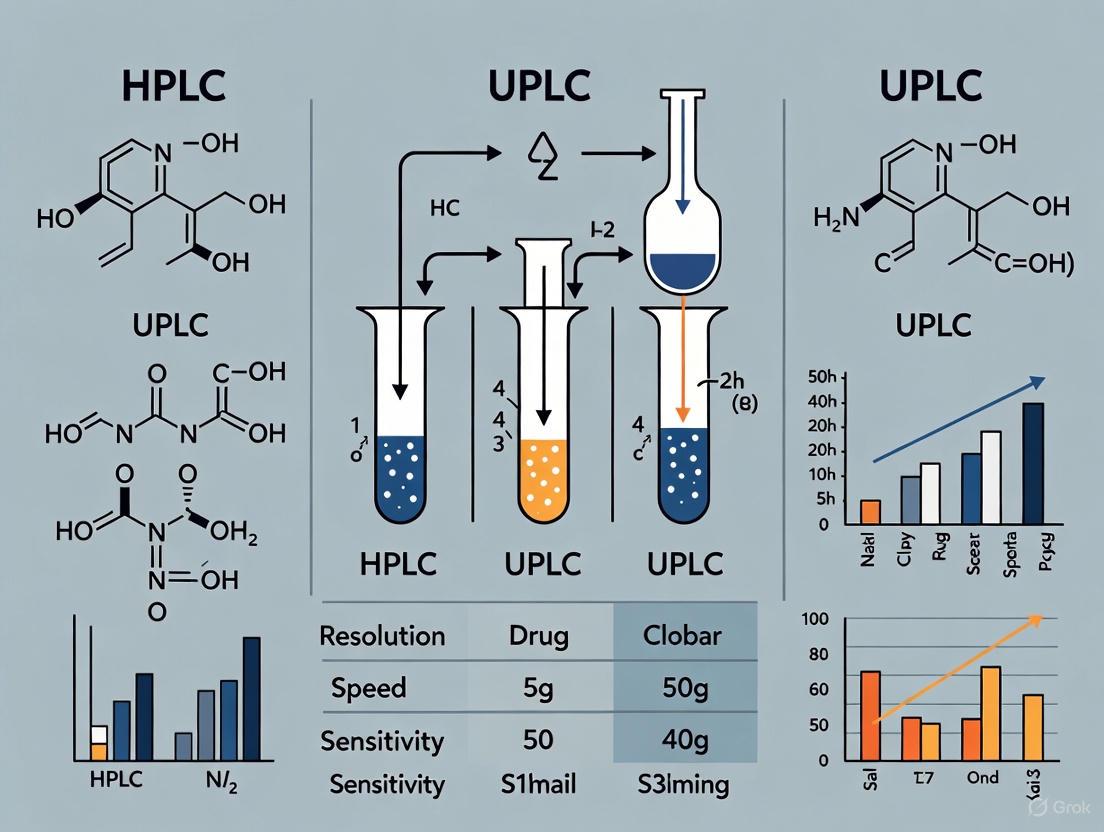
This article provides a comprehensive comparison of High-Performance Liquid Chromatography (HPLC) and Ultra-Performance Liquid Chromatography (UPLC) methods for drug quantification, tailored for researchers, scientists, and drug development professionals.
HPLC vs. UPLC: A Strategic Comparison for Modern Drug Quantification and Analysis
Abstract
This article provides a comprehensive comparison of High-Performance Liquid Chromatography (HPLC) and Ultra-Performance Liquid Chromatography (UPLC) methods for drug quantification, tailored for researchers, scientists, and drug development professionals. It explores the foundational principles separating these techniques, including operational pressures and particle size. The scope extends to practical methodological applications for various drug compounds, troubleshooting common challenges, and a detailed examination of validation parameters as per ICH guidelines. By synthesizing performance metrics on speed, sensitivity, resolution, and cost, this review serves as a strategic guide for selecting the optimal chromatographic method to enhance laboratory efficiency, ensure regulatory compliance, and support innovation in pharmaceutical analysis.
Core Principles: Unpacking the Fundamental Technologies of HPLC and UPLC
High-Performance Liquid Chromatography (HPLC) and Ultra-Performance Liquid Chromatography (UPLC) represent significant milestones in the evolution of analytical science. For researchers and drug development professionals, understanding the distinctions between these techniques is crucial for selecting the optimal method for drug quantification research. This guide provides an objective, data-driven comparison of their performance, supported by experimental data and detailed protocols.
Core Principles and Technological Evolution
Liquid chromatography separates, identifies, and quantifies components in a mixture. HPLC has been the trusted analytical workhorse for decades, known for its robustness, reproducibility, and widespread inclusion in pharmacopeial monographs [1]. It separates analytes based on their interactions between a liquid mobile phase and a solid stationary phase under pressures typically up to 400 bar, using column particles of 3–5 µm [1].
UPLC, a term trademarked by Waters Corporation, evolved from HPLC to meet growing demands for faster analyses, higher resolution, and improved sensitivity [2] [1]. The principal innovation lies in using sub-2 µm stationary phase particles, which significantly increase chromatographic efficiency. To accommodate these smaller particles, UPLC systems operate at much higher pressures, often exceeding 1,000 bar [1]. This combination enables faster analysis times, reduced solvent use, and enhanced signal clarity.
The following diagram illustrates the core workflow for drug quantification shared by both techniques, with key differentiators in system configuration:
Performance Comparison: HPLC vs. UPLC
The technological differences between HPLC and UPLC directly influence their analytical performance. The table below summarizes key quantitative differences based on experimental data [1]:
| Performance Parameter | HPLC | UPLC | Experimental Basis |
|---|---|---|---|
| Typical Operating Pressure | Up to 400 bar | 1,000 - 1,200 bar | System manufacturer specifications [1] |
| Column Particle Size | 3 - 5 µm | < 2 µm | Column packing technology [1] |
| Typical Analysis Time | 20 - 45 minutes | 2 - 5 minutes | Method runtime comparison for same separation [1] |
| Solvent Consumption | High ( ~1.0 mL/min) | Low ( ~0.2 mL/min) | Flow rate measurements for comparable methods [1] [3] |
| Peak Capacity | Lower | Up to 28% higher | Chromatographic measurement of resolved peaks [4] |
| Sensitivity | Moderate | High (due to reduced band broadening) | Signal-to-noise ratio analysis [1] [3] |
UPLC's superior performance arises from its ability to generate more theoretical plates per unit time. A direct instrument comparison study demonstrated that a holistically designed UPLC system achieved a peak capacity 28% to 33% higher than modified HPLC systems, directly impacting its ability to resolve complex mixtures [4]. Furthermore, UPLC can reduce analysis time by up to nine times compared to systems using 5µm particles, and by up to three times compared to 3µm particles [2].
Experimental Comparison: Methodologies and Data
Detailed Experimental Protocol for Drug Quantification
The following protocol is adapted from a clinical study comparing HPLC-UV and HPLC-MS/MS for quantifying therapeutic drugs in human serum [5]. It outlines a robust methodology suitable for both HPLC and UPLC platforms.
1. Sample Preparation (Solid-Phase Extraction - SPE)
- Materials: Patient serum samples, MonoSpin C18 monolithic silica disk centrifugal cartridges, acetonitrile (HPLC grade), purified water, ammonium acetate trihydrate.
- Procedure:
- Filter patient serum (150 µL) using a 0.45 µm syringe filter.
- Load filtered serum onto a pre-conditioned SPE cartridge (pre-treated with 500 µL CH3CN followed by 500 µL water via centrifugation at 5,000 rpm for 1 min).
- Wash cartridge with 500 µL water (centrifuge at 5,000 rpm for 2 min).
- Elute drug using 150 µL of aqueous 50% acetonitrile (for drugs like carbamazepine, phenytoin, lamotrigine, voriconazole) or 30% acetonitrile (for vancomycin) by centrifugation for 1 min.
- Collect eluate for analysis.
2. Chromatographic Analysis
- Apparatus: HPLC or UPLC system with autosampler, pump, column oven, and diode-array detector (e.g., Hitachi Chromaster system).
- Column: Chromolith HighResolution RP-18 endcapped column (100 mm x 4.6 mm i.d.).
- Mobile Phase: Compositions vary by drug. Example for Lamotrigine (LTG): 10 mM Ammonium Acetate (pH 4.5) / Acetonitrile (85/15, v/v).
- Flow Rate: 1.0 mL/min for HPLC; scaled appropriately for UPLC (e.g., ~0.3 mL/min).
- Column Temperature: 40 °C.
- Detection: UV detection at wavelength specific to drug (e.g., 215 nm for Carbamazepine, 305 nm for Voriconazole).
- Injection Volume: 10 µL for HPLC; 1-2 µL for UPLC.
Key Research Reagent Solutions
The table below details essential materials and their functions for the described drug quantification protocol [5]:
| Research Reagent / Material | Function in the Experiment |
|---|---|
| MonoSpin C18 SPE Cartridge | Rapid solid-phase extraction to isolate and purify target drugs from complex serum matrix. |
| Chromolith RP-18 Column | Monolithic stationary phase for fast, high-resolution reversed-phase separation. |
| Ammonium Acetate Buffer | Mobile phase additive to control pH and ionic strength, improving peak shape and separation. |
| Acetonitrile (HPLC Grade) | Organic mobile phase component for gradient elution; also used as SPE elution solvent. |
| Drug Reference Standards | High-purity compounds for method calibration, quantification, and quality control. |
Representative Experimental Data
A 2023 clinical study compared the quantitative performance of an HPLC-UV platform against established methods (immunoassay and HPLC-MS/MS) for therapeutic drug monitoring (TDM). The study quantified levels of anticonvulsants and antimicrobials in patient sera [5].
Results:
- Accuracy and Precision: The HPLC-UV method was fully validated, demonstrating high accuracy, precision, and reproducibility for all target drugs.
- Method Correlation: Passing-Bablok regression and Bland-Altman analysis revealed that serum levels of Phenytoin (PHT), Carbamazepine (CBZ), and Vancomycin (VCM) quantified by HPLC-UV were closely correlated with those quantified by a clinical immunoassay analyzer.
- Cross-Platform Validation: Levels of Lamotrigine (LTG) and Voriconazole (VRCZ) quantified by HPLC-UV also showed strong correlation with those quantified by the reference method of HPLC-MS/MS.
This study demonstrates that a well-optimized HPLC-UV platform can provide reliable, high-quality data suitable for in-hospital TDM, with UPLC offering potential for further improvements in throughput and sensitivity [5].
Strategic Selection for Drug Development
Choosing between HPLC and UPLC involves balancing performance needs with practical constraints. The following diagram outlines the decision-making process:
Application Scenarios and Method Transfer
- UPLC Applications: Ideal for drug discovery and development phases where high throughput is critical, such as metabolite identification in complex matrices, dissolution testing, and bioanalytical studies for pharmacokinetics [2] [1]. Its superior resolution is valuable for separating closely eluting impurities [3].
- HPLC Applications: Remains the benchmark for routine quality control (QC) in manufacturing and for methods defined in pharmacopeias due to its robustness, regulatory acceptance, and lower operational complexity [1]. It is also a cost-effective choice for labs with lower sample volumes.
Transferring a method from HPLC to UPLC requires careful scaling. Key parameters must be adjusted to maintain linear velocity and selectivity [1]:
- Scaling Factor (r):
r = (L₂ · d₂²) / (L₁ · d₁²)where L is column length and d is column internal diameter. - Flow Rate:
F₂ = F₁ · (d₂² / d₁²)to match linear velocity. - Injection Volume:
Vinj,2 = Vinj,1 · rto avoid column overload. - Gradient Time:
tG,2 = tG,1 · rwhile accounting for system dwell volume differences.
Example: Converting an HPLC method (250 mm x 4.6 mm, 5 µm, 1.0 mL/min) to UPLC (100 mm x 2.1 mm, 1.7 µm) results in a scaled flow rate of approximately 0.21 mL/min and a significantly reduced gradient time [1].
Future Trends in Liquid Chromatography
The chromatography landscape continues to evolve. Key trends include the development of more inert (biocompatible) hardware to improve analyte recovery for metal-sensitive compounds like phosphorylated species and certain pharmaceuticals [6]. There is also a strong focus on green chemistry, with efforts to reduce solvent consumption through miniaturization and the use of eco-friendly solvents [7]. Furthermore, the integration of artificial intelligence (AI) and machine learning is beginning to optimize method development, predictive maintenance, and data analysis, enhancing both HPLC and UPLC platforms [7]. These innovations ensure that liquid chromatography will remain a cornerstone of analytical science in drug development and beyond.
In the field of analytical chemistry, the separation, identification, and quantification of compounds in complex mixtures is paramount, particularly in drug development where precision, sensitivity, and speed directly impact research outcomes. For decades, High-Performance Liquid Chromatography (HPLC) has served as the reliable workhorse for these analyses. However, as analytical demands have intensified—with needs for higher throughput, better resolution of complex samples, and reduced solvent consumption—the operational backpressure of chromatography systems has emerged as a critical technological bottleneck. This fundamental limitation catalyzed the development of Ultra-Performance Liquid Chromatography (UPLC), which leverages significantly higher operational pressures to achieve transformative performance enhancements [3] [8].
The relationship between operating pressure and chromatographic performance is not merely incremental but foundational. The "Pressure Paradigm" posits that the maximum operational backpressure a system can withstand dictates the fundamental parameters of separation science: the particle size of the stationary phase, the speed of analysis, and ultimately, the resolution and sensitivity achievable. While HPLC systems typically operate at pressures up to 6,000 psi (approximately 400 bar), UPLC systems are engineered to withstand pressures up to 15,000 psi (over 1,000 bar) [3] [1]. This order-of-magnitude increase in pressure tolerance enables the use of chromatographic columns packed with sub-2-micron particles, as opposed to the 3-5 micron particles common in HPLC. This shift in a single physical parameter—pressure—unlocks a cascade of performance improvements that this article will explore through direct experimental comparisons and technical data, providing drug researchers with a clear framework for selecting the appropriate technology for their quantification needs.
Technical Foundations: HPLC and UPLC System Architecture
To understand how operational backpressure dictates performance, one must first examine the fundamental architectural differences between HPLC and UPLC systems. Both techniques share the same core principle: separating compounds based on their differential distribution between a mobile phase (liquid solvent) and a stationary phase (packed column). However, their design philosophies diverge significantly to accommodate different pressure regimes [1].
HPLC System Design: Traditional HPLC systems are engineered for robustness and reliability at moderate pressures. A typical HPLC configuration includes a pump capable of generating flows against backpressures up to 6,000 psi, a sample injector, a column packed with 3-5 μm particles, and a detector. These systems prioritize stability and compatibility with a wide range of solvents and sample types, making them exceptionally versatile for routine analyses. Their fluidic pathways have higher dwell volumes and are more tolerant of minor particulates, though this comes at the cost of extra-column band broadening which can reduce efficiency [3] [9].
UPLC System Design: UPLC represents a holistic re-engineering of liquid chromatography for ultra-high-pressure operation. Every component is optimized to minimize dead volume and withstand persistent pressures up to 15,000 psi. Key design differentiators include: low-dispersion, high-pressure pumps with specialized seals; low-volume injection systems; and detectors with minimized flow cell volumes. Crucially, UPLC systems are designed from the ground up to maintain chromatographic integrity at sub-2-micron scale separations, whereas modified HPLC systems often struggle with the significant band broadening and gradient delay volumes when attempting similar separations [10] [9]. This integrated design philosophy is essential for preserving the separation efficiency gained from smaller particle sizes.
The following diagram illustrates the critical architectural differences in the fluidic paths of HPLC versus UPLC systems and how these differences contribute to band broadening:
Experimental Comparisons: Resolution and Throughput Under Pressure
Direct Performance Comparison in Pharmaceutical Analysis
Numerous controlled studies have quantified the performance differential between HPLC and UPLC under standardized conditions. A particularly revealing investigation compared the separation of a series of anesthetics using both technologies. The experimental protocol utilized an ACQUITY UPLC BEH C18 column (1.7 μm, 2.1 × 30 mm) with a mobile phase gradient from 25% to 75% acetonitrile over 1 minute at a flow rate of 1.0 mL/min and temperature of 50°C [10].
The results demonstrated that the holistically-designed UPLC system consistently outperformed modified HPLC systems across all critical separation parameters. Specifically, the peak capacity—defined as the number of peaks that can be resolved during the gradient time—was 28-33% higher in the UPLC system compared to modified HPLC systems. Additionally, the UPLC system showed a peak width ratio (comparing the most polar and least polar components) approaching 1.0, indicating minimal system dispersion and highly efficient gradient separation. The sensitivity was also notably higher in the UPLC system, as other systems experienced reduced sensitivity due to the shorter path length of microbore flow cells needed to reduce extra-column band spreading [10].
Analysis Time and Solvent Consumption
The throughput advantages of UPLC become strikingly apparent when comparing run times for equivalent separations. In a study quantifying parathyroid hormone (PTH) in pharmaceutical formulations, researchers developed and validated parallel methods using both RP-HPLC and RP-UPLC techniques. The chromatographic separation for PTH was achieved in approximately 17 minutes using HPLC, but required only about 2 minutes using UPLC—an 88% reduction in analysis time [11]. This dramatic acceleration enables laboratories to increase sample throughput dramatically without compromising data quality.
Solvent consumption presents another critical differentiator with significant economic and environmental implications. The migration from traditional HPLC columns (4.6 mm I.D.) to UPLC microbore columns (2.1 mm I.D.) reduces solvent consumption by nearly 80% [10] [9]. For laboratories processing hundreds or thousands of samples monthly, this reduction translates to substantial cost savings in solvent procurement and waste disposal, while also supporting green chemistry initiatives.
Table 1: Quantitative Performance Comparison of HPLC vs. UPLC
| Performance Parameter | HPLC | UPLC | Improvement |
|---|---|---|---|
| Typical Operating Pressure | Up to 6,000 psi (400 bar) [3] [1] | Up to 15,000 psi (1,000-1,200 bar) [3] [1] | 2.5x increase |
| Column Particle Size | 3-5 μm [3] [1] | <2 μm (typically 1.7-1.8 μm) [3] [1] | ~2x reduction |
| Typical Analysis Time | 20-45 minutes [1] | 2-5 minutes [1] | Up to 10x faster [3] |
| Solvent Consumption | Higher [1] | 70-80% reduction [1] | Significant cost savings |
| Peak Capacity | Lower (example: 31 in comparative study) [10] | Higher (example: 46 in comparative study) [10] | 28-33% improvement [10] |
| Sensitivity | Moderate [1] | Enhanced due to reduced band broadening [3] | Improved for trace analysis |
The Technical Basis for UPLC Performance Advantages
The van Deemter Relationship: Particle Size and Efficiency
The superior performance of UPLC is fundamentally rooted in the van Deemter equation, which describes the relationship between linear velocity and theoretical plate height (a measure of separation efficiency). As particle size decreases below 2μm, the van Deemter curve flattens significantly, indicating that optimal efficiency can be maintained at higher linear velocities [12] [8]. This theoretical principle explains why UPLC can achieve faster separations without sacrificing resolution—the smaller particles provide more uniform flow paths and reduced longitudinal diffusion, allowing compounds to spend less time in the column while still achieving efficient separation.
The practical implication is that UPLC operates closer to the theoretical optimum of chromatography, where separation power is maximized regardless of flow rate. This contrasts with HPLC, where increasing flow rate to reduce analysis time typically comes at the expense of resolution. The ability to use smaller particles is directly enabled by higher system pressures, as the pressure required is inversely proportional to the square of the particle size (ΔP ∝ 1/dp²) [8].
Sensitivity Enhancements Through Reduced Band Broadening
UPLC's enhanced sensitivity—particularly valuable for quantifying low-abundance metabolites or drugs in complex matrices—stems from multiple factors. The reduced column internal diameter (typically 2.1 mm vs. 4.6 mm in HPLC) decreases sample dilution in proportion to the cross-sectional area, potentially yielding four times higher concentration in the detector when the diameter is halved [12]. Additionally, the sharper, narrower peaks produced by UPLC systems increase signal height relative to noise, improving detection limits. This sensitivity advantage is crucial in drug quantification research where analytes may be present at trace concentrations, such as in therapeutic drug monitoring or metabolite identification studies [13].
Practical Implementation in Drug Quantification Research
Method Transfer and Scaling Protocols
For researchers considering transitioning from HPLC to UPLC, method transfer requires careful scaling to maintain chromatographic performance. The following relationship enables accurate translation of methods between platforms:
Scaling Factor (r) = (L₂ × d₂²) / (L₁ × d₁²)
Where L is column length and d is column internal diameter [1].
A practical example demonstrates this scaling process:
- Original HPLC Method: 250 mm × 4.6 mm column (5 μm), flow rate = 1.0 mL/min
- Scaled UPLC Method: 100 mm × 2.1 mm column (1.7 μm), calculated flow rate ≈ 0.21 mL/min (practical setting 0.30 mL/min) [1]
This systematic approach ensures consistent separation performance while leveraging UPLC's speed and efficiency advantages. The following diagram illustrates the workflow for successfully transferring and scaling a method from HPLC to UPLC:
Essential Research Reagent Solutions
Successful implementation of either HPLC or UPLC methods requires specific reagents and materials optimized for each platform. The following table details key research reagent solutions and their functions in chromatographic analysis of pharmaceuticals:
Table 2: Essential Research Reagent Solutions for HPLC/UPLC Analysis
| Reagent/Material | Function | Technical Considerations |
|---|---|---|
| Stationary Phases | Separation of analytes based on chemical interactions | HPLC: 3-5 μm fully porous particles [1]. UPLC: Sub-2 μm particles (fully porous or core-shell) [12] [1] |
| Mobile Phase Additives | Modify retention and peak shape | Trifluoroacetic Acid (TFA): Ion-pairing for proteins/peptides [11]. Ammonium salts: MS-compatible buffers [13] |
| Sample Preparation | Extract, clean up, and concentrate analytes | Protein precipitation with methanol or acetonitrile [14]. Solid-phase extraction for complex matrices |
| Internal Standards | Normalize analytical variability | Isotopically-labeled analogs (e.g., voriconazole-d3) for MS methods [13]. Structural analogs for UV detection |
| Quality Controls | Monitor method performance | Prepared at low, medium, high concentrations in blank matrix [13]. Verify accuracy, precision, and stability |
The "Pressure Paradigm" in liquid chromatography reveals that operational backpressure is not merely a technical specification but a fundamental determinant of analytical capability. HPLC remains a robust, versatile, and pharmacopeia-recognized platform suitable for routine quality control, methods requiring high injection volumes, and applications where method transfer complexity outweighs performance benefits. Its larger particle columns (3-5 μm) and moderate pressure operation (up to 6,000 psi) provide exceptional reliability for standardized assays [1].
Conversely, UPLC represents the technological evolution of liquid chromatography, leveraging higher pressure tolerance (up to 15,000 psi) to unlock the theoretical advantages of sub-2-micron particles. The documented benefits—including analysis times reduced by up to 80%, solvent consumption lowered by 70-80%, and significantly enhanced resolution and sensitivity—make UPLC particularly valuable for drug development applications where speed, sample throughput, and detection of low-abundance compounds are critical [3] [1].
For drug quantification researchers, the selection between HPLC and UPLC should be guided by specific application requirements rather than presumed technological superiority. HPLC maintains its position for compendial methods, high-capacity routine testing, and laboratories with budget constraints. UPLC offers compelling advantages for method development, high-throughput screening, metabolomics studies, and bioanalytical applications requiring maximum sensitivity. As the field continues to evolve, the pressure paradigm will likely drive further innovation, potentially making today's UPLC performance tomorrow's standard for all liquid chromatography applications.
In the field of liquid chromatography, the evolution of particle size in stationary phases has been a primary driver of performance enhancement. The transition from traditional 3-5 µm particles to modern sub-2 µm particles represents a fundamental shift that has redefined the capabilities of analytical separations, particularly in drug quantification research. This guide objectively examines the impact of this critical parameter on chromatographic performance, supported by experimental data and practical methodologies.
The Fundamental Relationship Between Particle Size and Chromatographic Performance
The relationship between particle size and chromatographic efficiency is quantitatively described by the Van Deemter equation, which explains how band broadening varies with mobile phase linear velocity [15]. The equation is represented as:
H = A + B/μ + Cμ
Where H is the height equivalent to a theoretical plate (HETP, a measure of efficiency), μ is the linear flow velocity, and A, B, and C represent eddy diffusion, longitudinal diffusion, and mass transfer resistance terms, respectively [15] [16].
Smaller particles significantly improve chromatographic performance by reducing all three terms of the Van Deemter equation. The A-term (eddy diffusion), which represents the multiple flow paths a molecule can take through the column, is minimized with more uniformly packed beds achievable with smaller, more monodisperse particles [16]. The C-term (mass transfer), representing the time for analytes to diffuse into and out of the stationary phase pores, is substantially reduced with shorter diffusion paths in smaller particles [15]. This results in a lower Van Deemter curve minimum and extends the optimal efficiency to higher flow rates, enabling either higher efficiency or faster separations without significant loss of performance [15] [16].
The evolution to smaller particles has been facilitated by technological advancements in particle engineering. Second-generation hybrid technologies like bridged ethylsiloxane/silica hybrid (BEH) particles provide the enhanced mechanical stability required to withstand the extreme pressures needed for sub-2 µm particle columns [15]. These particles incorporate carbon in the form of methyl groups bridged within the silica matrix, enhancing mechanical stability while maintaining separation performance across extended pH ranges [15].
Performance Comparison: HPLC vs. UPLC Technologies
The transition from HPLC (3-5 µm particles) to UPLC (sub-2 µm particles) represents a significant technological advancement with measurable impacts on analytical performance. Each technique offers distinct advantages suited to different applications in drug research and development.
Technical Specifications and Performance Metrics
Table 1: Fundamental differences between HPLC and UPLC technologies
| Parameter | HPLC (3-5 µm) | UPLC (Sub-2 µm) | Impact on Performance |
|---|---|---|---|
| Particle Size | 3-5 µm [3] [17] | <2 µm (typically 1.7 µm) [15] [3] [17] | Smaller particles provide higher efficiency and resolution |
| Operating Pressure | Up to 6,000 psi [3] [17] | Up to 15,000 psi (100 MPa) [15] [3] [17] | Higher pressure enables use of smaller particles |
| Analysis Speed | Standard (reference) | 5-10x faster [3] | Increased sample throughput |
| Sample Volume | 10-20 µL [17] | 1-2 µL [17] | Reduced sample requirement |
| Solvent Consumption | Higher [15] [3] | 50-90% reduction [3] | Lower operating costs and environmental impact |
| Theoretical Plates | ~2,000 (example method) [11] | ~7,500 (example method) [11] | Significantly improved separation efficiency |
Experimental Comparison in Pharmaceutical Analysis
Direct methodological comparisons demonstrate the practical advantages of UPLC for drug quantification. A study quantifying parathyroid hormone (PTH) in pharmaceutical formulations developed parallel methods using both HPLC and UPLC, with results summarized in Table 2 [11].
Table 2: Experimental comparison of HPLC and UPLC methods for parathyroid hormone analysis
| Characteristic | HPLC Method | UPLC Method | Improvement |
|---|---|---|---|
| Column Dimensions | 2.1 × 100 mm [11] | 2.1 × 12.5 mm [11] | 8x shorter column |
| Particle Size | 3 µm [11] | 5 µm (totally porous) [11] | Note: This UPLC method used 5µm particles in a shorter column |
| Flow Rate | 0.3 mL/min [11] | 0.4 mL/min [11] | Similar flow rate |
| Injection Volume | Not specified | Not specified | Not comparable |
| Gradient Time | 26.1 min [11] | 4.8 min [11] | 5.4x faster gradient |
| Total Run Time | 10 min [11] | 1.5 min [11] | 6.7x faster analysis |
| Retention Time | ~17 min [11] | ~2 min [11] | 8.5x faster elution |
| Theoretical Plates | ~2,000 [11] | ~7,500 [11] | 3.75x higher efficiency |
| Limit of Quantitation | ~0.2 µg/mL [11] | ~0.054 µg/mL [11] | 3.7x better sensitivity |
| Solvent Consumption per Run | ACN: 10.5 mL, Water: 21.0 mL [11] | ACN: 0.53 mL, Water: 0.66 mL [11] | ~95% reduction |
The dramatic reduction in solvent consumption demonstrated in the PTH study highlights an often-overlooked advantage of UPLC technology. With acetonitrile consumption dropping from 10.5 mL per run to just 0.53 mL, laboratories can achieve significant cost savings while reducing their environmental impact [11]. This makes UPLC particularly advantageous for high-throughput laboratories performing dozens or hundreds of analyses daily.
Practical Implications for Method Development and Transfer
Modern Particle Technologies and Trends
The evolution of particle technology has continued with the introduction of superficially porous particles (also called core-shell or fused-core) that provide efficiency similar to sub-2 µm fully porous particles but with lower backpressure [6] [16]. These particles typically range from 2.7-3 µm in diameter and can be used on conventional HPLC instruments while approaching UPLC performance [16]. Recent innovations include the development of monodisperse fully porous particles that offer higher efficiency compared to conventional polydisperse particles [6].
The trend toward inert or biocompatible hardware has become increasingly important, particularly for analyzing metal-sensitive compounds like phosphorylated drugs, oligonucleotides, and certain pharmaceuticals [6]. This hardware minimizes analyte interaction with metal surfaces, improving peak shape and recovery for challenging compounds [6].
Method Transfer Between Platforms
Method transfer between UPLC and HPLC platforms requires careful consideration of several parameters to maintain separation quality. As demonstrated in a study on synthetic peptide impurity analysis, successful transfer requires adjusting method parameters to maintain constant L/dp (column length to particle size ratio), reduced linear velocity, and gradient slope [18].
When transferring a method from UPLC to HPLC, resolution can be maintained by connecting multiple columns in series to increase length, though this increases run time substantially [18]. A more practical approach may accept slightly lower resolution using a single column with larger particles (2.5-3.5 µm) while avoiding excessively long analysis times [18]. Temperature optimization can also help recover lost resolution, as higher temperatures improve mass transfer and can reduce peak broadening for certain compounds [18].
Essential Research Reagent Solutions for Chromatographic Method Development
Successful method development in both HPLC and UPLC requires careful selection of reagents and materials. The following table outlines key solutions and their functions based on applications in pharmaceutical analysis.
Table 3: Essential research reagents and materials for chromatography method development
| Reagent/Material | Function/Application | Examples from Literature |
|---|---|---|
| Stationary Phases | Separation mechanism based on analyte properties | C18 (general reverse-phase), Phenyl-Hexyl (alternative selectivity), HILIC (polar compounds) [6] |
| Mobile Phase Additives | Modify selectivity, improve peak shape, control pH | Trifluoroacetic Acid (0.1% for peptides), Formic Acid (for MS compatibility) [11] [18] |
| Organic Modifiers | Solvent strength adjustment, selectivity modification | Acetonitrile (most common), Methanol, Ethanol (cost-effective alternative) [11] [19] |
| Inert Column Hardware | Prevent analyte adsorption for metal-sensitive compounds | Phosphorylated compounds, oligonucleotides, chelating molecules [6] |
| Guard Columns/Cartridges | Protect analytical column from contamination | Compatible with analytical column chemistry, available in inert options [6] |
Application in Drug Research and Future Perspectives
The enhanced performance of UPLC technology has proven particularly valuable in drug research, where it accelerates method development and provides superior resolution for complex samples. In pharmaceutical quality control, methods are increasingly being transferred from HPLC to UPLC systems to decrease analysis time and reduce solvent consumption while maintaining or improving data quality [15] [11].
UPLC has demonstrated significant utility in biopharmaceutical analysis, where it provides improved separation of proteins, peptides, and their impurities [18]. The technology has also enhanced lipidomic studies in drug research, where its superior capability to resolve nonpolar lipid molecules provides advantages over traditional HPLC systems [20]. Furthermore, UPLC-MS has become indispensable in drug metabolism and pharmacokinetic studies, enabling high-throughput analysis of drugs and metabolites with improved sensitivity and resolution [20].
Future developments in chromatography continue to focus on particle technology, with ongoing research into core-shell particles, monolithic columns, and fabricated pillar arrays [16]. The integration of chromatography with mass spectrometry continues to advance, with UPLC-MS emerging as a cornerstone technique for drug research, particularly in absorption, distribution, metabolism, excretion, and toxicity studies [20]. As pharmaceutical research increasingly focuses on personalized medicine, the speed, sensitivity, and resolution of UPLC with sub-2 µm particles will play a crucial role in developing targeted therapies and understanding individual metabolic profiles [20].
The transition from 3-5 µm to sub-2 µm particles represents more than just an incremental improvement in liquid chromatography—it constitutes a fundamental shift in analytical capabilities. While HPLC with 3-5 µm particles remains a reliable workhorse for routine analyses where ultra-high pressure capabilities are unavailable or unnecessary, UPLC with sub-2 µm particles provides undeniable advantages in speed, resolution, and sensitivity for drug quantification research.
The choice between these technologies ultimately depends on specific application requirements, available instrumentation, and throughput needs. For laboratories focused on high-throughput drug development, metabolism studies, or complex impurity profiles, UPLC offers compelling benefits that justify the investment in specialized equipment. However, for many routine quality control applications in pharmaceutical manufacturing, well-developed HPLC methods continue to provide robust and reliable performance. Understanding the fundamental relationship between particle size and chromatographic performance enables scientists to make informed decisions about method development and technology implementation in drug research.
High-Performance Liquid Chromatography (HPLC) and Ultra-Performance Liquid Chromatography (UPLC) represent two generations of liquid chromatography technology that form the backbone of modern pharmaceutical analysis. HPLC is a well-established technique that utilizes 3–5 μm column packing material and operates at pressures up to 6,000 psi, serving as a versatile and reliable workhorse in laboratories worldwide for drug quantification and quality control [3]. In contrast, UPLC represents a significant technological advancement that employs substantially smaller particle sizes (~1.7 μm) and operates at much higher pressures up to 15,000 psi [3]. This fundamental difference in particle technology and pressure tolerance enables UPLC to deliver dramatically improved analytical performance, including faster analysis times, enhanced resolution, and superior sensitivity, making it particularly valuable for high-throughput pharmaceutical applications where efficiency and precision are paramount [2] [3].
The evolution from HPLC to UPLC was made possible through developments in column packing chemistry and instrumentation capable of withstanding extreme operating pressures. Waters Corporation pioneered this technology with the introduction of the ACQUITY UPLC System in 2004, which was specifically designed from the ground up as a holistic system optimized for high-resolution, low-dispersion chromatography [21] [9]. Subsequent years have seen various vendors introduce modified HPLC systems designed for ultra-high-pressure liquid chromatography (UHPLC), though their performance in critical microbore separations often fails to match that of truly optimized UPLC platforms [21]. This instrumentation breakdown will systematically compare the components and configurations of these systems, providing researchers and drug development professionals with objective data to inform their analytical technology investments.
System Component Comparison
Pump and Pressure Capabilities
The pumping systems represent one of the most fundamental differentiators between HPLC and UPLC platforms. Traditional HPLC pumps are engineered to generate stable flows against back-pressures typically not exceeding 6,000 psi, employing single-piston or dual-piston designs with standard volume mixers to combine mobile phase components [3]. These systems provide adequate performance for conventional 4.6 mm I.D. columns packed with 3-5 μm particles. In contrast, UPLC pumping systems feature specialized high-pressure capabilities reaching 15,000 psi, with advanced designs incorporating low-volume mixers, bypass modes for pump components, and enhanced sealing technologies to prevent failure under extreme pressures [21] [3]. The UPLC systems maintain precise compositional accuracy and flow rate stability despite these elevated pressures, ensuring reproducible chromatographic performance essential for method transfer and regulatory compliance in pharmaceutical quantification.
Column Technology and Geometry
Column technology constitutes another critical distinction between these platforms. HPLC columns are typically packed with 3-5 μm particles in 4.6 mm internal diameter formats with lengths ranging from 50-250 mm, providing sufficient theoretical plates for most conventional separations [3]. UPLC columns employ sub-2-micron particles (typically 1.7-1.8 μm) with smaller internal diameters (commonly 2.1 mm) and shorter lengths, dramatically enhancing separation efficiency [2] [3]. The smaller particle technology increases the surface area for interaction, providing greater resolution power, while the reduced column dimensions significantly decrease solvent consumption—by nearly 80% compared to 4.6 mm I.D. columns of the same length [21] [9]. Column chemistries have also evolved specifically for UPLC applications, with advanced stationary phases including Bridged Ethyl Siloxane/Silica Hybrid (BEH), Charge Surface Hybrid (CSH), and High-Strength Silica (HSS) particles that offer superior mechanical strength, enhanced pH stability, and improved peak shapes for challenging pharmaceutical compounds [2].
Autosampler and Injection Systems
Autosampler technology differs significantly between the platforms, particularly in injection volume capabilities and sample carryover prevention. HPLC autosamplers typically handle injection volumes in the 1-100 μL range with standard loop designs, while UPLC systems are optimized for much smaller injection volumes (approximately 5-10 times lower than HPLC) while maintaining precision, thanks to advanced partial loop injection techniques and low-volume fluidic paths [2]. The ACQUITY UPLC System incorporates a temperature-controlled sample manager and specialized needle wash protocols using solvent mixtures like 17:15:15 acetonitrile/isopropanol/water to minimize carryover between injections [21]. For method transfer applications, UPLC systems can implement injection loop bypass functions and hardware modifications to reduce system volume when running legacy HPLC methods, though these adjustments may introduce system peaks as noted in vendor comparisons [21].
Detector Design and Flow Cells
Detector configurations vary considerably between the platforms, particularly in the design of flow cells to minimize band broadening and maintain detection sensitivity. HPLC systems typically employ standard 8-10 μL flow cells with 10 mm path lengths, providing adequate sensitivity for most pharmaceutical applications but contributing significantly to peak dispersion, especially with narrower peaks [9]. UPLC systems incorporate specialized microbore flow cells with dramatically reduced volumes (often 500 nL or less) and shorter path lengths to minimize post-column band spreading [21] [9]. While these low-volume flow cells are essential for maintaining the separation efficiency gained from UPLC columns, they can reduce sensitivity compared to standard HPLC flow cells, as evidenced by fixed y-axis comparisons showing reduced peak heights in modified HPLC systems attempting UPLC separations [9]. Modern UPLC detectors also feature higher data acquisition rates (up to 80-100 Hz compared to 20-40 Hz for HPLC) to properly capture the narrower peaks produced by UPLC separations [21].
Performance Comparison: Experimental Data
System Performance Metrics
Direct comparative studies provide objective data on the performance differences between holistically designed UPLC systems and modified HPLC systems. In a systematic evaluation of multiple vendors' systems using identical columns and separation conditions, the ACQUITY UPLC System demonstrated significantly superior performance across all critical separation parameters [21]. The data revealed that modified HPLC systems from various vendors showed 28-57% lower peak capacity compared to the dedicated UPLC platform, directly impacting their ability to resolve complex mixtures in pharmaceutical analysis [21] [9]. The peak width ratio (comparing the most polar and least polar components) deviated more substantially from the ideal value of 1.0 in modified systems (up to 1.75) compared to the UPLC system (1.12), indicating greater system dispersion that particularly affects early eluting peaks [21]. These performance limitations directly impact the quality of information available to researchers for drug quantification, potentially compromising the ability to resolve closely eluting compounds or detect minor impurities in pharmaceutical formulations.
Table 1: Comparative Performance Metrics Across LC Systems
| System Type | Peak Capacity | First-to-Last Peak Width Ratio | Sensitivity Relative to UPLC | Analysis Time |
|---|---|---|---|---|
| UPLC System | 46 | 1.12 | Baseline | 1.5 min |
| Vendor A UHPLC | 33 (28% lower) | 1.75 | Reduced | Longer |
| Vendor B UHPLC | 31 (33% lower) | 1.19 | Reduced | Longer |
| Vendor C UHPLC | 39 (15% lower) | 1.67 | Reduced | Longer |
| Traditional HPLC | 29 (37% lower) | 1.73 | Significantly Reduced | Substantially Longer |
Pharmaceutical Application Data
The practical implications of these system differences are evident in direct method comparisons for drug quantification. In a study developing and validating methods for parathyroid hormone analysis, UPLC provided equivalent separation in dramatically reduced time—approximately 2 minutes versus 17 minutes for HPLC—while maintaining excellent precision (RSD <1% for UPLC versus <2% for HPLC) [11]. This represents nearly a 9-fold reduction in analysis time, significantly increasing laboratory throughput for routine quality control operations [2] [11]. Another study analyzing monoclonal antibodies like casirivimab and imdevimab demonstrated that UPLC methods optimized through Quality by Design principles could achieve excellent linearity (R² > 0.999) and good reproducibility (RSD < 2%) while incorporating green chemistry principles by using ethanol as a cost-effective, environmentally friendly organic solvent [19]. The sensitivity advantages of UPLC have proven particularly valuable for therapeutic drug monitoring, such as voriconazole quantification, where UPLC-MS/MS methods offer the specificity and sensitivity needed to manage narrow therapeutic ranges despite higher equipment costs and technical complexity [13].
Method Transfer: Experimental Protocols
Isocratic Method Transfer
Transferring existing HPLC methods to UPLC instrumentation requires careful consideration of system volume differences, particularly for isocratic separations. In a case study transferring a size exclusion chromatography (SEC) method for protein analysis, researchers used identical Biosuite SEC columns (10 μm, 250 Å, 7.5 mm × 300 mm) on both HPLC and UPLC systems with the same mobile phase and flow rate [22]. The protocol revealed consistently earlier retention times on the UPLC instrument despite identical flow rates, attributed to reduced system volume from injector to detector (approximately 360 μL difference) [22]. Interestingly, this volume reduction yielded an unexpected benefit—improved resolution between critical peak pairs due to less post-column dispersion—without requiring any method modifications [22]. For isocratic method transfers, the experimental protocol should maintain identical column chemistry, particle size, and dimensions when possible, while expecting potentially slightly shifted retention times and possibly improved resolution on UPLC platforms.
Gradient Method Transfer
Gradient method transfer requires more significant adjustments due to dwell volume differences between systems. In transferring a complex peptide mapping method, researchers first quantified the precise dwell volume difference between instruments (360 μL) and implemented a gradient start offset to compensate for this variance without altering the gradient table itself [22]. The protocol employed identical XBridge C18 columns (3.5 μm, 4.6 mm × 100 mm) on both systems and the same mobile phase composition, with the UPLC method incorporating the calculated delay to synchronize gradient arrival at the column [22]. When applied to a tryptic digest of infliximab, this approach demonstrated excellent retention time consistency across 65 monitored peaks, with only minor differences observed [22]. The successful transfer required consideration of additional parameters including column temperature stability, flow rate accuracy, and solvent delivery configuration, highlighting that each method transfer should be approached on a case-by-case basis with systematic evaluation of all influencing factors.
Advanced UPLC Applications and Troubleshooting
Anomaly Detection with Machine Learning
The integration of machine learning for quality control represents a cutting-edge application of UPLC technology in automated pharmaceutical analysis. Researchers have developed a novel framework for automated anomaly detection in HPLC/UPLC experiments, specifically targeting air bubble contamination—a common yet challenging issue that typically requires expert intervention [23]. The system employs a binary classifier trained on approximately 25,000 HPLC traces using active learning combined with human-in-the-loop annotation [23]. When deployed prospectively, the model demonstrated robust performance with 0.96 accuracy and a 0.92 F1 score, effectively identifying pressure fluctuations and peak shape abnormalities characteristic of air bubble introduction [23]. This machine learning approach is particularly valuable for cloud laboratories and high-throughput pharmaceutical screening where continuous instrument health monitoring surpasses traditional periodic qualification tests in identifying systematic issues before they compromise drug quantification results.
Diagram 1: Machine learning workflow for HPLC/UPLC anomaly detection in cloud laboratories
Essential Research Reagent Solutions
Table 2: Essential Research Reagents for UPLC Pharmaceutical Analysis
| Reagent/Column Type | Function/Purpose | Application Examples |
|---|---|---|
| BEH C18 Column (1.7 μm) | High-efficiency separation with pH stability (1-12) | Casirivimab/imdevimab analysis [19] |
| C8 Column (1.7 μm) | Alternative selectivity for biomolecules | Parathyroid hormone quantification [11] |
| Trifluoroacetic Acid (TFA) | Ion-pairing agent for improved peak shape | Peptide mapping, protein separations [11] |
| Formic Acid | Volatile mobile phase modifier for MS compatibility | Voriconazole UPLC-MS/MS analysis [13] |
| Ethanol | Green alternative to acetonitrile | Sustainable method development [19] |
| Stable Isotope-labeled Internal Standards | Normalization for quantitative precision | Voriconazole-d3 for therapeutic drug monitoring [13] |
The comprehensive comparison of HPLC and UPLC system components reveals a complex landscape where holistic instrument design profoundly impacts practical performance in pharmaceutical research. While UPLC technology clearly provides substantial advantages in speed, resolution, and solvent consumption, laboratories must carefully consider their specific application requirements, existing method portfolios, and budgetary constraints when selecting instrumentation [3]. The performance data demonstrates that modified HPLC systems attempting UHPLC applications often fail to match the efficiency of platforms specifically designed for ultra-performance separations, particularly for demanding microbore applications [21] [9]. As pharmaceutical analysis continues evolving toward higher throughput and greater sensitivity, UPLC technology—especially when coupled with advanced detection methods like tandem mass spectrometry and innovative quality control approaches like machine learning anomaly detection—promises to address increasingly challenging quantification requirements in drug development and quality control.
Diagram 2: Systematic workflow for successful HPLC to UPLC method transfer
From Theory to Practice: Method Development and Real-World Applications in Drug Analysis
Liquid chromatography is a fundamental separation technique used across numerous scientific fields, particularly for the identification and quantification of substances in various matrices. For decades, High-Performance Liquid Chromatography (HPLC) has served as the workhorse technique in pharmaceutical analysis, utilizing 3–5 μm column packing material and operating at pressures up to 6,000 psi [3]. This robust technology has proven invaluable for therapeutic drug monitoring, clinical research, and quality control of pharmaceutical products due to its reliability, specificity, and sensitivity [24]. The principles of HPLC are rooted in traditional chromatography methods where separation occurs based on differential interactions between analytes, a stationary phase, and a liquid mobile phase [3].
In contrast, Ultra-Performance Liquid Chromatography (UPLC) represents a significant technological evolution in liquid chromatography. While based on similar fundamental principles as HPLC, UPLC employs substantially smaller particle sizes (~1.7 μm) in the column packing material and operates at much higher pressures (up to 15,000 psi) [3] [2]. This advanced system design, capable of withstanding back-pressures up to 100 MPa, enables dramatic improvements in separation efficiency, speed, and sensitivity [25]. The development of UPLC has been facilitated by advances in column chemistry, including Bridged Ethyl Siloxane/Silica Hybrid (BEH) technology, which provides superior mechanical strength, enhanced peak shape, and broader pH stability compared to traditional column materials [2].
Technical Comparison: UPLC vs. HPLC Performance Parameters
Quantitative Performance Metrics
The translation from HPLC to UPLC methods yields substantial improvements across multiple performance parameters, as summarized in Table 1.
Table 1: Performance Comparison Between HPLC and UPLC Systems
| Performance Parameter | HPLC | UPLC | Improvement Factor |
|---|---|---|---|
| Typical Particle Size | 3-5 μm | ~1.7 μm | 2-3x reduction [3] [2] |
| Operating Pressure | Up to 6,000 psi | Up to 15,000 psi (~100 MPa) | 2.5x increase [3] [25] |
| Analysis Time | Reference method | 3-9x faster | 3-9x reduction [2] [25] |
| Solvent Consumption | Reference method | Significant reduction | Up to 80% savings [26] |
| Sample Volume | Conventional requirements | 5-10x smaller injection volume | 5-10x reduction [2] |
| Theoretical Plates | Standard efficiency | Maintained or improved efficiency | Enhanced resolution [25] |
Analytical Advantages of UPLC
The performance advantages of UPLC translate directly into tangible benefits for pharmaceutical analysis. The smaller particle size (~1.7 μm) in UPLC columns significantly reduces band broadening, resulting in narrower and sharper peaks with increased signal-to-noise ratios [2]. This enhancement provides more detailed chromatographic information and improved ability to resolve closely eluting compounds, which is particularly valuable for complex samples or impurity profiling [3].
The dramatic reduction in analysis time—by up to nine times compared to conventional HPLC systems using 5 μm particles—directly enhances laboratory productivity and throughput [2] [25]. This speed advantage was demonstrated in a direct method transfer case study where an HPLC assay with a 40-minute runtime was successfully translated to a UPLC method requiring only 15 minutes per injection while simultaneously improving resolution between impurities and degradation products [26]. Furthermore, UPLC's reduced solvent consumption offers significant cost savings and environmental benefits, aligning with green chemistry initiatives in the pharmaceutical industry [26].
Strategic Method Translation: From HPLC to UPLC
Systematic Translation Approach
The successful migration of analytical methods from HPLC to UPLC requires a systematic approach that accounts for the fundamental differences between the two platforms. Method translation is not merely a 1:1 transfer of parameters, but rather an optimization process that leverages UPLC's enhanced capabilities while maintaining analytical validity [24].
The process begins with column selection, typically choosing a UPLC column with chemistry similar to the original HPLC column but with smaller particle size (e.g., 1.7 μm) [2]. Subsequently, method parameters must be scaled to account for the differences in column dimensions and particle size. This includes adjusting flow rates, gradient programs, and injection volumes according to established scaling equations [24]. The final optimization phase focuses on fine-tuning separation conditions to maximize the performance benefits of UPLC technology while ensuring robust operation [25].
Experimental Evidence of Successful Translation
A compelling example of successful method translation comes from the analysis of parathyroid hormone (PTH) in pharmaceutical formulations. Researchers developed and validated both RP-HPLC and RP-UPLC methods for quantifying PTH in the presence of meta-cresol as a stabilizer [11]. The HPLC method required approximately 17 minutes retention time for the target analyte, while the UPLC method achieved separation in just 2 minutes—reducing analysis time by 88% while maintaining excellent precision (RSD <1% for UPLC versus <2% for HPLC) [11].
Another study demonstrated the transfer of quality control analyses for four different pharmaceutical formulations (Triamcinolon cream, Hydrocortison cream, Indomethacin gel, and Estrogel gel) from HPLC to UPLC systems [25]. The translated UPLC methods shortened analysis time by up to nine times compared to conventional systems using 5 μm particle-packed analytical columns, with no negative impact on the analytical column or other system components [25]. The separation efficiency remained maintained or was even improved in the UPLC system despite the significantly higher operating pressures [25].
Figure 1: Workflow for Translating HPLC Methods to UPLC
Essential Research Reagent Solutions
Successful method translation requires specific reagents and materials optimized for UPLC performance. The following table details key solutions essential for UPLC method development and operation.
Table 2: Essential Research Reagent Solutions for UPLC Method Translation
| Reagent/Material | Function | UPLC-Specific Considerations |
|---|---|---|
| BEH C18 Column (1.7 μm) | Stationary phase for separation | Superior mechanical strength, wide pH range (1-12) [2] |
| Charge Surface Hybrid (CSH) Technology | Column packing material | Incorporates surface charge to improve peak shape and selectivity [2] |
| UPLC-Grade Solvents | Mobile phase components | Low viscosity, high purity to prevent system damage [27] |
| Acquity UPLC System | Instrument platform | Designed to withstand high back-pressures (up to 15,000 psi) [3] |
| 0.1% Trifluoroacetic Acid (TFA) | Ion-pairing agent for peptide separation | Enhanced compatibility with MS detection [11] |
| Water: Tetrahydrofuran (50:50 v/v) | Receptor medium for in vitro release testing | Optimal drug recovery in pharmaceutical formulations [27] |
Validation Considerations for Translated UPLC Methods
Regulatory Compliance and Method Validation
Translated UPLC methods require comprehensive validation to demonstrate equivalence or superiority to original HPLC methods. According to International Conference on Harmonization (ICH) guidelines, key validation parameters include specificity, linearity, accuracy, precision, and robustness [24] [11]. The validation process must establish that the UPLC method maintains reliability and consistency for its intended application, particularly for pharmaceutical quality control and regulatory submissions [24].
For instance, in the development of a UPLC method for quantifying nystatin and triamcinolone acetonide in topical creams, researchers established linearity in the range of 0.65–31.93 μg/mL for triamcinolone acetonide and 17.67-863.27 IU/mL for nystatin with determination coefficients of 1.0000 for both drugs [27]. The method demonstrated excellent accuracy with recovery rates within acceptable ranges, low variability, and robustness against variations in experimental parameters [27].
System Suitability Testing
System suitability testing (SST) represents a critical component of method validation for translated UPLC methods. SST parameters verify that the entire chromatographic system—including instrument, reagents, column, and analyst—is performing adequately for the intended analysis [24]. Key SST parameters for UPLC methods typically include plate count (efficiency), tailing factor (symmetry), resolution (separation), and reproducibility [24].
During method translation from HPLC to UPLC, SST criteria may need adjustment to account for the improved performance characteristics of UPLC technology. For example, UPLC typically delivers higher plate counts and reduced tailing factors compared to HPLC due to the reduced band broadening effects of smaller particle sizes [2]. Establishing appropriate SST parameters ensures that the translated UPLC method consistently performs within designated operational limits.
The strategic translation of HPLC methods to UPLC platforms offers substantial benefits for pharmaceutical analysis, including dramatically reduced analysis times, enhanced sensitivity, and significant solvent savings. The systematic approach to method translation—encompassing column selection, parameter scaling, method optimization, and comprehensive validation—ensures successful migration while maintaining regulatory compliance. As pharmaceutical laboratories continue to seek efficiencies without compromising data quality, UPLC technology represents a powerful advancement that aligns with the evolving needs of modern drug development and quality control. The experimental evidence and practical guidelines presented in this article provide researchers with a framework for leveraging UPLC technology to enhance analytical capabilities in pharmaceutical research and development.
For researchers and drug development professionals, the choice of analytical technique is pivotal in balancing speed, efficiency, and data quality. High-Performance Liquid Chromatography (HPLC) has long been the trusted workhorse in pharmaceutical analysis, known for its robustness, reproducibility, and widespread inclusion in pharmacopeial monographs [1]. However, as laboratories face increasing pressure to accelerate analysis, reduce solvent use, and detect impurities at lower levels, Ultra-Performance Liquid Chromatography (UPLC) has emerged as a powerful alternative [3] [1]. This guide provides an objective comparison of HPLC and UPLC performance through experimental data and case studies, offering a scientific basis for selecting the optimal technique for small molecule drug analysis.
Fundamental Principles and Technical Comparisons
Core Technological Differences
The fundamental difference between HPLC and UPLC lies in the particle size of the stationary phase and the resulting system requirements. HPLC typically uses columns packed with 3–5 µm particles and operates at pressures up to 400 bar [1]. In contrast, UPLC utilizes sub-2 µm particles and operates at significantly higher pressures, often exceeding 1,000 bar [3] [1]. This reduction in particle size directly enhances chromatographic efficiency according to the Van Deemter equation, which describes the relationship between linear velocity and plate height (HETP) [15]. The equation, H = A + B/v + Cv, demonstrates that smaller particles reduce the path length for mass transfer (the C term), resulting in lower plate height and higher efficiency even at increased flow rates [15].
Performance Characteristic Comparison
The technological differences translate into distinct practical performance characteristics, summarized in the table below.
Table 1: Fundamental Operating Parameters and Performance Characteristics of HPLC vs. UPLC
| Parameter | HPLC | UPLC |
|---|---|---|
| Typical Particle Size | 3–5 µm [3] [1] | <2 µm (typically 1.7-1.8 µm) [3] [1] [15] |
| Operating Pressure | Up to 400 bar (6,000 psi) [3] [1] | Up to 1,000–1,200 bar (15,000-18,000 psi) [3] [1] |
| Typical Analysis Time | 20–45 minutes [1] | 2–5 minutes [1] |
| Solvent Consumption | High [1] | Low (up to 80% reduction) [1] |
| Sensitivity | Moderate [1] | High [1] |
| Limit of Detection (LOD) | Higher (e.g., 0.049 µg/mL for Vitamin C) [28] | Lower (e.g., 0.024 µg/mL for Vitamin C) [28] |
| Column Longevity | Longer, more robust [1] | Shorter, more prone to fouling [1] |
The following workflow diagram illustrates the decision-making process for technique selection based on project goals and constraints.
Diagram 1: Analytical Technique Selection Workflow. This diagram outlines the decision logic for choosing between HPLC and UPLC based on primary project requirements, regulatory constraints, and sample characteristics.
Experimental Data and Case Studies
Case Study 1: Pharmaceutical Formulation Analysis
A direct comparison study was conducted to analyze active pharmaceutical ingredients (APIs) using both HPLC and UPLC. The original HPLC method utilized a 50 x 4.6 mm column with 4 µm particles, a flow rate of 3.0 mL/min, and a total run time of 10 minutes [15]. After optimization for UPLC using a 50 x 2.1 mm column with 1.7 µm particles and a flow rate of 0.6 mL/min, the total run time was dramatically reduced to 1.5 minutes [15]. This represents an 85% reduction in analysis time. Furthermore, solvent consumption was significantly lower with UPLC: acetonitrile usage dropped from 10.5 mL to 0.53 mL, and water usage from 21.0 mL to 0.66 mL per run, representing approximately 95% and 97% reductions, respectively [15]. Despite the faster analysis, the UPLC method demonstrated superior performance with a plate count of 7500 compared to 2000 for HPLC, and a USP resolution of 3.4 compared to 3.2 [15].
Case Study 2: Vitamin C Determination in Complex Matrices
A 2015 study directly compared HPLC and UPLC methods for determining vitamin C (ascorbic acid) in fruit beverages and pharmaceutical preparations [28]. The UPLC method demonstrated clear advantages in sensitivity and speed. The Limit of Detection (LOD) for UPLC was 0.024 µg/mL compared to 0.049 µg/mL for HPLC, while the Limit of Quantification (LOQ) was 0.073 µg/mL for UPLC versus 0.149 µg/mL for HPLC [28]. The total analysis time was 6 minutes for UPLC versus 15 minutes for HPLC, a 60% reduction [28]. Both methods showed excellent precision, with intra-day precision for fruit juices expressed as RSD at 1.7% for UPLC and 2.2% for HPLC [28].
Case Study 3: Monoclonal Antibody Analysis Using Quality by Design
A 2025 study developed a Quality by Design (QbD)-based UPLC method for simultaneously analyzing casirivimab and imdevimab in a monoclonal antibody cocktail [19]. Through systematic optimization using Design of Experiments (DoE), the researchers identified optimal conditions of 60% ethanol, a flow rate of 0.2 mL/min, and a column temperature of 30°C [19]. The validated method demonstrated excellent linearity (R² > 0.999), low detection limits, and good reproducibility with percentage relative standard deviation values below 2% [19]. This case highlights how UPLC's superior resolution capabilities are particularly beneficial for analyzing complex biopharmaceuticals.
Table 2: Quantitative Performance Comparison from Experimental Case Studies
| Analysis Type | Technique | Analysis Time | Solvent Saved | Sensitivity (LOD) | Key Performance Metric |
|---|---|---|---|---|---|
| Pharmaceutical Formulation [15] | HPLC | 10 min | - | - | Plate Count: 2000 |
| UPLC | 1.5 min | ~95% vs. HPLC | - | Plate Count: 7500 | |
| Vitamin C Determination [28] | HPLC | 15 min | - | 0.049 µg/mL | Precision (RSD): 2.2% |
| UPLC | 6 min | - | 0.024 µg/mL | Precision (RSD): 1.7% | |
| mAb Analysis [19] | UPLC | Not Specified | Greenness Assessed | Low LOD/LOQ | Linearity: R² > 0.999 |
Method Translation and Practical Implementation
Systematic Method Transfer from HPLC to UPLC
Transferring existing HPLC methods to UPLC requires careful scaling to maintain chromatographic performance. The relationship between parameters for successful method transfer is visualized below.
Diagram 2: HPLC to UPLC Method Transfer Relationships. This diagram shows the mathematical relationships and parameters involved in systematically scaling methods from HPLC to UPLC, preserving separation efficiency while leveraging UPLC speed advantages.
The scaling process uses defined mathematical relationships [1]:
- Column Volume/Geometric Scale (r):
r = (L₂ · d₂²) / (L₁ · d₁²)where L is column length and d is internal diameter - Flow Rate:
F₂ = F₁ · (d₂² / d₁²) · (dₚ₁ / dₚ₂)to maintain linear velocity - Injection Volume:
Vinj,2 = Vinj,1 · rscaled by column volume ratio - Gradient Time:
tG,2 = tG,1 · (r · F₁ / F₂)adjusted for system dwell-volume differences
Worked Example [1]: Converting from HPLC (250 mm × 4.6 mm, 5 µm particles) to UPLC (100 mm × 2.1 mm, 1.7 µm particles):
- Scaling ratio:
r = (100 · 2.1²) / (250 · 4.6²) ≈ 0.083 - Flow rate:
F₂ = 1.0 · (2.1²/4.6²) ≈ 0.21 mL/min(practically set to 0.30 mL/min) - Injection volume:
Vinj,2 = 10 µL · 0.083 ≈ 0.8 µL(use 1-2 µL) - Gradient time:
tG,2 ≈ 20 min · (0.083 · 1.0 / 0.30) ≈ 5.5-6.0 min
The Scientist's Toolkit: Essential Research Reagents and Materials
Table 3: Key Research Reagent Solutions for HPLC/UPLC Analysis
| Item | Function | Technical Considerations |
|---|---|---|
| C18 Stationary Phases | Reversed-phase separation of small molecules | Choose particle size (5µm for HPLC, <2µm for UPLC) and pH stability (2-12 for modern phases) [6] |
| Biphenyl Columns | Alternative selectivity for complex separations | Provides π-π interactions for aromatic compounds, superior for isomer separations [6] |
| Bioinert/Inert Columns | Analysis of metal-sensitive compounds | Metal-free hardware prevents analyte adsorption and improves recovery for phosphorylated compounds [6] |
| Mass Spectrometry-Grade Mobile Phase Additives | Modifying separation selectivity and improving ionization | Formic acid and ammonium formate are common; use high-purity grades for UPLC-MS to prevent source contamination [19] |
| UPLC-QSM (Quaternary Solvent Manager) | High-pressure solvent delivery | Capable of >1,000 bar pressure for sub-2µm particle columns [15] |
| Column Manager with Temperature Control | Maintaining separation reproducibility | Precise temperature control (±0.1°C) critical for UPLC retention time stability [1] |
The experimental data and case studies presented demonstrate that UPLC provides significant advantages in analysis speed, solvent consumption, and sensitivity for small molecule drug analysis. The 85% reduction in analysis time and over 90% reduction in solvent usage observed in formulation analysis [15], coupled with improved sensitivity for compounds like vitamin C [28], make UPLC particularly valuable for high-throughput environments and method development. However, HPLC maintains importance for routine quality control where method robustness, longer column lifetime, and regulatory compliance are paramount [1].
Future developments continue to enhance both technologies. Recent innovations include columns with Fused-Core particles that offer higher efficiency at moderate backpressures [29], bioinert columns to minimize metal-analyte interactions [6], and systems with increased automation and IoT-enabled diagnostics [30] [29]. For researchers, the choice between HPLC and UPLC should be guided by specific application needs, regulatory requirements, and economic considerations, with the understanding that both techniques offer complementary strengths in the pharmaceutical analyst's toolkit.
For researchers and scientists in drug development, selecting the appropriate chromatographic technique is pivotal for the accurate quantification of peptides and proteins. This guide provides an objective comparison between High-Performance Liquid Chromatography (HPLC) and Ultra-Performance Liquid Chromatography (UPLC) methods, supported by technical data and experimental protocols.
Technical Comparison: HPLC vs. UPLC
The core differences between HPLC and UPLC stem from their operating parameters, which directly impact their performance in separating and quantifying biomolecules [3] [17] [1].
Table 1: Key Technical Specifications of HPLC and UPLC
| Parameter | HPLC | UPLC |
|---|---|---|
| Typical Particle Size | 3–5 μm [3] [17] [1] | <2 μm (commonly 1.7 μm) [3] [17] [1] |
| Operating Pressure | Up to 6,000 psi (≈400 bar) [3] [8] [1] | Up to 15,000 psi (≈1,000-1,200 bar) [3] [8] [1] |
| Analysis Speed | Longer run times (e.g., 20-45 min) [31] [1] | Shorter run times (e.g., 2-5 min) [31] [1] |
| Sample Volume | Higher (e.g., 10-20 μL) [17] | Lower (e.g., 1-2 μL) [17] |
| Solvent Consumption | Higher [3] [1] | Reduced by 70-80% [1] |
| Sensitivity & Resolution | Moderate [3] [1] | High, with sharper peaks [3] [1] |
Performance and Application in Biopharmaceutical Analysis
The technical specifications in Table 1 translate into distinct performance outcomes for peptide and protein analysis, influencing their suitability for different applications.
Table 2: Performance Comparison for Peptide and Protein Analysis
| Aspect | HPLC | UPLC |
|---|---|---|
| Resolution | Good for standard separations [8] | Superior for complex mixtures and closely eluting peaks [3] [8] |
| Throughput | Suitable for routine analysis [3] [17] | High throughput, ideal for large sample sets and method development [8] [1] |
| Detection Limits | Moderate sensitivity [3] | Enhanced sensitivity for trace-level analysis [3] [32] |
| Primary Application Context | Quality control (QC) labs, compendial methods, and routine analysis of drug substances and products [3] [17] [1] | Research & Development (R&D), characterization of biopharmaceuticals (e.g., peptides, proteins, glycans), and high-throughput bioanalysis [3] [33] [1] |
Supporting Experimental Data
A study developing methods for quantifying erythropoietin (EPO) in the presence of human serum albumin (HSA) demonstrated these performance differences concretely [31]. The RP-HPLC method achieved a retention time for EPO of less than 20 minutes, while the developed RP-UPLC method had a retention time of less than 4 minutes [31]. Both methods were validated and found to be precise and accurate, but UPLC offered a significant speed advantage [31].
Experimental Protocols for Protein Quantification
A prevalent and powerful LC-MS approach for quantifying proteins is the surrogate peptide method [32] [33]. This technique involves digesting the target protein into peptides and using one or more unique peptides as a surrogate for quantification.
Workflow: Surrogate Peptide Method
The following diagram illustrates the key steps in this workflow, from sample preparation to data analysis.
Method Validation Parameters
After developing an analytical method, it must be validated to ensure reliability and reproducibility. Key validation parameters, as per ICH guidelines, include [31] [34] [35]:
- Accuracy: Measure of the closeness of agreement between an accepted reference value and the value found. Typically documented as percent recovery over a minimum of nine determinations across three concentration levels [35].
- Precision: The closeness of agreement among individual test results from repeated analyses. Assessed as repeatability (intra-assay) and intermediate precision (inter-day, inter-analyst) [31] [35].
- Specificity: The ability to measure the analyte accurately in the presence of other potential components like impurities, degradants, or matrix components [31] [35].
- Linearity and Range: The ability to obtain test results proportional to the analyte concentration, demonstrated across a specified range [31] [35].
- Limit of Quantification (LOQ): The lowest concentration of an analyte that can be quantified with acceptable precision and accuracy, often determined with a signal-to-noise ratio of 10:1 [35].
Essential Research Reagent Solutions
Successful implementation of chromatography methods relies on specific reagents and materials. The following table details key items used in typical workflows for peptide and protein analysis.
Table 3: Essential Materials for Chromatography of Peptides and Proteins
| Item | Function / Description | Example Use Case |
|---|---|---|
| Reverse-Phase Columns | Separation based on hydrophobicity. C8/C18 for peptides [31] [33]. | HPLC: C8, 250mm L, 5μm particles [31]. UPLC: C18, 50mm L, 1.7μm particles [31]. |
| Digestion Kits | Standardized reagents & protocols for reproducible protein digestion into peptides [33] [36]. | Accelerating and standardizing sample preparation for surrogate peptide analysis [33] [36]. |
| Stable Isotope-Labeled Peptides | Internal standards for Mass Spectrometry; identical chemistry but distinguished by mass [32]. | Added to sample pre-digestion for precise & accurate quantification via LC-MS/MS [32]. |
| Mobile Phase Additives | Modifiers to improve chromatography. For peptides/proteins, 0.1% Trifluoroacetic Acid (TFA) is common [31]. | Used with water/acetonitrile gradients to achieve optimal peak separation and shape [31]. |
| Sample Preparation Kits | Includes tools for purification, desalting, and buffer exchange (e.g., solid-phase extraction) [33]. | Cleaning samples to prevent column clogging, crucial for UPLC's smaller particle sizes [33] [1]. |
HPLC remains a robust, versatile, and widely validated tool for many routine quality control applications in biopharmaceuticals [3] [1]. In contrast, UPLC offers significant gains in speed, resolution, and sensitivity, making it highly advantageous for research, development, and high-throughput bioanalysis where these factors are critical [3] [8] [33]. The choice between them should be guided by the specific analytical needs, regulatory context, and available resources.
The rigorous profiling of impurities and degradation products is a critical component of pharmaceutical development, essential for ensuring drug safety, efficacy, and quality. The choice of analytical technique directly impacts the resolution, speed, and accuracy of this profiling. For decades, High-Performance Liquid Chromatography (HPLC) has been the standard workhorse in quality control laboratories. However, the emergence of Ultra-Performance Liquid Chromatography (UPLC) represents a significant technological advancement, offering superior resolution that is particularly beneficial for separating complex mixtures of closely related impurities. This guide provides an objective comparison of UPLC and HPLC performance within the context of drug quantification research, supported by experimental data and detailed methodologies to inform scientists and drug development professionals.
Fundamental Principles and Technological Comparison
UPLC and HPLC are both liquid chromatographic techniques used to separate, identify, and quantify compounds in a mixture. The fundamental difference lies in the particle size of the stationary phase and the resulting system pressure. HPLC typically uses larger particles of 3-5 μm, which generate lower backpressure [26]. In contrast, UPLC employs much smaller particles, usually 1.7 μm or smaller, which requires the system to operate at significantly higher pressures [26] [37] [2].
This reduction in particle size is the primary driver behind UPLC's enhanced performance. The van Deemter equation, which describes the relationship between linear velocity and plate height, shows that smaller particles provide higher efficiency across a wider range of flow rates. This translates directly into improved chromatographic resolution [24] [2]. The UPLC system is engineered to tolerate these high back-pressures, enabling analysts to leverage the full advantages of the sub-2-micron particle chemistry [2].
Table 1: Core Technological Differences Between HPLC and UPLC
| Feature | HPLC | UPLC |
|---|---|---|
| Typical Particle Size | 3-5 μm [26] | 1.7 μm or smaller [26] [37] |
| Operating Pressure | Lower pressure systems | Very high pressure (up to 100 MPa) [2] |
| Theoretical Basis | Higher minimum plate height according to van Deemter | Lower minimum plate height, leading to higher efficiency [24] |
Comparative Performance Data in Pharmaceutical Analysis
Extensive research and application in pharmaceutical analysis have quantified the performance advantages of UPLC over traditional HPLC. These benefits are most evident in parameters critical to impurity profiling: analysis speed, sensitivity, and solvent consumption.
A direct case study involving the release analysis of a pharmaceutical product demonstrated the dramatic impact of method transfer from HPLC to UPLC. The original HPLC method had a run time of approximately 40 minutes and sometimes failed to fully resolve co-eluting impurities. After developing a new UPLC method, the run time was reduced to just 15 minutes per injection while simultaneously achieving better resolution between impurities and degradation products [26]. This improvement directly increases laboratory throughput and enables the analysis of more batches per week.
Furthermore, UPLC's narrower peaks and increased resolution lead to higher sensitivity, allowing for the detection and quantification of low-abundance compounds that might be missed by HPLC [26]. This feature is particularly valuable in trace analysis and the determination of impurities in drug substances. The technique also offers significant cost and environmental benefits; the same case study noted a substantial decrease in solvent consumption and a reduction in waste costs [26].
Table 2: Quantitative Performance Comparison: HPLC vs. UPLC
| Performance Parameter | HPLC | UPLC | Practical Implication |
|---|---|---|---|
| Analysis Speed | Longer run times (e.g., 40 min) [26] | Shorter run times (e.g., 15 min) [26] | Faster release of products & higher lab productivity |
| Sensitivity | Lower sensitivity due to broader peaks [26] | Higher sensitivity due to narrower peaks [26] | Better detection of low-abundance impurities |
| Solvent Consumption | Higher solvent volume per analysis [26] | Reduced solvent consumption [26] [2] | Lower cost and reduced environmental impact |
| Chromatographic Peak Width | Broader peaks | Narrower peaks (~2.7 s at half-height) [38] | Improved resolution and data accuracy [26] |
UPLC Methodologies for Impurity and Degradant Profiling
Experimental Protocol: Forced Degradation and Impurity Profiling
The following detailed methodology is adapted from a 2025 study on the drug substance Nirogacestat, which developed a validated UPLC-MS method for stability and impurity profiling in accordance with ICH guidelines [39].
1. Instrumentation and Chromatographic Conditions:
- System: UPLC coupled with mass spectrometry (MS) detector.
- Column: Acquity UPLC BEH Shield RP-18 (50 × 1.0 mm, 1.7 μm) [39].
- Mobile Phase: A mixture of acetonitrile and 0.1% triethylamine/formic acid (adjusted to pH 2.5) in a 30:70 (v/v) ratio [39].
- Flow Rate: 0.5 mL/min [39].
- Detection: PDA detector at 251 nm [39].
- Column Temperature: Maintained at ambient or controlled temperature as optimized.
2. Stress Testing (Forced Degradation) Procedures: The drug substance is subjected to various stress conditions to induce degradation and study its stability profile [39] [40].
- Acid Hydrolysis: Expose the drug to 0.1 M and 1 M HCl at room temperature or elevated temperature for a defined period.
- Base Hydrolysis: Treat the drug with NaOH solution at room temperature or elevated temperature.
- Oxidative Degradation: Subject the drug to 30% w/v hydrogen peroxide (H₂O₂) under controlled conditions [39].
- Thermal Degradation: Heat the solid drug substance to 105°C to study the effect of temperature [39].
- Photolytic Degradation: Expose the drug solution and solid to UV light as per ICH guidelines.
- Reductive Degradation: A more recent addition, involves exposing the drug to a reductive environment [39].
3. Analysis and Identification:
- Analyze stressed samples using the developed UPLC-PDA-MS method.
- Monitor the chromatogram for the appearance of new peaks indicating degradation products.
- Use online LC-Q-TOF tandem mass spectrometry to identify and characterize the molecular structure of the degradation products and process-related impurities [40].
- Ensure the method is specific, meaning it can adequately separate and resolve the active pharmaceutical ingredient from all its impurities and degradation products.
The workflow for this comprehensive profiling is outlined below.
Case Study: UPLC Separation of Velpatasvir Impurities
A compelling application of UPLC's superior resolution is found in the analysis of the antiviral drug Velpatasvir. The drug and its process-related impurities have closely related structures, making their separation a critical factor. Method development involved testing various elution systems and column chemistries. Optimal separation was achieved using a CSH Phenyl hexyl column with a mobile phase of ammonium formate buffer and acetonitrile in a gradient elution mode. This UPLC method successfully provided baseline separation for Velpatasvir, its nine process-related impurities, and forced degradation products, all within a runtime of 25 minutes. The exceptional resolution allowed for the subsequent identification and characterization of all separated compounds using LC-Quadrupole-Time of Flight tandem mass spectrometry (LC-Q-TOF-MS/MS), providing deep insights into the drug's degradation pathways [40].
The Scientist's Toolkit: Essential Reagents and Materials
Successful implementation of UPLC methods for impurity profiling relies on a set of specific reagents, columns, and instruments. The following table details key solutions and their functions based on the cited experimental protocols.
Table 3: Key Research Reagent Solutions for UPLC Impurity Profiling
| Item | Function / Application | Example from Research |
|---|---|---|
| BEH Shield RP-18 Column | Stationary phase for high-resolution separation of polar and non-polar compounds. | 50 × 1.0 mm, 1.7 µm column used for Nirogacestat profiling [39]. |
| CSH Phenyl Hexyl Column | Provides alternative selectivity via π-π interactions, ideal for separating structurally similar aromatics. | Used for baseline separation of Velpatasvir and its nine impurities [40]. |
| Triethylamine/Formic Acid Buffer | Mobile phase additive to control pH and improve peak shape for ionizable compounds. | 0.1% solution, pH adjusted to 2.5, used in Nirogacestat method [39]. |
| Ammonium Formate Buffer | Volatile buffer compatible with mass spectrometry for compound identification. | Used in the mobile phase for Velpatasvir impurity analysis [40]. |
| Hydrogen Peroxide (30%) | Reagent for forced degradation studies to simulate oxidative stress. | Used to study oxidative degradation pathways of drug substances [39]. |
| LC-Q-TOF Mass Spectrometer | High-resolution mass analyzer for accurate mass measurement and structural elucidation of impurities. | Used to characterize degradation products of Velpatasvir [40]. |
UPLC technology demonstrably outperforms traditional HPLC in the critical area of impurity and degradant profiling. The presented experimental data and case studies confirm that UPLC provides tangible advantages in resolution, speed, sensitivity, and solvent efficiency. While HPLC remains a robust and versatile technique, the transition to UPLC enables pharmaceutical scientists to achieve more detailed and reliable impurity profiles, accelerate drug development timelines, and enhance overall product quality control. The continued adoption and development of UPLC methods, particularly when hyphenated with advanced mass spectrometry, represent the future of analytical science in pharmaceutical research and development.
The relentless pursuit of faster and more efficient analytical methods is a cornerstone of modern pharmaceutical development. As researchers and drug development professionals strive to accelerate timelines while maintaining rigorous quality standards, the evolution of separation technologies has become critical. High-performance liquid chromatography (HPLC) has served as the reliable workhorse of analytical laboratories for decades, providing robust separation, identification, and quantification of compounds in complex mixtures [3]. This technique functions by pumping a liquid solvent containing the sample mixture under high pressure through a column packed with a solid adsorbent material, separating components based on their varying interactions with the packing material [41].
In recent years, ultra-performance liquid chromatography (UPLC or UHPLC) has emerged as a powerful technological advancement that addresses the growing demand for higher throughput analysis [42]. By utilizing significantly smaller particle sizes in the stationary phase and operating at much higher pressures, UPLC systems deliver dramatic improvements in analysis speed, resolution, and sensitivity compared to traditional HPLC [3] [41]. This head-to-head comparison will objectively examine the performance characteristics of both techniques within the context of drug quantification research, supported by experimental data and detailed methodologies to guide scientists in selecting the appropriate technology for their specific analytical challenges.
Technical Comparison: HPLC vs. UPLC Fundamentals
The fundamental differences between HPLC and UPLC systems create distinct performance characteristics that directly impact their application in pharmaceutical analysis. These core technological distinctions stem from the particle size of the column packing material, which in turn dictates the pressure requirements, separation efficiency, and overall capabilities of each system [41].
Table 1: Core Technical Specifications of HPLC vs. UPLC Systems
| Parameter | Traditional HPLC | UPLC/UHPLC |
|---|---|---|
| Typical Particle Size | 3-5 μm [3] [41] | <2 μm, typically 1.7 μm [3] [42] |
| Operating Pressure Range | Up to 6,000 psi (400 bar) [3] [41] | Up to 15,000-18,000 psi (1,000-1,200 bar) [43] [41] |
| Typical Analysis Time | Longer (e.g., 10 minutes for 5 analytes) [44] | Significantly shorter (e.g., <5 minutes for 5 analytes) [43] [44] |
| Theoretical Plates (Efficiency) | Standard efficiency (e.g., ~12,000 for 150mm column) [44] | Higher efficiency due to smaller particles [42] |
| Sample Injection Volume | Larger (e.g., 10-20 μL) [45] | Smaller (e.g., 1-10 μL) [43] [44] |
| Solvent Consumption | Higher volume per analysis [42] | Reduced by up to 80-90% [42] |
The relationship between particle size, pressure, and separation efficiency follows fundamental chromatographic principles as described by the van Deemter equation. Smaller particles reduce the flow path, diminishing band broadening and resulting in sharper peaks and greater resolution [44]. However, these smaller particles create significantly higher backpressure, necessitating specialized instrumentation capable of withstanding these extreme pressures while maintaining precise flow rates and minimal system volumes [3] [41]. The dramatic reduction in analysis time offered by UPLC systems—often providing results up to ten times faster than HPLC—stems from the ability to use higher flow rates without sacrificing separation efficiency due to the enhanced mass transfer properties of sub-2μm particles [3].
Performance Comparison in Drug Quantification
Analysis Speed and Throughput
The most immediately noticeable advantage of UPLC systems is the dramatic reduction in analysis time, which directly translates to higher throughput in drug discovery and quality control settings. In a practical comparison study examining the separation of five cardiovascular drug compounds including digoxin and its metabolites, a standard HPLC column (150 × 4.6 mm, 3.5 μm particles) achieved complete baseline separation in approximately 10 minutes at a flow rate of 1.0 mL/min [44]. In contrast, the UPLC system utilizing a column packed with 1.7 μm particles achieved comparable separation in just 30 seconds while operating at approximately 800 bar pressure [44].
This 20-fold reduction in analysis time is particularly valuable in high-throughput screening environments where thousands of compounds may need evaluation. Another study focusing on the simultaneous analysis of five proton pump inhibitors (omeprazole, esomeprazole, lansoprazole, pantoprazole, and rabeprazole) demonstrated that UPLC could achieve excellent resolution with a total run time of less than 5 minutes [43]. The significantly shorter run times directly accelerate method development cycles, stability testing protocols, and quality control workflows, enabling pharmaceutical companies to make critical decisions faster throughout the drug development pipeline.
Resolution and Sensitivity
The enhanced resolution provided by UPLC systems directly impacts method robustness and detection capability, especially when analyzing complex mixtures or closely eluting compounds. The smaller particle sizes in UPLC columns (typically 1.7 μm compared to 3-5 μm in HPLC) provide more theoretical plates per column, resulting in narrower peaks and improved resolution between analytes with similar retention characteristics [3] [42].
Table 2: Quantitative Performance Comparison in Pharmaceutical Applications
| Performance Metric | HPLC Performance | UPLC Performance | Application Context |
|---|---|---|---|
| Linear Range | Varies by compound [45] | 0.75–200 μg/mL for PPIs [43] | Method dynamic range |
| Detection Limits | LOD: 0.01-0.03 μg/mL for pralsetinib impurities [45] | LOD: 0.23–0.59 μg/mL for PPIs [43] | Sensitivity for trace analysis |
| Precision (Intra-day %RSD) | Typically <2% [45] | ≤0.21% for PPIs [43] | Method reproducibility |
| Precision (Inter-day %RSD) | Validated per ICH guidelines [45] | ≤5% for PPIs [43] | Method ruggedness |
| Peak Capacity | Standard | Significantly enhanced [3] | Complex mixture separation |
This resolution advantage is particularly valuable in pharmaceutical analysis where closely related compounds such as drug metabolites, degradation products, or synthetic impurities must be separated for accurate quantification. The improved sensitivity of UPLC systems, resulting from reduced band broadening and sharper peak profiles, enables more reliable detection and quantification of low-abundance compounds [3]. This enhanced sensitivity is especially beneficial in applications such as metabolite identification, impurity profiling, and trace-level quantification where detection limits are critical [41].
Solvent Consumption and Operational Costs
While UPLC systems typically require a higher initial capital investment compared to traditional HPLC instruments, the operational cost considerations present a more complex picture. The reduced analysis times and lower solvent consumption of UPLC can lead to significant long-term savings [3] [41]. A typical UPLC analysis uses substantially less solvent—often reductions of 80-90% compared to conventional HPLC methods—due to both shorter run times and lower flow rates [42]. This reduction in solvent consumption translates to lower reagent costs and reduced waste disposal expenses, contributing to more sustainable laboratory operations.
The higher throughput of UPLC systems also means more analyses can be performed per instrument, potentially reducing the number of systems needed in high-volume laboratories or freeing up instrument time for additional applications. However, these benefits must be balanced against the typically higher costs of UPLC columns and the potential for more frequent column replacement due to the susceptibility of smaller particles to clogging from samples with complex matrices [41]. Additionally, the specialized instrumentation required to withstand the high operating pressures of UPLC systems contributes to both higher initial costs and potentially increased maintenance expenses [41].
Experimental Protocols and Methodologies
UPLC Method for Simultaneous Proton Pump Inhibitor Analysis
A validated UPLC method for the simultaneous detection and quantification of five proton pump inhibitors (omeprazole, esomeprazole, lansoprazole, pantoprazole, and rabeprazole) demonstrates the technical approach and performance capabilities of UPLC technology [43]. This method addresses the need for rapid analysis of multiple PPIs in finished drug products for content uniformity and stability testing.
Chromatographic Conditions:
- System: Waters Acquity H-class UPLC with quaternary solvent manager, refrigerated sample manager, column heater, and photo diode array detector [43]
- Column: Waters BEH C18 (50 mm × 3.0 mm, 1.7-μm particle size) [43]
- Mobile Phase: Gradient elution from 80:20 to 50:50 water/ACN over 4.5 minutes [43]
- Flow Rate: 0.45 mL/min [43]
- Column Temperature: 35.0°C [43]
- Injection Volume: 1.0 μL [43]
- Detection: Photo diode array scanning from 210 to 400 nm [43]
Sample Preparation: USP analytical standards (10 mg) of each PPI were dissolved in 1:1 acetonitrile/water (50 mL) to prepare 200-μg/mL stock solutions. Calibration standards were prepared by appropriate dilution of stock solutions to concentrations ranging from 0.75 to 200 μg/mL. All samples were filtered through a 0.2-μm filters prior to UPLC analysis [43].
Method Validation: The method was validated according to International Conference on Harmonization (ICH) guidelines, demonstrating linearity (r² ≥ 0.98) over the concentration range of 0.75-200 μg/mL for all analytes. Precision was excellent with %RSD ≤0.21% for intraday and ≤5% for interday measurements. The limits of detection ranged from 0.23-0.59 μg/mL, while limits of quantification ranged from 0.71-1.78 μg/mL for the five drugs [43].
HPLC Method for Pralsetinib Related Substances
A recently developed HPLC method for the detection of related substances in pralsetinib, a new anti-lung cancer drug, illustrates the continued application and capabilities of traditional HPLC in pharmaceutical quality control [45].
Chromatographic Conditions:
- System: Agilent 1200 HPLC system with UV detector or Shimadzu LC-20AD system with photodiode array detector [45]
- Column: Waters XBridge C18 (4.6 mm × 250 mm, 5 μm particle size) [45]
- Mobile Phase: Gradient elution with mobile phase A (20 mmol/L KH₂PO₄ and ACN, 19:1 v/v) and mobile phase B (ACN) [45]
- Flow Rate: 1.0 mL/min [45]
- Detection: UV at 260 nm [45]
- Injection Volume: 10 μL [45]
- Column Temperature: Ambient [45]
Sample Preparation: Approximately 25 mg of pralsetinib was accurately weighed and transferred to a 50 mL volumetric flask, dissolved in 50% methanol-water mixture, sonicated for dissolution, and diluted to volume with the same solvent [45].
Method Validation: The method demonstrated excellent linearity over specific concentration ranges for pralsetinib and its impurities (r² > 0.99). Detection limits were 0.01-0.03 μg/mL for various impurities, with quantification limits of 0.035-0.09 μg/mL. The method met acceptance criteria for specificity, stability, repeatability, accuracy, and robustness according to ICH Q2(R1) guidelines [45].
Analytical Workflow Visualization
Figure 1: Comparative Analytical Workflow for HPLC and UPLC Methods
Essential Research Reagent Solutions
Successful implementation of either HPLC or UPLC methods requires careful selection of reagents, columns, and supporting materials. The following table outlines key research reagent solutions and their specific functions in pharmaceutical analysis applications.
Table 3: Essential Research Reagents and Materials for Chromatographic Analysis
| Reagent/Material | Function | Application Examples |
|---|---|---|
| C18 Stationary Phases | Reverse-phase separation of compounds based on hydrophobicity | Waters BEH C18 (UPLC) [43], Waters XBridge C18 (HPLC) [45] |
| Acetonitrile (HPLC Grade) | Organic mobile phase component for gradient elution | Proton pump inhibitor analysis [43], pralsetinib impurity testing [45] |
| Buffer Salts (e.g., KH₂PO₄) | Mobile phase additive to control pH and improve peak shape | 20 mmol/L potassium dihydrogen phosphate for pralsetinib analysis [45] |
| Analytical Standards | Reference materials for method calibration and validation | USP analytical standards for PPI quantification [43] |
| Formic Acid | Mobile phase modifier to enhance ionization in MS detection | 0.2% formic acid in mobile phase for UPLC-MS/MS methods [46] |
| Methanol (HPLC Grade) | Alternative organic solvent or sample diluent | Preparation of pralsetinib stock solutions [45] |
The comparative analysis of HPLC and UPLC technologies reveals a nuanced landscape where both systems maintain relevant positions in modern pharmaceutical laboratories. UPLC systems unequivocally deliver superior performance in terms of analysis speed, resolution, and solvent economy, making them ideally suited for high-throughput environments such as drug discovery screening, stability testing, and bioanalytical applications where rapid turnaround and maximum sensitivity are paramount [43] [3]. The ability to perform analyses in minutes rather than tens of minutes, while simultaneously reducing solvent consumption by up to 90%, represents a significant advancement for laboratories processing large sample volumes [42].
Traditional HPLC systems maintain important advantages in terms of method transferability, established regulatory acceptance, and lower initial investment, making them perfectly adequate for many routine quality control applications where extreme sensitivity or maximum throughput are less critical [45] [41]. The decision between these complementary technologies ultimately depends on specific application requirements, available resources, and throughput needs. As pharmaceutical analysis continues to evolve toward increasingly complex mixtures and tighter regulatory standards, the enhanced performance characteristics of UPLC suggest it will gradually become the dominant technology for most research and development applications, while HPLC will maintain its position for specific routine analyses where its capabilities remain sufficient and cost-effective.
Overcoming Challenges: A Guide to Troubleshooting and System Optimization
Ultra-Performance Liquid Chromatography (UPLC) represents a significant technological advancement over traditional High-Performance Liquid Chromatography (HPLC), primarily achieved through the use of columns packed with smaller particles (~1.7 μm) and systems capable of operating at significantly higher pressures (up to 15,000 psi) [3] [47]. While these design features enable faster analysis times, improved resolution, and enhanced sensitivity, they also make UPLC systems more susceptible to backpressure-related issues [3]. Managing high backpressure is crucial for maintaining system integrity, ensuring data quality, and preventing costly downtime in drug quantification research.
The fundamental relationship between particle size and operating pressure means that UPLC systems inherently operate at higher baseline pressures than HPLC systems, which typically use 3-5 μm particles and operate below 6,000 psi [3]. Understanding what constitutes "normal" pressure for your specific UPLC method is the first step in diagnosing problems, as pressure fluctuations can indicate developing issues that may compromise analytical results [48]. This guide provides a systematic approach to understanding, diagnosing, and resolving high backpressure issues in UPLC systems, with specific consideration for their application in pharmaceutical research.
UPLC vs. HPLC: Pressure Characteristics Compared
The operational differences between UPLC and HPLC systems directly influence their pressure profiles and troubleshooting approaches. Understanding these distinctions helps researchers select the appropriate technique and establish realistic pressure expectations.
Table 1: Comparison of HPLC and UPLC Pressure Characteristics
| Parameter | HPLC | UPLC |
|---|---|---|
| Typical Particle Size | 3–5 μm [3] | ~1.7 μm [3] |
| Operating Pressure Range | Up to 6,000 psi [3] | Up to 15,000 psi [3] |
| Primary Pressure Advantage | Lower initial backpressure [47] | Superior efficiency and resolution [3] [47] |
| Common Pressure Issues | Mobile phase viscosity effects, column frit clogging [49] [50] | Rapid pressure buildup due to narrower flow paths, susceptibility to micro-particulates [3] |
| Troubleshooting Priority | Checking for large particulate clogs [48] | Managing micro-particulates and solvent quality [48] |
UPLC technology provides significant performance benefits, including analysis speeds up to ten times faster than HPLC, improved resolution for complex samples, and enhanced sensitivity for trace-level analysis [3] [47]. These advantages are particularly valuable in drug quantification research, where separating closely eluting compounds and detecting low-abundance analytes is often required. However, the higher operating pressures in UPLC systems also make them more vulnerable to pressure-related problems that can develop more rapidly and with greater severity than in HPLC systems [3].
The relationship between column parameters and pressure is critical in both techniques. Smaller particle sizes, longer column lengths, and higher flow rates all contribute to increased system pressure [50] [51]. Additionally, mobile phase viscosity significantly impacts pressure, with methanol/water mixtures typically generating higher backpressure than acetonitrile/water mixtures at similar concentrations [48] [51]. During method development for drug quantification, researchers must balance these parameters to achieve optimal separation while maintaining system pressure within operational limits.
Root Causes of High Backpressure in UPLC
Particulate Contamination
Particulate contamination represents the most frequent cause of abnormally elevated backpressure in UPLC systems [48]. These particulates can originate from multiple sources:
Sample-Derived Particulates: Unfiltered samples may introduce particles that accumulate on column frits, especially problematic in UPLC due to the smaller void volumes and narrower flow paths [48]. Even extensively prepared samples can cause issues if solvent mismatches with the mobile phase cause components to precipitate [48].
Mobile Phase Contaminants: Bacterial growth in aqueous mobile phases and precipitated buffer salts can generate system-clogging particulates [48]. Buffering salts may precipitate when mobile phase composition changes during gradients, particularly when moving to highly organic phases [48].
System-Derived Particles: Wear and tear on pump seals, injector rotors, and other components can generate particulate debris that accumulates downstream [48]. As one troubleshooting example noted, "Running IPA through a C18 does NOT clean or flush it (makes no sense)" [52], highlighting the need for appropriate flushing procedures based on specific contamination types.
Mobile Phase and Method Conditions
Mobile phase composition and method parameters significantly influence UPLC system pressure:
Solvent Viscosity: Switching organic modifiers from acetonitrile to methanol increases system pressure due to methanol's higher viscosity [48]. During gradient analysis, pressure naturally changes as mobile phase composition and viscosity change [48].
Buffer Precipitation: Phosphate and other buffer salts can precipitate when switching between miscible solvents with different eluting strengths or when solvent composition changes dramatically during gradient methods [48]. This is particularly problematic when lines containing buffered mobile phase are exposed to highly organic solvents.
Degassing Issues: Inadequate mobile phase degassing can lead to bubble formation in the system, potentially causing pressure fluctuations [50]. One troubleshooting guide recommends vacuum degassing for approximately 5 minutes for effective gas removal [49].
System Component Failures
Hardware-related issues can develop over time, leading to pressure problems:
Column Degradation: Column frit clogging remains a common pressure culprit, with one HPLC case study noting that reversing and flushing the column may resolve the issue about one-third of the time [49]. Stationary phase collapse or void formation can also increase backpressure.
Pump Seal Wear: Worn pump seals not only cause leaks but can also generate particulate debris that contributes to clogs downstream [48] [50]. Regular replacement of seals is particularly important in UPLC systems due to their higher operating pressures.
Tubing Restrictions: Crimped or blocked tubing, especially in narrow-bore sections designed for UPLC applications, can create significant pressure increases [48]. Incompatible solvents can also damage tubing, such as PEEK tubing swelling when exposed to tetrahydrofuran [48].
Diagnostic and Troubleshooting Methodology
A systematic approach to troubleshooting high backpressure ensures efficient problem resolution while minimizing system downtime.
Figure 1: Systematic troubleshooting workflow for identifying and resolving high backpressure in UPLC systems.
Establishing Baseline Pressure
Knowing your system's "normal" operating pressure is fundamental to identifying abnormalities [48]. Researchers should:
- Document baseline pressures for each method, noting that pressure will vary with mobile phase composition during gradient elution [48].
- Measure system pressure without the column installed by replacing it with an appropriate union, ensuring the union can handle system pressure (PEEK connectors are reliable up to ≤5,000 psi; stainless steel up to ≤20,000 psi) [48].
- Record pressure trends during method development to establish normal pressure profiles throughout the chromatographic run [48].
Systematic Isolation Procedure
When elevated pressure occurs, follow this isolation procedure:
Disconnect the column and replace with a pressure-rated union. If pressure normalizes, the issue is column-related; if pressure remains high, the problem is in the system components [48] [52].
For column-related issues: Consider backflushing the column if manufacturer guidelines permit, directing the flow to waste (never back into the detector) [53]. If backflushing fails, column replacement may be necessary.
For system-related issues: Work backward from the detector, adding or removing one component at a time to identify the restriction point [48]. Pay particular attention to inline filters, the autosampler, and pump components [52] [50].
Pressure Problem Pattern Recognition
Different pressure patterns suggest different underlying causes:
- Sudden pressure increases often indicate complete or near-complete blockages, typically from particulates [50].
- Gradual pressure buildup suggests accumulating contamination, such as frit loading or buffer precipitation [48].
- Pressure fluctuations may point to pump seal issues, inadequate degassing, or check valve problems [50].
- Pressure spikes during injection typically indicate sample-derived particulates [49].
Experimental Protocols for Pressure Management
Column Maintenance and Cleaning
Protocol 1: Column Backflushing Procedure
- Disconnect the column from the system.
- Reverse the column direction, connecting the outlet to the tubing normally connected to the inlet.
- Direct the new outlet (formerly the inlet) to waste—never back into the detector.
- Perform a solvent wash using manufacturer-recommended solvents, choosing flow rates based on contamination type: high flow rates for particulates, low flow rates for adsorbed contaminants.
- Reconnect the column in normal orientation and test pressure and performance [53].
Note: Not all columns tolerate backflushing—always consult manufacturer guidelines before proceeding [53].
Protocol 2: Inline Filter Installation and Maintenance
- Select a 0.5-μm inline filter appropriate for UPLC pressure requirements.
- Install the filter between the autosampler and column following manufacturer instructions.
- Monitor filter pressure drop during use, replacing when pressure increases significantly.
- Replace filters as part of routine preventative maintenance [49].
Sample Preparation Techniques for Pressure Prevention
Protocol 3: Sample Filtration Methods
- Syringe Filtration: Draw sample through a 0.2-μm PVDF or nylon syringe filter compatible with your sample solvent.
- Filter Vials: Use certified filter vials for automated processing of multiple samples.
- Centrifugation: Centrifuge samples at high speed (10,000-15,000 × g) for 10-15 minutes, then carefully aspirate the supernatant, adjusting the autosampler needle depth to draw from the clarified portion [48].
Protocol 4: Mobile Phase Management
- Prepare fresh aqueous mobile phases daily to prevent bacterial growth.
- Filter all mobile phases through 0.2-μm filters before use.
- Use high-purity HPLC-grade solvents and buffers.
- Regularly clean solvent reservoir bottles to prevent contamination [48].
Preventive Maintenance Strategies
Implementing a comprehensive preventive maintenance program significantly reduces unexpected pressure-related downtime.
Table 2: UPLC Preventive Maintenance Schedule
| Component | Maintenance Activity | Frequency | Purpose |
|---|---|---|---|
| Guard Column | Replacement | Every 500-1000 injections or when pressure increases 10% | Protect analytical column from particulates [48] |
| Piston Seals | Inspection and replacement | Every 3-6 months or per manufacturer recommendation | Prevent leaks and particulate generation [48] [50] |
| Inlet Solvent Filters | Cleaning or replacement | Monthly | Prevent mobile phase contamination [48] |
| Check Valves | Inspection and cleaning | When pressure fluctuations occur | Maintain consistent flow and pressure [50] |
| Needle Seat | Replacement | Every 6-12 months | Prevent injector-related pressure issues [48] |
Research Reagent Solutions for UPLC
Table 3: Essential Research Reagents and Materials for UPLC Pressure Management
| Reagent/Material | Function in Pressure Management | Application Notes |
|---|---|---|
| 0.2-μm Syringe Filters | Remove particulates from samples before injection | Choose membrane material compatible with sample solvent [48] |
| UPLC Guard Columns | Trap particulates before analytical column | Select guard column chemistry matching analytical column [48] [6] |
| Inline Filters (0.5 μm) | Protect column from system-derived particles | Install between autosampler and column [49] |
| High-Purity Solvents | Minimize mobile phase-derived particulates | Use HPLC-grade solvents only [48] [50] |
| Mobile Phase Filters | Remove particles from prepared mobile phases | Available in glass and stainless steel [48] |
Modern column technologies continue to evolve, with recent innovations including inert hardware designed to minimize metal-analyte interactions and improve recovery for metal-sensitive compounds [6]. These specialized columns can be particularly valuable in pharmaceutical applications where analyte adsorption to metal surfaces may cause both quantitative errors and pressure changes over time.
Effective management of high backpressure in UPLC systems requires understanding the technique's fundamental operating principles, implementing systematic troubleshooting approaches, and establishing comprehensive preventive maintenance protocols. The higher operating pressures that enable UPLC's superior performance also demand greater vigilance in sample preparation, mobile phase management, and system maintenance compared to HPLC.
Successful pressure management in drug quantification research involves recognizing that not all pressure changes indicate problems—normal variations occur with mobile phase composition changes during gradients [48]. However, sudden pressure increases or progressive buildup typically signals issues requiring intervention. By establishing baseline pressures, implementing regular maintenance schedules, utilizing appropriate guard columns and filters, and following systematic diagnostic protocols, researchers can minimize pressure-related disruptions and maintain the analytical performance advantages of UPLC technology.
The investment in proper UPLC maintenance and troubleshooting expertise pays significant dividends in sustained system performance, data quality, and operational efficiency—critical factors in pharmaceutical research where method reliability and data integrity are paramount.
Column Selection and Maintenance for Extended Lifespan
In the realm of drug quantification research, the selection of chromatographic columns is a fundamental decision that directly impacts the efficiency, sensitivity, and longevity of analytical methods. High-Performance Liquid Chromatography (HPLC) and Ultra-Performance Liquid Chromatography (UPLC) represent two generations of liquid chromatography technologies, with core differences rooted in their column packing materials and system designs. HPLC traditionally utilizes columns packed with 3-5 μm particles, operating at pressures up to 400 bar, providing robust separation for a wide array of pharmaceutical compounds. In contrast, UPLC technology employs sub-2 μm particles packed into smaller dimension columns, enabling superior resolution, speed, and sensitivity while operating at significantly higher pressures (often exceeding 1000 bar). This technological evolution demands careful consideration of column selection and maintenance practices to maximize column lifespan while ensuring data integrity across pharmaceutical research applications. The smaller particle sizes and reduced column dimensions in UPLC not only enhance performance but also introduce distinct requirements for column care and handling to prevent premature failure and maintain consistent performance in regulated laboratory environments.
Technical Comparison: HPLC vs. UPLC Columns
The fundamental differences between HPLC and UPLC column technologies create distinct performance characteristics and operational requirements. Understanding these technical specifications is crucial for proper column selection and application-specific method development in pharmaceutical analysis.
Table 1: Physical Characteristics and Performance Metrics of HPLC vs. UPLC Columns
| Parameter | HPLC Columns | UPLC Columns |
|---|---|---|
| Typical Particle Size | 3-5 μm [24] | <2 μm [24] [54] |
| Column Dimensions | 4.6 × 250 mm (typical) [31] | 2.1 × 50-100 mm (typical) [31] [55] |
| Operating Pressure | <400 bar | ~1000 bar [54] |
| Separation Time | ~20 minutes (for EPO analysis) [31] | ~4 minutes (for EPO analysis) [31] |
| Theoretical Plates | Lower | Superior [54] |
| Flow Rate | 1.5 mL/min (for EPO analysis) [31] | 0.35 mL/min (for EPO analysis) [31] |
The separation mechanisms in UPLC benefit from reduced eddy diffusion and resistance to mass transfer due to the smaller particle sizes, according to the Van Deemter equation, which explains the relationship between particle size and chromatographic efficiency [24]. This fundamental principle allows UPLC to maintain efficiency at higher flow rates, enabling faster separations without compromising resolution. The superior resolution and enhanced sensitivity of UPLC columns make them particularly valuable for complex pharmaceutical mixtures and low-abundance compounds, though their higher pressure operation demands more stringent maintenance protocols to preserve column integrity over time.
Diagram 1: Column Selection and Lifespan Management Workflow. This diagram illustrates the decision-making process for column selection based on application requirements and the maintenance pathway for maximizing column lifespan.
Experimental Comparison and Validation Data
Direct experimental comparisons between HPLC and UPLC methods demonstrate the practical implications of column selection for specific pharmaceutical applications. These studies provide validated performance data highlighting the trade-offs between separation efficiency, analysis time, and resource utilization.
Drug Analysis Applications
In a study quantifying erythropoietin (EPO) in pharmaceutical formulations, researchers developed and validated parallel methods using both HPLC and UPLC technologies [31]. The HPLC method utilized a C8 column (4.6 × 250 mm, 5 μm) with a flow rate of 1.5 mL/min, achieving separation in approximately 20 minutes. In contrast, the UPLC method employed a C18 column (2.1 × 50 mm, 1.7 μm) with a reduced flow rate of 0.35 mL/min, completing the analysis in under 4 minutes while maintaining accuracy and precision. Both methods demonstrated excellent linearity (correlation coefficient = 0.99) and precision (RSD < 2%), validating their suitability for quality control applications, with UPLC offering significant time savings without compromising data quality.
A more recent application in COVID-19 drug analysis utilized UPLC for the simultaneous separation of oseltamivir phosphate, daclatasivir dihydrochloride, remdesivir, and dexamethasone [55]. The method employed a UPLC BEH C18 column (1.7 μm, 2.1 × 100 mm) with a flow rate of only 0.048 mL/min, achieving complete separation within 9.5 minutes. The method demonstrated exceptional sensitivity with detection limits ranging from 0.5 to 2.0 ng/mL, highlighting the enhanced sensitivity achievable with UPLC columns while maintaining low solvent consumption.
Table 2: Experimental Method Performance Comparison for Pharmaceutical Applications
| Application | Technique | Column Details | Analysis Time | Key Performance Metrics |
|---|---|---|---|---|
| EPO Analysis [31] | HPLC | C8, 4.6×250 mm, 5 μm | ~20 min | RSD <2%, correlation coefficient=0.99 |
| EPO Analysis [31] | UPLC | C18, 2.1×50 mm, 1.7 μm | ~4 min | RSD <2%, correlation coefficient=0.99 |
| COVID-19 Drugs [55] | UPLC | BEH C18, 2.1×100 mm, 1.7 μm | 9.5 min | LOD: 0.5-2.0 ng/mL, RSD <1.2% |
| Acyclovir Analysis [56] | UPLC | BEH C18, 2.1×50 mm, 1.7 μm | 1.2 min | LOD: 0.3 ppm, LOQ: 1 ppm |
Method Validation Protocols
For both HPLC and UPLC methods, validation follows established regulatory guidelines to ensure reliability and reproducibility [34] [35]. Key validation parameters include:
Specificity: Ability to measure analyte accurately in presence of potential interferents. For chromatographic methods, this is demonstrated through resolution factors, with values greater than 1.5 indicating baseline separation [35].
Linearity and Range: Established by a minimum of five concentration levels covering the specified range. For assay methods, ICH guidelines typically require demonstration of linearity from 80-120% of target concentration [35].
Accuracy: Measured as percent recovery of known amounts of analyte, with data from nine determinations across three concentration levels recommended [35].
Precision: Evaluated as repeatability (intra-assay) and intermediate precision (inter-day, inter-analyst). Acceptance criteria typically include RSD values less than 2% for assay methods [31] [35].
Robustness: Measured as method capacity to remain unaffected by small variations in method parameters, confirmed by testing factors such as mobile phase composition, column temperature, and flow rate variations [31].
Column Maintenance Protocols for Lifespan Extension
Proper column maintenance is essential for maximizing lifespan and ensuring consistent performance in both HPLC and UPLC systems. The smaller particle sizes and tighter tolerances in UPLC columns make them particularly susceptible to damage from improper handling, requiring more stringent protection protocols.
Essential Maintenance Practices
Mobile Phase Filtration: Always filter mobile phases through 0.45 μm or 0.22 μm membranes to prevent particulate accumulation at the column frit. This is especially critical for UPLC columns with smaller pore architectures [56].
Sample Cleanup: Utilize protein precipitation, liquid-liquid extraction, or solid-phase extraction for biological samples to minimize matrix components that could accumulate on the column [31] [55].
Guard Column Implementation: Employ appropriate guard columns matching the stationary phase of the analytical column. Guard columns protect against irreversible adsorption of matrix components that degrade performance over time [31].
Pressure Monitoring: Regularly monitor system pressure against baseline values. Sudden increases indicate potential clogging, while decreases may suggest void formation in the column bed.
Proper Storage: Store columns in appropriate solvents as recommended by manufacturers (typically methanol or acetonitrile for reversed-phase columns) with ends tightly sealed to prevent drying [31].
Regeneration and Cleaning Procedures
For reversed-phase columns experiencing performance degradation, implement a structured cleaning protocol:
Flush with 100% weak solvent (typically water or aqueous buffer) to remove salts and hydrophilic contaminants
Gradually increase organic concentration to 50-70% to elute moderately retained compounds
Use 100% strong solvent (acetonitrile or methanol) for highly retained compounds
Consider stronger solvents like isopropanol or tetrahydrofuran for stubborn contaminants, ensuring compatibility with column specifications
Re-equilibrate with starting mobile phase until stable baseline and retention times are achieved
Table 3: Essential Research Reagent Solutions for Column Maintenance
| Reagent/Material | Function in Column Maintenance | Application Notes |
|---|---|---|
| Filter Membranes (0.22 μm, 0.45 μm) | Removal of particulate matter from mobile phases and samples | Essential for UPLC systems; prevents frit blockage [56] |
| HPLC Grade Water | Mobile phase component; column flushing | Low UV absorbance; minimal particulate content |
| HPLC Grade Organic Solvents (acetonitrile, methanol) | Mobile phase components; cleaning solvents | Low UV cutoff; minimal impurities [31] |
| Guard Columns | Pre-column filtration; protection of analytical column | Must match analytical column chemistry [31] |
| Column Storage Solutions | Prevention of microbial growth; maintaining column integrity | Typically 70-100% organic solvent for reversed-phase |
The selection between HPLC and UPLC columns represents a strategic decision balancing separation needs, throughput requirements, and operational constraints. HPLC columns with their larger particle sizes and lower operating pressures offer robust performance with less stringent maintenance requirements, making them suitable for methods where ultra-fast analysis isn't critical. UPLC columns with sub-2 μm particles provide superior speed, resolution, and sensitivity but demand more meticulous care and higher pressure instrumentation. For both technologies, implementing comprehensive maintenance protocols including mobile phase filtration, guard column usage, and regular performance monitoring is essential for extending column lifespan and protecting investment in chromatographic resources. As pharmaceutical research continues to demand higher throughput and greater sensitivity, understanding these fundamental differences in column technologies and their maintenance requirements becomes increasingly critical for sustainable laboratory operations in drug development and quality control.
The transfer of analytical methods, particularly between High-Performance Liquid Chromatography (HPLC) and Ultra-Performance Liquid Chromatography (UPLC) systems, is a critical step in pharmaceutical development. Failures in this process can lead to costly delays, compliance issues, and questions about data integrity. This guide objectively compares the performance of HPLC and UPLC in the context of method transfer for drug quantification, providing a scientific framework for ensuring robustness and reproducibility.
Fundamental Technical Differences Between HPLC and UPLC
The core differences between HPLC and UPLC stem from their engineering design, which directly impacts their performance and the challenges associated with transferring methods between them.
Table 1: Core Technical Specifications of HPLC and UPLC
| Parameter | HPLC | UPLC |
|---|---|---|
| Typical Pressure Range | Up to 400 bar (6,000 psi) [1] | Up to 1,000–1,200 bar (15,000 psi) [3] [1] |
| Column Particle Size | 3–5 μm [3] [1] | <2 μm (typically ~1.7 μm) [3] [1] |
| Typical Runtime | 20–45 minutes [1] | 2–5 minutes [1] |
| Sensitivity | Moderate [1] | High [3] [1] |
| Solvent Consumption | High [1] | Low (up to 80% reduction) [1] [2] |
UPLC's use of sub-2μm particles and higher pressures provides superior chromatographic efficiency, resulting in faster analysis, improved resolution, and enhanced sensitivity [3] [1]. However, these advantages introduce distinct considerations for method transfer, as methods are highly sensitive to small variations in parameters [1].
Common Pitfalls in Method Transfer and Cross-Platform Translation
Method transfer failures often arise from unaccounted-for system variances. When moving methods between HPLC and UPLC, or even between instruments of the same type, several pitfalls are common.
Dwell Volume Differences
The dwell volume (system volume from the mixing point to the column inlet) is often the most significant source of transfer problems in gradient methods [57]. Differences in dwell volume between systems create an unintentional isocratic hold at the beginning of the run, shifting retention times and potentially affecting the resolution of early-eluting peaks [57].
Mobile Phase Mixing and Composition
The method of mobile phase preparation can cause retention time variations. Online-mixed mobile phases in high-pressure mixing systems can deliver a different actual composition than hand-mixed phases or low-pressure mixing systems due to solvent compressibility [57]. For instance, a 50:50 buffer-acetonitrile mixture mixed online might require a setting of 48:52 to match the retention of a hand-mixed 50:50 preparation [57].
Misinterpretation of Method Parameters
A lack of clear communication is a primary cause of transfer failure [58]. Ambiguous instructions, such as "make a 5 ppm solution," can be interpreted as either volumetric or gravimetric, leading to significant errors. Effective transfer requires that all key information, including known method quirks and specific standard operating procedures, is fully documented and communicated [58].
Experimental Protocols for Robust Method Transfer
System Equivalency and Pre-Transfer Qualification
Before method transfer, ensure both the sending and receiving instruments are performing optimally.
- Equipment Qualification: Verify critical instrument parameters, including detector linearity, pump precision, injector accuracy, and column oven temperature calibration [59]. A periodic system performance qualification test is recommended [57].
- System Suitability Test: Execute the method with a standard solution on the original system to establish a performance baseline. The receiving laboratory must then run the same standard and meet all pre-defined acceptance criteria (e.g., retention time, resolution, tailing factor) before proceeding with the transfer [59].
Standardized Method Transfer Protocol for HPLC to UPLC
Transferring an established HPLC method to UPLC requires systematic scaling. The following protocol, adapted from a published approach, ensures preservation of chromatographic separation [1].
Experimental Workflow for HPLC to UPLC Method Transfer
Detailed Methodology:
Calculate the Scaling Factor (r):
- Use the formula:
r = (L_UPLC × d_UPLC²) / (L_HPLC × d_HPLC²)where L is column length and d is the internal diameter [1].
- Use the formula:
Select an Equivalent UPLC Column:
- Choose a UPLC column with the same stationary phase chemistry but with sub-2μm particles and smaller dimensions (e.g., from 250 mm × 4.6 mm, 5 μm to 100 mm × 2.1 mm, 1.7 μm) [1].
Scale the Flow Rate:
- Calculate the new flow rate to maintain linear velocity:
F_UPLC = F_HPLC × (d_UPLC² / d_HPLC²)[1].
- Calculate the new flow rate to maintain linear velocity:
Scale the Injection Volume:
- Calculate the new volume:
V_UPLC = V_HPLC × r. Ensure the new volume is ≤ 1-2% of the total column volume to prevent peak broadening [1].
- Calculate the new volume:
Adjust the Gradient Time:
- Scale the gradient time to maintain the same number of column volumes:
t_G,UPLC = t_G,HPLC × (r × F_HPLC / F_UPLC)[1].
- Scale the gradient time to maintain the same number of column volumes:
Account for Dwell Volume:
- This is a critical adjustment. The formula is extended to:
t_G,UPLC = t_G,HPLC × (r × F_HPLC / F_UPLC) + (V_Dw,UPLC / F_UPLC - V_Dw,HPLC / F_HPLC)where V_Dw is the system dwell volume [1].
- This is a critical adjustment. The formula is extended to:
Worked Example: Transferring a method from an HPLC (250 mm × 4.6 mm, 5 μm) at 1.0 mL/min to a UPLC (100 mm × 2.1 mm, 1.7 μm).
- Scaling Factor (r): (100 × 2.1²) / (250 × 4.6²) ≈ 0.083
- Scaled Flow Rate: 1.0 × (2.1² / 4.6²) ≈ 0.21 mL/min (practically set to ~0.30 mL/min)
- Scaled Injection Volume: 10 μL × 0.083 ≈ 0.83 μL (use 1–2 μL)
- Scaled Gradient Time: 20 min × (0.083 × 1.0 / 0.30) ≈ 5.5–6.0 min (before dwell volume adjustment) [1].
Case Study: Simultaneous Drug Quantification
A study developing methods for Metoclopramide (MET) and Camylofin (CAM) highlights robustness testing.
Chromatographic Conditions:
- Column: Phenyl-hexyl column.
- Mobile Phase: Methanol and 20 mM ammonium acetate buffer (pH 3.5) in a 35:65 ratio [60].
- Mode: Isocratic.
- Validation: The method was validated per ICH guidelines, demonstrating good linearity (R² > 0.999) and precision (RSD < 2%) [60].
Robustness Verification:
- Protocol: Deliberate variations were introduced to key parameters, including flow rate (±0.1 mL/min), column temperature (±5 °C), and mobile phase composition [60].
- Outcome: The method maintained performance, confirming its suitability for transfer and routine quality control [60].
The Scientist's Toolkit: Essential Research Reagent Solutions
Table 3: Key Reagents and Materials for Robust HPLC/UPLC Analysis
| Item | Function | Application Note |
|---|---|---|
| High-Purity Solvents (HPLC Grade) | Serves as the mobile phase; purity is critical to minimize baseline noise and ghost peaks. | Essential for both HPLC and UPLC; UPLC is more sensitive to solvent impurities [60] [11]. |
| Ammonium Acetate / Trifluoroacetic Acid (TFA) | Common mobile phase additives for controlling pH and ion-pairing to improve peak shape. | Used in methods for analytes like MET and CAM [60] and peptide analysis like PTH [11]. |
| Stable Reference Standards | Used for instrument calibration and quantification of target analytes. | Critical for accuracy; a two-tiered approach linking to a primary reference standard is recommended [61]. |
| Sub-2μm UPLC Columns | The stationary phase for UPLC separations, providing high efficiency under high pressure. | Shorter lifetime than HPLC columns; requires strict sample filtration [1]. |
| 0.2 μm Nylon Membrane Filters | For filtering mobile phases and samples to prevent clogging and column damage. | Mandatory for UPLC systems due to smaller particle sizes; 0.45 μm may be sufficient for HPLC [1]. |
UPLC offers compelling advantages in speed, sensitivity, and solvent reduction for drug quantification research. However, HPLC remains a robust, well-understood platform with widespread regulatory acceptance. The choice between them should be guided by application needs, with UPLC favoring high-throughput environments and HPLC suesting standardized, compendial methods. Successful method transfer is not a check-box exercise but a scientific process that demands careful planning, clear communication, and a systematic approach to managing technical differences. By employing rigorous experimental protocols, thorough robustness testing, and standardized scaling procedures, scientists can navigate the pitfalls of method transfer, ensuring data integrity and reproducibility across platforms and laboratories.
In the realm of pharmaceutical analysis, liquid chromatography stands as a cornerstone technique for drug quantification research. However, traditional analytical methods have historically consumed significant volumes of organic solvents, generating substantial waste that poses both economic and environmental challenges. High-Performance Liquid Chromatography (HPLC) has been the trusted analytical workhorse for decades, known for its robustness and reproducibility [1]. Yet, as laboratories face increasing pressure to reduce operating costs and minimize ecological footprints, the paradigm has shifted toward more sustainable practices.
The evolution of Ultra-Performance Liquid Chromatography (UPLC) represents a significant technological advancement addressing these concerns. While both techniques operate on the same fundamental separation principles, their approach to solvent utilization differs dramatically [62]. This comparison guide objectively examines the solvent consumption and waste generation profiles of HPLC versus UPLC systems, providing researchers and drug development professionals with critical data to inform their analytical choices while advancing sustainability goals in pharmaceutical sciences.
Fundamental Differences Between HPLC and UPLC Systems
Technical Specifications and Operational Parameters
The core differences between HPLC and UPLC systems that directly impact solvent consumption revolve around particle size, operating pressure, and column geometry. HPLC typically utilizes columns packed with 3-5 µm particles and operates at pressures up to 400 bar (approximately 6,000 psi) [1] [26]. In contrast, UPLC employs significantly smaller particles (<2 µm) and operates at substantially higher pressures of 1,000-1,200 bar (15,000 psi or higher) [1] [62]. This fundamental engineering difference enables UPLC to achieve superior separation efficiency, which directly translates to reduced analysis times and lower solvent consumption.
The column dimensions further differentiate these technologies. HPLC commonly uses columns with 150-250 mm lengths and 4.6 mm internal diameters, while UPLC columns are typically shorter and narrower (30-100 mm length, 2.1 mm internal diameter) [1]. These reduced dimensions contribute significantly to solvent savings in UPLC systems, as the required mobile phase volumes are proportionally lower. The combination of smaller particles, higher pressure capabilities, and optimized column geometry allows UPLC to deliver comparable or superior analytical performance to HPLC while utilizing substantially less solvent.
Performance Comparison and Mechanism of Solvent Reduction
The enhanced efficiency of UPLC systems stems from the Van Deemter equation, which describes the relationship between flow rate and plate height (column efficiency) [63]. Smaller particles in UPLC columns exhibit reduced diffusion paths, allowing analytes to move in and out of particles more rapidly. This results in less peak broadening and sharper chromatographic peaks, enabling faster separations without compromising resolution [62]. The practical manifestation of this principle is that UPLC can achieve equivalent separations in a fraction of the time required by HPLC, directly proportional to solvent savings.
Reduced analysis time is a straightforward approach for greening pharmaceutical analysis as it significantly reduces solvent consumption and consequent waste generation [64]. By fundamentally improving separation efficiency, UPLC technology addresses both the economic burden of solvent purchase and the environmental impact of waste disposal. This dual benefit makes UPLC particularly valuable for high-throughput laboratories where numerous samples are processed daily, multiplying the potential savings and environmental advantages.
Quantitative Comparison: Solvent Consumption and Analysis Time
Direct Performance Metrics Comparison
The operational differences between HPLC and UPLC systems translate to significant variances in solvent consumption, analysis time, and associated parameters. The following table summarizes key performance metrics based on experimental data and technical specifications from multiple studies:
Table 1: Direct Comparison of HPLC and UPLC Performance Parameters
| Parameter | HPLC | UPLC | Improvement Factor |
|---|---|---|---|
| Typical Particle Size | 3-5 µm [1] | <2 µm [1] | 2-3x smaller |
| Operating Pressure | Up to 400 bar [1] | 1,000-1,200 bar [1] | 2.5-3x higher |
| Typical Runtime | 20-45 minutes [1] | 2-5 minutes [1] | 5-10x faster |
| Flow Rate | 0.5-2.0 mL/min [1] | 0.2-0.5 mL/min [1] | 60-80% reduction |
| Solvent Consumption per Run | High [1] | Low [1] | 70-80% reduction [1] |
| Column Dimensions | 150-250 mm × 4.6 mm [1] | 30-100 mm × 2.1 mm [1] | Significantly reduced volume |
| Injection Volume | ~10 µL (example) [1] | 1-2 µL (example) [1] | 5-10x reduction |
A specific case study analyzing benzodiazepines demonstrated that UPLC reduced total runtime from 40 minutes with HPLC to just 15 minutes, while simultaneously decreasing flow rates and solvent consumption [65]. This acceleration in analysis speed directly corresponds to reduced solvent usage, as the mobile phase is delivered over a shorter duration. The cumulative effect of these efficiency improvements makes UPLC particularly advantageous for laboratories processing large sample volumes, where small per-analysis savings compound into substantial resource conservation.
Economic and Environmental Impact Assessment
The quantitative differences in solvent usage between HPLC and UPLC systems translate to direct economic benefits and environmental advantages. Research indicates that UPLC reduces solvent consumption by approximately 70-80% compared to conventional HPLC methods [1]. This reduction manifests not only in lower solvent purchasing costs but also in decreased waste disposal expenses, which can represent a significant operational burden for analytical laboratories.
Table 2: Economic and Environmental Impact Comparison
| Impact Category | HPLC | UPLC | Implications |
|---|---|---|---|
| Solvent Cost | High | Significantly reduced | Direct savings on mobile phase reagents |
| Waste Disposal Cost | High | Significantly reduced | Lower hazardous waste management expenses |
| Throughput | Lower sample throughput | 3-5x higher throughput [3] | Faster results and increased laboratory productivity |
| Environmental Impact | Higher carbon footprint | Reduced carbon footprint | Alignment with sustainability goals |
| Operator Safety | Greater solvent exposure | Reduced solvent handling | Improved workplace safety |
From an environmental perspective, reduced solvent consumption directly translates to lower carbon emissions associated with solvent production, transportation, and waste treatment [66]. One life cycle assessment study comparing UPLC and HPLC methods concluded that for any impact category, the HPLC method had more environmental impact than the UPLC method [67]. This comprehensive evaluation considered the entire lifecycle impact of the analytical methods, providing robust evidence for the environmental superiority of UPLC technology in pharmaceutical analysis.
Experimental Protocols and Method Transfer Strategies
Method Transfer and Scaling Principles
Transferring existing HPLC methods to UPLC platforms requires careful consideration of scaling factors to maintain chromatographic performance while leveraging UPLC's efficiency advantages. The process involves mathematical adjustments to column dimensions, flow rates, and gradient profiles while preserving the separation mechanism and selectivity [1].
The fundamental scaling factor (r) is calculated based on column geometry: r = (L₂ × d₂²) / (L₁ × d₁²) Where L₁ and d₁ represent the length and internal diameter of the original HPLC column, and L₂ and d₂ represent the dimensions of the target UPLC column [1]. This factor serves as the foundation for adjusting other method parameters while maintaining equivalent separation kinetics.
Flow rate adjustment follows the formula: F₂ = F₁ × (d₂² / d₁²) This adjustment maintains equivalent linear velocity through the column despite the diameter reduction [1]. For example, transferring a method from a conventional 250 mm × 4.6 mm HPLC column operating at 1.0 mL/min to a 100 mm × 2.1 mm UPLC column would require a flow rate of approximately 0.21 mL/min based on diameter ratio alone, though practical adjustments might set it to 0.30 mL/min [1].
Practical Implementation Workflow
The following diagram illustrates the systematic approach for transferring HPLC methods to UPLC while optimizing for reduced solvent consumption:
Injection volumes must be scaled proportionally to maintain appropriate loading relative to column volume: Vinj,UPLC = Vinj,HPLC × r Typically, UPLC injection volumes range from 1-2 µL compared to 10 µL in HPLC [1]. This reduction further contributes to solvent savings by minimizing potential solvent usage for sample preparation and injection.
Gradient time requires adjustment according to: tG,UPLC = tG,HPLC × (r × FHPLC / FUPLC) This formula accounts for both the column volume scaling and flow rate adjustments [1]. A practical example demonstrates that a 20-minute HPLC gradient would translate to approximately 5.5-6.0 minutes in UPLC [1]. This gradient time reduction represents one of the most significant contributors to solvent savings in UPLC applications.
Environmental Impact Assessment Tools and Metrics
Green Analytical Chemistry Assessment Frameworks
The environmental impact of analytical methods can be systematically evaluated using established greenness assessment tools specifically developed for analytical chemistry. These tools help researchers quantify and compare the ecological footprint of HPLC versus UPLC methods, providing objective metrics to support sustainability claims [66].
The National Environmental Methods Index (NEMI) is one of the oldest and simplest tools, representing method greenness through a pictogram with four quadrants indicating whether the method meets basic criteria for hazardous chemical usage, corrosiveness, waste generation, and environmental persistence [64]. While user-friendly, NEMI provides limited granularity as it offers binary (green/white) assessment without degrees of greenness [66].
The Analytical Eco-Scale provides a more quantitative assessment by assigning penalty points to non-green method attributes (reagents, energy, waste) and subtracting them from a base score of 100 [64]. Methods scoring above 75 are considered excellent green, 50-75 represent acceptable green, and below 50 indicate inadequate greenness [64]. This semi-quantitative approach facilitates direct comparison between methods but relies on expert judgment for penalty assignments [66].
The Green Analytical Procedure Index (GAPI) offers a comprehensive visual assessment using a five-part color-coded pictogram that evaluates the entire analytical process from sample collection to final determination [64]. This tool provides a more complete picture of method environmental impact but lacks an overall numerical score, making quantitative comparisons challenging [66].
The Analytical Greenness (AGREE) metric represents the most recent advancement, incorporating all 12 principles of green analytical chemistry into a unified assessment that generates both a pictogram and a numerical score between 0 and 1 [64]. This tool offers enhanced comprehensiveness and user-friendliness, though it still involves some subjectivity in weighting criteria [66].
Application to Chromatographic Method Evaluation
In practice, these assessment tools consistently demonstrate the environmental superiority of UPLC over HPLC. One comprehensive evaluation of liquid chromatographic methods for hydroxychloroquine analysis found that methods employing UPLC technology consistently achieved better greenness scores across multiple assessment frameworks [64]. The primary factors contributing to this advantage included reduced solvent consumption, decreased waste generation, and lower energy requirements per analysis.
The following diagram illustrates the relationship between assessment tools and their application to chromatographic method evaluation:
Recent advancements in assessment methodology include the Carbon Footprint Reduction Index (CaFRI), which specifically estimates and encourages reduction of carbon emissions associated with analytical procedures [66]. This tool aligns analytical chemistry with broader climate goals by quantifying the global warming potential of analytical methods, further validating the environmental advantages of UPLC technology.
The Scientist's Toolkit: Essential Research Reagent Solutions
Critical Materials for Chromatographic Analysis
Successful implementation of either HPLC or UPLC methods requires specific reagents and materials optimized for each platform. The following table details essential research reagent solutions and their functions in chromatographic analysis for drug quantification:
Table 3: Essential Research Reagent Solutions for Chromatographic Analysis
| Reagent/Material | Function | HPLC Specifications | UPLC Specifications | Sustainability Considerations |
|---|---|---|---|---|
| Chromatographic Columns | Stationary phase for compound separation | 150-250 mm length, 4.6 mm ID, 3-5 µm particles [1] | 30-100 mm length, 2.1 mm ID, <2 µm particles [1] | UPLC columns contain less packing material |
| Mobile Phase Solvents | Liquid carrier for analytes | HPLC-grade acetonitrile or methanol, 0.5-2.0 mL/min flow [1] | UPLC-grade purity, 0.2-0.5 mL/min flow [1] | UPLC reduces consumption by 70-80% |
| Sample Filtration | Particulate removal | 0.45 µm filters standard [1] | 0.2 µm filters required [1] | UPLC requires stricter filtration |
| Buffer Salts | Mobile phase modifiers | Standard purity for pH control | Higher purity to prevent clogging | Similar consumption for both techniques |
| Reference Standards | Method calibration and quantification | Certified reference materials | Certified reference materials | Similar requirements for both techniques |
System-Specific Considerations and Compatibility
UPLC systems demand higher purity solvents and reagents due to their reduced column particle sizes and higher operating pressures [1]. The smaller particle architectures (<2 µm) in UPLC columns are more susceptible to fouling from particulate matter or buffer precipitation, necessitating stricter quality control for mobile phase preparation and more rigorous sample cleanup procedures [1]. These requirements partially offset the environmental advantages of reduced solvent consumption but remain essential for optimal system performance and longevity.
HPLC systems demonstrate greater tolerance to moderate contamination and can operate reliably with standard 0.45 µm filtration rather than the 0.2 µm filters typically required for UPLC [1]. This robustness makes HPLC more suitable for analyzing complex or poorly cleaned samples, particularly in quality control environments where sample preparation may be less rigorous. However, this advantage must be weighed against the significantly higher solvent consumption and waste generation associated with HPLC methods.
The comprehensive comparison of HPLC and UPLC technologies reveals a clear trajectory toward more sustainable analytical practices in pharmaceutical research. UPLC systems demonstrably reduce solvent consumption by 70-80% and decrease analysis times by factors of 5-10 while maintaining or improving analytical performance [1]. These advantages translate to substantial economic benefits through reduced reagent costs and waste disposal expenses, alongside meaningful environmental improvements through lower carbon footprints and reduced ecological impact [67].
The ongoing evolution of green analytical chemistry assessment tools provides researchers with increasingly sophisticated methodologies to quantify and validate these sustainability claims [66]. As global awareness of environmental issues grows, the pharmaceutical industry faces increasing pressure to adopt greener technologies throughout the drug development pipeline. UPLC represents a significant step toward this goal, offering a practical solution that aligns economic incentives with environmental responsibility.
Future developments in chromatographic science will likely focus on further miniaturization, enhanced solvent recycling systems, and improved energy efficiency. The integration of green chemistry principles into analytical method development represents not merely an ethical imperative but a practical strategy for creating more efficient, cost-effective, and sustainable pharmaceutical research practices. For drug development professionals seeking to optimize their analytical workflows, the transition from HPLC to UPLC offers a compelling opportunity to advance both scientific and sustainability objectives simultaneously.
For decades, High-Performance Liquid Chromatography (HPLC) has been the trusted analytical workhorse in pharmaceutical laboratories, known for its robustness, reproducibility, and widespread inclusion in nearly every pharmacopeial monograph [1]. However, as laboratories face increasing pressure to accelerate analysis, reduce solvent use, and detect impurities at lower levels, the shift toward Ultra-Performance Liquid Chromatography (UPLC) has become inevitable [1]. This guide provides an objective comparison of these two techniques, supported by experimental data and structured decision matrices to help researchers, scientists, and drug development professionals select the optimal approach for their specific quantification needs.
The evolution from HPLC to UPLC represents a significant technological progression in analytical chemistry [8]. While HPLC emerged in the 1970s as a revolutionary technique offering unprecedented separation capabilities, UPLC was introduced commercially in 2004 by Waters Corporation, marking another pivotal advancement [8] [4]. UPLC systems operate at significantly higher pressures than conventional HPLC, utilizing sub-2μm particle columns that dramatically enhance separation efficiency and speed [8]. Understanding the capabilities, limitations, and practical implementation requirements of both techniques is essential for making informed analytical decisions in modern drug development environments.
Fundamental Principles and Technological Evolution
Core Principles of HPLC and UPLC
Both HPLC and UPLC are grounded in the same fundamental separation principle: the separation of chemical components based on their differential distribution between a mobile phase (a liquid solvent) and a stationary phase (a packed column) [1]. As analytes pass through the column, their varying affinities for each phase cause them to elute at distinct retention times, enabling precise identification and quantification [1].
The primary technological distinction lies in the stationary phase particle size and the resulting system requirements. HPLC typically uses 3-5μm column packing material and operates at pressures up to 400 bar (6,000 psi), while UPLC employs sub-2μm particles and requires pressures exceeding 1,000-1,200 bar (15,000 psi) [1] [3]. This particle size reduction fundamentally changes the separation dynamics according to the van Deemter equation, which describes the relationship between flow rate and column efficiency [68]. Smaller particles reduce the height equivalent to a theoretical plate (HETP), meaning the column becomes more efficient, allowing for faster analyses without sacrificing resolution [68].
Historical Development and Market Position
The chromatography market has undergone significant evolution to meet increasing demands for improved resolution, increased throughput, and reduced analysis time [8]. Currently, HPLC maintains approximately 75% market share in liquid chromatography applications across pharmaceutical, environmental, and food safety sectors, but UPLC technology has been gaining substantial traction with approximately 15% annual growth compared to HPLC's 5% [8]. This growth differential highlights the gradual technological transition occurring in analytical laboratories worldwide.
Market analysis indicates that the global HPLC market is valued at approximately 4.5 billion USD, with projections to reach 6.4 billion USD by 2027 [8]. The pharmaceutical and biotechnology sectors remain the largest consumers of HPLC technology, accounting for nearly 60% of market demand, driven by stringent regulatory requirements for drug development and quality control processes [8]. UPLC systems are expected to capture over 40% of new system sales by 2025, facilitated by decreasing price differentials between high-end HPLC and entry-level UPLC systems [8].
Comparative Performance Analysis
Resolution, Sensitivity, and Throughput
Table 1: Direct Performance Comparison of HPLC and UPLC Systems
| Performance Parameter | HPLC | UPLC | Improvement Factor |
|---|---|---|---|
| Typical Pressure Range | Up to 400 bar (6,000 psi) [1] | Up to 1,000-1,200 bar (15,000 psi) [1] | 2.5-3x |
| Column Particle Size | 3-5 μm [1] | <2 μm (typically 1.7 μm) [1] | ~2x reduction |
| Typical Analysis Time | 20-45 minutes [1] | 2-5 minutes [1] | 5-10x faster |
| Sensitivity | Moderate [1] | High (2-3x increase) [68] | 2-3x |
| Solvent Consumption per Analysis | High [1] | Low (70-80% reduction) [1] | 70-80% less |
| Peak Capacity | ~100,000 plates/meter [8] | ~300,000 plates/meter [8] | 2-3x |
| Retention Time Reproducibility (RT SD) | Vendor A: 0.062 min; Vendor B: 0.033 min [69] | 0.012 min [69] | 2.7-5.2x better |
UPLC consistently demonstrates superior performance across all key chromatographic parameters. The enhanced resolution and sensitivity are particularly beneficial for complex pharmaceutical analyses such as peptide mapping and impurity profiling, where separating closely eluting compounds is critical [69]. The retention time reproducibility of UPLC systems (0.012 minutes standard deviation) significantly outperforms even other vendor UHPLC systems (0.033-0.062 minutes), highlighting the importance of holistic system design rather than simply modifying existing HPLC platforms [69].
Experimental Data from Comparative Studies
A direct performance comparison of binary UHPLC systems from multiple vendors evaluated retention time reproducibility using a generic peptide mapping method with long, shallow gradients [69]. The ACQUITY UPLC I-Class PLUS System demonstrated exceptional reproducibility with an average retention time standard deviation of 0.012 minutes (0.7 seconds) across eight replicate injections, compared to 0.062 minutes (3.7 seconds) and 0.033 minutes for Vendor A and B systems respectively [69].
This superior reproducibility is crucial for methods requiring long, shallow gradients, such as those used in biomolecule analyses including peptide mapping and glycan analysis [69]. The consistent gradient delivery of the UPLC system ensures reliable peak identification and tracking, which is particularly important for complex samples where retention of specific peptides can be greatly affected by small changes in organic solvent percentage [69].
Another application note compared the performance of a UPLC method across multiple UHPLC systems for the separation of a series of anesthetics [4]. The holistically-designed UPLC system demonstrated 15-33% higher peak capacity compared to modified HPLC systems, highlighting that simply using a sub-2μm particle column is insufficient without a low-dispersion system to maximize the benefits of its resolving power [4].
Method Transfer and Scaling Protocols
Systematic Method Transfer Approach
Transferring methods between HPLC and UPLC requires careful scaling to preserve linear velocity and selectivity. The following parameters must be adjusted to maintain equivalent separation performance [1]:
Column Volume/Geometric Scale Factor (r):
Where L is column length and d is internal diameter. This ratio is used to scale injection volume and gradient time between systems.
Flow Rate Adjustment:
This calculation maintains constant linear velocity, including the particle-size term (dₚ₁/dₚ₂) if particle sizes differ.
Injection Volume Scaling:
The injection volume should be scaled by the column-volume ratio, keeping Vinj,2 ≤ 1-2% of column volume to prevent peak broadening.
Gradient Time Adjustment:
This formula accounts for system dwell-volume differences to maintain equivalent gradient slope.
Practical Method Transfer Example
Table 2: HPLC to UPLC Method Transfer Example
| Parameter | HPLC System | UPLC System (Scaled) | Adjustment Calculation |
|---|---|---|---|
| Column | 250 × 4.6 mm (5 μm) | 100 × 2.1 mm (1.7 μm) | Scale by L×d² |
| Flow Rate | 1.0 mL/min | 0.3 mL/min | F₂ = 1.0 · (2.1²/4.6²) ≈ 0.21 mL/min (practical: 0.30 mL/min) |
| Injection Volume | 10 μL | 1-2 μL | Vinj,2 = 10 μL · 0.083 ≈ 0.8 μL |
| Gradient Time | 20 min | 5.5-6.0 min | tG,2 ≈ 20 min · (0.083 · 1.0 / 0.30) ≈ 5.5-6.0 min |
This systematic approach ensures successful method transfer while maintaining separation quality. When transferring an established HPLC method to UPLC, the scaled method should be thoroughly validated to verify performance characteristics including precision, accuracy, specificity, and robustness according to regulatory requirements.
Application-Specific Decision Matrix
Selection Criteria for Pharmaceutical Applications
Table 3: Analytical Technique Selection Matrix for Drug Quantification Research
| Application Scenario | Recommended Technique | Rationale | Key Considerations |
|---|---|---|---|
| Compendial/Pharmacopeial Methods | HPLC | Official methods validated for HPLC; maximum compliance [1] | Regulatory acceptance; established procedures |
| High-Throughput Screening | UPLC | 5-10x faster analysis; reduced solvent consumption [3] | Method development time; initial investment |
| Complex Mixtures (e.g., peptide mapping) | UPLC | Superior resolution and peak capacity [69] | Retention time reproducibility; gradient precision |
| Trace Analysis/Impurity Profiling | UPLC | Enhanced sensitivity (2-3x) [1] | Detection limits; matrix effects |
| Budget-Constrained Laboratories | HPLC | Lower initial instrument cost [3] | Total cost of ownership; throughput requirements |
| Method Transfer to QC Labs | HPLC | Greater tolerance to operator variability [1] | Robustness; operational simplicity |
Economic Considerations and Total Cost of Ownership
While UPLC systems typically command a 30-50% higher acquisition cost compared to HPLC systems, the total cost of ownership analysis often favors UPLC in high-volume environments [8] [3]. The significant reduction in analysis time (5-10x faster) and solvent consumption (70-80% less) translates to substantially lower operational costs per sample [1]. Additionally, UPLC systems provide higher sample throughput without requiring additional instrument acquisition, effectively increasing laboratory capacity without expanding physical footprint.
However, HPLC maintains advantages in environments with established methods, multi-operator use, and less stringent throughput requirements [1]. The longer column lifetime and greater tolerance to sample matrix effects also contribute to lower maintenance costs and operational complexity [1].
Experimental Protocols and Research Reagent Solutions
Detailed Methodology for Peptide Mapping Analysis
The experimental conditions cited in the performance comparison of binary UHPLC systems provide a robust protocol for evaluating separation systems [69]:
Sample Preparation:
- Waters MassPREP Enolase Digestion Standard (p/n: 186002325) reconstituted in 100 µL of 0.1% trifluoroacetic acid in water
- Fresh sample prepared daily by reconstituting in mobile phase A, vortexing, then pooling
- Pooled sample divided among compared LC systems
Chromatographic Conditions:
- Column: Waters ACQUITY UPLC Peptide BEH C18, 130Å, 1.7 µm, 2.1 × 100 mm (p/n: 186003555)
- Column temperature: 65 °C
- Mobile phase A: 0.1% Trifluoroacetic acid in water
- Mobile phase B: 0.1% Trifluoroacetic acid in acetonitrile
- Flow rate: 0.200 mL/min
- Injection volume: 10 μL
- Detection: UV at 214 nm (collection rate: 10 Hz)
- Needle wash: 25/75 Mobile phase A/Mobile phase B
- Seal wash: 80/20 Water/methanol
Gradient Profile:
- Long, shallow gradient optimized for peptide separation
- Initial low organic percentage (<5%) to retain highly polar peptides
- Precise gradient delivery critical for retention time reproducibility
Essential Research Reagent Solutions
Table 4: Key Research Reagent Solutions for HPLC/UPLC Analysis
| Reagent/Consumable | Function | Application Notes |
|---|---|---|
| BEH C18 Column (1.7µm) | Stationary phase for UPLC separations | Ethylene Bridged Hybrid technology; stable at high pressures [68] |
| CSH (Charged Surface Hybrid) Columns | Modified BEH columns with surface charge | Wide selectivity; excellent for alkaline compounds in acidic phases [68] |
| MassPREP Digestion Standards | System suitability testing | Verify performance for biomolecular applications [69] |
| 0.1% Trifluoroacetic Acid | Ion-pairing mobile phase modifier | Improves peptide separation; UV transparency [69] |
| Sub-2µm In-line Filter | Protection for UPLC columns | Essential due to susceptibility to blockage [1] |
| Isotopically Labeled Internal Standards | Quantitative accuracy | Correct for matrix effects in mass spectrometry [70] |
Visual Decision Framework and Experimental Workflows
Technique Selection Algorithm
Method Transfer and Validation Workflow
The selection between HPLC and UPLC for drug quantification research involves careful consideration of multiple factors including analytical requirements, throughput needs, regulatory constraints, and economic considerations. HPLC remains the robust, proven choice for compendial methods and environments where operational simplicity and method stability are paramount. UPLC offers compelling advantages in resolution, speed, and sensitivity for research applications, high-throughput environments, and analyses of complex samples.
The experimental data clearly demonstrates that UPLC systems provide superior chromatographic performance with 2-3x higher efficiency, 5-10x faster analysis times, and significantly better retention time reproducibility compared to HPLC and modified UHPLC systems [69] [8]. However, these advantages must be balanced against the higher initial investment, more stringent maintenance requirements, and need for method revalidation when transitioning from established HPLC methods.
As the chromatographic field continues to evolve, the trend toward UPLC adoption is expected to accelerate, particularly in research and development environments where the quality and speed of analytical data directly impact project timelines and decision-making. By applying the decision matrices, method transfer protocols, and performance comparisons outlined in this guide, scientists and drug development professionals can make informed, strategic selections that optimize their analytical capabilities for specific pharmaceutical quantification challenges.
Validation and Comparative Analysis: Ensuring Data Integrity and Making the Business Case
For researchers and scientists in drug development, selecting the appropriate chromatographic technique is pivotal for generating reliable and regulatory-compliant data. High-Performance Liquid Chromatography (HPLC) has been a workhorse in laboratories for decades, offering versatility and reliability for the quantification of drugs and impurities [71]. Ultra-Performance Liquid Chromatography (UPLC), a significant technological advancement, utilizes smaller particle sizes and higher operating pressures to deliver faster analysis, improved resolution, and enhanced sensitivity [3]. A core aspect of demonstrating the reliability of any analytical method, whether HPLC or UPLC, is the process of analytical method validation. This process verifies that a method is suitable for its intended purpose and is governed by harmonized international guidelines, such as the ICH Q2(R2) [72]. This guide provides an objective comparison of HPLC and UPLC methods, focusing on four key validation parameters—Accuracy, Precision, Specificity, and Linearity—supported by experimental data and detailed protocols.
Core Principles of Analytical Method Validation
Analytical method validation is a critical step in pharmaceutical analysis to ensure that the generated data is accurate, reliable, and reproducible. According to ICH guidelines, the validation process involves demonstrating that the method meets several key performance characteristics [72]. The following parameters are fundamental:
- Specificity: The ability of a method to assess the analyte unequivocally in the presence of other components that may be expected to be present, such as impurities, degradants, or matrix components [73]. A specific method yields results for the target analyte free from interference.
- Accuracy: This expresses the closeness of agreement between the value found and a value accepted as a true or reference value. It is typically reported as a percentage recovery of the known amount of analyte spiked into the sample matrix [72] [73].
- Precision: The closeness of agreement between a series of measurements obtained from multiple sampling of the same homogeneous sample. It is usually divided into:
- Repeatability: Precision under the same operating conditions over a short interval of time.
- Intermediate Precision: Precision within the same laboratory, incorporating variations like different analysts, different days, or different instruments [72].
- Linearity: The ability of the method to obtain test results that are directly proportional to the concentration of the analyte in a given range. It is demonstrated by a high correlation coefficient (r) or coefficient of determination (r²) from a linear regression model [72] [73].
These principles form the basis for the comparative evaluation of HPLC and UPLC methods in the following sections.
Comparative Analysis: HPLC vs. UPLC Performance Data
The following table summarizes experimental data from recent studies, directly comparing the performance of HPLC and UPLC methods against the core validation parameters.
Table 1: Comparison of HPLC and UPLC Validation Performance Based on Experimental Data
| Validation Parameter | HPLC Performance (Carvedilol Analysis) | UPLC Performance (Caffeine & Potassium Sorbate) | UPLC Performance (p-Nitroaniline in Blood) |
|---|---|---|---|
| Specificity | Successfully separated carvedilol from impurity C and N-formyl carvedilol [74]. | Effectively separated caffeine and potassium sorbate in a complex energy drink matrix [75]. | Simultaneously determined p-NA and five metabolites in a complex blood matrix using high-resolution MS detection [76]. |
| Accuracy (% Recovery) | 96.5% to 101% [74]. | 100.7% for caffeine; 100.5% for potassium sorbate [75]. | 83.1% to 101.3% for p-NA and its metabolites [76]. |
| Precision (% RSD) | RSD < 2.0% [74]. | RSD 1.48% for caffeine; 2.02% for potassium sorbate [75]. | Intra-day CV < 9.9%; Inter-day CV < 8.7% [76]. |
| Linearity (R²) | R² > 0.999 for all analytes [74]. | R² = 0.9996 for caffeine; R² = 0.9994 for potassium sorbate [75]. | R > 0.999 for all target analytes [76]. |
| Analysis Runtime | 60 minutes [74]. | 4 minutes [75]. | 10 minutes [76]. |
Technical and Practical Considerations
The data in Table 1 shows that both techniques can be validated to meet stringent acceptance criteria. However, the key differentiators lie in practical performance:
- Speed and Throughput: UPLC leverages sub-2µm particles and higher pressure limits (up to 15,000 psi) to achieve significantly shorter run times without compromising data quality. As shown, a UPLC method can complete analysis in 4-10 minutes, compared to 60 minutes for a typical HPLC method [74] [75] [3]. This translates to dramatically higher sample throughput.
- Resolution and Sensitivity: The smaller particle size in UPLC provides higher efficiency, leading to sharper peaks, improved resolution of closely eluting compounds, and greater sensitivity due to reduced band broadening [3]. This is particularly beneficial for trace-level impurity analysis or complex matrices like biological fluids [76].
- Solvent Consumption: UPLC methods use lower flow rates (e.g., 0.24 mL/min) and shorter run times, resulting in substantial reductions in solvent consumption and waste generation compared to HPLC [75] [3].
- Cost and Accessibility: HPLC systems have a lower initial investment and remain a robust, well-understood technology suitable for many routine applications where extreme speed or sensitivity is not required [3].
Experimental Protocols for Method Validation
To illustrate how the data in Table 1 was generated, here are detailed methodologies from the cited studies.
HPLC Protocol for Drug and Impurity Quantification
A validated method for the analysis of Carvedilol and its related impurities demonstrates a typical HPLC setup [74].
- Instrumentation: Agilent 1260 HPLC system [74].
- Chromatographic Conditions:
- Column: Inertsil ODS-3 V (4.6 mm x 250 mm, 5 µm).
- Mobile Phase: Gradient elution with (A) 0.02 mol/L potassium dihydrogen phosphate (pH 2.0) and (B) acetonitrile.
- Flow Rate: 1.0 mL/min.
- Detection: UV at 240 nm.
- Column Temperature: Programmed from 20°C to 40°C and back to 20°C.
- Injection Volume: 10 µL.
- Runtime: 60 minutes [74].
- Validation Experiments:
- Specificity: Assessed via forced degradation studies (acid, base, oxidative, thermal, photolytic stress) to demonstrate separation of degradants from the main peak [74].
- Linearity: Prepared and analyzed standard solutions at multiple concentration levels. The peak area versus concentration was plotted, and the correlation coefficient was calculated [74].
- Accuracy: Determined by spiking known amounts of carvedilol and impurities into a placebo matrix, then analyzing and calculating the percentage recovery [74].
- Precision: Evaluated through repeatability (multiple injections of a homogeneous sample) and intermediate precision (different analysts/days) [74].
UPLC Protocol for Compound Quantification with Chemometric Optimization
A UPLC method for an energy drink showcases the use of experimental design for optimization [75].
- Instrumentation: UPLC system with photodiode array (PDA) detection [75].
- Chromatographic Conditions:
- Column: Waters Acquity BEH C18 (100 mm x 2.1 mm, 1.7 µm).
- Mobile Phase: Isocratic elution with phosphate buffer (59.3%) and methanol (40.7%) containing 0.4 mL/L triethylamine.
- Flow Rate: 0.24 mL/min.
- Column Temperature: 58.9°C.
- Detection: PDA at 284 nm.
- Runtime: 4 minutes [75].
- Validation Experiments:
- Optimization: A 3³-full factorial design was employed, optimizing three factors (column temperature, buffer percentage, flow rate) to achieve the best separation [75].
- Linearity, Accuracy, Precision: Conducted similarly to the HPLC protocol but over the defined UPLC range, demonstrating excellent linearity and high precision with low solvent consumption [75].
Analytical Method Validation Workflow
Essential Research Reagent Solutions
The following table lists key materials and reagents commonly used in HPLC/UPLC method development and validation, based on the protocols examined.
Table 2: Key Reagents and Materials for HPLC/UPLC Analysis
| Item | Function / Description | Example from Literature |
|---|---|---|
| C18 Chromatographic Column | The stationary phase for reverse-phase separation; particle size is a key differentiator (5µm for HPLC, 1.7µm for UPLC). | Inertsil ODS-3 V (5µm) [74]; Waters Acquity BEH C18 (1.7µm) [75]. |
| Buffered Mobile Phase | Aqueous component of the mobile phase; controls pH and ionic strength to optimize separation and peak shape. | Potassium dihydrogen phosphate buffer (pH 2.0) [74]; Phosphate buffer with triethylamine [75]. |
| HPLC-Grade Organic Solvent | Organic modifier in the mobile phase (e.g., acetonitrile, methanol) to elute analytes from the column. | Acetonitrile [74]; Methanol [75] [76]. |
| Reference Standards | Highly purified compounds of known concentration and identity used for calibration and quantification. | Carvedilol reference standard (99.6%) from NIFDC [74]; Certified caffeine and potassium sorbate standards [75]. |
| Stable Isotope-Labeled Internal Standards | Used in complex matrices (e.g., blood) to correct for sample preparation and ionization variability in MS detection. | p-NA-D4, p-PD-D4, etc. [76]. |
Both HPLC and UPLC are capable of being validated to the high standards required for pharmaceutical analysis, demonstrating excellent accuracy, precision, specificity, and linearity. The choice between them is not a matter of one being "better" than the other, but rather which is more fit-for-purpose.
- Choose HPLC for its proven robustness, lower initial cost, and suitability for routine analyses where maximum speed is not critical [3].
- Choose UPLC when the application demands higher throughput, superior resolution for complex mixtures, increased sensitivity, or reduced solvent consumption [75] [3] [76].
The decision should be guided by the specific analytical problem, available resources, and the desired balance between performance and operational costs. As the field of chromatography continues to evolve, both techniques will remain vital tools in the scientist's arsenal for ensuring drug quality and safety.
For researchers and drug development professionals, selecting the appropriate chromatographic technique is a critical decision that influences the efficiency, cost, and success of analytical workflows. For decades, High-Performance Liquid Chromatography (HPLC) has been the cornerstone of pharmaceutical analysis. However, the emergence of Ultra-Performance Liquid Chromatography (UPLC) has presented a powerful alternative. This guide provides an objective, data-driven comparison of HPLC and UPLC, focusing on the core performance parameters of speed, sensitivity, and resolution to inform method selection for drug quantification research.
Core Performance Metrics: A Technical Breakdown
The fundamental differences between HPLC and UPLC systems translate directly into variations in performance. The table below summarizes the key technical distinctions that underpin these differences.
Table 1: Fundamental Technical Specifications of HPLC vs. UPLC
| Parameter | HPLC | UPLC |
|---|---|---|
| Particle Size | 3–5 μm [3] [17] | <2 μm (typically 1.7 μm) [3] [2] [17] |
| System Pressure | Up to 6,000 psi [3] [17] | Up to 15,000 psi (100 MPa) [3] [2] [17] |
| Typical Sample Volume | 10–20 μL [17] | 1–2 μL [17] |
| Solvent Consumption | Higher | Lower (more economical) [3] [2] [17] |
These specifications have a direct and measurable impact on analytical performance:
- Analysis Speed: UPLC can provide results up to ten times faster than conventional HPLC [3]. This is achieved through the use of smaller column packing particles, which allow for shorter columns and higher linear flow rates without losing efficiency. A 2025 study analyzing caffeine and potassium sorbate achieved a total runtime of just 4.0 minutes using UPLC [75].
- Sensitivity: UPLC generally provides better sensitivity due to reduced band broadening, making it superior for trace-level analysis [3]. The peaks in UPLC are narrower and sharper, leading to a higher signal-to-noise ratio [2].
- Resolution: The smaller particle size in UPLC often results in improved resolution, which is critical for separating complex mixtures or closely eluting compounds [3] [2].
Experimental Protocol: A Case Study in Drug Quantification
To illustrate a real-world application, the following workflow and methodology are adapted from a recent 2025 study that developed and validated an HPLC method for the simultaneous determination of four cardiovascular drugs in human plasma [77].
Experimental Workflow Diagram
The following diagram outlines the key steps of the analytical protocol, from sample preparation to data analysis.
Detailed Methodology
The experiment was conducted as follows [77]:
- Drug Analytes: Bisoprolol (BIS), amlodipine besylate (AML), telmisartan (TEL), and atorvastatin (ATV).
- Sample Preparation: A liquid-liquid extraction (LLE) technique was employed. Briefly, 200 µL of human plasma was mixed with 600 µL of absolute ethanol and 50 µL of the working standard solution. After vortexing and centrifugation to remove proteins, the sample was extracted twice using 1.0 mL of diethyl ether and 0.5 mL of dichloromethane. The combined organic layers were evaporated under nitrogen and the residue was reconstituted in 500 µL of ethanol for injection.
- Chromatographic Conditions:
- Instrument: Waters Alliance 2695 HPLC system.
- Column: Thermo Hypersil BDS C18 column (150 mm × 4.6 mm, 5 μm).
- Mobile Phase: Isocratic elution with ethanol and 0.03 M potassium phosphate buffer (pH 5.2) in a 40:60 ratio.
- Flow Rate: 0.6 mL/min.
- Injection Volume: 20 µL.
- Run Time: Less than 10 minutes.
- Detection: The eluate was analyzed using a photodiode array detector (UV, 210–260 nm) to confirm separation. For enhanced specificity, a fluorescence detector was used with optimized excitation/emission wavelengths for each drug (e.g., 227/298 nm for BIS, 361/442 nm for AML).
- Method Validation: The method was validated per International Council for Harmonisation (ICH) guidelines, demonstrating linearity across ranges of 5–100 ng/mL for BIS and AML, 0.1–5 ng/mL for TEL, and 10–200 ng/mL for ATV.
The Scientist's Toolkit: Key Research Reagents & Materials
The following table details the essential materials used in the featured HPLC experiment and their critical functions in the analytical process [77].
Table 2: Essential Research Reagents and Materials for HPLC Drug Quantification
| Item | Function / Rationale |
|---|---|
| Thermo Hypersil BDS C18 Column | A reverse-phase column providing the solid support for separating the drug molecules based on their hydrophobicity. |
| Potassium Dihydrogen Phosphate | Used to prepare the aqueous buffer component of the mobile phase, helping to control pH and ionic strength for consistent retention times. |
| Ethanol & Dichloromethane | Organic solvents used in the mobile phase (ethanol) and as extraction solvents in LLE (dichloromethane) to isolate analytes from the plasma matrix. |
| Drug Reference Standards | High-purity compounds (BIS, AML, TEL, ATV) used to prepare calibration standards for accurate quantification. |
| Human Plasma | The biological matrix used to mimic the real-world sample, requiring sample preparation to remove interfering proteins and other components. |
Performance Comparison & Method Selection
The quantitative data from the case study and general specifications allow for a direct performance comparison. The table below synthesizes this information to highlight the practical implications of each technique.
Table 3: Head-to-Head Performance Comparison for Drug Quantification
| Performance Aspect | HPLC Performance | UPLC Performance | Implication for Researchers |
|---|---|---|---|
| Analysis Speed | ~10 min runtime for 4 drugs [77] | Up to 10x faster; e.g., ~4 min for 2 analytes [75] | UPLC drastically increases sample throughput. |
| Sensitivity (LOQ) | LLOQ in low ng/mL range (e.g., 5 ng/mL for BIS) [77] | Generally improved; lower LOD/LOQ achievable [3] [2] | UPLC is preferable for trace-level analysis. |
| Resolution | Achieved baseline separation of 4 drugs [77] | Improved resolution for complex samples [3] | UPLC offers superior power for challenging separations. |
| Solvent Consumption | ~6 mL for a 10-min run at 0.6 mL/min [77] | Significantly lower due to shorter runs and lower flow rates [3] [17] | UPLC reduces operating costs and environmental impact. |
Strategic Selection Guide
Choosing between HPLC and UPLC depends on the specific research and development goals:
Choose HPLC for:
Choose UPLC for:
- High-Throughput Screening: During drug discovery where analyzing thousands of samples quickly is essential [17].
- Complex Mixtures: When separating and quantifying drugs with numerous metabolites or impurities requires superior resolution [3] [75].
- Limited Sample Volume: Common in bioanalysis, where only small volumes of plasma or serum are available [17].
- Hyphenation with MS: UPLC significantly enhances MS detection by providing sharper peaks and faster analysis, improving data quality [2].
Emerging Trends and Future Outlook
The field of liquid chromatography continues to evolve. A significant trend is the integration of Artificial Intelligence (AI) and machine learning to accelerate and improve method development. Recent presentations at HPLC 2025 highlighted systems that use AI-driven digital twins to autonomously optimize HPLC methods with minimal experimentation, making the process faster and more efficient [78]. Furthermore, new instrumentation introduced in 2024-2025 focuses on higher pressure capabilities, bio-inert flow paths for analyzing sensitive biomolecules, and enhanced connectivity with CDS software [30].
Both HPLC and UPLC are vital techniques in the analytical scientist's arsenal. HPLC remains a reliable and cost-effective workhorse for many routine pharmaceutical analyses. However, for applications demanding the highest levels of speed, sensitivity, and resolution, UPLC offers a compelling performance advantage. The choice is not about which technology is universally better, but which is the most appropriate tool for a specific analytical question. As the drive for efficiency in drug development intensifies, the adoption of UPLC and emerging smart chromatography systems is poised to grow, shaping the future of pharmaceutical analysis.
For researchers in drug development, selecting the appropriate chromatographic technique is a critical decision that balances analytical performance with financial investment. This guide provides a detailed cost-benefit analysis of High-Performance Liquid Chromatography (HPLC) and Ultra-Performance Liquid Chromatography (UPLC) to inform your laboratory planning and method development.
Instrumentation & Operational Cost Analysis
The fundamental differences between HPLC and UPLC technologies translate into distinct financial profiles, from initial acquisition to daily operational expenditures. The following breakdown covers the primary cost components.
Core System Costs
The initial purchase price of the instrument is the most apparent cost differentiator. UPLC systems, incorporating advanced high-pressure pumps and specialized components, command a higher initial investment.
Table 1: Instrumentation and Operational Cost Comparison
| Cost Component | HPLC | UPLC |
|---|---|---|
| Typical New System Cost | ||
| Analytical Systems | $20,000 - $70,000 [79] | 20-30% more than comparable HPLC [8] |
| UHPLC/UPLC Systems | - | $60,000 - $200,000 [79] |
| System Pressure | Up to 6,000 psi [3] | Up to 15,000 psi+ [3] [80] |
| Particle Size | 3–5 μm [3] | ~1.7 μm [3] |
| Annual Maintenance Contract | $5,000 - $20,000 [81] | Often higher due to system complexity |
Consumables & Solvent Consumption
While the columns for UPLC are often more expensive than their HPLC counterparts, the technique offers significant savings in solvent consumption, a major recurring operational cost. UPLC requires smaller sample volumes and less solvent, leading to cost savings and environmental benefits over time [3]. This is particularly valuable for labs with high throughput, as the reduced solvent usage also lowers waste disposal costs.
Cost-Benefit Decision Workflow
Selecting between HPLC and UPLC involves evaluating technical needs against financial constraints. The following workflow visualizes the key decision-making process.
Performance & Economic Value Comparison
The higher cost of UPLC must be evaluated against its superior performance and the potential for greater long-term efficiency and return on investment (ROI).
Quantitative Performance Metrics
UPLC systems provide tangible performance enhancements that directly impact laboratory productivity.
Table 2: Performance and Economic Value Comparison
| Performance & Value Metric | HPLC | UPLC |
|---|---|---|
| Analysis Speed | Baseline | 5-10x Faster [47] / 50-80% Reduction [8] |
| Theoretical Plate Count | ~100,000 plates/meter [8] | >300,000 plates/meter [8] |
| Solvent Consumption | Baseline | Significantly Lower [3] [47] |
| Best Suited For | Routine analysis, applications where high pressure is not essential, labs with budget constraints [3] | High-throughput needs, trace-level analysis, complex samples, applications where speed and resolution are critical [3] [80] |
Long-Term Return on Investment (ROI)
While UPLC systems come with a higher price tag, when you take into account shorter run times and higher throughput, UPLC systems may be considered more cost-effective over time [3]. The operational costs, including solvent usage and time savings, can mitigate the higher initial investment, making UPLC a cost-effective option for high-throughput labs [47]. The "solvent savings" and "increased throughput" contribute directly to this improved ROI, allowing a laboratory to analyze more samples per day at a lower cost per sample.
Experimental Protocols for Drug Quantification
To objectively compare the performance of HPLC and UPLC in a drug quantification context, the following experimental protocols can be adopted. These methodologies highlight the practical differences in analysis time and resolution.
Method Translation Protocol
This protocol is designed to separate and quantify a model active pharmaceutical ingredient (API) and its potential degradants.
- Sample Preparation: Prepare a standard solution of the API and its known degradants in an appropriate solvent (e.g., mobile phase). A common concentration range is 1-100 µg/mL.
- HPLC Conditions:
- UPLC Conditions (Translated Method):
Expected Outcome: The UPLC method will achieve a similar or superior resolution of the API and degradants in approximately one-quarter of the analysis time, with a 4-5 fold reduction in solvent consumption.
Sensitivity and Resolution Assessment Protocol
This protocol tests the limits of detection and separation power for closely eluting compounds.
- Sample Preparation: Prepare a series of diluted standard solutions of the API (e.g., 100 µg/mL down to 1 ng/mL) and a mixture of structurally similar analogs that are difficult to separate.
- Chromatographic Conditions: Apply the optimized HPLC and UPLC methods from Protocol 3.1.
- Data Analysis:
- Sensitivity: Plot the peak area versus concentration for both systems to determine the Limit of Detection (LOD) and Limit of Quantification (LOQ). UPLC generally provides better sensitivity due to reduced band broadening [3].
- Resolution: Calculate the resolution (Rs) between the most challenging peak pair in the analog mixture. UPLC often offers improved resolution, which is crucial for complex samples or closely eluting compounds [3] [8].
The Scientist's Toolkit: Essential Research Reagent Solutions
A successful chromatography workflow relies on high-quality consumables and reagents. The following table details key materials essential for both HPLC and UPLC analyses in drug development.
Table 3: Essential Research Reagent Solutions for HPLC/UPLC Analysis
| Item | Function & Importance in Drug Quantification |
|---|---|
| Chromatographic Column | The heart of the separation; choice of chemistry (e.g., C18), particle size, and dimensions dictates resolution, speed, and backpressure [82]. |
| High-Purity Solvents | The mobile phase; purity is critical to prevent baseline noise, ghost peaks, and system damage, ensuring accurate quantification [81]. |
| Sample Vials & Caps | To hold the sample for injection; vial quality and cap seal integrity prevent sample evaporation and contamination, safeguarding data reproducibility. |
| Solvent Filtration Kits | Used to filter and degas mobile phases before use, preventing column clogging and detector noise caused by particles or air bubbles [82]. |
| Standard Reference Materials | Highly purified analytes of known concentration; essential for instrument calibration, method validation, and ensuring quantitative accuracy. |
The choice between HPLC and UPLC is not a matter of one technology being universally superior, but rather of matching the technique to the specific application and operational context.
- HPLC remains a robust, versatile, and financially accessible workhorse, ideal for labs with diverse but less time-sensitive applications, established methods, or stricter budget limitations [3].
- UPLC represents a significant performance advancement, offering dramatic improvements in speed, resolution, and solvent efficiency. Its higher initial cost is frequently justified by a strong long-term ROI in high-throughput environments like pharmaceutical R&D and quality control, where throughput and data quality are paramount [3] [8].
For drug quantification research, the trend is moving toward UPLC adoption, driven by the need for faster analysis and higher-quality data. However, a well-maintained HPLC system continues to be a highly valuable asset for a wide range of analytical challenges.
In the field of drug development, high-performance liquid chromatography (HPLC) and ultra-performance liquid chromatography (UPLC) serve as foundational techniques for the precise quantification of active pharmaceutical ingredients (APIs) and the detection of impurities. The choice between these techniques extends beyond technical performance to encompass comprehensive regulatory compliance, a critical factor in pharmaceutical quality control. Regulatory bodies including the US Food and Drug Administration (FDA), the United States Pharmacopeia (USP), and the International Council for Harmonisation (ICH) provide the framework for analytical method validation, ensuring that data generated is reliable, accurate, and reproducible [83] [84]. Adherence to these guidelines is not optional; it is a mandatory requirement for drug approval and commercialization. This guide provides a detailed, objective comparison of HPLC and UPLC methods, focusing on their application in drug quantification research within the boundaries of established regulatory standards. It aims to equip researchers and scientists with the data necessary to select the most appropriate technique for their regulated analytical workflows.
HPLC vs. UPLC: A Technical and Regulatory Comparison
Fundamental Technical Differences
The core differences between HPLC and UPLC stem from advancements in column packing material and system pressure capabilities.
- HPLC is a well-established technique that typically uses 3–5 μm column packing material and operates at pressures up to 6,000 psi [3]. Its principles are rooted in traditional chromatography, offering versatility and reliability for a broad range of applications [3].
- UPLC represents a significant technological evolution, utilizing much smaller particle sizes (~1.7 μm) and operating at significantly higher pressures, up to 15,000 psi [3]. These design modifications are the primary drivers for its enhanced performance in speed, resolution, and sensitivity [3].
Performance Comparison and Compliance Implications
The following table summarizes the key performance characteristics of HPLC and UPLC and their direct relevance to regulatory validation parameters.
Table 1: Performance Comparison of HPLC and UPLC in Pharmaceutical Analysis
| Performance Characteristic | HPLC | UPLC | Relevance to Regulatory Validation (ICH Q2(R2), USP <1225>) |
|---|---|---|---|
| Analysis Speed | Standard run times | Up to 10x faster than HPLC [3] | Impacts throughput and efficiency; method robustness must be demonstrated over the shorter runtime. |
| Chromatographic Resolution | Good resolution | Improved resolution for closely eluting compounds [3] | Critical for specificity; essential for separating the API from impurities and degradation products [83]. |
| Sensitivity | Good sensitivity | Enhanced sensitivity due to reduced band broadening [3] | Directly relates to lower detection and quantitation limits, crucial for impurity profiling. |
| Solvent Consumption | Higher volume | Reduced solvent consumption (up to 80-90% less) [3] | Lowers operational costs and environmental impact; must be validated to ensure no impact on separation. |
| System Suitability | Well-established parameters | Parameters must be re-established for the higher-pressure system and smaller particle size. | Mandatory requirement before any regulated testing batch [83]. Pressure limits and baseline noise may need new criteria. |
| Method Transfer and Adaptation | Extensive established methods; easier transfer between labs. | Requires instrument-specific verification; not all labs have UPLC capability. | Must be considered during method development and lifecycle management (ICH Q12). HPLC methods often require re-validation for transfer to UPLC. |
Experimental Protocols for Method Validation
To comply with ICH, FDA, and USP guidelines, any analytical method must undergo a rigorous validation process. The following protocols outline the key experiments required, applicable to both HPLC and UPLC methods.
Establishing a Validation Plan
The first step is to determine the objective of the method—whether it is for assay/potency determination, impurity quantification, or another purpose—as this defines the validation characteristics required [84]. The validation plan must be documented and include all necessary pre-validation instrument qualification [84].
Key Validation Experiments and Methodologies
Table 2: Essential Validation Experiments as per Regulatory Guidelines
| Validation Parameter | Experimental Protocol Summary | Acceptance Criteria (Example for Assay) |
|---|---|---|
| Specificity | Inject blank, placebo, standard, and sample stressed under forced degradation conditions (acid, base, oxidation, thermal, photolytic). | The method must demonstrate that it is free from interference from excipients or degradation products. The API peak should be pure and baseline resolved from all other peaks [83]. |
| Linearity & Range | Prepare and analyze a minimum of 5 concentrations of the analyte, typically from 50% to 150% of the target concentration. Plot response vs. concentration. | A correlation coefficient (r) > 0.998 is typically expected. The residuals plot should show random scatter. |
| Accuracy (Recovery) | Spike the analyte into a placebo or sample matrix at multiple levels (e.g., 50%, 100%, 150%) in triplicate. Compare measured value to true value. | Mean recovery should be 98.0–102.0% with low RSD (e.g., < 2.0%). |
| Precision | 1. Repeatability: Analyze six independent preparations at 100% of the test concentration.2. Intermediate Precision: Perform the analysis on a different day, with a different analyst, and/or a different instrument. | RSD ≤ 1.0% for repeatability. No significant statistical difference between the two sets of data in intermediate precision. |
| Detection Limit (LOD) & Quantitation Limit (LOQ) | Based on signal-to-noise ratio: Inject a series of dilute samples and determine the concentration that yields S/N ≥ 3 for LOD and S/N ≥ 10 for LOQ. | The LOD and LOQ concentrations must be experimentally demonstrated by injecting the respective solutions. |
System Suitability Testing
As mandated by regulatory requirements, system suitability tests must be performed before and during the analysis of a validation batch. This confirms that the chromatographic system is performing adequately [83]. Parameters include plate count (efficiency), tailing factor, resolution between two key peaks, and repeatability of standard injections (RSD).
Workflow for Regulatory Method Development and Validation
The following diagram illustrates the logical workflow for developing and validating an analytical method under a regulatory framework, incorporating the principles of Analytical Procedure Lifecycle Management (ICH Q14).
Analytical Method Lifecycle
This workflow underscores that validation is not a one-time event but a continuous, evolving process that starts before an instrument is placed on-line and continues through the entire lifecycle of the method [84].
The Scientist's Toolkit: Essential Reagents and Materials
The table below details key research reagent solutions and materials essential for conducting validated HPLC/UPLC analyses for drug quantification.
Table 3: Essential Reagents and Materials for Regulated Chromatography
| Item | Function & Importance in Regulated Analysis |
|---|---|
| Chromatography Column | The heart of the separation. Selection (C18, C8, etc.) is based on the analyte's properties. Must be from a qualified supplier and its performance history documented. |
| Mobile Phase Solvents & Buffers | High-purity HPLC/MS-grade solvents and reagents are mandatory to minimize baseline noise and ghost peaks. Mobile phase composition is a critical method parameter. |
| Reference Standards | Certified reference standards of the API and known impurities are essential for peak identification, method specificity, and calibration [83]. These must be of known purity and traceable to a recognized standard. |
| System Suitability Standard | A prepared mixture used to verify that the resolution, efficiency, and repeatability of the system are adequate for the analysis before the batch is run [83]. |
| Volumetric Glassware | Class A volumetric flasks and pipettes are required for accurate and precise sample preparation, which is often a manual and critical step [83]. |
The choice between HPLC and UPLC for drug quantification research in a regulated environment is multifaceted. HPLC remains a robust, versatile, and widely available technology with a vast repository of established methods. It is a dependable choice for many routine quality control applications where the highest speed is not critical.
In contrast, UPLC offers transformative advantages in speed, resolution, and solvent consumption, which can significantly accelerate drug development and improve data quality [3]. However, these advantages come with considerations, including higher initial instrumentation costs and the need for method re-validation or transfer from existing HPLC methods.
Ultimately, the decision should be guided by the specific analytical needs, available resources, and the broader context of the drug development lifecycle. Regardless of the chosen platform, the foundation of success lies in a thorough understanding and strict adherence to the validation guidelines set forth by the ICH, FDA, and USP, ensuring that every piece of data generated stands up to regulatory scrutiny.
High-Performance Liquid Chromatography (HPLC) has long been the cornerstone analytical technique for drug quantification in pharmaceutical research and quality control. However, the evolution of chromatographic science has introduced Ultra-Performance Liquid Chromatography (UPLC), a technology designed to address modern demands for higher throughput, superior resolution, and enhanced sensitivity. This comparison guide objectively evaluates HPLC versus UPLC methodologies within the context of drug quantification research, providing researchers and drug development professionals with evidence-based metrics to inform their analytical strategies. The fundamental distinction between these techniques lies in their operational parameters: HPLC typically utilizes 3-5 µm column particles and operates at pressures up to 6,000 psi, while UPLC employs sub-2 µm particles and can withstand pressures up to 15,000 psi, enabling significant improvements in separation efficiency [3] [8] [1].
Technical Comparison: HPLC vs. UPLC
Core Performance Parameter Comparison
| Performance Parameter | HPLC | UPLC | Impact on Drug Quantification |
|---|---|---|---|
| Typical Pressure Range | Up to 400 bar (6,000 psi) [1] | Up to 1,000-1,200 bar (15,000 psi) [3] [1] | Enables use of smaller particles for higher efficiency separations |
| Column Particle Size | 3–5 µm [3] [1] | <2 µm (typically 1.7 µm) [3] [1] | Red band broadening, sharper peaks, better resolution |
| Typical Analysis Runtime | 20–45 minutes [1] | 2–5 minutes [1] | Increases laboratory throughput; ideal for high-volume screening |
| Sensitivity | Moderate [1] | High [1] | Improves detection and quantification of low-abundance analytes and impurities |
| Chromatographic Resolution | Lower [8] | Superior; 2-3x higher efficiency [8] | Better separation of complex mixtures and closely eluting peaks |
| Solvent Consumption per Run | High [3] [1] | Low (up to 80% reduction) [3] [1] | Reduces operational costs and environmental impact |
| Sample Injection Volume | 10–20 µL [1] [17] | 1–2 µL [1] [17] | Beneficial for volume-limited samples |
| System Cost | Lower initial investment [3] | Higher initial investment (30-50% premium) [8] | Important consideration for capital expenditure and return on investment |
Instrumentation and Column Technology
The instrumentation for both HPLC and UPLC consists of similar core components—pumps, autosamplers, columns, and detectors—but engineered for different performance envelopes. UPLC systems require specialized high-pressure pumps capable of delivering solvent smoothly at pressures up to 15,000 psi, injection valves hardened for ultra-high-pressure operation, and detectors with high sampling rates and low-dispersion flow cells to accurately capture narrow peaks [85]. The column technology is a primary differentiator. HPLC columns are typically 150-250 mm long with 4.6 mm internal diameters (ID) and 3-5 µm fully porous particles [1]. In contrast, UPLC columns are shorter and narrower (30-100 mm, 2.1 mm ID) packed with sub-2 µm particles, often using advanced materials like bridged ethyl hybrid (BEH) technology for enhanced mechanical stability and performance over a wide pH range [6] [85].
A significant trend in column development is the move toward inert or biocompatible hardware. These columns feature passivated surfaces that minimize metal-analyte interactions, which is particularly beneficial for analyzing metal-sensitive compounds like phosphorylated molecules, chelating PFAS, pesticides, and biomolecules [6]. This enhanced inertness improves peak shape and analyte recovery, providing more accurate quantification for challenging analytes in drug research [6].
Experimental Evidence and Methodologies
Metabolite Profiling Case Study
Experimental Protocol: A comparative study evaluated the resolution and sensitivity of UPLC and monolithic HPLC columns for profiling the in-vitro metabolites of verapamil, a calcium channel blocker [86]. The experimental conditions were carefully defined for both systems:
- LC Conditions:
- UPLC System: ACQUITY UPLC BEH C18 Column (1.7 µm, 2.1 x 50 mm); Flow rate: 500 µL/min; Injection volume: 2 µL.
- Monolithic HPLC System: Chromolith SpeedROD RP-18e column (4.6 x 50 mm); Flow rate: 2 mL/min (split to 100 µL/min for MS); Injection volume: 10 µL.
- Shared Parameters: Both methods used a gradient of 15–90% acetonitrile (with 0.1% formic acid) over 10 minutes, with a mobile phase A of 0.1% aqueous formic acid. Column temperature was maintained at 40°C [86].
- Detection: Analysis was performed using a Waters Micromass Q-Tof micro Mass Spectrometer with electrospray ionization in positive mode (ESI+) [86].
Results and Discussion: The UPLC analysis successfully resolved one major and four minor distinct dealkylated metabolites of verapamil (m/z=441.2753) within a ten-minute separation [86]. In contrast, the monolithic HPLC analysis resulted in the co-elution of the minor metabolites as a single unresolved peak preceding the major metabolite [86]. This case demonstrates UPLC's superior resolving power for complex metabolite mixtures, a common challenge in drug metabolism and pharmacokinetics (DMPK) studies. The ability to distinguish between closely related metabolites provides researchers with more comprehensive data for evaluating drug safety and efficacy.
Method Transfer and Scaling Protocol
Transferring an established HPLC method to UPLC requires systematic scaling to maintain chromatographic fidelity. The following workflow and calculations ensure equivalent separation performance.
Workflow for HPLC to UPLC Method Transfer
Worked Example of Method Scaling: Converting an HPLC method using a 250 mm × 4.6 mm column with 5 µm particles to UPLC with a 100 mm × 2.1 mm column with 1.7 µm particles [1]:
- Calculate Scaling Ratio (r): r = (100 × 2.1²) / (250 × 4.6²) ≈ 0.083
- Scale Flow Rate: F₂ = 1.0 mL/min × (2.1² / 4.6²) ≈ 0.21 mL/min (practically set to ~0.30 mL/min)
- Scale Injection Volume: V_inj,2 = 10 µL × 0.083 ≈ 0.8 µL (use 1–2 µL)
- Scale Gradient Time: t_G,2 = 20 min × (0.083 × 1.0 / 0.30) ≈ 5.5–6.0 min
Parameter Legend: L=Column length (mm), d=Column internal diameter (mm), F=Flow rate (mL/min), Vinj=Injection volume (µL), tG=Gradient time (min) [1].
The Scientist's Toolkit: Essential Research Reagents and Materials
| Item | Function in Drug Quantification |
|---|---|
| UPLC/MS Grade Solvents | High-purity solvents (water, acetonitrile, methanol) minimize baseline noise and system contamination, crucial for high-sensitivity UPLC-MS applications [6]. |
| High-Purity Mobile Phase Additives | Additives like formic acid, ammonium acetate, or ion-pairing reagents (e.g., TFA) modify mobile phase properties to optimize ionization, retention, and peak shape for specific analytes [86]. |
| Sub-2µm UPLC Columns | The core of UPLC separation; columns like C18, phenyl-hexyl, or HILIC with 1.7-1.8 µm particles provide the high efficiency and resolution required for fast, sensitive analyses [6] [86]. |
| Inert or Biocompatible Columns | Featuring passivated hardware to minimize interactions with metal-sensitive analytes (e.g., phosphoproteins, chelating compounds), improving peak shape and recovery [6]. |
| Sample Filtration Kits | Pre-column filters and 0.2 µm syringe filters protect UPLC columns and systems from particulates that could cause clogging or pressure spikes [1]. |
| Standard Reference Compounds | High-purity drug substance and impurity standards are essential for method development, calibration, and ensuring accurate quantification [86]. |
The evidence synthesized in this guide demonstrates that HPLC and UPLC are complementary technologies serving distinct roles in the drug development pipeline. HPLC remains a robust, versatile, and cost-effective solution for routine quality control, compendial testing, and applications where method stability and wide regulatory acceptance are paramount [1]. Its established infrastructure and operational simplicity continue to make it a valuable workhorse in many laboratories.
Conversely, UPLC delivers transformative performance benefits—including significantly higher throughput, superior resolution, and enhanced sensitivity—making it the superior choice for research and development environments where speed and data quality are critical [3] [8] [1]. These advantages are particularly evident in complex analyses such as metabolite identification, impurity profiling, and bioanalytical studies [86]. The transition to UPLC represents an investment in analytical capability that can accelerate drug development timelines, reduce solvent consumption, and provide deeper insights into sample composition.
The choice between HPLC and UPLC should be guided by specific application requirements, regulatory constraints, and total cost of ownership. As the chromatographic landscape evolves, UPLC is increasingly becoming the technology of choice for high-throughput drug quantification research, while HPLC maintains its strong position in regulated, routine analysis.
Conclusion
The choice between HPLC and UPLC is not a matter of one superseding the other, but rather of selecting the right tool for a specific analytical need. HPLC remains a robust, cost-effective choice for routine, standard analyses, while UPLC offers transformative gains in speed, resolution, and sensitivity for complex samples and high-throughput environments. The future of pharmaceutical analysis will be shaped by the continued evolution of these technologies, including further integration with mass spectrometry, the adoption of Quality by Design (QbD) principles, and the push for greener analytical chemistry. For researchers, a deep understanding of this comparative landscape is crucial for driving efficiency, ensuring data quality, and accelerating the journey of drugs from development to clinic.
References
- 1. HPLC Vs UPLC: Differences In Application, Performance ... [https://gmpinsiders.com/hplc-vs-uplc/]
- 2. Prospects of UPLC in Pharmaceutical Analysis over HPLC [https://biomedres.us/fulltexts/BJSTR.MS.ID.007138.php]
- 3. Comparing HPLC and UPLC: Which Analytical Technique ... [https://www.sepscience.com/comparing-hplc-and-uplc-which-analytical-technique-is-right-for-your-lab-8286]
- 4. Comparison of a UPLC Method across Multiple UHPLC ... [https://www.chromatographyonline.com/view/comparison-uplc-method-across-multiple-uhplc-systems]
- 5. Evaluation of the clinical and quantitative performance ... [https://pmc.ncbi.nlm.nih.gov/articles/PMC10544152/]
- 6. Innovations in Liquid Chromatography: 2025 HPLC ... [https://www.chromatographyonline.com/view/innovations-in-liquid-chromatography-2025-hplc-column-and-accessories-review]
- 7. High-Performance Liquid Chromatography Market [https://www.researchandmarkets.com/report/high-performance-liquid-chromatography?srsltid=AfmBOopalu3QJkEdQhXXLLkqa4TixLE8YH1HyzbTP_n_5zKlzkVjAb2P]
- 8. HPLC vs UPLC: Resolution and Throughput Compared [https://eureka.patsnap.com/report-hplc-vs-uplc-resolution-and-throughput-compared]
- 9. Comparison of a Fast HPLC Method across Multiple LC ... [https://www.chromatographyonline.com/view/comparison-fast-hplc-method-across-multiple-lc-systems]
- 10. Comparison of a UPLC Method Across Multiple UHPLC ... [https://www.waters.com/nextgen/us/en/library/application-notes/2009/comparison-of-a-uplc-method-across-multiple-uhplc-systems.html?srsltid=AfmBOoplgT1AVZ7v9U9ybypn69S9ab_PY0G9CbrD_uO6NXM6u3MuxNCc]
- 11. Development and validation of RP-HPLC and RP-UPLC ... [https://pmc.ncbi.nlm.nih.gov/articles/PMC5760891/]
- 12. HPLC Tips & Tricks: Increase Your HPLC/UHPLC Method ... [https://www.sigmaaldrich.com/US/en/technical-documents/technical-article/analytical-chemistry/small-molecule-hplc/increase-your-hplc-uhplc-method-sensitivity?srsltid=AfmBOoo3Ymh1xP8ooAhFwNwYn6ujSoFM3ZgJe_ivb4xr3ff7JX4CSF9J]
- 13. Comparison of ultra-performance liquid chromatography ... [https://pmc.ncbi.nlm.nih.gov/articles/PMC10692776/]
- 14. A sensitive HPLC method with fluorescence detection for ... [https://www.sciencedirect.com/science/article/abs/pii/S0003269725000430]
- 15. Ultra Performance Liquid Chromatography (Uplc): A New ... [https://www.ijsrtjournal.com/article/Ultra-Performance-Liquid-Chromatography-Uplc-A-New-Trend-in-Analysis]
- 16. Impact of Particle Size Distribution on HPLC Column ... [https://www.chromatographyonline.com/view/impact-particle-size-distribution-hplc-column-performance]
- 17. HPLC vs UPLC: Key differences in chromatography ... [https://www.linkedin.com/posts/er-anurag-rathore-a1793222a_chromatography-hplc-uplc-activity-7365224719589019650-irUk]
- 18. Method Development and Transfer of Synthetic Peptide ... [https://www.waters.com/nextgen/ph/en/library/application-notes/2018/method-development-transfer-synthetic-peptide-impurity-analysis-waters-reversed-phase-columns.html?srsltid=AfmBOop4iAllIESbDvwaVsYhlOOjWhr3XrW8W1F2ZycB1UgP69nDKB8L]
- 19. Development of a quality by design-based ultra ... [https://www.sciencedirect.com/science/article/pii/S2772577425000448]
- 20. Innovative applications and future perspectives of ... [https://pmc.ncbi.nlm.nih.gov/articles/PMC11979114/]
- 21. Comparison of a UPLC Method Across Multiple UHPLC ... [https://www.waters.com/nextgen/us/en/library/application-notes/2009/comparison-of-a-uplc-method-across-multiple-uhplc-systems.html?srsltid=AfmBOor0VVqIW-O6B3xpz81Ygh82uxIWSk_xhExge1wkorN4ncagkoZs]
- 22. Running HPLC Legacy Methods with UPLC [https://www.genengnews.com/insights/running-hplc-legacy-methods-with-uplc/]
- 23. Machine learning anomaly detection of automated HPLC ... [https://pubs.rsc.org/en/content/articlehtml/2025/dd/d5dd00253b]
- 24. UPLC versus HPLC on Drug Analysis: Advantageous ... [https://link.springer.com/article/10.1007/s10337-013-2477-8]
- 25. Advantages of application of UPLC in pharmaceutical ... [https://pubmed.ncbi.nlm.nih.gov/18970409/]
- 26. UPLC vs HPLC: what is the difference? [https://www.alispharm.com/articles/uplc-vs-hplc-what-is-the-difference/]
- 27. Ultra-performance liquid chromatography method for ... [https://pmc.ncbi.nlm.nih.gov/articles/PMC11924836/]
- 28. Comparison of UPLC and HPLC methods for determination ... [https://pubmed.ncbi.nlm.nih.gov/25577057/]
- 29. High-Performance Liquid Chromatography (HPLC) Market ... [https://www.mordorintelligence.com/industry-reports/high-performance-liquid-chromatography-market]
- 30. New HPLC, MS, and CDS Products from 2024–2025 [https://www.chromatographyonline.com/view/new-hplc-ms-and-cds-products-from-2024-2025-a-brief-review]
- 31. Development and validation of RP-HPLC and RP-UPLC ... [https://pmc.ncbi.nlm.nih.gov/articles/PMC5760914/]
- 32. Quantitative analysis of peptides and proteins in biomedicine ... [https://pmc.ncbi.nlm.nih.gov/articles/PMC3943160/]
- 33. Protein Quantification Using the Surrogate Peptide Method [https://www.waters.com/blog/5-insights-regarding-protein-quantification-using-the-surrogate-peptide-method/?srsltid=AfmBOopnHCpNHKQGgGaHWxYESxKAqCpgLiipw7fd6Wz_RpZJc1ZLDk10]
- 34. Steps for HPLC Method Validation [https://www.pharmaguideline.com/2017/12/hplc-method-validation.html]
- 35. Analytical Method Validation: Back to Basics, Part II [https://www.chromatographyonline.com/view/analytical-method-validation-back-basics-part-ii]
- 36. Peptide Mapping Information [https://www.thermofisher.com/us/en/home/industrial/pharma-biopharma/pharma-biopharma-learning-center/biopharmaceutical-characterization-information/peptide-mapping-information.html]
- 37. Ultra Performance Liquid Chromatography (UPLC) Further ... [https://www.sciencedirect.com/science/article/pii/S1044030505009116]
- 38. High-speed and high-resolution UPLC separation at zero ... [https://pubmed.ncbi.nlm.nih.gov/18672890/]
- 39. UPLC-LCMS-Based Method Development, Validation ... [https://pubmed.ncbi.nlm.nih.gov/40851211/]
- 40. UPLC Separation of forced degradation and process ... [https://www.sciencedirect.com/science/article/abs/pii/S0026265X19318041]
- 41. Difference Between UHPLC and Traditional HPLC [https://lifesciences.danaher.com/us/en/products/chromatography-columns/topics/uhplc-vs-hplc-columns.html]
- 42. A NOVEL APPROACH IN ANALYSIS OF ... [https://www.ijnrd.org/viewpaperforall.php?paper=IJNRD2310328]
- 43. Development and Validation of a UPLC Method for Rapid ... [https://pmc.ncbi.nlm.nih.gov/articles/PMC4309820/]
- 44. Practical Comparison of Different Approaches to Speed Up ... [https://www.chromatographyonline.com/view/practical-comparison-different-approaches-speed-lc-separations-0]
- 45. Development and validation of a novel high-performance ... [https://www.frontiersin.org/journals/chemistry/articles/10.3389/fchem.2024.1450692/full]
- 46. Comprehensive UPLC-MS/MS Method for Quantifying Four ... [https://pmc.ncbi.nlm.nih.gov/articles/PMC12430079/]
- 47. HPLC vs. UPLC: An In-Depth Comparison [https://www.linkedin.com/pulse/hplc-vs-uplc-in-depth-comparison-rajasekar-amirtharaj-qduoc]
- 48. Diagnosing and Preventing High Back Pressure in LC ... [https://www.restek.com/articles/diagnosing-and-preventing-high-back-pressure-in-lc-systems?srsltid=AfmBOoq7SGaBOVtwk4zH9cWSOpc3yoL6uaniVeBnslP0UgkMZ_D279hj]
- 49. HPLC Back Pressure Problem [https://www.chromatographyonline.com/view/hplc-back-pressure-problem]
- 50. Optimizing HPLC Pressure: Real Solutions for Better ... [https://www.sepscience.com/optimizing-hplc-pressure-real-solutions-for-better-performance-10610]
- 51. Methods for Changing Peak Resolution in HPLC [https://www.chromatographyonline.com/view/methods-changing-peak-resolution-hplc-advantages-and-limitations]
- 52. Troubleshooting High Backpressure in HPLC System [http://www.chromforum.org/viewtopic.php?t=122135]
- 53. How To Reduce Column Pressure in HPLC [https://chromtech.com/how-to-reduce-column-pressure-in-hplc]
- 54. Ultra Performance Liquid Chromatography (UPLC) - A Review [https://www.semanticscholar.org/paper/Ultra-Performance-Liquid-Chromatography-(UPLC)-A-Sanjay-Sanjay/c9edeed27ecb794754c52c753f0fb9d04c7da65b/figure/0]
- 55. Development of UPLC method for simultaneous assay of some COVID-19 drugs utilizing novel instrumental standard addition and factorial design | Scientific Reports [https://www.nature.com/articles/s41598-023-32405-x]
- 56. Development and validation of a UPLC method for ... [https://www.sciencedirect.com/science/article/pii/S1878535214001865]
- 57. Method Transfer Problems [https://www.chromatographyonline.com/view/method-transfer-problems]
- 58. Challenges and Trends in Analytical Methods Transfer [https://www.labmanager.com/challenges-and-trends-in-analytical-methods-transfer-2464]
- 59. How to Improve HPLC Method Transfer Across Instruments [https://eureka.patsnap.com/report-how-to-improve-hplc-method-transfer-across-instruments]
- 60. Developing and Validating a Robust RP-HPLC Method for ... [https://pmc.ncbi.nlm.nih.gov/articles/PMC12543500/]
- 61. Challenges in Analytical Method Development and ... [https://www.biopharminternational.com/view/challenges-analytical-method-development-and-validation]
- 62. A Comprehensive Review on UHPLC and UPLC: Advancements, Comparison, and Applications [https://www.ijsrtjournal.com/article/A+Comprehensive+Review+on+UHPLC+and+UPLC+Advancements+Comparison+and+Applications]
- 63. A Mini-review on Ultra Performance Liquid Chromatography : Oriental Journal of Chemistry [https://www.orientjchem.org/vol37no4/a-mini-review-on-ultra-performance-liquid-chromatography/]
- 64. The ecological impact of liquid chromatographic methods ... [https://pmc.ncbi.nlm.nih.gov/articles/PMC9643294/]
- 65. Comparison of UHPLC and HPLC in Benzodiazepines ... [https://pmc.ncbi.nlm.nih.gov/articles/PMC4554044/]
- 66. Assessing the Environmental Impact of Analytical Methods [https://www.chromatographyonline.com/view/the-green-component-assessing-the-environmental-impact-of-analytical-methods]
- 67. From a critical review towards a proposal using a life cycle ... [https://www.sciencedirect.com/science/article/abs/pii/S0165993622000085]
- 68. UPLC Technique in Pharmacy—An Important Tool of the ... [https://www.mdpi.com/2227-9717/10/12/2498]
- 69. Performance Comparison of Binary Ultra High ... [https://www.waters.com/nextgen/us/en/library/application-notes/2018/performance-comparison-of-binary-uhplc-systems-utilize-long-shallow-gradients.html?srsltid=AfmBOop9-7BR_UU0ayJkY8bk1QxJgl7oPswYhIsQqx5qsWkgPTuHBIXs]
- 70. Ultra-Performance Liquid Chromatography–High ... [https://pmc.ncbi.nlm.nih.gov/articles/PMC6184476/]
- 71. UPLC versus HPLC on Drug Analysis: Advantageous ... [https://www.semanticscholar.org/paper/UPLC-versus-HPLC-on-Drug-Analysis%3A-Advantageous%2C-Gumustas-Kurbano%C4%9Flu/8af994b6f45b7f4e379e7ad09667d25a8fb010ae]
- 72. ICH Guidelines for Analytical Method Validation Explained [https://amsbiopharma.com/ich-guidelines-analytical-method/]
- 73. The 6 Key Aspects of Analytical Method Validation [https://www.elementlabsolutions.com/uk/chromatography-blog/post/6-key-aspects-of-analytical-method-validation]
- 74. Optimization and Validation of an HPLC Method ... [https://pmc.ncbi.nlm.nih.gov/articles/PMC12409534/]
- 75. A Novel UPLC Method Development for Quantifying Active ... [https://link.springer.com/article/10.1007/s12161-025-02782-2]
- 76. Development and validation of a novel UPLC-Q-Orbitrap ... [https://www.frontiersin.org/journals/chemistry/articles/10.3389/fchem.2025.1631203/full]
- 77. Development and validation of a highly sensitive HPLC ... [https://www.nature.com/articles/s41598-025-94907-0]
- 78. HPLC Update Day 2: Modern Method Development [https://www.chromatographyonline.com/view/hplc-update-day-2-modern-method-development]
- 79. Comprehensive Guide to HPLC Systems: Cost, Suitability ... [https://arcscientific.com/scientific-equipment/hplc-systems/]
- 80. LC vs. HPLC vs. UHPLC: Tracing the Evolution of ... [https://www.metwarebio.com/lc-vs-hplc-vs-uhplc-evolution-chromatography/]
- 81. Chromatography System Costs: Factors & Pricing Breakdown [https://www.excedr.com/blog/chromatography-system-pricing-guide]
- 82. HPLC Consumables 2025-2033 Trends: Unveiling Growth ... [https://www.datainsightsmarket.com/reports/hplc-consumables-953524]
- 83. The Good, the Bad, and the Ugly of HPLC ... [https://www.chromatographyonline.com/view/reflections-on-hplc-in-pharma-analysis]
- 84. Validation of high-performance liquid chromatography ... [https://www.sciencedirect.com/science/article/abs/pii/S0021967302015364]
- 85. Ultra Performance Liquid Chromatography (Uplc): A New ... [https://www.ijsrtjournal.com/article/Ultra+Performance+Liquid+Chromatography+Uplc+A+New+Trend+in+Analysis]
- 86. Comparison of the Resolution and Sensitivity of UPLC ... [https://www.waters.com/nextgen/ca/en/library/application-notes/2004/comparison-of-the-resolution-and-sensitivity-of-uplc-and-monolithic-columns-for-metabolite-profiling.html?srsltid=AfmBOorBNcp87sWs1e_at0avBXJ9JEs9g8uXKTEQxhScErvh_go9KZkA]