Partial Agonists vs. Full Agonists: A Comprehensive Guide to Efficacy, Mechanism, and Therapeutic Application
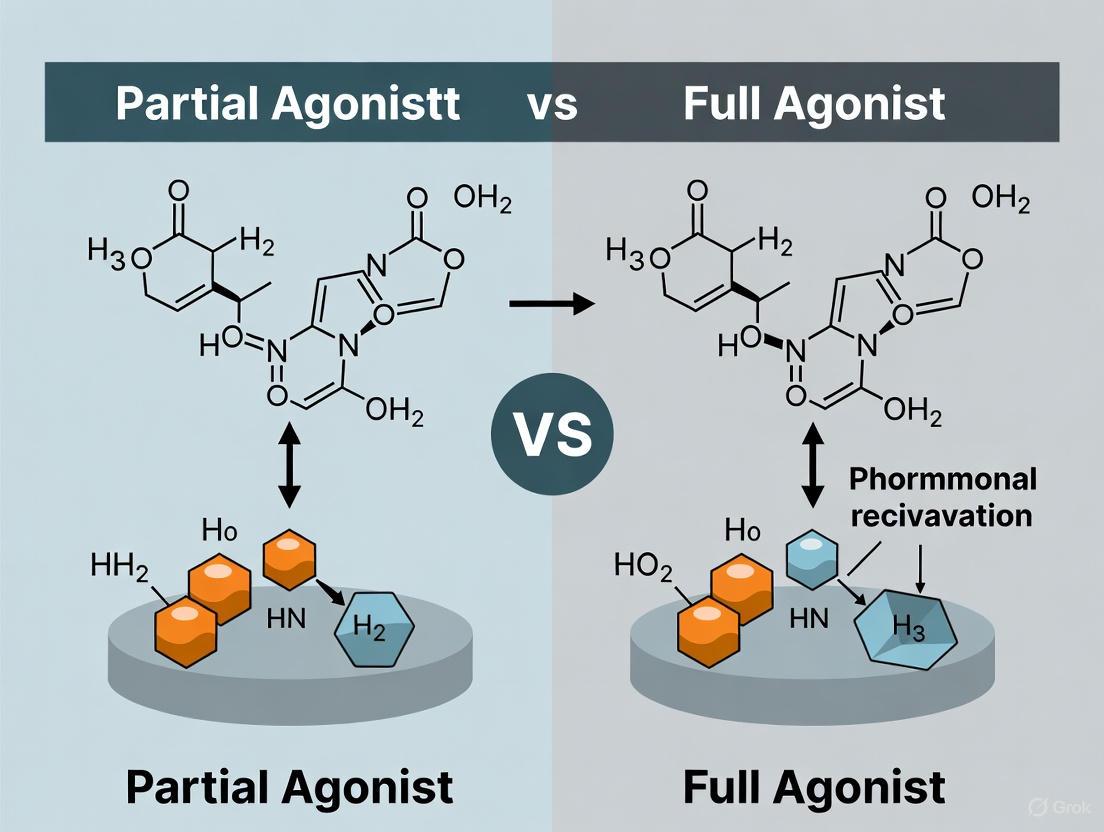
This article provides a detailed comparative analysis of partial and full agonists for researchers, scientists, and drug development professionals.
Partial Agonists vs. Full Agonists: A Comprehensive Guide to Efficacy, Mechanism, and Therapeutic Application
Abstract
This article provides a detailed comparative analysis of partial and full agonists for researchers, scientists, and drug development professionals. It covers the foundational pharmacodynamic principles of intrinsic efficacy and receptor occupancy, explores methodological approaches for characterizing agonist activity in assays and structural biology, and addresses key challenges in drug design such as managing ceiling effects and signaling bias. The content further validates these concepts through comparative case studies of established drugs and discusses the translational impact of partial agonists in developing safer therapeutics with improved side-effect profiles.
Agonist Fundamentals: Defining Efficacy, Potency, and Receptor Activation
Agonists represent a fundamental concept in pharmacology, referring to ligands that bind to a receptor and alter the receptor's state, resulting in a biological response [1]. This binding triggers a conformational change in the receptor protein, which is necessary to initiate intracellular signaling that culminates in a physiological effect [2]. The degree of response elicited by an agonist is not uniform; it depends on the drug's intrinsic efficacy, a dimensionless property that describes the effect the drug has on receptor activity once bound [3]. It is this variation in intrinsic efficacy that forms the basis for classifying agonists into different categories, primarily full agonists and partial agonists.
A Full Agonist is a drug that binds to a receptor and triggers the maximal biological response that the system is capable of producing [1] [4]. It is important to note that a full agonist can achieve this maximum effect without necessarily occupying all available receptors, a concept related to "spare receptors" [1] [2]. In contrast, a Partial Agonist is a drug that binds to and activates a given receptor but possesses lower intrinsic efficacy, resulting in only a partial activation of the receptor [5] [6]. Regardless of its concentration and even when occupying the entire receptor population, a partial agonist cannot elicit as large an effect as a full agonist acting on the same receptor system [1].
Table 1: Core Characteristics of Receptor Ligands
| Ligand Type | Intrinsic Efficacy | Maximum Biological Response | Key Behavioral Characteristic |
|---|---|---|---|
| Full Agonist | High | Maximum system response | Can produce maximal effect without full receptor occupancy [1] |
| Partial Agonist | Intermediate | Submaximal response | Acts as an antagonist in the presence of a full agonist [1] [5] |
| Antagonist | Zero | No response | Prevents agonist binding but produces no effect itself [2] |
| Inverse Agonist | Negative (Below zero) | Opposite effect to agonist | Reduces constitutive receptor activity [1] [3] |
Key Differences and Functional Consequences
The primary distinction between a full and a partial agonist lies in their maximal efficacy (Emax), which is the ceiling of the dose-response curve. A key functional consequence of this difference is that a partial agonist can act as a competitive antagonist in the presence of a full agonist [1] [5]. By occupying receptor sites, the partial agonist prevents the more efficacious full agonist from binding, thereby reducing the overall net response. The system's response in a mixture of a full and partial agonist will lie somewhere between the maximum effect of the full agonist and the maximum effect of the partial agonist alone [1].
This unique property grants partial agonists significant clinical utility. They can be employed to activate receptors to provide a desired submaximal response when inadequate amounts of the endogenous ligand are present. Conversely, they can also reduce the overstimulation of receptors when excess amounts of the endogenous ligand are present by competing with and displacing the full agonist [5]. This can result in a superior safety profile; for example, the partial µ-opioid receptor agonist buprenorphine produces analgesic effects but causes less respiratory depression than full agonists like morphine [2] [7].
Diagram 1: Agonist-Induced Receptor Activation. This diagram illustrates the conformational changes in a receptor induced by different agonist types. The full agonist stabilizes the active receptor state (R), while the partial agonist results in only partial activation. Some receptors exhibit constitutive activity (dotted line) even in the absence of a ligand [3].*
Quantitative Analysis and Spare Receptors
The concepts of full and partial agonism are quantitatively analyzed through dose-response curves. These curves reveal two key pharmacological properties: potency (often measured as EC50, the concentration producing 50% of the maximum effect) and efficacy (the maximum possible effect, Emax) [1]. For a full agonist, the Emax is the system's maximum. For a partial agonist, the Emax is submaximal, even at saturating concentrations.
A critical concept underlying these relationships is that of "spare receptors" or "receptor reserve." A system is said to have spare receptors if a full agonist can elicit the maximum response while occupying only a fraction of the total receptor population [1] [3]. This does not mean these receptors are superfluous; they increase the system's sensitivity. If some receptors are inactivated by an irreversible antagonist, a full agonist can still achieve the maximum response, but its potency is reduced (a higher concentration is required) [1].
Table 2: Quantitative Parameters of Agonist Activity
| Parameter | Definition | Interpretation for Full Agonist | Interpretation for Partial Agonist |
|---|---|---|---|
| EC₅₀ | Concentration producing 50% of maximal effect | Indicates potency; lower EC₅₀ = higher potency | Indicates binding affinity; lower EC₅₀ = higher affinity |
| E_max (Efficacy) | Maximum possible effect of the drug | Maximum system response (100%) | Submaximal system response (<100%) |
| Receptor Occupancy at E_max | Fraction of receptors occupied when E_max is achieved | Can be less than 100% (in systems with spare receptors) | Typically 100% (all receptors occupied at submaximal effect) |
Experimental Protocols for Characterization
Characterizing a compound as a full or partial agonist requires a systematic experimental approach to measure its functional response relative to a known standard.
Functional Dose-Response Assay
This primary methodology involves stimulating a cellular or tissue system expressing the target receptor with increasing concentrations of the test compound and a reference full agonist.
Detailed Protocol:
- System Preparation: Use a cell line (e.g., CHO, HEK-293) stably or transiently expressing the recombinant human target receptor. The choice of cell background is critical as it determines the signaling machinery [3].
- Response Measurement: The specific readout depends on the receptor class:
- For G Protein-Coupled Receptors (GPCRs): Measure intracellular secondary messengers. For Gαs-coupled receptors, monitor cAMP accumulation using a FRET-based or ELISA assay. For Gαq-coupled receptors, measure intracellular calcium flux using fluorescent dyes like Fura-2 or Fluo-4 in a fluorometric imaging plate reader (FLIPR) [3].
- For other receptors (e.g., ion channels), electrophysiological methods such as patch-clamping are employed.
- Agonist Application: Apply a range of concentrations (typically from picomolar to micromolar, in half-log or log increments) of the test compound and the reference full agonist to separate cell samples. Include a vehicle control to determine basal activity.
- Data Analysis: Plot the response against the logarithm of the agonist concentration. Fit the data using a four-parameter logistic (4PL) nonlinear regression model to generate sigmoidal dose-response curves. The model is defined by the equation: ( E = E{min} + \frac{(E{max} - E{min})}{1 + 10^{((LogEC{50} - X) * HillSlope)}} ), where E is the effect, X is the logarithm of concentration, and Emax is the maximal effect.
- Classification: Compare the Emax of the test compound to the Emax of the reference full agonist. A test compound with an Emax not statistically different from the reference is a full agonist. A compound with a significantly lower Emax is a partial agonist.
Schild Regression Analysis for Assessing Partial Agonism
This method is particularly useful for confirming that a partial agonist can antagonize the response of a full agonist, a key behavioral characteristic [1].
Detailed Protocol:
- Generate a control dose-response curve for the full agonist alone.
- Incubate the tissue or cell system with a fixed concentration of the partial agonist.
- Re-generate the dose-response curve for the full agonist in the presence of the partial agonist.
- Repeat step 3 with at least two different, higher concentrations of the partial agonist.
- Analyze the data by performing Schild regression. The dose-response curves of the full agonist will be shifted to the right in the presence of the partial agonist. Plotting log(dose ratio - 1) against the log of the partial agonist concentration should yield a linear regression. A slope not significantly different from unity confirms simple competitive antagonism, characteristic of a partial agonist.
Diagram 2: Experimental Workflow for Agonist Classification. This flowchart outlines the key steps in a functional assay to characterize an unknown compound as a full or partial agonist, based on the comparison of its maximal efficacy (Emax) to a reference standard.
The Scientist's Toolkit: Key Research Reagents
Successful characterization of agonists relies on a suite of specialized research reagents and tools.
Table 3: Essential Research Reagents for Agonist Studies
| Reagent / Material | Function in Agonist Research | Specific Examples |
|---|---|---|
| Clonal Cell Lines | Provides a consistent, recombinant system expressing the target receptor; allows for control of receptor density. | HEK-293, CHO cells transfected with human GPCRs or ligand-gated ion channels [3]. |
| Reference Agonists | Serves as a benchmark (full agonist) for comparison of efficacy and potency of test compounds. | Morphine (µ-opioid receptor), Serotonin (5-HT1A receptor), Isoprenaline (β2-adrenoceptor) [1] [7]. |
| Fluorescent Dyes / Kits | Enable measurement of intracellular second messengers as a quantitative readout of receptor activation. | Fura-2, Fluo-4 (for calcium mobilization); HTRF cAMP kits; IP-One ELISA kits (for IP₈ accumulation) [3]. |
| Irreversible Antagonists | Used to inactivate a fraction of receptors to probe for the existence of "spare receptors" in a system. | Phenoxybenzamine (for α-adrenoceptors); EEDQ [1]. |
| Signal Detection Instrumentation | Essential hardware for accurately measuring the functional response from the assay system. | Fluorometric Imaging Plate Reader (FLIPR); Plate reader for HTRF/ELISA; Electrophysiology rig for patch-clamping. |
Research Applications and Clinical Implications
The differentiation between full and partial agonists is not merely academic; it has profound implications for drug discovery and therapeutics. Partial agonists offer a unique stabilizing or buffering effect on physiological systems, making them valuable for treating conditions where a full agonist response is undesirable [5].
In psychiatry, aripiprazole is a partial agonist at dopamine D2 receptors. In states of high dopamine (positive symptoms of schizophrenia), it acts as an antagonist, while in states of low dopamine, it provides mild agonism, helping to avoid side effects like extrapyramidal symptoms associated with full antagonists [5]. Similarly, buspirone, a 5-HT1A receptor partial agonist, is used as an anxiolytic with a potentially improved side effect profile compared to benzodiazepines [8].
In pain management and addiction treatment, buprenorphine, a partial agonist at the µ-opioid receptor, provides effective analgesia with a ceiling effect on respiratory depression, reducing the risk of fatal overdose compared to full agonists like fentanyl or morphine [6] [7]. This property also makes it effective in opioid use disorder, as it can suppress withdrawal cravings without producing the same intense euphoria.
Research continues to explore novel applications. Recent systematic reviews investigate the use of 5-HT1A receptor partial agonists like tandospirone as augmentation therapy to improve cognitive function in patients with depressive disorders [8]. This highlights the ongoing relevance of understanding partial agonism for developing new treatment strategies for complex neuropsychiatric conditions.
Intrinsic efficacy is a fundamental pharmacological concept describing the inherent capacity of a drug-receptor complex to produce a functional biological response. This property is distinct from affinity and determines the maximal effect (Emax) an agonist can elicit, thereby serving as the principal differentiator between full and partial agonists. Within drug discovery, quantifying intrinsic efficacy is critical for predicting therapeutic potential and understanding ligand-specific receptor conformations that lead to diverse signaling outcomes. This whitepaper delineates the theoretical underpinnings of intrinsic efficacy, explores advanced experimental methodologies for its quantification, and contextualizes its indispensable role in the rational design of receptor-targeted therapeutics.
In pharmacology, an agonist is defined as a ligand that binds to a receptor and alters its state, resulting in a biological response [1]. The magnitude of this response is not solely determined by how tightly a drug binds to its receptor (affinity) but by the drug's ability to activate the receptor upon binding. This capability is encapsulated by two interrelated concepts: efficacy and intrinsic efficacy.
Efficacy, in a broad sense, refers to the ability of a drug to illicit a pharmacological response once it interacts with a receptor [9]. Intrinsic efficacy is a more precise term that describes the mechanistic property intrinsic to the ligand-receptor pair. It is the power of a drug to produce an effect per unit of receptor occupancy [10]. A drug with high intrinsic activity can fully activate a receptor, leading to a strong biological response, whereas a drug with low intrinsic activity may bind to the same receptors but produce only a partial response [11].
The concept of intrinsic efficacy is pivotal for classifying agonists. A full agonist is a substance that, upon binding, stabilizes the receptor in its active form, leading to the maximum possible biological response the system can produce [12] [1]. In contrast, a partial agonist also binds and activates the receptor but elicits a submaximal response, even when occupying the entire receptor population [12] [1] [9]. This difference in maximal response, or Emax, is a direct reflection of the compound's intrinsic efficacy.
Theoretical Foundations: Quantifying Agonist Activity
The Operational Model of Agonism
The action of an agonist is governed by its affinity for the receptor and its intrinsic efficacy. Affinity, quantified by the dissociation constant (Kd), is the concentration at which 50% of the receptors are occupied [13]. Intrinsic efficacy, often denoted as ε or e, determines the power of the agonist to activate the receptor post-binding.
The following table summarizes the key parameters used to characterize agonist activity:
| Parameter | Symbol | Definition | Experimental Derivation |
|---|---|---|---|
| Potency | EC~50~ | The concentration of a drug required to produce 50% of that drug’s maximal effect [14]. | Calculated from the graded dose-response curve. |
| Maximal Efficacy | E~max~ | The maximum effect which can be expected from a drug; the system's maximal response capability [14]. | The maximal asymptote of a concentration-response curve [15]. |
| Intrinsic Activity | α | The maximal agonist effect expressed as a fraction of the effect produced by a full agonist under the same conditions [14] [15]. | α = E~max~ (Drug) / E~max~ (Full Agonist). Ranges from 0 (antagonists) to 1 (full agonists) [15]. |
| Affinity | K~d~ | The concentration of a drug at which 50% of the available receptors are occupied; a measure of binding firmness [13]. | Determined from radioligand binding or functional assays. |
Differentiating Full and Partial Agonists
The central difference between a full and a partial agonist lies in their respective intrinsic efficacies. A full agonist possesses high intrinsic efficacy, allowing it to produce the system's maximal response, sometimes without even occupying all receptors (a phenomenon known as "spare receptors") [1]. A partial agonist has lower intrinsic efficacy; even at 100% receptor occupancy, it cannot activate the receptor population sufficiently to elicit the system's maximum response [1] [9].
This relationship is not merely a matter of amplitude but of ligand-specific receptor conformations. Research on G protein-coupled receptors (GPCRs) suggests that full and partial agonists stabilize distinct active receptor states, which in turn differentially engage downstream signaling proteins [16]. This molecular understanding moves beyond the classical "on/off" switch model to a more nuanced "multi-state" model of receptor activation.
Experimental Protocols for Measuring Intrinsic Efficacy
Quantifying intrinsic efficacy requires systems that can dissect receptor activation from the confounding variables of signal amplification and tissue-specific factors.
The GPCR-Gα Fusion Protein System
A robust methodology for analyzing ligand-receptor interactions involves the use of GPCR-Gα fusion proteins expressed in Sf9 insect cell membranes [16].
Detailed Methodology:
- Construct Preparation: Create fusion genes where the C-terminus of the target GPCR (e.g., wild-type β~2~-adrenergic receptor or a constitutively active mutant, β~2~ARCAM) is linked directly to the N-terminus of the Gα subunit (e.g., Gsα). This ensures a fixed 1:1 stoichiometry, eliminating variability from differing receptor/G protein ratios in native systems [16].
- Membrane Preparation: Infect Sf9 cells with baculoviruses containing the fusion constructs. Harvest cells and isolate plasma membranes via differential centrifugation. Determine receptor expression levels (pmol/mg) using radioligand binding assays [16].
- Functional Assays:
- GTPase Assay: Measure the rate of GTP hydrolysis to GDP, a direct indicator of G protein activation. Incubate membranes with various concentrations of the test agonist and [γ-~32~P]GTP. Terminate the reaction and quantify the released ~32~P~i~. Plot the GTPase activity against the agonist concentration to generate a dose-response curve [16].
- Ternary Complex Stabilization: Assess the formation of the agonist-receptor-G protein complex. This can be evaluated by observing the enhancement of agonist binding affinity in the presence of stable GTP analogues (like Gpp(NH)p), which is a hallmark of ternary complex formation [16].
- Data Analysis: The E~max~ values from the GTPase dose-response curves for various ligands provide a system-independent measure of relative intrinsic efficacy. In this fused system, a partial agonist will show a lower E~max~ in GTP hydrolysis compared to a full agonist, directly reflecting its lower capacity to activate the coupled G protein [16].
Extended Concentration-Response Curves
A significant challenge in differentiating between high-efficacy full agonists is the "tissue maximum" ceiling effect. An advanced technique to overcome this involves constructing extended concentration-response curves.
Detailed Methodology:
- Tissue Preparation: Mount a tissue (e.g., tracheal ring for relaxant response) in an organ bath.
- Functional Antagonism: After establishing a control concentration-response curve to a full agonist (which causes full tissue relaxation), add a contracting agent (e.g., a muscarinic agonist) via a separate signaling pathway. This alters the tissue's baseline state, moving it away from its physiological maximum [15].
- Cumulative Dosing: While maintaining the altered tissue state, apply cumulative increments of the relaxant agonist.
- Response Measurement: The "response" for each agonist concentration increment is defined as the change from the tissue state immediately prior to the addition. These incremental responses are cumulated to construct an "extended" concentration-response curve that bypasses the conventional tissue maximum, allowing for finer discrimination of efficacy between potent full agonists [15].
The Scientist's Toolkit: Essential Research Reagents
The following table details key reagents and their functions in experiments designed to probe intrinsic efficacy, particularly in GPCR systems.
| Research Reagent | Function/Application |
|---|---|
| GPCR-Gα Fusion Protein (e.g., β~2~ARGsα) | Ensures a defined 1:1 receptor-G protein stoichiometry; eliminates bias from variable expression levels; ideal for quantifying ligand efficacy [16]. |
| Sf9 Insect Cell Line | A baculovirus expression system capable of producing high levels of recombinant membrane proteins, including GPCR-G protein fusions [16]. |
| [γ-~32~P]GTP | Radiolabeled substrate for GTPase assays; hydrolysis to GDP and ~32~P~i~ provides a direct, quantitative measure of G protein activation [16]. |
| Gpp(NH)p | A non-hydrolyzable GTP analogue; used to probe the stability of the agonist-receptor-G protein (ternary) complex by assessing its effect on agonist binding affinity [16]. |
| Constitutively Active Receptor Mutant (CAM) | A receptor mutant that exhibits basal activity in the absence of an agonist; used to study inverse agonism and to amplify the signal from low-efficacy partial agonists [16]. |
| Functional Antagonists (e.g., Carbachol) | Agents acting via a separate pathway to alter the baseline state of a tissue; used in extended concentration-response experiments to discriminate between high-efficacy agonists [15]. |
Signaling Pathways and Experimental Workflows
The following diagrams, generated using Graphviz DOT language, illustrate the core concepts and experimental workflows discussed in this whitepaper.
Ligand-Directed Receptor Signaling
This diagram contrasts the signaling outcomes of full and partial agonists, highlighting how different ligand-specific receptor conformations lead to varying levels of pathway activation and functional response.
GPCR-Gα Fusion Protein Assay
This diagram outlines the experimental workflow for measuring intrinsic efficacy using the GPCR-Gα fusion protein system and a GTPase assay, a key method for direct quantification.
Implications for Drug Development and Research
The precise characterization of intrinsic efficacy has profound implications for pharmaceutical research and therapeutic strategy. In the development of drugs for opioid use disorder, buprenorphine, a partial agonist at the mu-opioid receptor, is strategically employed. Its lower intrinsic efficacy compared to full agonists like morphine or fentanyl results in a ceiling effect for both analgesia and respiratory depression, conferring a superior safety profile and reduced abuse potential [7]. Furthermore, the concept of biased agonism—where ligands stabilize unique receptor conformations that preferentially activate specific signaling pathways—is a frontier in drug discovery [9]. Understanding intrinsic efficacy at the level of pathway-specific signaling (e.g., G protein vs. β-arrestin recruitment) allows for the design of "biased" ligands that may offer therapeutic efficacy with minimized adverse effects [9].
Intrinsic efficacy is the fundamental molecular determinant that dictates the maximal response a drug can elicit from a biological system. It is the critical parameter distinguishing full agonists from partial agonists and provides a framework for understanding ligand-specific receptor states. While classical methods using E~max~ from tissue-based assays provide a practical index of efficacy, advanced reductionist systems like GPCR-Gα fusion proteins offer more direct and precise quantification. As drug discovery moves towards targeting specific receptor conformations and signaling pathways, a deep and nuanced understanding of intrinsic efficacy will remain indispensable for the rational design of safer, more effective, and pathway-selective therapeutics.
In quantitative pharmacology, the relationship between receptor occupancy and the resulting biological response is fundamental, yet often complex and non-linear. A common assumption is that occupying all available receptors with an agonist will invariably produce the system's maximal response. However, a central tenet of modern pharmacology is that full receptor binding does not guarantee a maximal effect [1]. This phenomenon is primarily explained by the distinct concepts of affinity (a drug's ability to bind to a receptor) and intrinsic efficacy (a drug's ability, once bound, to activate the receptor and produce a cellular response) [3]. The interplay between these properties, combined with system-specific factors like signal amplification and constitutive activity, explains why ligands can be categorized as full agonists, partial agonists, or inverse agonists, each with profound implications for drug development and therapeutic research [1] [3].
Core Pharmacological Concepts: Agonists, Efficacy, and Signal Amplification
Defining Agonist Types
- Full Agonist: A ligand that binds to a receptor and produces the maximal response capability of the biological system. This can often occur at sub-maximal receptor occupancy, a phenomenon known as "receptor reserve" or "spare receptors" [1] [3].
- Partial Agonist: A ligand that, even when occupying all available receptors, cannot elicit the system's maximal response. Its intrinsic efficacy is lower than that of a full agonist. In the presence of a full agonist, a partial agonist will act as a functional antagonist by competing for receptor binding sites [1].
- Inverse Agonist: A ligand that reduces the fraction of receptors in an active conformation by preferentially binding to and stabilizing the inactive state. This produces an effect opposite to that of an agonist in systems where the receptor exhibits constitutive (basal) activity in the absence of a ligand [1] [3].
The Critical Role of Intrinsic Efficacy and Signal Amplification
The disconnect between occupancy and response arises from several key mechanisms:
- Intrinsic Efficacy (ε): This is a dimensionless, system-independent property of the ligand-receptor pair that quantifies the ligand's ability to change the receptor's state to an active conformation [3]. A full agonist has high intrinsic efficacy, while a partial agonist has lower intrinsic efficacy.
- Signal Amplification (γ): Biological systems often contain signaling cascades that amplify the initial signal from an activated receptor. This means that activation of a small fraction of receptors can be sufficient to produce a full system response, creating the appearance of "spare receptors" [17] [18]. The SABRE quantitative receptor model explicitly includes an amplification parameter (γ) to account for this. When γ > 1, the response curve is left-shifted relative to the occupancy curve (i.e., the EC₅₀ is less than the Kd) [17].
- Constitutive Activity: Some receptor systems are naturally active in the absence of any agonist. This baseline activity arises from receptors spontaneously adopting an active conformation, and it can be modulated by inverse agonists [3].
The following diagram illustrates how these factors determine the cellular response.
Quantitative Analysis: Modeling the Occupancy-Response Relationship
The SABRE Receptor Model
Advanced quantitative models like the SABRE (Single Assay-Binding and Response) model provide a unified framework to fit complex occupancy-response data [17] [18]. The model uses key parameters to describe the system:
- Kd: Equilibrium dissociation constant, representing binding affinity.
- ε: Intrinsic efficacy of the ligand.
- γ: Signal amplification factor of the pathway.
- n: Hill coefficient, representing steepness of the response.
Within this framework, and assuming no constitutive activity, the fractional response (f_resp) is given by:
Consequently, the observed half-maximal effective concentration (K_obs or EC₅₀) is:
This equation highlights that the potency (EC₅₀) depends not only on binding affinity (Kd) but also critically on ligand efficacy (ε) and system amplification (γ) [18]. When signal amplification is high (γ >> 1), the EC₅₀ will be much lower than the Kd, meaning a response occurs at very low levels of receptor occupancy.
Comparative Data: Agonist Profiles and System Dependence
The table below summarizes how different types of agonists interact with receptors and the resulting effects, illustrating the core thesis that binding and effect are separable.
Table 1: Characteristics of Different Agonist Types and Their Relationship to Receptor Occupancy
| Agonist Type | Receptor Binding (Affinity) | Intrinsic Efficacy | Maximum System Response | Effect in Presence of Full Agonist |
|---|---|---|---|---|
| Full Agonist | High | High | 100% (Full Response) | N/A (Is the reference agonist) |
| Partial Agonist | High | Low | <100% (Submaximal Response) | Acts as a functional antagonist [1] |
| Inverse Agonist | High | Negative (Reduces R*) | Suppresses Basal (Constitutive) Activity | Reduces effect of constitutive activity, opposes full agonists [3] |
The next table provides quantitative examples from research, showing how the same drug can produce different response curves depending on the measured pathway, a phenomenon known as functional selectivity or biased agonism.
Table 2: Experimentally Determined Parameters for μ-Opioid Receptor (MOPr) Agonists in Different Signaling Pathways [17]
| Agonist | Measured Pathway | Reported Kd (nM) | Reported EC₅₀ (nM) | Shift (κ = Kd/EC₅₀) | Interpretation |
|---|---|---|---|---|---|
| DAMGO | G protein activation (Gprt) | ~2.5 | ~0.8 | κ > 1 (Left-shift) | Signal amplification (γ > 1); response requires low occupancy. |
| DAMGO | β-arrestin2 recruitment (βArr) | ~2.5 | ~12.0 | κ < 1 (Right-shift) | Apparent signal attenuation (γ < 1); response requires high occupancy. |
| Morphine | G protein activation (Gprt) | ~5.0 | ~3.0 | κ ≈ 1 | Occupancy and response curves are closely aligned. |
| Morphine | β-arrestin2 recruitment (βArr) | ~5.0 | ~45.0 | κ < 1 (Right-shift) | Apparent signal attenuation (γ < 1); weak response in this pathway. |
Experimental Protocols: Quantifying Occupancy and Response
The Furchgott Method for Estimating Kd from Response Data
A classic experimental approach to dissect binding from response is Furchgott's method of partial irreversible receptor inactivation [18]. This protocol allows for the estimation of the dissociation constant (Kd) using only functional response data, without the need for direct binding assays with labeled ligands.
Table 3: Research Reagent Solutions for the Furchgott Method
| Reagent / Material | Function in the Protocol |
|---|---|
| Isolated Tissue or Cell Culture | Provides the biological system containing the target receptor (e.g., rabbit myocardium for muscarinic receptors) [18]. |
| Irreversible Antagonist (e.g., Phenoxybenzamine) | Covalently binds to and permanently inactivates a fraction of the receptor population, reducing total receptor density [18]. |
| Test Agonist | The drug whose binding affinity (Kd) and efficacy are being characterized. |
| Organ Bath or Cell-Based Assay System | Allows for the precise application of drug concentrations and measurement of the resulting biological response (e.g., muscle contraction, cAMP levels). |
Detailed Methodology:
- Generate a Control Concentration-Response Curve (CRC): A full concentration-response curve for the test agonist is established in the native tissue or cells, providing E_max and EC₅₀ values for the system with a full complement of receptors [18].
- Partial Irreversible Receptor Inactivation: The tissue or cells are treated with a concentration of an irreversible antagonist that inactivates a known fraction (q) of the total receptor pool. The value of q is determined in separate binding experiments (q = [remaining receptors] / [total original receptors]) [18].
- Generate a Post-Treatment CRC: After washing, a second concentration-response curve for the same test agonist is generated in the receptor-depleted system, yielding new parameters (E'_max and EC'₅₀).
- Data Analysis and Kd Calculation: The dissociation constant (Kd) of the agonist can be calculated using the following equation, which is derived from the comparison of the two curves and is more robust than the original double-reciprocal method proposed by Furchgott [18]:
Investigating Biased Signaling in Divergent Pathways
Modern drug discovery often focuses on engineered ligands that selectively activate therapeutic pathways over those leading to side effects. The following workflow is typical for characterizing such "biased agonists" at a target like the μ-opioid receptor, where G protein signaling is thought to mediate analgesia while β-arrestin recruitment is linked to respiratory depression and constipation [17].
Implications for Drug Discovery and Therapeutic Research
Understanding the distinction between receptor occupancy and activation, and the role of partial agonism, is critical in modern pharmacology.
- Therapeutic Targeting of Partial Agonists: Partial agonists can be valuable therapeutics when an intermediate level of response is desired, or when they need to act as "brakes" in the presence of a full endogenous agonist. A prime example is buprenorphine, a partial agonist at the μ-opioid receptor used in treating pain and opioid use disorder. It provides sufficient analgesia while having a ceiling effect on respiratory depression, enhancing its safety profile compared to full agonists like morphine [1] [3].
- Functional Selectivity and Biased Agonism: The concept that a drug can have multiple intrinsic efficacies depending on the downstream pathway measured is known as functional selectivity or biased agonism [3]. This is powerfully illustrated by the data in Table 2, where DAMGO and morphine show different relative potencies in G protein versus β-arrestin pathways. This paradigm shift means a drug can be simultaneously an agonist for one pathway and an antagonist or inverse agonist for another pathway of the same receptor, opening new avenues for designing safer, more targeted drugs [17] [3].
- Interpreting Receptor Occupancy in Clinical Studies: In clinical development, measuring target engagement through receptor occupancy (RO) assays is common. However, as the SABRE model and other frameworks show, high RO is neither necessary nor sufficient for a strong biological response. The interpretation of RO data can be confounded by assay format, signal amplification, and the intrinsic efficacy of the therapeutic agent, as was the case with the PD-1 inhibitor nivolumab [19].
The Concept of Spare Receptors and Its Impact on Agonist Potency
The concept of spare receptors, also known as receptor reserve, describes a phenomenon in which a maximal biological response is elicited when an agonist occupies only a fraction of the total receptor population in a system [20] [1] [21]. This fundamental pharmacological principle has profound implications for understanding agonist potency, signal amplification, and the functional differences between full and partial agonists [20] [22]. The presence of spare receptors means that the concentration of an agonist required to produce 50% of the maximal effect (EC₅₀) is often much lower than the concentration needed to occupy 50% of the receptors (Kd) [21] [23]. This review provides a comprehensive technical examination of spare receptors, their experimental quantification, and their critical role in contemporary drug discovery, with particular emphasis on differentiating partial and full agonist profiles.
Fundamental Agonist Classes
In pharmacological systems, ligands interacting with receptors can be classified based on their intrinsic efficacy and the resulting biological response:
- Full Agonists: Ligands that produce the maximal response capability of the system [1]. High-efficacy full agonists often require occupancy of only a small receptor fraction to achieve this maximum response [20] [3].
- Partial Agonists: Ligands that, even at full receptor occupancy, cannot elicit the maximal response achievable by a full agonist acting through the same receptors in the same tissue [1]. Their maximal efficacy is inherently lower.
- Inverse Agonists: Ligands that reduce the fraction of receptors in an active conformation, thereby producing effects opposite to those of agonists in systems with constitutive receptor activity [1] [3].
The Spare Receptor Concept
The spare receptor phenomenon arises from signal amplification within the cellular signaling cascade [20]. A single agonist-receptor complex can activate multiple downstream effector molecules, and activated effectors can continue signaling even after the agonist-receptor complex has dissociated [23]. This amplification means that not all available receptors need to be occupied to generate a maximal cellular response. The remaining unoccupied receptors are termed "spare" [21].
This receptor reserve is not merely a numerical excess but results from kinetic amplification that increases as the signal propagates through the cascade [20]. The degree of spare receptors is both agonist-dependent and tissue-dependent, varying with the biological output measured and exhibiting strong brain-regional variations even for a single GPCR activating a single second messenger cascade [20].
Quantitative Analysis of Spare Receptors
Relationship Between Occupancy and Response
The presence of spare receptors fundamentally alters the relationship between receptor occupancy and functional response. In systems with significant receptor reserve, the dose-response curve for a full agonist is characteristically left-shifted relative to the occupancy curve [20]. This translates to higher potency, with the EC₅₀ occurring at a much lower concentration than the Kd [21] [23].
The Operational Model of receptor function provides a mathematical framework to quantify this relationship, where the parameter τ (tau) represents a composite measure of agonist efficacy in a particular tissue [22]. This can be further broken down to describe the influence of intrinsic efficacy (Kᴇ) and receptor concentration ([Rₜ]) according to the equation: τ = [Rₜ]/Kᴇ [22].
Experimental Measurement Techniques
Irreversible Receptor Inactivation
The classical method for quantifying receptor reserve involves using irreversible antagonists or alkylating agents to progressively reduce the total receptor population [20] [22]. The Furchgott analysis method then compares equiactive agonist concentrations before and after receptor inactivation to determine agonist affinity and efficacy [24].
Protocol for Irreversible Receptor Inactivation:
- Treat tissue or cell preparation with an irreversible antagonist such as N-ethoxycarbonyl-2-ethoxy-1,2-dihydroquinoline (EEDQ) or other alkylating agents [20].
- Generate concentration-response curves for the test agonist before and after irreversible receptor inactivation.
- Apply Furchgott analysis to compare equiactive agonist concentrations from the intact and inactivated preparations [24].
- Calculate agonist affinity (Kd) and determine the fraction of receptors required to produce a given response.
This method has been successfully applied to characterize receptor reserve for serotonin, dopamine, and alpha-2 adrenergic receptors, revealing higher reserve for presynaptic autoreceptors compared to postsynaptic receptors [20].
System-Independent Agonist Evaluation
For assays monitoring receptor-proximal events (G protein recruitment, β-arrestin recruitment, GTP exchange), the concept of receptor reserve is less applicable as these early events minimize signal amplification [20]. Comparing results from receptor-proximal assays with those from more distal second-messenger assays (cAMP, Ca²⁺, MAPK-based) can reveal the extent of signal amplification in a system [20].
A proposed test for system amplification involves comparing a high-efficacy agonist (e.g., DAMGO for opioid receptors) with a well-established partial agonist (e.g., morphine) [20]. If the assay fails to identify the partial agonist as having lower efficacy, it suggests the assay is not sensitive to efficacy differences across that range.
Table 1: Experimentally Determined Receptor Reserve Across Biological Systems
| Receptor Type | Tissue/Cell Type | Agonist | Occupancy for Maximal Response | Biological Response Measured |
|---|---|---|---|---|
| D2 dopamine | Presynaptic autoreceptor | N-propylnorapomorphine | 24-30% | Inhibition of dopamine cell firing [20] |
| D2 dopamine | Presynaptic autoreceptor | NPA | 30% | Control of dopamine synthesis [20] |
| D2 dopamine | Postsynaptic | NPA | ~100% | Striatal acetylcholine levels [20] |
| Insulin | Various cell types | Insulin | ~1% | Glucose uptake [23] |
| β-adrenoceptor | Cardiomyocytes | Catecholamines | <10% | Cardiac effects [21] |
| Luteinizing hormone | Leydig cells | LH | 1% | Steroidogenesis [21] |
| β₂-adrenoceptor | Airway smooth muscle | Formoterol | Low occupancy | Bronchodilation [22] |
Table 2: Key Reagent Solutions for Spare Receptor Research
| Research Reagent | Application/Function | Example Specific Agents |
|---|---|---|
| Irreversible Antagonists | Receptor alkylation to reduce available receptor population | EEDQ, phenoxybenzamine [20] |
| High-Efficacy Agonists | Reference full agonists for system comparison | DAMGO (opioid), formoterol (β₂-adrenoceptor) [20] [22] |
| Well-Characterized Partial Agonists | Efficacy comparison standards | Morphine (opioid), salmeterol (β₂-adrenoceptor) [20] [22] |
| GTPγ[³⁵S] | Measurement of G-protein activation | Receptor-proximal signaling assessment [20] |
| cAMP Assay Systems | Second-messenger measurement | Downstream signal amplification quantification [20] |
| β-arrestin Recruitment Assays | Alternative signaling pathway assessment | BRET/FRET, PathHunter systems [20] |
Impact on Agonist Potency and Implications for Partial Agonists
Differential Effects on Agonist Classes
The presence of spare receptors has distinct consequences for different agonist classes:
- Full Agonists: Benefit significantly from spare receptors, demonstrating left-shifted concentration-response curves and increased potency [20]. In systems with high receptor reserve, full agonists may produce maximal responses at very low fractional occupancies (sometimes <1%) [20] [23].
- Partial Agonists: Exhibit limited ability to exploit spare receptors due to their lower intrinsic efficacy [22]. They require higher receptor occupancy to achieve their submaximal responses and are more sensitive to reductions in receptor number [22].
This differential effect creates a therapeutic window where partial agonists may act as functional antagonists in the presence of full agonists, competing for receptor binding while producing diminished responses [1].
Functional Consequences in Drug Action
The clinical implications of spare receptors are substantial. In the β₂-adrenoceptor system, the high-efficacy agonist formoterol and lower-efficacy partial agonist salmeterol demonstrate different desensitization profiles influenced by their interaction with the receptor reserve [22]. Modeling studies show that high-efficacy agonists can tolerate up to 90% receptor loss before effects on maximal response are observed, whereas partial agonists show immediate reduction in maximal response with receptor loss [22].
In neuronal systems, the differential receptor reserve between pre- and postsynaptic receptors results in higher potency of dopaminergic and serotonergic agonists at presynaptic receptors, contributing to their complex pharmacological profiles [20].
Diagram 1: Impact of Receptor Reserve on Full vs. Partial Agonist Responses. Systems with high receptor reserve allow full agonists to achieve maximal responses at low occupancy, while partial agonists produce submaximal responses regardless of reserve. In low-reserve systems, even full agonists require high occupancy for maximal effect.
Methodological Framework for Investigating Spare Receptors
Experimental Design Considerations
When designing experiments to evaluate spare receptors and agonist efficacy, several critical factors must be addressed:
System Selection:
- Native tissues often preserve physiological receptor densities and coupling efficiencies but may present experimental complexity [20].
- Recombinant systems with controlled receptor expression levels enable systematic evaluation but may not fully replicate native environments [22].
- Endpoint selection is crucial, as receptor-proximal assays minimize amplification while downstream second-messenger assays enhance it [20].
Protocol for Evaluating Agonist Efficacy and Receptor Reserve:
- Characterize agonist concentration-response relationships in the target system using appropriate functional assays.
- Determine agonist binding affinity (Kd) through saturation or competition binding studies.
- Apply irreversible receptor inactivation to progressively reduce receptor density.
- Compare concentration-response curves before and after inactivation using Furchgott analysis [24].
- Calculate operational parameters including efficacy (τ) and the relationship between EC₅₀ and Kd.
- Validate in multiple assay formats comparing receptor-proximal and distal signaling endpoints.
Data Interpretation Guidelines:
- A significant leftward shift of the functional response curve relative to the binding curve indicates spare receptors.
- The ratio Kd/EC₅₀ > 1 suggests the presence of spare receptors [21] [23].
- Comparison of high- and low-efficacy agonists in the same system reveals the impact of intrinsic efficacy on reserve utilization.
Diagram 2: Experimental Workflow for Quantifying Spare Receptors. The systematic approach involves comparing agonist response curves before and after irreversible receptor inactivation to determine the relationship between receptor occupancy and functional response.
Advanced Quantitative Approaches
Contemporary pharmacology employs sophisticated modeling techniques to quantify spare receptors and agonist efficacy:
Operational Model Analysis: Global curve fitting of concentration-response data using the Operational Model allows determination of all affinity and efficacy parameters, enabling quantitative comparison of agonists across different systems [24].
Equi-Response and Equi-Occupancy Selectivity: Advanced quantitative measures calculate selectivity based on equal response or occupancy conditions, providing a panoramic comparison of agonist and modulator properties [24]. This approach enables more accurate prediction of in vivo efficacy and safety margins.
Research Implications and Therapeutic Applications
Implications for Drug Discovery and Development
The spare receptor concept has significant ramifications for pharmaceutical research:
Target Validation and Compound Screening:
- Understanding receptor density and coupling efficiency in target tissues informs screening strategy design [20].
- Compounds may be prioritized based on their ability to exploit receptor reserve in therapeutically relevant systems [22].
Therapeutic Differentiation:
- The differential interaction of full and partial agonists with spare receptors creates opportunities for tissue-selective effects [20].
- In β₂-adrenoceptor therapeutics, the high receptor reserve in airway smooth muscle contributes to the preserved bronchodilator response despite desensitization mechanisms [22].
Safety Margin Prediction:
- The relationship between target site free drug concentrations, endogenous agonist tones, and receptor reserve parameters may help predict in vivo efficacy and safety margins [24].
Context Within Partial vs. Full Agonist Research
Framed within broader research on partial versus full agonists, the spare receptor concept provides a mechanistic foundation for understanding fundamental efficacy differences:
Efficacy-Activity Relationships: The presence of spare receptors explains why efficacy differences between agonists are magnified in systems with high amplification capacity [20]. This amplification means that small differences in intrinsic efficacy can produce substantial differences in functional response.
Tissue-Selective Agonism: The tissue-specific nature of receptor reserve (e.g., high reserve in presynaptic autoreceptors versus low reserve in postsynaptic receptors) enables the potential development of agonists with selective actions in different tissues [20].
Therapeutic Window Optimization: Understanding how partial and full agonists differentially engage spare receptors informs rational drug design aimed at maximizing therapeutic effects while minimizing adverse reactions [22].
The concept of spare receptors represents a cornerstone of modern pharmacology with profound implications for understanding agonist potency and efficacy. The differential utilization of receptor reserve by full and partial agonists provides a mechanistic basis for their distinct pharmacological profiles and therapeutic applications. Advanced experimental approaches and quantitative modeling techniques continue to refine our understanding of this phenomenon, enabling more predictive pharmacology and optimized therapeutic interventions. As drug discovery evolves toward targeting specific signaling pathways and tissue contexts, comprehensive understanding of spare receptors and their impact on agonist potency remains essential for rational drug design and therapeutic optimization.
Partial agonists are ligands that bind to and activate a receptor but produce only a submaximal biological response compared to a full agonist, even when occupying all available receptors [1]. This fundamental property distinguishes them from full agonists, which can elicit the maximum response capability of a biological system, and antagonists, which bind to receptors without activating them [1] [3]. The dual nature of partial agonists—exhibiting both agonist and antagonist properties—represents a pivotal concept in receptor pharmacology with significant implications for drug development.
The study of partial agonists challenges traditional receptor theory and provides critical insights into the complex relationship between drug structure and functional response. Unlike full agonists that typically drive maximal system activation, partial agonists demonstrate context-dependent activity that varies based on the presence and concentration of endogenous ligands [25]. This unique characteristic enables partial agonists to function as system stabilizers, enhancing receptor activity when endogenous ligand levels are low while inhibiting excessive activation when endogenous ligand levels are high [25]. The investigation of partial agonism has revealed sophisticated mechanisms of receptor regulation that extend beyond simple occupancy-based models, advancing our understanding of functional selectivity and ligand-biased signaling in pharmacological research [3] [26].
Mechanistic Basis of Partial Agonism
Fundamental Mechanisms of Partial Agonist Action
The functional behavior of partial agonists stems from their reduced intrinsic efficacy—a drug property that describes its ability to change receptor activity upon binding [1] [3]. While a full agonist efficiently stabilizes receptor conformations that readily couple with intracellular signaling systems, a partial agonist induces a suboptimal active state with less efficient signaling output [1]. This mechanistic difference explains why partial agonists cannot achieve the maximal response capability of a biological system, even at full receptor occupancy [1].
At the molecular level, partial agonists may produce distinct structural changes in receptors compared to full agonists. For instance, research on ion channels demonstrates that partial agonists might cause incomplete channel opening with reduced ionic conductance compared to full agonists [1]. In G protein-coupled receptors (GPCRs), partial agonists often induce unique receptor conformations that differentially engage intracellular signaling partners, resulting in biased signaling profiles where certain pathways are preferentially activated over others [27] [26]. This structural basis for partial agonism represents a significant advancement beyond classical receptor theory, which primarily considered efficacy as a single-dimensional property.
The Agonist-Antagonist Spectrum and Functional Antagonism
The dual functionality of partial agonists becomes particularly evident when they compete with full agonists for receptor binding. In the presence of a full agonist, a partial agonist acts as a competitive antagonist, reducing the overall response by occupying receptors that would otherwise be activated by the full agonist [1] [5]. This phenomenon, known as functional antagonism, occurs because receptors bound by partial agonists contribute less to the total system response than those bound by full agonists.
Table 1: Comparative Properties of Receptor Ligands
| Ligand Type | Receptor Binding | Intrinsic Efficacy | Maximum Response | Effect in Presence of Full Agonist |
|---|---|---|---|---|
| Full Agonist | Yes | High (≈100%) | Maximum system response | Reference standard |
| Partial Agonist | Yes | Intermediate (<100%) | Submaximal response | Reduces overall response (functional antagonist) |
| Antagonist | Yes | None (0%) | No response | Blocks agonist action without effect |
| Inverse Agonist | Yes | Negative (<0%) | Reduces basal activity | Reduces constitutive activity |
This spectrum of activity creates a therapeutic window where partial agonists can modulate physiological systems with potentially greater safety margins than full agonists. The functional antagonism exhibited by partial agonists provides a built-in safety mechanism that prevents excessive system activation, making them particularly valuable for targets where overstimulation could produce adverse effects [28] [25].
Experimental Characterization of Partial Agonists
Key Methodologies for Assessing Partial Agonism
The experimental characterization of partial agonists requires multidisciplinary approaches that quantify both binding properties and functional outcomes. Standard pharmacological assessments include:
Dose-Response Analysis: Concentration-response curves are fundamental for classifying partial agonists. These experiments measure the relationship between ligand concentration and biological effect, revealing the maximal efficacy (Emax) and potency (EC50) parameters that distinguish partial from full agonists [1] [25]. For accurate characterization, agonists must be tested at saturating concentrations that achieve full receptor occupancy to confirm the submaximal nature of the response [27].
Receptor Occupancy Studies: These investigations examine the relationship between receptor occupancy and functional output. Partial agonists typically require full receptor occupancy to produce their maximal effect, unlike full agonists that may activate "spare receptors"—situations where a maximal response can be achieved while occupying only a fraction of the total receptor population [1].
Competition Experiments: Testing partial agonists in combination with full agonists reveals their functional antagonist properties. The characteristic rightward shift and depression of the maximal response in the full agonist's dose-response curve provides evidence of partial agonism [1].
Advanced Techniques for Mechanistic Insights
Contemporary research employs sophisticated biophysical and structural biology techniques to elucidate the molecular basis of partial agonism:
Quantitative Mass Spectrometry: This approach enables precise mapping of receptor modifications in response to different ligands. A landmark study on μ-opioid receptors used stable isotope labeling with amino acids in cell culture (SILAC) and quantitative mass spectrometry to demonstrate that the partial agonist morphine promotes markedly disproportional production of multi-site phosphorylated receptor forms compared to the full agonist DAMGO [27]. This revealed that partial and full agonists produce qualitatively similar but quantitatively distinct phosphorylation patterns, with partial agonists generating fewer phosphorylation events at specific Ser/Thr motifs critical for efficient β-arrestin recruitment and subsequent receptor endocytosis [27].
Table 2: Research Reagent Solutions for Partial Agonism Studies
| Research Tool | Application | Key Function | Example |
|---|---|---|---|
| SILAC Labeling | Quantitative proteomics | Enables precise comparison of protein modifications across conditions | Identification of differential receptor phosphorylation patterns [27] |
| Cryo-EM | Structural biology | Resolves high-resolution structures of ligand-receptor complexes | Visualization of partial agonist-bound receptor conformations [29] |
| Nanodisc/SMA | Membrane protein studies | Provides native-like lipid environment for structural studies | Preservation of physiological receptor conformations [29] |
| Molecular Dynamics Simulations | Computational pharmacology | Models dynamic ligand-receptor interactions | Prediction of partial agonist binding modes and efficacy [30] |
Structural Biology Techniques: Cryo-electron microscopy (cryo-EM) has provided unprecedented insights into the structural basis of partial agonism. Studies on glycine receptors with full (glycine) and partial (taurine and GABA) agonists revealed that partial agonists preferentially populate agonist-bound, closed channel states, providing structural evidence for previously unseen conformational states along the receptor activation pathway [29]. These structural insights correlate agonist-induced conformational changes with open probabilities across receptor family members, offering a hypothetical mechanism for partial agonist action at Cys-loop receptors [29].
Electrophysiological Recordings: Single-channel analysis quantifies the maximum open probability (Po) when channels are fully occupied by agonist, providing a direct measure of agonist efficacy [29]. This technique has demonstrated that neurotransmitters typically function as full agonists, while partial agonists produce characteristically reduced open probabilities despite full receptor occupancy [29].
Research Workflow: Signaling Pathway Analysis
The following diagram illustrates the experimental workflow for analyzing how partial agonists differentially engage intracellular signaling pathways compared to full agonists, using key techniques from recent research:
Structural Insights and Signaling Bias
Molecular Determinants of Partial Agonism
Recent structural studies have identified specific molecular interactions that govern partial agonist efficacy. Research on the δ-opioid receptor demonstrates that the sodium binding pocket serves as an "efficacy-switch" controlling ligand efficacy [30]. Structure-guided design of bitopic ligands targeting both the orthosteric site and the allosteric sodium-binding pocket yielded selective δOR partial agonists with improved therapeutic profiles [30]. Cryo-EM structures of these partial agonist-bound receptors revealed water-mediated interactions with key residues in the sodium site that control efficacy at both G-protein and β-arrestin signaling pathways [30].
In Cys-loop receptors, single-channel analysis combined with cryo-EM structures indicates that partial agonists exhibit reduced ability to change the channel conformation to a short-lived pre-open intermediate ("flipped/primed" state), rather than simply reducing the ability to open the receptor once the intermediate is reached [29]. This mechanistic insight explains the reduced maximum open probabilities characteristic of partial agonists and represents a significant advancement in understanding efficacy at pentameric ligand-gated ion channels.
Functional Selectivity and Biased Signaling
The concept of biased agonism or functional selectivity has revolutionized our understanding of partial agonists. This principle recognizes that a drug acting at a single receptor subtype can have multiple intrinsic efficacies that differ depending on which specific response is measured [3]. Consequently, a ligand can simultaneously function as an agonist for one signaling pathway while acting as an antagonist or partial agonist for another pathway coupled to the same receptor [3].
This signaling bias has profound therapeutic implications. For GLP-1R/GCGR co-agonists, diminished β-arrestin-2 recruitment—achieved through partial rather than biased agonism—was associated with slower GLP-1R internalization and prolonged glucose-lowering action in vivo [26]. Similarly, at opioid receptors, partial agonists with specific signaling profiles demonstrate improved side effect profiles compared to full agonists [30]. These findings highlight how the multidimensional nature of efficacy enables more precise therapeutic targeting through partial agonists.
Research Workflow: Signaling Pathway Analysis
The following diagram illustrates key signaling pathway differences between full and partial agonists, highlighting how these differences translate to distinct physiological outcomes:
Clinical and Therapeutic Implications
Therapeutic Advantages of Partial Agonists
The unique pharmacological profile of partial agonists offers several clinical advantages:
Reduced Adverse Effects: Partial agonists typically demonstrate better safety profiles than full agonists. For δ-opioid receptor targeting, partial agonists like C6-Quino show analgesic activity in chronic pain models without causing δOR-related seizures or μOR-related respiratory depression [30]. Similarly, dopamine D2 receptor partial agonists (aripiprazole, brexpiprazole, cariprazine) treat psychotic symptoms while producing fewer movement disorders and prolactin alterations compared to full antagonists [28].
Stabilization of Physiological Systems: Partial agonists can buffer system fluctuations, enhancing receptor activity when endogenous ligand levels are low while blocking excessive activation when endogenous ligand levels are high [25]. This stabilizing effect is particularly valuable for systems with significant tone variability, such as neurotransmitter pathways in neuropsychiatric disorders.
Reduced Desensitization and Tolerance: By producing less intense receptor activation, partial agonists often cause less receptor desensitization and downregulation. GLP-1R agonists with reduced β-arrestin recruitment exhibit slower internalization and prolonged glucose-lowering action [26]. This property can extend therapeutic efficacy and reduce the development of tolerance.
Applications in Specific Therapeutic Areas
Table 3: Clinical Applications of Partial Agonists
| Therapeutic Area | Partial Agonist | Target Receptor | Clinical Utility |
|---|---|---|---|
| Pain Management | Buprenorphine | μ-opioid | Analgesia with reduced respiratory depression [31] |
| Schizophrenia | Aripiprazole, Cariprazine | Dopamine D2/D3 | Antipsychotic effect with lower movement side effects [28] |
| Addiction Treatment | Buprenorphine | μ-opioid | Opioid maintenance therapy with lower abuse potential [31] |
| Anxiety Disorders | Buspirone | Serotonin 5-HT1A | Anxiolysis without dependency issues [25] |
| Type 2 Diabetes | Oxyntomodulin analogs | GLP-1R/GCGR | Improved glucose control with prolonged action [26] |
Dual Disorders: Partial agonists show particular promise in treating co-occurring psychiatric and substance use disorders. Dopamine D3-preferring D3/D2 receptor partial agonists like cariprazine may address both psychotic symptoms and addiction vulnerability in patients with dual schizophrenia [28]. These agents function as functional antagonists in areas with high dopamine levels (mesolimbic pathway) while having minimal effect in areas with normal dopamine levels, potentially reducing both positive symptoms and substance craving [28].
Chronic Pain Management: The development of δ-opioid receptor partial agonists represents an innovative approach to pain management with potentially fewer adverse effects than traditional μ-opioid agonists. Structure-guided design has yielded selective δOR partial agonists that demonstrate efficacy in neuropathic pain, inflammatory pain, and migraine models without causing convulsions—a limitation of earlier δOR full agonists [30].
Partial agonists represent a sophisticated pharmacological tool that transcends traditional classification systems. Their ability to function as both activators and inhibitors of receptor signaling—depending on the physiological context—provides a unique mechanism for fine-tuning biological responses. The ongoing research into partial agonism continues to reveal complex structural and mechanistic insights that challenge simplified models of drug-receptor interactions.
The investigation of partial agonists has significantly advanced our understanding of receptor pharmacology by demonstrating that efficacy is not a single-dimensional property but rather a complex, pathway-specific phenomenon. This recognition has paved the way for developing functionally selective therapeutics with improved benefit-risk profiles. As structural biology techniques continue to illuminate the precise molecular determinants of partial agonism, and quantitative methods enable more precise characterization of signaling bias, the rational design of partial agonists with tailored therapeutic effects will undoubtedly expand, offering new opportunities for addressing complex diseases through refined receptor modulation.
From Bench to Bedside: Characterizing Agonists and Their Clinical Applications
G protein-coupled receptors (GPCRs) mediate cellular responses to diverse stimuli and represent prominent drug targets, with approximately 34% of FDA-approved drugs targeting this receptor family [32]. A core principle in GPCR pharmacology is functional efficacy—the ability of a ligand to activate a receptor and produce a cellular response. Ligands are classified based on their efficacy: full agonists stabilize active receptor conformations that elicit maximal response, while partial agonists produce submaximal responses even at full receptor occupancy [30] [7] [16]. The therapeutic interest in partial agonists stems from their potential to provide controlled receptor activation, which may translate to improved safety profiles, as demonstrated by the δ-opioid receptor (δOR) partial agonist C6-Quino, which shows analgesic activity without inducing seizures or respiratory depression [30].
A critical advancement in GPCR biology is the recognition of biased signaling (or functional selectivity), where ligands preferentially activate specific downstream pathways (e.g., G-proteins versus β-arrestin) over others [32] [33]. This paradigm shift underscores that efficacy is not a single property but is pathway-specific. Consequently, modern experimental assays must independently quantify ligand efficacy across multiple signaling endpoints to fully characterize their pharmacological profile. This guide details the methodologies enabling such nuanced efficacy measurements within the context of partial versus full agonist research.
Core Pharmacological Concepts
Quantifying Agonist Efficacy: The Operational Model
The Operational Model of Agonism is a fundamental tool for quantifying agonist efficacy from functional response data [34]. It describes the relationship between agonist concentration ([A]) and functional response using the equation:
Where:
- KA is the equilibrium dissociation constant of the agonist-receptor complex
- EMAX is the maximal possible response of the system
- τ (tau) is the operational efficacy parameter, a system-independent measure of a ligand's intrinsic efficacy
A significant challenge in applying this model is the interdependence of parameters (KA, EMAX, and τ), which can lead to large fitting errors if not carefully constrained [34]. A robust fitting procedure involves:
- Determining KA and EMAX from a series of functional response curves, potentially using a reference full agonist.
- Fixing these system parameters (KA and EMAX) when fitting the operational model to data for individual agonists to obtain reliable τ estimates [34].
This approach allows for the system-independent ranking of agonist efficacies, crucial for accurately classifying partial agonists.
Signal Amplification and "Receptor Reserve"
In many GPCR systems, a maximal functional response can be achieved when only a small fraction of receptors are occupied—a phenomenon historically termed "receptor reserve" [35]. This occurs due to signal amplification downstream of receptor activation. The degree of amplification can be quantified by the gain parameter, gK = Kd/EC50, calculated for a full agonist [35]. This ratio corresponds to the horizontal shift between the occupancy curve (characterized by Kd) and the response curve (characterized by EC50) on a semi-log plot.
This amplification has critical implications for assessing partial agonists. In systems with high signal amplification, a partial agonist might produce a maximal response indistinguishable from a full agonist, obscuring its true partial nature. Therefore, proper characterization requires methods that either account for this amplification or directly probe early steps in the signaling cascade.
Experimental Assays for G-protein Pathway Efficacy
G-protein activation is the primary signaling event for most GPCRs. The following assays measure the initial steps of this pathway, from nucleotide exchange to second messenger production.
Table 1: Key Assays for Measuring G-protein Pathway Efficacy
| Assay Type | Measured Parameter | Experimental Readout | Key Advantages | Considerations for Efficacy |
|---|---|---|---|---|
| GTPγS Binding | Gα subunit nucleotide exchange | Radioactivity of membrane-bound [³⁵S]-GTPγS | Direct measure of initial activation step; applicable to purified systems [16]. | Low signal-to-noise; may not capture all G protein subtypes efficiently. |
| cAMP Accumulation | Adenylyl cyclase activity (Gs/Gi) | cAMP levels via BRET, FRET, or ELISA | High sensitivity and amplification; physiologically relevant [32]. | For Gi-coupled receptors, requires forskolin stimulation to measure inhibition. |
| Calcium Mobilization | Intracellular Ca²⁺ release (Gq) | Fluorescence of Ca²⁺-sensitive dyes (e.g., Fura-2) | Very high throughput and sensitivity [32]. | Can be indirect; potential for dye saturation and artifacts. |
| Gi1 Signaling Assay | Gi protein activation | Multiple (e.g., cAMP inhibition, GTPγS) | Used to demonstrate δOR selectivity of C6-Quino [30]. | Subtype-specific; may not reflect coupling to other Gi/o subtypes. |
Detailed Protocol: [³⁵S]-GTPγS Binding Assay
This assay directly measures the GDP/GTP exchange on the Gα subunit, the most proximal step in G-protein activation.
Methodology:
- Membrane Preparation: Isolate cell membranes expressing the target GPCR and relevant G-proteins.
- Reaction Setup: Incubate membranes with a range of agonist concentrations in assay buffer containing GDP (to promote dissociation of endogenous nucleotide) and [³⁵S]-GTPγS (a non-hydrolyzable GTP analog).
- Termination and Filtration: The reaction is terminated by rapid filtration, trapping the membranes (now with bound [³⁵S]-GTPγS) on a filter.
- Quantification: Radioactivity on the filter is measured by scintillation counting. The level of bound [³⁵S]-GTPγS is directly proportional to the number of activated G-proteins [16].
Data Analysis:
- Concentration-response curves are generated from the agonist-stimulated increase in [³⁵S]-GTPγS binding over basal levels.
- Data is fitted to the operational model to determine the agonist's KA and operational efficacy τ in this pathway [34].
- Partial agonists will exhibit a lower maximal [³⁵S]-GTPγS binding (lower Emax) and a lower τ value compared to a full agonist.
Detailed Protocol: cAMP Assay for Gs- or Gi-Coupled Receptors
cAMP is a key second messenger regulated by Gs (stimulatory) and Gi (inhibitory) pathways.
Methodology (Using a BRET-based Biosensor):
- Cell Transfection: Co-express the GPCR of interest with a cAMP biosensor (e.g., a protein that changes BRET signal upon cAMP binding).
- Stimulation:
- Signal Detection: Measure the BRET ratio before and after agonist addition. The change in ratio is proportional to the change in intracellular cAMP concentration.
Data Analysis:
- For a full agonist at a Gs-coupled receptor, a steep increase in cAMP is observed, reaching the system's maximum.
- A partial agonist will produce a shallower curve and a lower maximal cAMP response, indicating reduced efficacy in activating Gs.
- The EC50 value and operational efficacy (τ) are derived by fitting the cAMP concentration-response curve to the operational model.
Experimental Assays for β-Arrestin Pathway Efficacy
β-arrestin recruitment serves two primary functions: mediating receptor desensitization and initiating distinct G-protein-independent signaling cascades [32].
Table 2: Key Assays for Measuring β-Arrestin Pathway Efficacy
| Assay Type | Measured Parameter | Experimental Readout | Key Advantages | Considerations for Efficacy |
|---|---|---|---|---|
| BRET/FRET | Proximity between receptor and β-arrestin | Energy transfer upon fusion protein interaction [33]. | Real-time kinetics in live cells; high specificity. | Requires fusion protein engineering; signal is relative. |
| Enzyme Fragment Complementation | β-arrestin recruitment | Luminescence upon complementation of enzyme fragments. | Excellent for high-throughput screening (HTS). | Typically an endpoint assay; less suitable for kinetics. |
| Tango Assay | GPCR-induced transcription | Luciferase or fluorescence reporter gene expression. | Highly amplified signal; very high throughput. | Indirect measure; can be confounded by other cellular processes. |
Detailed Protocol: β-Arrestin Recruitment Using BRET
Bioluminescence Resonance Energy Transfer (BRET) is a sensitive technique for monitoring protein-protein interactions in live cells.
Methodology:
- Construct Design: Create fusion proteins where the GPCR is tagged with a luciferase (e.g., NanoLuc) and β-arrestin is tagged with a fluorescent protein (e.g., GFP).
- Cell Transfection: Co-express the receptor and β-arrestin fusion constructs in an appropriate cell line.
- Stimulation and Measurement: Treat cells with an agonist and add the luciferase substrate. Energy from the luciferase reaction is transferred to the GFP tag if the two proteins are in close proximity (<10 nm), causing GFP emission.
- Kinetic Reading: The BRET ratio (GFP emission / Luciferase emission) is monitored over time to capture the dynamics of β-arrestin recruitment [33].
Data Analysis:
- A concentration-response curve is generated from the maximal BRET signal at each agonist concentration.
- The EC50 and maximal response (Emax) for β-arrestin recruitment are determined.
- Ligands can be characterized as full, partial, or biased agonists for the β-arrestin pathway by comparing their Emax and τ values to those of a reference agonist.
Data Analysis and Interpretation of Signaling Bias
Quantifying Ligand Bias
The ultimate goal of pathway-specific efficacy measurement is to identify biased ligands. A ligand is considered biased if it preferentially activates one signaling pathway (e.g., G-protein) over another (e.g., β-arrestin) relative to a reference agonist (typically the endogenous ligand).
A standard method for quantifying bias involves:
- For each agonist and in each pathway, determine the transduction coefficient, log(τ/KA). This parameter incorporates both affinity and efficacy.
- Calculate the bias factor for Agonist A relative to Reference Agonist R between Pathway 1 and Pathway 2 as:
Log(Bias Factor) = ΔLog(τ/KA) = [Log(τ/KA)A - Log(τ/KA)R]Pathway1 - [Log(τ/KA)A - Log(τ/KA)R]Pathway2A significant deviation of the bias factor from zero indicates statistical evidence of biased signaling.
Case Study: Differentiating a Partial Agonist
Research on the delta opioid receptor (δOR) provides a clear example. The bitopic ligand C6-Quino was rationally designed as a δOR partial agonist. In functional studies:
- In G-protein signaling assays (e.g., Gi activation), C6-Quino exhibited submaximal efficacy compared to the full agonist C5-Quino [30].
- Cryo-EM structures revealed that C6-Quino interacts with the sodium-binding allosteric pocket, a key "efficacy-switch" in GPCRs, providing a structural basis for its partial agonism [30].
- In vivo, this partial agonism translated to analgesic activity in chronic pain models without the seizures historically associated with δOR full agonists [30].
This case highlights how measuring efficacy in both pathways, coupled with structural biology, provides a comprehensive understanding of a partial agonist's unique profile.
The Scientist's Toolkit: Essential Research Reagents
Table 3: Key Reagent Solutions for GPCR Signaling Assays
| Reagent / Assay System | Function | Example Use-Case |
|---|---|---|
| GPCR-Gα Fusion Proteins | Ensures 1:1 receptor-G protein stoichiometry; eliminates variability from co-expression [16]. | Critical for obtaining accurate ligand potency and efficacy rankings in G-protein activation assays [16]. |
| Cryo-EM | Determines high-resolution structures of ligand-receptor-effector complexes. | Used to confirm C6-Quino's binding mode and interaction with the δOR sodium pocket [30]. |
| Constitutively Active Mutant (CAM) Receptors | Receptors with basal activity; amplify weak signals. | Useful for detecting very low intrinsic efficacy of partial agonists or inverse agonists [16]. |
| BRET/FRET Biosensors | Enable real-time monitoring of signaling events (cAMP, Ca²⁺, recruitment) in live cells. | The primary tool for kinetic assessment of β-arrestin recruitment and second messenger production [33]. |
| Operational Model Fitting | Quantifies system-independent agonist efficacy (τ) and corrects for signal amplification. | Essential for accurate classification of partial agonists and calculation of bias factors [34]. |
Signaling Pathway and Experimental Workflow Diagrams
GPCR Signaling Pathways and Assay Measurement Points
Experimental Workflow for Differentiating Agonists
The strategic differentiation between partial and full agonists, and the precise quantification of their pathway-specific efficacies, are foundational to modern GPCR drug discovery. By applying the detailed experimental assays and analytical frameworks outlined in this guide—from GTPγS binding and BRET recruitment to operational modeling and bias factor calculation—researchers can move beyond simple efficacy classifications. This approach enables the rational design of safer, more effective therapeutics, such as G-protein-biased μOR agonists or δOR partial agonists, which aim to provide therapeutic efficacy while minimizing adverse effects. The ongoing integration of high-resolution structural data from cryo-EM with sophisticated cellular pharmacology promises to further refine our understanding and exploitation of efficacy in GPCR signaling.
G protein-coupled receptors (GPCRs) are dynamic molecular switches that regulate vast physiological processes by transitioning between multiple conformational states. The intrinsic flexibility of these receptors allows them to be differentially modulated by ligands with varying efficacy profiles. Partial agonists, which elicit a submaximal biological response even with full receptor occupancy, are of immense therapeutic interest due to their potential for achieving desired therapeutic effects with reduced side effects [1] [25]. Understanding the precise structural mechanisms that differentiate partial from full agonists has, however, been a long-standing challenge. The advent of single-particle cryo-electron microscopy (cryo-EM) has revolutionized this landscape by enabling high-resolution visualization of these receptors in complex with their signaling partners and diverse ligands [32]. This technical guide explores how cryo-EM provides unprecedented structural insights into the ligand-specific receptor conformations that underlie partial agonism, framing these findings within the broader thesis of GPCR drug discovery.
Core Concepts: Agonism and Receptor Conformational Landscapes
Defining Partial and Full Agonists
- Full Agonist: A ligand that binds to a receptor and produces the maximal response capability of the biological system. It stabilizes receptor conformations that most efficiently activate downstream signaling pathways [1].
- Partial Agonist: A ligand that, even when occupying all available receptors, cannot elicit a maximal response. Its intrinsic efficacy is lower than that of a full agonist. In the presence of a full agonist, a partial agonist can act as a functional antagonist by competing for receptor binding sites [1] [25].
- Inverse Agonist: A ligand that reduces the fraction of receptors in an active conformation, thereby suppressing basal receptor activity [1].
The Conformational Spectrum of GPCR Activation
GPCRs are not simple two-state switches. They exist in a dynamic equilibrium among multiple conformational states, including inactive, active, and intermediate states. Different ligands, through "conformational selection" or "induced fit," stabilize distinct subsets of these states, thereby shaping the downstream signaling output [36] [37]. This conformational heterogeneity is the fundamental basis for complex pharmacological phenomena like biased signaling and partial agonism [36]. Biased ligands preferentially stabilize receptor conformations that activate specific downstream pathways (e.g., G protein over β-arrestin pathways) over others [36] [38].
Cryo-EM Methodologies for Elucidating Receptor Conformations
Sample Preparation for GPCR Complexes
Determining high-resolution structures of agonist-bound GPCR complexes requires stabilizing the receptor in a fully active state, which is typically achieved by co-complexing it with an intracellular signaling partner.
- Receptor Engineering: The use of thermostabilizing mutations and fusion proteins like BRIL (cytochrome b562 RIL) at the receptor N-terminus enhances protein expression and stability, facilitating crystallization and cryo-EM grid preparation [38] [32].
- Complex Stabilization: The active-state GPCR is complexed with a heterotrimeric G protein (e.g., Gi, Gs) or a mini-G protein mimic. The addition of a stabilizing scFv antibody fragment (e.g., scFv16) that binds to the Gα subunit further rigidifies the complex, improving particle alignment and reconstruction resolution [38] [39].
- Ligand Binding: The complex is formed in the presence of the agonist of interest (e.g., partial agonist salbutamol, full agonist isoprenaline) to ensure occupancy of the orthosteric binding pocket [39].
Data Collection and Processing Workflow
The following workflow outlines a standard cryo-EM structure determination pipeline for ligand-bound GPCR complexes, integrating key steps from multiple studies [38] [39]:
Complementary Biophysical Techniques
While cryo-EM provides atomic-resolution snapshots, other biophysical methods offer complementary, dynamic information:
- Hydrogen-Deuterium Exchange Mass Spectrometry (HDX-MS): Probes protein flexibility and conformational dynamics in solution [37].
- Nuclear Magnetic Resonance (NMR) Spectroscopy: Detects dynamic features and transient states of GPCRs in liquid environments [32].
- Double Electron-Electron Resonance (DEER) Spectroscopy: Measures distance distributions between spin labels to infer conformational states [32].
- Molecular Dynamics (MD) Simulations: Provides a time-resolved, atomic-level view of conformational transitions and validates structural hypotheses [38] [40].
Structural Basis of Partial vs. Full Agonism Revealed by Cryo-EM
Cryo-EM structures have directly visualized how partial and full agonists stabilize distinct conformations of the receptor and its bound transducer. A prime example comes from the β2 Adrenergic Receptor (β2AR).
Key Structural Differences at the Orthosteric Pocket
Comparative cryo-EM structures of β2AR-Gs complexes bound to the partial agonist salbutamol and the full agonist isoprenaline reveal critical differences within the orthosteric binding site that explain their differing efficacies [39].
Table 1: Structural and Functional Comparison of Agonists at the β2AR-Gs Complex
| Feature | Partial Agonist (Salbutamol) | Full Agonist (Isoprenaline) | Functional Implication |
|---|---|---|---|
| Hydrogen Bond Network | Disrupted H-bond between S2035.43 and N2936.55; no H-bond with N2936.55 meta-OH [39] | Intact H-bond between S2035.43 and N2936.55; H-bond between N2936.55 and meta-OH [39] | Reduced binding affinity and weakened activation for the partial agonist. |
| Hydrophobic Interactions | Attenuated interactions; involves V1173.36 and F193ECL2 only [39] | Extensive interactions with V1143.33, V1173.36, F193ECL2, and F2906.52 [39] | Contributes to higher affinity and full efficacy of the full agonist. |
| Rotamer Toggle Switch | Altered conformation in TM6 [39] | Conformation optimal for full activation [39] | Impacts the outward swing of TM6, crucial for G protein coupling. |
| Lid Formation over Pocket | Weaker interaction between Y3087.35 and F193ECL2; longer distance [39] | Strong "lid" formed over the binding pocket, obstructing ligand dissociation [39] | Explains the lower affinity and faster off-rate of the partial agonist. |
These distinct interaction networks lead to quantifiable differences in the global conformation of the activated receptor. Specifically, the outward movement of transmembrane helix 6 (TM6), which is essential for creating the G protein-binding cavity, is less pronounced in partial agonist-bound structures compared to full agonist-bound structures [36] [39].
Conformational Differences at the Receptor-Transducer Interface
The conformational changes initiated in the binding pocket are allosterically propagated to the intracellular surface, affecting the receptor-transducer interface.
Table 2: Conformational Differences in GPCR-G Protein Complexes
| Structural Element | Partial Agonist Effect | Full Agonist Effect | Experimental Evidence |
|---|---|---|---|
| TM6 Outward Displacement | Moderate displacement (~10-12 Å from inactive) [36] | Large displacement (~12-14 Å from inactive) [36] | Cryo-EM structures of β2AR-Gs and δOR-Gi complexes [36] [38] [39] |
| Gα α5-Helix Engagement | Suboptimal interaction with the receptor core [39] | Tight, complementary interaction with the receptor core [39] | Cryo-EM structures show distinct conformations at the GPCR-G protein interface [39]. |
| ICL2 and ICL3 Interactions | Stronger interactions between ICL2/ICL3 and Gαs [39] | Different interaction pattern, potentially favoring GRK recruitment [39] | Suggests a structural link to differential phosphorylation and desensitization. |
The following diagram synthesizes findings from multiple studies to illustrate how ligand binding differentially stabilizes receptor states, leading to distinct functional outcomes through G protein and arrestin pathways [36] [32] [39]:
Case Study: Partial Agonism at the Delta Opioid Receptor (δOR)
The delta opioid receptor is a therapeutic target for pain management with a potentially improved side-effect profile compared to the mu opioid receptor. Cryo-EM has been instrumental in elucidating the mechanism of partial agonism here as well.
- Bitopic Ligand Design: A structure-based approach led to the design of C6-Quino, a selective δOR partial agonist. This bitopic ligand was engineered to simultaneously engage the orthosteric site and the intracellular sodium-binding pocket, a conserved allosteric site that acts as an "efficacy-switch" in Class A GPCRs [40].
- Structural Validation: Cryo-EM structures of δOR-Gi complexes with C6-Quino and a related full agonist (C5-Quino) confirmed this dual binding mode. The engagement of the sodium pocket by the ligand's polar head group introduces water-mediated interactions and subtle conformational restraints that reduce the efficiency of G protein activation, resulting in partial agonism [40].
- Therapeutic Advantage: In animal models, C6-Quino provided potent analgesia in chronic pain conditions without inducing seizures or significant respiratory depression—side effects historically linked to full δOR agonists [40]. This demonstrates how cryo-EM-guided rational design can yield safer therapeutics.
Table 3: Key Research Reagents for Cryo-EM Studies of GPCR Partial Agonism
| Reagent / Resource | Function in Research | Specific Examples / Notes |
|---|---|---|
| Stabilized Receptor Constructs | Enhances expression and stability for structural studies. Often includes thermostabilizing mutations and fusion proteins. | BRIL fusion, truncated intracellular loops (e.g., δOR 36-352) [38] [40]. |
| scFv16 | A stabilizing antibody fragment that binds to the Gα subunit of the heterotrimeric G protein, rigidifying the complex for improved cryo-EM reconstruction. | Used in β2AR-Gs and δOR-Gi complex structures [38] [39]. |
| G Protein Heterotrimers | The native intracellular signaling partner; its recruitment and activation is the hallmark of the active GPCR state. | Purified Gi, Gs, Go complexes co-expressed with receptors in insect or mammalian cells [38] [32]. |
| Reference Agonists | Pharmacological standards for comparing the efficacy and structural impact of novel partial agonists. | Isoprenaline (full agonist, β2AR), SNC80 (full agonist, δOR), Leu-enkephalin (endogenous agonist, δOR) [38] [39]. |
| Computational Tools (e.g., DynamicBind) | AI-based methods for predicting ligand-induced conformational changes, useful for docking and virtual screening against flexible receptor models. | Predicts ligand-specific conformations from apo structures, identifying cryptic pockets [41]. |
Cryo-EM has transitioned from a complementary technique to a central tool for deciphering the structural logic of GPCR partial agonism. By providing high-resolution snapshots of receptors caught in the act of signaling, it has conclusively shown that partial agonists are not merely "weaker" versions of full agonists. Instead, they act as precision modulators that stabilize unique, sub-fully-active conformational states characterized by distinct orthosteric network interactions, altered allosteric sodium site engagement, and a compromised transducer interface. These ligand-specific conformational states translate directly into submaximal efficacy and, often, a more desirable therapeutic window. As cryo-EM methodologies continue to advance, integrating with computational predictions and dynamical analyses, the stage is set for the rational design of a new generation of GPCR therapeutics with tailored efficacy and signaling profiles.
Contemporary pharmacology has undergone a paradigm shift with the recognition of constitutive receptor activity and allosteric regulatory sites, moving beyond traditional models of drug-receptor interactions. This whitepaper examines the strategic targeting of allosteric sites, with particular focus on the sodium pocket in Class A GPCRs, for the rational design of partial agonists. These ligands produce submaximal responses by stabilizing unique receptor conformations that differ from both fully active and inactive states. Through structure-based design approaches and advanced experimental methodologies, researchers can now precisely engineer signaling bias and efficacy profiles, offering unprecedented opportunities for developing safer therapeutics with improved selectivity. The δ-opioid receptor serves as a compelling case study demonstrating how sodium pocket engagement enables the development of partial agonists with optimized therapeutic windows, providing a framework applicable across multiple receptor families.
Traditional receptor theory, which guided drug development for over 50 years, postulated that receptors exist in a single quiescent state unless activated by ligand binding. Within this framework, drugs were classified primarily as agonists (with varying degrees of intrinsic efficacy) or antagonists (with zero intrinsic efficacy) [3]. This paradigm has been fundamentally reshaped by two key conceptual advances: constitutive receptor activity and functional selectivity.
We now understand that receptor proteins can spontaneously adopt active conformations capable of regulating cellular signaling in the absence of any activating ligand [3]. This constitutive activity varies across receptor systems and has profound implications for drug classification. Similarly, the concept of functional selectivity (biased agonism) has demonstrated that intrinsic efficacy is not a single drug property but rather can differ dramatically depending on which of the multiple responses coupled to a receptor is measured [3]. A drug can simultaneously act as an agonist, antagonist, and inverse agonist at the same receptor subtype when different signaling pathways are considered.
These advances have necessitated a more nuanced classification of agonist activity, illustrated in Table 1, which distinguishes ligands based on their efficacy and effects on constitutive activity.
Table 1: Classification of Ligands by Efficacy and Signaling Profile
| Ligand Type | Efficacy Relative to Full Agonist | Effect on Constitutive Activity | Key Characteristics |
|---|---|---|---|
| Full Agonist | 100% (Maximal system response) | Increases activity | Produces maximal system response even at partial receptor occupancy |
| Partial Agonist | 0% < Efficacy < 100% (Submaximal response) | May increase or decrease activity | Produces submaximal response even at full receptor occupancy; can antagonize full agonists |
| Inverse Agonist | Negative efficacy (Less than 0%) | Decreases constitutive activity | Produces opposite effect of agonist; reduces basal receptor signaling |
| Antagonist | 0% (No intrinsic activity) | No effect on constitutive activity | Binds receptors without activating them; blocks agonist binding |
Partial agonists represent a particularly valuable therapeutic class because they produce a submaximal response compared to full agonists and exhibit a "ceiling effect" where increasing doses beyond a certain point provide no additional efficacy [1] [7]. This property makes them attractive for clinical applications where excessive receptor activation may cause adverse effects, such as in opioid analgesia where respiratory depression represents a dose-limiting toxicity [7].
Theoretical Foundation: Partial vs. Full Agonism
Molecular Mechanisms of Partial Agonism
Partial agonists bind to receptors but induce a conformational change that is intermediate between the fully active and inactive states. Unlike full agonists that stabilize the receptor in a conformation capable of maximal signaling output, partial agonists stabilize distinct conformational states with reduced ability to activate downstream signaling pathways [1]. This molecular mechanism explains why partial agonists produce submaximal responses even at 100% receptor occupancy.
The extent of partial agonism is quantified as "intrinsic efficacy" – a dimensionless, system-independent property that is unique for each drug-receptor pair [3]. Intrinsic efficacy should be distinguished from "intrinsic activity," which is system-dependent and reflects the actual response measured in a specific tissue or cellular system. A drug's observed effect depends on both its intrinsic efficacy and system-dependent factors including receptor density and the efficiency of receptor-effector coupling [3].
Structural Determinants of Efficacy
Recent structural biology advances have revealed that efficacy is determined by specific ligand-receptor interactions that control the equilibrium between active and inactive receptor states. Critical insights have come from cryo-EM and X-ray crystallography studies showing that:
Microswitches in the Orthosteric Pocket: Specific residues in the orthosteric binding site undergo conformational changes that propagate to the intracellular signaling surfaces [42].
Allosteric Sodium Pocket: A conserved allosteric site deep within the transmembrane bundle serves as an "efficacy switch" by modulating the energy barrier between receptor states [42].
Water-Mediated Hydrogen Bonding Networks: Ordered water molecules facilitate communication between the orthosteric and allosteric sites, creating allosteric networks that control receptor activation [42].
The distinction between full and partial agonism has profound therapeutic implications. While full agonists are valuable when maximal receptor activation is desired, partial agonists often provide superior safety profiles by avoiding excessive pathway activation. This is particularly important for receptors with constitutive activity or where overdose of full agonists can be life-threatening, such as with opioid receptors [7].
The Sodium Pocket as an Allosteric Target for Partial Agonism
Structural and Functional Characteristics
The sodium pocket is a highly conserved allosteric site in Class A GPCRs located in the transmembrane core, approximately 10-12Å below the orthosteric binding site [42]. Structural studies have revealed that this pocket is characterized by:
- Key Residues: D².⁵⁰ (Ballesteros-Weinstein numbering), S³.³⁹, and N⁷.⁴⁹ form a coordinated network that can bind a sodium ion or appropriate ligand functional groups [42].
- Allosteric Communication: The sodium site is conformationally linked to both the orthosteric pocket and the intracellular G protein-coupling interface, serving as a central regulatory hub [42].
- State-Dependent Accessibility: The pocket undergoes dramatic conformational changes during receptor activation, with the inactive state exhibiting higher affinity for sodium ions and sodium site-targeting ligands [42].
At physiological concentrations, sodium acts as a negative allosteric modulator (NAM) for many GPCRs, stabilizing inactive receptor conformations and reducing agonist binding and efficacy [43] [42]. However, sodium's effects are receptor-specific, with recent studies revealing opposing actions at μ-opioid (MOR) versus κ-opioid (KOR) receptors – acting as a NAM at MOR while positively modulating conformational transitions and signaling at KOR [43].
Mechanism of Efficacy Modulation
Targeting the sodium pocket enables precise control of receptor efficacy through several interconnected mechanisms:
Stabilization of Inactive States: Ligands that engage the sodium pocket preferentially stabilize inactive receptor conformations, reducing the probability of spontaneous or agonist-induced transition to fully active states [42].
Bitopic Engagement: By simultaneously binding both the orthosteric site and the sodium pocket, bitopic ligands can fine-tune receptor conformation through a "dual-engagement" mechanism that constrains receptor mobility [42].
Water Network Disruption: Ligand interactions with the sodium pocket can displace ordered water molecules that are critical for allosteric communication between binding sites, thereby modulating signaling efficacy [42].
The strategic importance of the sodium pocket lies in its lower evolutionary conservation compared to orthosteric sites, which enables the development of highly subtype-selective ligands – a significant advantage over traditional orthosteric targeting approaches [44].
Experimental Approaches and Methodologies
Structural Biology Techniques
Determining the structural basis of partial agonism requires high-resolution methods capable of capturing intermediate receptor states:
Cryo-Electron Microscopy (Cryo-EM)
- Protocol: Purified receptor bound to partial agonist is embedded in vitreous ice and imaged using a cryo-electron microscope. Multiple 2D class averages are used to reconstruct a 3D density map at 2.5-3.5Å resolution [42].
- Application: Enables visualization of receptor-partial agonist complexes in near-native states, revealing distinct conformational features compared to full agonist-bound structures [42].
X-ray Crystallography
- Protocol: Receptor-partial agonist complexes are crystallized using lipidic cubic phase or vapor diffusion methods. Diffraction data collected at synchrotron sources are used to solve atomic structures [42].
- Application: Provides ultra-high-resolution (1.8-2.5Å) views of ligand-receptor interactions, particularly valuable for observing water-mediated hydrogen bonding networks in the sodium pocket [42].
Functional Assays for Characterizing Partial Agonism
Comprehensive profiling of partial agonists requires multiple functional assays to determine efficacy, potency, and signaling bias:
G Protein Activation (TRUPATH BRET² Assay)
- Principle: Measures G protein dissociation using BRET between Gα-RLuc8 and Gγ-GFP10 [43] [42].
- Protocol:
- Transfect cells with receptor and TRUPATH biosensor components (Gα-RLuc8, Gβ, Gγ-GFP10)
- Seed cells in white 96-well plates (30,000-50,000 cells/well)
- Replace medium with assay buffer containing 5μM coelenterazine 400a
- Add agonist dilutions and incubate 10 minutes at room temperature
- Measure BRET ratio (GFP emission ~510nm / RLuc8 emission ~400nm) [43]
- Data Analysis: Concentration-response curves are fitted to a four-parameter logistic equation to determine E𝐶₅₀ and E𝑚ₐₓ values [42].
β-Arrestin Recruitment (Presto-Tango Assay)
- Principle: Measures β-arrestin2 recruitment using a transcription-based reporter system [45].
- Protocol:
- Transfert cells with GPCR-Tango construct (receptor fused to TEV protease-cleavable transcription factor)
- Seed in 384-well plates and incubate with ligands for 16-24 hours
- Measure luciferase activity as a surrogate for β-arrestin recruitment [45]
- Application: Quantifies efficacy in β-arrestin pathway, enabling calculation of signaling bias factors [45].
Radioligand Binding with Sodium Modulation
- Protocol:
- Prepare receptor membrane preparations from transfected Expi293 cells
- Conduct competition binding with [³H]-labeled radioligand in presence/absence of 140mM NaCl
- Separate bound/free ligand by vacuum filtration through GF/C filter plates
- Measure radioactivity using scintillation counting [43]
- Data Analysis: Competition curves fitted to allosteric binding models to determine the effect of sodium on ligand affinity [43].
Conformational Biosensors
Real-time monitoring of receptor conformational changes provides direct insights into partial agonist mechanisms:
Nanobody-Based BRET Sensors
- Principle: Nanobodies that recognize specific receptor conformations (active vs. inactive) are fused to BRET donors/acceptors [43].
- Protocol:
- Co-transfect cells with receptor-RLuc and nanobody-GFP fusions
- Monitor BRET signals in real-time following ligand addition
- Assess sodium effects by comparing signals in NaCl vs. choline chloride buffers [43]
- Application: Enables quantification of ligand-induced conformational transitions and their modulation by sodium [43].
The following diagram illustrates the key signaling pathways and experimental approaches for characterizing partial agonism:
Diagram 1: GPCR Signaling Pathways and Experimental Assessment. Partial agonists differentially activate G protein versus β-arrestin pathways, which can be quantified using specific assays to determine signaling bias.
Case Study: δ-Opioid Receptor Partial Agonism via Sodium Pocket Targeting
Rational Design Strategy
A recent groundbreaking study demonstrated the rational design of a selective δOR partial agonist (C6-Quino) through deliberate targeting of the sodium pocket [42]. The design strategy involved:
Molecular Starting Point: Naltrindole (NTI), a known δOR antagonist with confirmed structural interactions in the orthosteric site, served as the chemical scaffold [42].
Bitopic Ligand Design: The NTI core was modified by replacing the cyclopropylmethyl group with an aliphatic linker (6-carbon chain) connected to a positively charged guanidine "warhead" designed to engage the anionic sodium pocket [42].
Selectivity Optimization: The indole moiety was replaced with a quinoline ring to enhance δOR selectivity over κOR and μOR by exploiting differences in sub-pocket hydrophobicity and volume [42].
Experimental Validation
The resulting compound, C6-Quino, was comprehensively characterized to confirm its partial agonist profile and mechanism:
Table 2: Pharmacological Characterization of C6-Quino at δ-Opioid Receptor
| Parameter | C6-Quino | C5-Quino (Full Agonist) | NTI (Antagonist) |
|---|---|---|---|
| G𝑖 Signaling E𝑚ₐₓ | 47.2% | 100% | 0% |
| G𝑖 Signaling E𝐶₅₀ (nM) | 28.3 | 15.7 | No activation |
| β-arrestin Recruitment | Minimal | Robust | None |
| δOR Binding K𝑖 (nM) | 0.81 | 0.93 | 0.11 |
| Selectivity (δOR vs. κOR) | >1000-fold | ~50-fold | >1000-fold |
| Sodium Sensitivity | Enhanced binding with NaCl | Reduced binding with NaCl | Minimal change |
Cryo-EM structures of C6-Quino bound to δOR (2.8Å resolution) confirmed the bitopic binding mode, with the guanidine group forming water-mediated interactions with D952.⁵⁰ in the sodium pocket [42]. Molecular dynamics simulations revealed that the 6-carbon linker length was optimal for simultaneous engagement of both orthosteric and allosteric sites without forcing the receptor into fully active conformations [42].
Therapeutic Advantages
C6-Quino demonstrated exceptional therapeutic properties in preclinical models:
- Analgesic Efficacy: Effective in chronic pain models (neuropathic, inflammatory, migraine) with potency similar to morphine [42].
- Safety Profile: No convulsions (a limitation of δOR full agonists), reduced respiratory depression versus morphine, and no hyperlocomotor effects [42].
- Tolerance Profile: Reduced analgesic tolerance compared to full agonists [42].
This case establishes a robust framework for designing partial agonists by targeting the sodium pocket, with applicability extending beyond opioid receptors to other Class A GPCR targets.
The Scientist's Toolkit: Essential Research Reagents and Methodologies
Successful investigation of sodium pocket-targeted partial agonism requires specialized reagents and methodologies:
Table 3: Essential Research Reagents and Methodologies
| Reagent/Method | Specifications | Research Application |
|---|---|---|
| TRUPATH System | BRET-based G protein activation biosensor (Gα-RLuc8/Gγ-GFP10) | Quantifies efficacy and potency in G𝑖, Gₛ, Gq signaling pathways [43] |
| Nanobody Conformational Sensors | Nb6 (inactive state-selective), Nb39 (active state-selective) | Monitors receptor conformational states in real-time using BRET [43] |
| Cryo-EM with δOR Constructs | Thermostabilized δOR with miniG𝑖 fusion | Enables high-resolution structure determination of partial agonist complexes [42] |
| Sodium Modulation Binding Assays | [³H]-Naloxone competition binding ±140mM NaCl | Quantifies allosteric effects of sodium on ligand binding affinity [43] |
| Molecular Dynamics Simulations | All-atom simulations in explicit lipid bilayer (1-2μs) | Reveals dynamic interactions with sodium pocket and water-mediated networks [42] |
| Bitopic Ligand Chemistries | Aliphatic linkers (C3-C7) with guanidine warheads | Enables systematic optimization of orthosteric-allosteric linker length [42] |
Targeting allosteric sites like the sodium pocket represents a transformative approach in rational drug design, enabling precise control of receptor efficacy to create partial agonists with optimized therapeutic profiles. The structural insights and methodologies discussed provide researchers with a robust framework for developing safer, more selective therapeutics across multiple receptor families.
Future directions in this field will likely focus on:
- Expanding sodium pocket targeting to additional Class A GPCR families beyond opioid receptors
- Developing more sophisticated bitopic ligands with pathway-specific bias
- Integrating computational predictions with machine learning to accelerate design cycles
- Exploring the therapeutic potential of partial agonism for disorders currently treated with full agonists or antagonists
The successful application of this approach to δOR partial agonism demonstrates the power of structure-based drug design and underscores the importance of fundamental pharmacological concepts, particularly the nuanced distinction between partial and full agonism, in advancing therapeutic development.
Partial agonists are ligands that bind to and activate a given receptor but produce a submaximal response compared to a full agonist, even when occupying the entire receptor population [5] [1]. This unique pharmacological property enables them to function as "therapeutic stabilizers" or "endogenous system modulators" by fine-tuning physiological signaling pathways. Unlike full agonists that maximally stimulate receptors, or antagonists that block them completely, partial agonists can either increase or decrease activity depending on the existing endogenous tone [46]. In the absence of endogenous agonist, they demonstrate functional agonist activity, providing baseline stimulation. Conversely, in the presence of high levels of endogenous full agonist, they act as functional antagonists by competing for receptor binding sites and reducing the overall response [46] [1]. This dual functionality makes them particularly valuable for treating conditions where system imbalance, rather than simple deficiency or excess, underlies the pathophysiology.
The development of partial agonists represents a paradigm shift in pharmacotherapy, moving beyond simple receptor blockade or maximal activation toward sophisticated modulation of endogenous systems. Contemporary drug development strategies now intentionally exploit partial agonism to achieve improved safety profiles and therapeutic effects across diverse medical domains including psychiatry, neurology, pain management, and metabolic diseases [30] [46] [47]. This whitepaper examines the mechanistic basis, research methodologies, and clinical applications of partial agonists, with particular emphasis on their role as stabilizers of endogenous system activity within the broader context of agonist research.
Molecular Mechanisms and Signaling Properties
Structural Basis of Partial Agonism
The molecular mechanism mediating partial agonism involves structural limitations in inducing the complete conformational changes required for full receptor activation. Recent structural biology studies provide unprecedented insights into these mechanisms. Cryo-electron microscopy (cryo-EM) structures of receptors bound to partial agonists reveal that they often stabilize intermediate, pre-active states rather than fully active conformations [29]. For instance, in Cys-loop receptors such as the glycine receptor, partial agonists like taurine and γ-aminobutyric acid (GABA) populate agonist-bound closed channel states that differ structurally from both resting and fully open states [29]. These structural intermediates exhibit narrower ion channel pores compared to full agonist-bound states, providing a direct structural correlate for reduced efficacy.
In G protein-coupled receptors (GPCRs), partial agonism is frequently associated with specific interactions with conserved allosteric sites. For the δ opioid receptor (δOR), targeting the sodium binding pocket—a negative allosteric regulatory site—enables rational design of partial agonists [30]. The bitopic ligand C6-Quino was specifically engineered to engage both the orthosteric binding site and the sodium-binding pocket simultaneously, resulting in controlled receptor activation [30]. Molecular dynamics simulations confirm that water-mediated interactions between the ligand's functional groups and key residues (particularly D952.50) in the sodium site control efficacy at both G-protein and β-arrestin signaling pathways [30]. This engagement of allosteric sites represents a general strategy for controlling ligand efficacy and modulating signaling activity across Class A GPCRs.
Functional Selectivity and Signaling Bias
Partial agonists frequently exhibit functional selectivity or biased agonism, whereby they differentially activate specific signaling pathways downstream of a receptor [3]. Traditional receptor theory posited that intrinsic efficacy was a single drug property independent of the measured response. We now recognize that a drug acting at a single receptor subtype can have multiple intrinsic efficacies that differ depending on which of the multiple responses coupled to that receptor is measured [3]. A partial agonist may simultaneously activate G-protein signaling while having minimal effect on β-arrestin recruitment, or vice versa.
The therapeutic implications of signaling bias are substantial. For opioid receptors, G protein-biased δOR agonists like TRV250 and PN6047 have completed Phase I clinical trials for neuropathic pain, potentially offering analgesia without adverse effects associated with balanced agonists [30]. Similarly, tavapadon, a dopamine D1/D5 receptor partial agonist for Parkinson's disease, demonstrates preferential G-protein signaling with reduced β-arrestin recruitment, resulting in sustained receptor activation without desensitization [47]. This signaling profile translates to maintained motor benefits with lower dyskinesia risk compared to full agonists.
Diagram: Partial agonists stabilize intermediate receptor states that preferentially activate specific signaling pathways, potentially separating therapeutic from adverse effects.
Quantitative Comparison of Agonist Properties
The table below summarizes key pharmacological parameters that distinguish partial from full agonists:
Table 1: Quantitative Comparison of Agonist Classes
| Parameter | Full Agonist | Partial Agonist | Inverse Agonist |
|---|---|---|---|
| Intrinsic Efficacy | Maximum (100%) | Submaximal (0-100%) | Negative (<0%) [1] |
| Maximum Response (Emax) | System maximum | Submaximal [1] | Reduces basal activity [3] |
| Receptor Occupancy at Max Effect | May be partial (spare receptors) [1] | Full occupancy required | Full occupancy required |
| Effect on Basal Activity | Increases | Increases or decreases | Decreases [3] |
| Clinical Examples | Morphine (μOR) [7], Glycine (GlyR) [29] | Buprenorphine (μOR) [7], Tavapadon (D1R) [47] | Flumazenil (GABAAR) [1] |
Research Methodologies for Partial Agonist Characterization
Functional Assays and Signaling Profiling
Comprehensive characterization of partial agonists requires multiple complementary assay systems to evaluate signaling bias and intrinsic efficacy across pathways:
G Protein Activation Assays: For Gi-coupled receptors like opioid receptors, [[35S]]GTPγS binding assays measure G protein activation directly [30]. Concentration-response curves generated from these assays determine the potency (EC50) and intrinsic efficacy (Emax) relative to a reference full agonist. For Gs-coupled receptors such as D1 dopamine receptors, cAMP accumulation assays are employed, with tavapadon showing approximately 65% of dopamine's intrinsic efficacy at D1 receptors [47].
β-Arrestin Recruitment assays: Bioluminescence resonance energy transfer (BRET) or enzyme complementation assays quantify receptor interaction with β-arrestin, a process involved in receptor desensitization and internalization [47]. Comparing the relative potency and efficacy between G protein and β-arrestin pathways calculates a bias factor that quantifies functional selectivity.
Electrophysiological Studies: For ion channels like glycine receptors, single-channel patch clamp recordings determine the maximum open probability (Po), with full agonists like glycine achieving Po of 97% compared to lower values for partial agonists [29]. Whole-cell recordings in neuronal systems, such as rat ventral tegmental area neurons for δOR characterization, provide physiological context [30].
Structural Biology Techniques
Advanced structural techniques illuminate the molecular basis of partial agonism:
Cryo-Electron Microscopy (cryo-EM): This technique has revealed distinct conformational states stabilized by partial agonists. For glycine receptors, cryo-EM structures with partial agonists (taurine, GABA) show agonist-bound closed states alongside open and desensitized states [29]. Similarly, cryo-EM analysis of δOR partial agonist complexes confirms interaction with the sodium site and reveals water-mediated interactions with key residues [30].
X-ray Crystallography: High-resolution crystal structures of nuclear receptors like PPARγ with partial agonists bound to alternative binding pockets (e.g., pocket 6-5) reveal mechanisms of partial activation distinct from full agonists [48].
Molecular Dynamics Simulations: These computational approaches complement structural data by modeling the dynamic interaction between partial agonists and their receptors over time, such as water-mediated interactions in the δOR sodium binding pocket [30].
In Vivo Behavioral Models
Animal models of disease are essential for evaluating the therapeutic potential and safety profiles of partial agonists:
Pain Models: For δOR partial agonists like C6-Quino, models of chronic neuropathic pain (e.g., chronic constriction injury), inflammatory pain (e.g., complete Freund's adjuvant), and migraine are used to demonstrate analgesic efficacy without seizures or respiratory depression [30].
Psychiatric Models: For antipsychotic partial agonists like aripiprazole, models assessing positive symptoms (e.g., amphetamine-induced hyperactivity) and negative symptoms (e.g., social interaction) validate the functional antagonist/agonist profile in different neural pathways [46].
Motor Function Models: For Parkinsonian agents like tavapadon, non-human primate models with MPTP-induced parkinsonism demonstrate levodopa-like motor rescue with markedly less dyskinesia [47].
Experimental Case Study: δ-Opioid Receptor Partial Agonist Development
Research Objectives and Rationale
The development of C6-Quino as a selective δOR partial agonist addressed a significant unmet need in pain management: effective analgesia without the adverse effects of μ-opioid receptor (μOR) agonists (respiratory depression, constipation, abuse potential) or early δOR full agonists (seizures) [30]. The rationale stemmed from three key observations: (1) δOR expression increases in chronic pain states; (2) δOR agonists lack μOR-associated respiratory depression; and (3) partial agonism might provide more controlled receptor activation than full agonism [30].
Research Protocols and Experimental Workflow
Step 1: Ligand Design and Synthesis The research employed structure-based design starting from naltrindole (NTI), a δOR antagonist [30]. The design strategy created bitopic ligands by:
- Maintaining the indole core for orthosteric site binding
- Replacing the N-cyclopropylmethyl group with aliphatic linkers (Cn, n=3,5,6,7)
- Adding a guanidine "warhead" to engage the sodium binding pocket
- Subsequent modification from indole to quinoline to improve δOR selectivity over κOR
Step 2: In Vitro Pharmacological Characterization
- Binding Affinity assays: Competition binding with [3H]naltrindole in membranes from HEK293 cells expressing human δOR, μOR, or κOR determined Ki values and subtype selectivity [30]
- Functional G protein activation: [[35S]]GTPγS binding assays measured potency (EC50) and intrinsic efficacy (Emax) relative to reference agonists
- Selectivity screening: Binding and functional assays at NOP receptor confirmed absence of activity [30]
Step 3: Structural Characterization
- Cryo-EM sample preparation: δOR-Gi protein complex with C6-Quino or C5-Quino stabilized in amphipols
- Data collection and processing: Single-particle cryo-EM with 2.6-2.8Å resolution
- Molecular dynamics simulations: All-atom simulations in explicit lipid bilayer to analyze ligand-receptor interactions
Step 4: In Vivo Efficacy and Safety Assessment
- Analgesic efficacy: Multiple mouse models of chronic pain (neuropathic, inflammatory, migraine)
- Seizure liability: Observation for convulsions at higher doses
- Respiratory depression: Comparison with morphine using whole-body plethysmography
- Locomotor effects: Open field test for hyperlocomotion compared to morphine
Diagram: Experimental workflow for δOR partial agonist development integrating structure-based design with comprehensive pharmacological characterization.
Key Findings and Implications
C6-Quino demonstrated high δOR selectivity (>90-fold over κOR, no μOR activity), partial agonist efficacy in [[35S]]GTPγS binding (approximately 60% of full agonist), and differential signaling with preference for G protein over β-arrestin pathway [30]. Cryo-EM structures confirmed bitopic binding with quinoline core in the orthosteric site and guanidine head group engaging the sodium binding pocket through water-mediated interactions [30]. Critically, C6-Quino showed:
- Oral activity and analgesic efficacy in chronic pain models
- No seizure activity at higher doses
- Reduced respiratory depression compared to morphine
- No development of analgesic tolerance
This case study demonstrates how structure-guided design targeting allosteric sites can yield partial agonists with optimized therapeutic profiles.
The Scientist's Toolkit: Essential Research Reagents and Methodologies
Table 2: Key Research Reagent Solutions for Partial Agonist Studies
| Reagent/Method | Function | Example Applications |
|---|---|---|
| [[35S]]GTPγS Binding Assay | Quantifies G protein activation | Determining intrinsic efficacy at GPCRs [30] |
| BRET/FRET β-Arrestin Recruitment | Measures receptor-arrestin interaction | Assessing signaling bias [47] |
| Cryo-EM with Nanodiscs | High-resolution structure in lipid environment | Visualizing intermediate states [29] |
| Molecular Dynamics Simulations | Models dynamic ligand-receptor interactions | Analyzing allosteric mechanisms [30] |
| Whole-Cell Patch Clamp | Measures ion channel activity | Determining open probability [29] |
| Virtual Screening Libraries | Identifies novel scaffolds | Discovering allosteric modulators [48] |
Clinical Applications and Therapeutic Advantages
Partial agonists have demonstrated significant clinical advantages across multiple therapeutic areas:
Psychiatry: Aripiprazole, a dopamine D2 receptor partial agonist, represents a paradigm shift in antipsychotic therapy [46]. It acts as a functional antagonist in the mesolimbic pathway (reducing positive symptoms) while providing functional agonist activity in the mesocortical pathway (improving negative symptoms and cognition) [46]. This region-specific modulation avoids the complete dopamine blockade that causes extrapyramidal symptoms and hyperprolactinemia with earlier antagonists.
Pain Management: Buprenorphine (partial μOR agonist) provides effective analgesia with reduced abuse potential and a ceiling on respiratory depression [49] [7]. The recently developed δOR partial agonist C6-Quino demonstrates analgesic efficacy in chronic pain models without μOR-related adverse effects or δOR-mediated seizures [30].
Parkinson's Disease: Tavapadon, a D1/D5 receptor partial agonist, provides levodopa-level motor benefits while avoiding D2/D3-mediated adverse effects (hallucinations, impulse control disorders) and reducing dyskinesia risk [47]. Its partial agonist properties and signaling bias prevent receptor desensitization, enabling sustained therapeutic response.
Metabolic Disease: Selective PPARγ modulators (SPPARγMs) that function as partial agonists via alternative binding pockets (e.g., pocket 6-5) provide insulin sensitization while mitigating weight gain and cardiovascular risks associated with full agonists [48].
The "ceiling effect" observed with many partial agonists, where response plateaus despite increasing doses, provides inherent safety advantages by limiting maximum adverse effects [49]. Additionally, their ability to stabilize systems rather than fully activate or inhibit makes them particularly valuable for chronic conditions requiring long-term modulation of endogenous tone.
Partial agonists represent a sophisticated pharmacological approach to modulating endogenous systems with enhanced therapeutic precision. Their unique ability to function as both functional agonists and antagonists depending on physiological context enables stabilization of dysregulated systems rather than maximal activation or complete inhibition. Advances in structural biology, particularly cryo-EM, have illuminated the molecular mechanisms underlying partial agonism, revealing intermediate receptor states and allosteric modulation strategies that can be deliberately targeted in drug design.
Future development will likely focus on optimizing signaling bias to further separate therapeutic from adverse effects, exploiting novel binding pockets revealed through structural studies, and applying computational methods to design partial agonists with predetermined efficacy profiles. As our understanding of receptor dynamics and allosteric modulation deepens, partial agonists will continue to evolve as essential therapeutic stabilizers for diverse pathological conditions characterized by system imbalance rather than simple deficiency or excess.
Partial agonists represent a pivotal class of therapeutic agents that exhibit a unique pharmacological profile, distinguished by their ability to simultaneously activate and block receptor signaling. Unlike full agonists that maximally stimulate receptors upon binding, and antagonists that merely block receptors without activating them, partial agonists possess intrinsic efficacy that is substantially lower than endogenous neurotransmitters or full agonist drugs. This fundamental property enables them to act as functional stabilizers within biological systems, providing activation in low-signal environments while inhibiting excessive signaling in high-signal contexts. This dual functionality makes them particularly valuable for treating complex neuropsychiatric disorders and substance use conditions where system stabilization is paramount.
The therapeutic advantage of partial agonists primarily stems from their ceiling effects for both therapeutic and adverse responses. As dosage increases, the effects of partial agonists reach a plateau, unlike full agonists whose effects continue to escalate linearly with dose. This pharmacological signature translates to enhanced safety profiles, particularly for drugs acting on critical physiological systems such as respiration (opioids) and movement regulation (dopaminergic antipsychotics). The following case studies examine three prototypical partial agonists—buprenorphine, aripiprazole, and buspirone—that have revolutionized treatment paradigms within their respective therapeutic domains through their unique receptor-level actions.
Case Study 1: Buprenorphine as a μ-Opioid Receptor Partial Agonist
Mechanism of Action and Pharmacological Profile
Buprenorphine, a synthetic derivative of thebaine, functions as a partial agonist at the μ-opioid receptor (MOR) while acting as a weak antagonist at κ-opioid and δ-opioid receptors [50] [51]. This multi-receptor profile underpins its unique therapeutic utility in both pain management and opioid use disorder. As a partial MOR agonist, buprenorphine demonstrates high receptor affinity but low intrinsic activity, approximately 50% that of full agonists like morphine or methadone [52]. This translates to submaximal activation of the receptor even at complete receptor occupancy.
The most clinically significant consequence of buprenorphine's partial agonism is its ceiling effect on respiratory depression, which distinguishes it from full opioid agonists and substantially improves its safety profile [50] [51]. As dosage increases, the respiratory depressive effects plateau, markedly reducing the risk of fatal overdose compared to full agonists. This ceiling effect does not apply to buprenorphine's analgesic properties, which remain potent—buprenorphine is 20-50 times more potent than morphine as an analgesic [51]. Additionally, buprenorphine's slow receptor dissociation kinetics contribute to its long duration of action and lower potential for physical dependence compared to full agonists [52].
Table 1: Key Pharmacological Properties of Buprenorphine
| Property | Characteristic | Clinical Implication |
|---|---|---|
| Receptor Profile | Partial μ-opioid agonist; weak κ- and δ-opioid antagonist | Reduces opioid craving while limiting abuse potential |
| Receptor Affinity | High affinity for μ-opioid receptors | Displaces other opioids, potentially precipitating withdrawal if administered too early |
| Intrinsic Efficacy | Approximately 50% of full μ-agonists | Ceiling effect on respiratory depression |
| Analgesic Potency | 20-50 times more potent than morphine | Effective for pain management at low doses |
| Half-Life | 24-42 hours (sublingual) | Allows for alternate-day dosing in maintenance therapy |
Experimental Protocols for Characterizing Buprenorphine Action
Electrophysiological Assessment in Locus Ceruleus Neurons The locus ceruleus (LC), a noradrenergic nucleus rich in μ-opioid receptors, serves as a key model system for investigating opioid receptor function. The following protocol outlines the approach used to characterize buprenorphine's partial agonist properties [52]:
- Tissue Preparation: Horizontal brain slices (260 μm thick) containing the LC are prepared from adult male Sprague Dawley rats (150-250 g) using a vibratome.
- Slice Maintenance: Slices are maintained at 35°C in artificial cerebrospinal fluid (aCSF) continuously equilibrated with 95% O₂/5% CO₂.
- Whole-Cell Recording: Pipettes (1.7-2.1 MΩ resistance) are filled with internal solution containing methyl potassium sulfate, NaCl, MgCl₂, HEPES, BAPTA, Mg-ATP, Na-GTP, and phosphocreatine (pH 7.3).
- Drug Application: Buprenorphine is applied via bath superfusion while maintaining neurons in voltage-clamp mode at -55 mV.
- GIRK Current Measurement: Buprenorphine-induced hyperpolarization/outward currents through G-protein-gated inwardly rectifying K⁺ (GIRK) channels are measured.
- Desensitization Protocol: The depression in GIRK current during continuous application of a saturating concentration of [Met]⁵enkephalin (ME; 30 μM) for 10 minutes is assessed with and without buprenorphine pretreatment.
This experimental paradigm demonstrated that buprenorphine pretreatment eliminates ME-induced MOR desensitization and internalization, highlighting its unique regulatory properties distinct from both full agonists and antagonists [52].
Clinical Applications and Dosing Protocols
Buprenorphine is FDA-approved for both chronic pain management and opioid use disorder (OUD) [50]. Its use in OUD follows a structured three-phase protocol:
- Induction Phase: Medically monitored startup performed when the patient has abstained from opioids for 12-24 hours and is in early withdrawal. Initial doses are administered to avoid precipitated withdrawal.
- Stabilization Phase: Dosage is adjusted until the patient ceases or dramatically reduces opioid misuse, with minimal cravings or side effects.
- Maintenance Phase: Continued treatment at a stable dose, with possible transition to alternate-day dosing due to buprenorphine's long half-life [51].
The elimination of the X-waiver requirement in 2023 under the Consolidated Appropriations Act has significantly expanded access to buprenorphine for OUD treatment, as clinicians with Schedule III authority on their DEA registration can now prescribe it without a DATA waiver [50].
Case Study 2: Aripiprazole as a Dopamine D₂ Receptor Partial Agonist
Mechanism of Action and Pharmacological Profile
Aripiprazole exemplifies the concept of dopamine system stabilization through its unique mechanism as a partial agonist at dopamine D₂ and D₃ receptors [53] [54]. This pharmacological profile enables aripiprazole to modulate dopaminergic neurotransmission in a bidirectional manner—reducing excessive dopamine activity in the mesolimbic pathway while enhancing deficient activity in the mesocortical pathway. With high binding affinity equivalent to dopamine but lower intrinsic activity (approximately 30% of dopamine's efficacy), aripiprazole occupies receptors without producing the full biological response of the endogenous neurotransmitter [54].
This dopamine-stabilizing action translates to simultaneous reduction of positive symptoms (hallucinations, delusions) associated with mesolimbic hyperdopaminergia and improvement of negative symptoms (avolition, flattened affect) and cognitive symptoms linked to mesocortical hypodopaminergia [53]. Aripiprazole also exhibits partial agonism at serotonin 5-HT₁A receptors and antagonism at 5-HT₂A receptors, which contributes to its favorable effects on mood, cognition, and lower incidence of extrapyramidal side effects compared to typical antipsychotics [54].
Table 2: Receptor Binding Profile of Dopamine Partial Agonist Antipsychotics
| Receptor | Aripiprazole | Brexpiprazole | Cariprazine | Clinical Correlation |
|---|---|---|---|---|
| D₂ Intrinsic Activity | High (~30%) | Lower (~24%) | Moderate | Higher activity may increase activating effects |
| D₃ Selectivity | Low | Low | High | D₃ selectivity may benefit negative symptoms |
| 5-HT₁A Affinity | Partial agonist | Higher affinity | Moderate affinity | Improves anxiety, depression, and reduces EPS |
| 5-HT₂A Affinity | Antagonist | Higher affinity | Antagonist | Reduces EPS risk; improves negative symptoms |
| α-Adrenergic | Weak antagonist | Higher affinity | Weak antagonist | Affects sedation and cardiovascular effects |
Experimental Protocols for Characterizing Aripiprazole Action
Animal Models of Schizophrenia Symptoms The unique pharmacological profile of aripiprazole has been elucidated through various animal models that capture different symptom domains of schizophrenia [53]:
Prepulse Inhibition (PPI) Deficits:
- PPI measures sensorimotor gating, which is typically impaired in schizophrenia.
- Animals are placed in chambers with acoustic startle stimuli.
- Baseline startle response is measured followed by trials where a weak prepulse precedes the startle stimulus.
- Aripiprazole's effect is tested by measuring restoration of PPI in pharmacologically impaired models (e.g., MK-801-induced deficits).
Social Interaction Testing:
- Measures sociability deficits resembling negative symptoms.
- Test animals are placed in apparatus with an unfamiliar conspecific.
- Time spent in active social behaviors (sniffing, grooming, following) is quantified.
- Aripiprazole's ability to reverse social withdrawal induced by NMDA antagonists is assessed.
Cognitive Flexibility Assessments:
- Using operant conditioning chambers, animals are trained on reward-based tasks.
- Extinction learning is measured by persistent responding after reward discontinuation.
- Aripiprazole's effect on facilitating extinction learning is evaluated.
These behavioral paradigms have demonstrated aripiprazole's efficacy in reversing MK-801 (NMDA receptor antagonist)-induced deficits across multiple schizophrenia-relevant domains, supporting its dopamine-stabilizing hypothesis [53].
Clinical Efficacy Across Disorders
Aripiprazole's unique mechanism translates to broad clinical efficacy across multiple neuropsychiatric conditions. In schizophrenia, it effectively manages positive, negative, and cognitive symptoms with lower risk of extrapyramidal side effects and metabolic disturbances compared to many other antipsychotics [53] [55]. For bipolar disorder, aripiprazole demonstrates efficacy in managing acute manic episodes and maintaining euthymia [55]. As an adjunct treatment for major depressive disorder, aripiprazole enhances antidepressant response, likely through its 5-HT₁A partial agonism and D₂ stabilization properties [55]. This diverse therapeutic application underscores the clinical value of dopamine partial agonism across diagnostic boundaries.
Case Study 3: Buspirone as a Serotonin 5-HT₁A Receptor Partial Agonist
Mechanism of Action and Pharmacological Profile
Buspirone, an azapirone derivative, primarily exerts its anxiolytic effects through partial agonism at serotonin 5-HT₁A receptors [56] [57]. Unlike benzodiazepines that target GABAergic systems, buspirone's serotonergic mechanism provides anxiolysis without significant sedative, cognitive, or dependence liabilities. Buspirone demonstrates a complex pharmacological profile, acting as a full agonist at presynaptic 5-HT₁A autoreceptors and a partial agonist at postsynaptic 5-HT₁A heteroreceptors [58]. This differential activity enables buspirone to auto-regulate serotonergic neurotransmission—reducing excessive serotonin release through somatodendritic autoreceptor activation while providing modest stimulation at postsynaptic sites.
Buspirone also possesses low affinity antagonism at dopamine D₂ receptors, which may contribute to its side effect profile but not its primary anxiolytic action [56]. The delayed onset of buspirone's therapeutic effects (2-4 weeks) suggests that adaptive changes in 5-HT₁A receptor sensitivity and downstream signaling pathways, rather than immediate receptor occupancy, mediate its clinical efficacy [56]. Recent research also indicates potential cognitive-enhancing properties of buspirone, possibly through modulation of 5-HT₁A receptors in hippocampal and prefrontal cortical regions [58].
Experimental Protocols for Characterizing Buspirone Action
Molecular Receptor Expression and EEG Correlation Studies A comprehensive protocol for investigating buspirone's dose-dependent effects on cognition and neural activity includes [58]:
Animal Grouping and Dosing:
- Subjects: 24 Albino rats divided into 3 groups (n=8 each)
- Dosing: Normal saline (vehicle), 0.1 mg/kg buspirone, and 3 mg/kg buspirone
- Administration: Intraperitoneal injection for 13 consecutive days
Behavioral Assessments:
- Elevated Plus Maze (EPM): Conducted on day 8 to assess anxiolytic effects
- Morris Water Maze (MWM):
- Training trials: Days 9-10 (4 trials/day)
- Test trials for learning acquisition: Day 11
- Memory retention probe test: Day 13
Molecular Analysis:
- Tissue collection: Hippocampus and prefrontal cortex dissected post-behavioral testing
- Western Blotting: 5-HT₁A receptor expression levels quantified using specific antibodies
- Protein concentration determined by Bradford assay
Electroencephalography (EEG):
- Electrode implantation: Skull electrodes placed over frontal and parietal cortices
- Recording: 30-minute sessions in awake, freely moving rats
- Power spectral analysis: Delta (0.5-4 Hz), theta (4-8 Hz), alpha (8-12 Hz), beta (12-30 Hz) bands
This integrated approach demonstrated that 0.1 mg/kg buspirone enhanced cognitive performance, increased 5-HT₁A receptor expression in hippocampal and prefrontal regions, and augmented EEG power in delta and theta bands, while the 3 mg/kg dose showed reduced effects, indicating an inverted U-shaped dose-response relationship [58].
Clinical Applications and Dosing Considerations
Buspirone is FDA-approved for the management of generalized anxiety disorder (GAD) and is typically used as a second-line agent after SSRIs or when patients cannot tolerate SSRI side effects [56]. The standard dosing protocol initiates treatment at 15 mg daily (administered as 7.5 mg twice daily or 5 mg three times daily), with potential titration every 2-3 days by 5 mg until achieving desired clinical response. The maximum recommended daily dosage is 60 mg [56].
Buspirone has also demonstrated utility in augmenting antidepressant response in unipolar depression and mitigating SSRI-induced sexual dysfunction [56]. Off-label applications include potential benefits for gastroparesis, functional dyspepsia, and certain cognitive impairments, though evidence for these uses remains preliminary [56] [58]. Unlike benzodiazepines, buspirone exhibits no cross-tolerance with GABAergic agents and does not alleviate benzodiazepine withdrawal symptoms, reflecting its distinct mechanism of action.
Comparative Analysis of Partial Agonist Therapeutics
Receptor-Level Signaling and Functional Selectivity
The three case study agents exemplify how partial agonism manifests differently across receptor systems and therapeutic contexts. While all share the fundamental property of submaximal intrinsic efficacy, they differ significantly in their receptor interaction kinetics, signal transduction biases, and functional consequences at the systems level.
Buprenorphine's slow dissociation kinetics from μ-opioid receptors produces long-lasting effects and contributes to its lower abuse potential [52]. Aripiprazole demonstrates functional selectivity at D₂ receptors, differentially modulating intracellular signaling pathways to achieve unique regulatory effects [53]. Buspirone exhibits differential activity at pre- versus postsynaptic 5-HT₁A receptors, enabling auto-regulation of serotonergic tone [58]. These nuances highlight that partial agonism encompasses a spectrum of pharmacological behaviors beyond simple submaximal receptor activation.
Table 3: Comparative Therapeutic Profiles of Partial Agonists
| Parameter | Buprenorphine | Aripiprazole | Buspirone |
|---|---|---|---|
| Primary Target | μ-opioid receptor | Dopamine D₂ receptor | Serotonin 5-HT₁A receptor |
| Therapeutic Applications | Opioid use disorder, chronic pain | Schizophrenia, bipolar disorder, adjunct for MDD | Generalized anxiety disorder, adjunct for MDD |
| Onset of Action | Rapid (hours) | Intermediate (days-weeks) | Slow (2-4 weeks) |
| Dosing Schedule | Once daily or alternate-day | Once daily | 2-3 times daily |
| Ceiling Effect | Yes (respiratory depression) | No | No |
| Abuse Potential | Moderate (Schedule III) | Low | Low |
| Key Safety Concerns | Precipitated withdrawal, hepatic effects | Akathisia, metabolic effects (mild) | Dizziness, serotonin syndrome (with MAOIs) |
Research Reagent Solutions
Table 4: Essential Research Tools for Investigating Partial Agonism
| Reagent/Cell Line | Application | Function in Research |
|---|---|---|
| HEK293 cells expressing human MOR, D₂, or 5-HT₁A | Receptor binding and signaling assays | Provide standardized systems for measuring affinity, efficacy, and signaling bias |
| [³⁵S]GTPγS | G-protein activation assays | Quantifies receptor-mediated G-protein activation to determine intrinsic efficacy |
| β-chlornaltrexamine (β-CNA) | Irreversible opioid receptor antagonist | Distinguishes receptor reserve and measures occupancy-response relationships |
| Locus ceruleus brain slices | Electrophysiological studies | Native tissue preparation for measuring neuronal responses to opioid partial agonists |
| MK-801 (dizocilpine) | Animal models of schizophrenia | NMDA receptor antagonist that induces behavioral deficits relevant to schizophrenia |
| 8-OH-DPAT | Serotonin receptor studies | Selective 5-HT₁A receptor agonist used as reference compound in binding/functional assays |
| cAMP accumulation assays | Second messenger signaling | Measures Gαi-coupled receptor function through inhibition of forskolin-stimulated cAMP |
| Flag-tagged receptor transgenic mice | Receptor trafficking studies | Enables visualization and quantification of receptor internalization and recycling |
Signaling Pathway Diagrams
The case studies of buprenorphine, aripiprazole, and buspirone collectively illustrate how partial agonism provides a sophisticated pharmacological approach to modulating critical neurochemical systems. Rather than simply blocking or fully activating receptors, partial agonists establish a middle-ground therapeutic strategy that balances efficacy with safety through their ceiling effects and functional stabilization properties. This approach has proven particularly valuable for targets where full agonism produces unacceptable adverse effects (respiratory depression with opioids) or where system stabilization rather than complete inhibition is desired (dopamine pathways in psychosis).
Future development of partial agonists is evolving toward greater receptor specificity and signaling bias, as exemplified by ongoing research into δ-opioid receptor partial agonists for pain management without convulsant or respiratory depressant effects [30]. The structural insights gained from cryo-EM studies of receptor-ligand complexes are enabling rational design of bitopic ligands that simultaneously engage orthosteric and allosteric sites to fine-tune signaling outcomes [30]. Additionally, the concept of functional selectivity—where ligands preferentially activate specific downstream signaling pathways while avoiding others—represents an exciting frontier for optimizing therapeutic indices beyond simple receptor activation profiles.
The continued investigation of partial agonism across receptor systems promises to yield increasingly sophisticated therapeutics that provide optimal system modulation for complex neuropsychiatric conditions. As our structural and mechanistic understanding of receptor signaling deepens, the deliberate design of partial agonists with tailored efficacy and safety profiles will undoubtedly expand the therapeutic armamentarium for challenging medical conditions.
Navigating Challenges: Ceiling Effects, Signaling Bias, and Optimization Strategies
In pharmacology, the ceiling effect denotes the phenomenon where increasing the dose of a drug beyond a certain point yields no additional therapeutic benefit, graphically represented as a plateau in the dose-response curve [59]. This concept is intrinsically linked to a drug's intrinsic efficacy and is a fundamental property distinguishing partial agonists from full agonists [1]. A full agonist achieves the maximal response capability of a biological system, whereas a partial agonist, even with full receptor occupancy, cannot elicit this maximum response, thereby exhibiting an inherent ceiling effect [1]. This in-depth guide explores the mechanistic basis, experimental characterization, and profound clinical implications of ceiling effects, providing critical insights for researchers and drug development professionals.
The interplay between drug efficacy and receptor activation is central to modern pharmacodynamics. The ceiling effect refers to the point at which increasing doses of a drug produce no further increase in therapeutic or physiological response, resulting in a plateau of maximal effect due to factors like receptor saturation [59]. This principle received particular attention in opioid research by the 1970s, as partial agonists demonstrated limited escalation in effects like respiratory depression, influencing safer analgesic development [59].
The foundation of this effect lies in the differential behavior of agonist classes. An agonist is defined as a ligand that binds to a receptor and alters the receptor state, resulting in a biological response [1]. The International Union of Pharmacology further classifies agonists based on their efficacy:
- Full Agonists: These ligands reach the maximal response capability of the system [1]. They stabilize the receptor in its fully active conformation.
- Partial Agonists: These ligands do not reach the maximal response capability of the system, even under full receptor occupancy [1]. They stabilize the receptor in a partially active state, producing a submaximal response and exhibiting a inherent ceiling effect.
- Inverse Agonists: These ligands reduce the fraction of receptors in an active conformation, producing an effect opposite to that of an agonist, which is particularly relevant in systems with constitutive (baseline) activity [1].
Table 1: Key Definitions in Agonist Pharmacology
| Term | Definition | Clinical Implication |
|---|---|---|
| Ceiling Effect | The maximum level of drug response achievable; further dose increases do not produce additional effects [59]. | Prevents additional therapeutic benefit but may also limit side effects. |
| Full Agonist | A drug that produces the maximal response capability of the biological system [1]. | Can achieve full system activation (e.g., morphine for pain). |
| Partial Agonist | A drug that cannot elicit the system's maximal response, even at full receptor occupancy [1]. | Has intrinsic ceiling effect; can antagonize full agonists [1]. |
| Intrinsic Efficacy | The property of a drug that determines the magnitude of its biological effect per receptor occupied. | Dictates whether a drug is a full or partial agonist. |
| Receptor Occupancy | The fraction of total receptors that are bound by a ligand. | A partial agonist may have full occupancy but submaximal effect. |
Quantitative Analysis of Dose-Response Relationships
The relationship between drug dose and pharmacological effect is quantitatively described by dose-response curves, which are critical for visualizing ceiling effects.
The Dose-Response Curve and the Emax Model
The dose-response curve typically exhibits a sigmoidal shape when plotted on a logarithmic dose scale. This curve begins with minimal response at low doses, rises steeply in the mid-range, and approaches an upper asymptote where further dose increases yield no additional effect—this plateau represents the ceiling [59]. The simple Emax model mathematically captures this relationship:
(E = E{\max} \cdot \frac{[D]}{EC{50} + [D]})
Where:
- (E) is the observed effect.
- (E_{\max}) is the maximum possible effect (the ceiling).
- ([D]) is the drug dose or concentration.
- (EC{50}) is the dose required to produce 50% of (E{\max}), a measure of potency [59].
For more complex interactions, the Hill equation extends this model by incorporating a coefficient (n) (Hill slope) to model sigmoidicity: (E = E{\max} \cdot \frac{[D]^n}{EC{50}^n + [D]^n}) [59]
The parameter (E{\max}) quantifies the ceiling limit and reflects the drug's intrinsic efficacy. A full agonist has a high intrinsic efficacy and a high (E{\max}), while a partial agonist has low intrinsic efficacy and a lower (E_{\max}), as shown in the conceptual diagram below.
Comparative Parameters of Agonists
The dose-response relationship allows for the quantitative comparison of different agonists. Two agents may share the same (EC{50}) (potency) but have vastly different (E{\max}) values (efficacy), which defines them as full or partial agonists [59].
Table 2: Quantitative Comparison of Full and Partial Agonist Parameters
| Parameter | Full Agonist | Partial Agonist | Explanation |
|---|---|---|---|
| Intrinsic Efficacy | High | Low | The ability to activate a receptor and produce a response once bound. |
| Maximal Effect (E_max) | System Maximum | Submaximal (Therapeutic Ceiling) [1] | The highest response the drug can produce. |
| Potency (EC_50) | Variable (can be high or low) | Variable (can be high or low) | The dose required for 50% of that drug's E_max. Not directly related to efficacy. |
| Receptor Occupancy at E_max | Can be less than 100% (if spare receptors exist) [1] | Typically 100% (no spare receptor effect for its own ceiling) | Full agonists can achieve maximal system response without occupying all receptors. |
| Clinical Ceiling Effect | No (for the therapeutic effect) | Yes (intrinsic property) [59] | Further dose increases for a partial agonist do not increase the therapeutic effect. |
Mechanistic Basis of Partial Agonism and Ceiling Effects
Understanding the structural and mechanistic underpinnings of partial agonism is crucial for rational drug design.
Molecular and Structural Mechanisms
The differential efficacy of partial agonists is not merely due to imperfect receptor fit but rather to their ability to induce distinct, intermediate receptor conformations. For instance, in ion channels, a partial agonist might cause incomplete opening, leading to reduced ionic conductance compared to a full agonist [1]. Comparative molecular dynamics simulations of dopamine D3 receptor (D3R) partial agonists reveal that partial agonists induce common structural rearrangements near the ligand binding site that are features of partially activated receptor conformations, distinct from both the inactive and fully active states [60].
In the context of AMPA-type glutamate receptors, structural studies have shown a correlation between the degree of domain closure in the agonist-binding site and efficacy. A series of partial agonists induced varying amounts of cleft closure, which correlated with their relative efficacy and the probability of channel opening [61]. However, this straightforward relationship is not universal. For the glycine-binding site of the NMDA receptor, crystallographic data showed similar degrees of cleft closure for full and partial agonists, suggesting that more subtle changes, potentially involving specific helices, underlie efficacy differences [61].
The Dual Role: Agonism and Antagonism
A critical clinical consequence of partial agonism is its dual functional role. A partial agonist acts as an antagonist in the presence of a full agonist if they compete for the same receptors [1]. This occurs because the partial agonist, with its lower efficacy, displaces the higher-efficacy full agonist from the receptor population. The overall system response is reduced towards the partial agonist's own lower ceiling. This property is leveraged therapeutically, for example, in using buprenorphine (a partial agonist) for opioid use disorder, where it can reduce craving and withdrawal while blocking the effects of full opioid agonists [59] [12].
The diagram below illustrates the signaling consequences and functional output when a partial agonist interacts with a receptor system alone and in the presence of a full agonist.
Experimental Protocols for Characterizing Ceiling Effects
Robust experimental methodologies are required to characterize the efficacy of a compound and identify its ceiling effect.
In Vitro Functional Assays
Objective: To determine the intrinsic efficacy and maximal response ((E_{\max})) of a test compound relative to a known standard.
Protocol Summary:
- Tissue/Cell Preparation: Use a cell line engineered to stably express the target human receptor of interest (e.g., HEK 293 cells for dopamine D3R [60]). Ensure a consistent and measurable signal transduction pathway (e.g., cAMP modulation, calcium flux, GTPγS binding [61]).
- Dose-Response Curve Generation:
- Prepare a minimum of 8-10 concentrations of the test compound and a reference full agonist, spanning a logarithmic range (e.g., 1 nM to 100 µM).
- Apply each concentration to the cellular system in a randomized order, with appropriate replicates (n=3-6).
- Measure the functional response (e.g., second messenger levels) after a defined incubation period.
- Data Analysis:
- Plot the mean response against the logarithm of the drug concentration.
- Fit the data to the four-parameter logistic (Hill) equation using nonlinear regression software to determine the (EC{50}) and (E{\max}) for each compound.
- The test compound is classified as a partial agonist if its fitted (E_{\max}) is significantly lower than that of the reference full agonist.
Radioligand Binding to Determine Kd for a Partial Agonist
Objective: To determine the equilibrium dissociation constant ((K_{dp})) of a partial agonist, which quantifies its receptor affinity.
Protocol Summary [61]:
- Membrane Preparation: Prepare cell membranes containing the target receptor.
- Competition Binding: Incubate membranes with a fixed concentration of a radioactive ligand (e.g., (^3H)-spiperone for D3R [60]) and varying concentrations of the unlabeled partial agonist.
- Comparison with Full Agonist: Run a parallel assay with a full agonist of known affinity ((K_{da})).
- Calculation: The (K{dp}) is derived by comparing the concentration-inhibition curves of the full and partial agonists. A common method involves obtaining dose-response curves for both and using a double-reciprocal plot (1/[A] vs. 1/[P]) of equi-effective concentrations to solve for (K{dp}) [61]. This analysis relies on the assumption that the concentration of the full agonist producing a response is small relative to its (K_{da}).
Molecular Dynamics Simulations
Objective: To investigate the structural basis of partial agonism and the receptor conformations stabilized by different ligands.
Protocol Summary [60]:
- System Setup: Construct a model of the receptor (e.g., from a crystal structure) in complex with the partial agonist or full agonist, embedded in a lipid bilayer and solvated in an explicit water box with ions.
- Simulation Run: Perform microsecond-scale molecular dynamics (MD) simulations using high-performance computing resources. Multiple independent replicates are recommended for robustness.
- Trajectory Analysis: Analyze the simulation trajectories to identify:
- Stable ligand-receptor interaction patterns (e.g., hydrogen bonds, salt bridges).
- Conformational changes in key structural motifs (e.g., the "Pro-Ile-Phe" motif in GPCRs [60]).
- The degree of closure of the binding pocket and the rearrangement of transmembrane helices associated with activation.
- Comparative Analysis: Compare the conformational ensembles induced by the partial agonist to those induced by a full agonist and an antagonist to identify the intermediate, partially active state.
The Scientist's Toolkit: Key Research Reagents and Materials
Table 3: Essential Reagents for Studying Agonist Efficacy and Ceiling Effects
| Reagent / Material | Function / Application | Example(s) |
|---|---|---|
| Stable Cell Lines | Engineered to consistently express the target human receptor; provides a reproducible system for functional and binding assays. | HEK 293 cells expressing human D3R [60]. |
| Reference Agonists | Full agonists serve as a benchmark for determining the system's maximum response (E_max) and classifying test compounds. | Dopamine (for dopamine receptors), Isoproterenol (for β-adrenoceptors). |
| Radiolabeled Ligands | Allow for the quantitative measurement of receptor affinity (Kd) in competitive binding experiments. | (^3H)-spiperone, (^3H)-SCH23390 [60]. |
| Functional Assay Kits | Measure downstream signaling events to quantify pharmacological effect (e.g., GTPγS binding for GPCRs, cAMP assays, calcium flux assays) [61]. | GTPγS binding kits, cAMP Gs Dynamic kits. |
| Molecular Dynamics Software | Enables simulation of atomistic receptor-ligand interactions over time to study structural mechanisms of partial agonism. | GROMACS, NAMD, AMBER [60]. |
| High-Performance Computing (HPC) Cluster | Provides the computational power required for long-timescale, all-atom molecular dynamics simulations. | Local university clusters, national supercomputing resources, cloud computing. |
Clinical Implications and Clinical Trial Considerations
The ceiling effect has profound implications for drug dosing, safety, and therapeutic application.
Enhanced Safety Profile
A quintessential example of the therapeutic advantage of ceiling effects is the opioid partial agonist buprenorphine. It demonstrates a clear ceiling for the potentially fatal side effect of respiratory depression, with effects plateauing at high doses (e.g., 32 mg sublingually) [59]. This contrasts with full agonist opioids like morphine, where respiratory depression increases linearly with dose, posing a significant overdose risk. Similarly, nalbuphine exhibits a ceiling for respiratory depression at approximately 30 mg/70 kg [59]. This selective ceiling—where the dangerous side effect plateaus while analgesic efficacy is maintained—underpins the clinical utility of these agents in pain management and opioid dependence treatment [59] [62].
Impact on Clinical Trial Design and Data Interpretation
Ceiling effects are not limited to pharmacology but also critically important in the design and interpretation of clinical trials, particularly those using patient-reported outcome (PRO) measures. A ceiling effect in this context occurs when a large proportion of participants score at the maximum or top end of a measurement scale, creating a clustering of data that limits the ability to detect improvement over time [63]. For instance, studies of the EORTC QLQ-C30 Physical Functioning subscale in advanced cancer patients found notable ceiling effects, with 14-20% of patients scoring a perfect 100 at baseline, creating uncertainty about the scale's ability to detect improvement in high-functioning patients [63]. This can invalidate comparisons between treatment and control groups if the scale cannot capture true differences at the high end of functioning [64]. Statistical analysis becomes problematic, as standard parametric tests assume normality, and significantly skewed distributions due to ceiling effects can lead to serious errors [64]. Mitigation strategies include adding more challenging items to the PRO scale for high-functioning populations or using statistical methods designed for skewed data [63].
The ceiling effect, intrinsically linked to the pharmacology of partial agonists, represents a fundamental concept with wide-ranging implications from molecular drug design to clinical therapy. Understanding that a partial agonist possesses lower intrinsic efficacy, resulting in a submaximal response plateau, allows researchers to differentiate it from a full agonist based on (E{max}) rather than potency ((EC{50})). The mechanistic basis lies in the ligand's ability to stabilize unique, intermediate receptor conformations, a phenomenon now increasingly accessible through techniques like molecular dynamics simulations. Therapeutically, this translates into a valuable safety profile, as exemplified by buprenorphine, where ceiling effects on side effects like respiratory dissociation mitigate overdose risk. For the drug development professional, a deep understanding of these principles is indispensable for characterizing new chemical entities, designing informative clinical trials, and ultimately developing safer and more effective targeted therapies.
The differentiation between partial and full agonists is a cornerstone of receptor pharmacology with profound implications for therapeutic drug development, particularly in the management of substance dependence. A full agonist is a ligand that binds to a receptor and produces the maximal response capability of the biological system [1]. In contrast, a partial agonist binds to the same receptor but does not reach the maximal response capability even at full receptor occupancy [1]. This fundamental difference in intrinsic efficacy—the property of a drug that describes the effect it has on receptor activity to produce a cellular response—becomes critically important when these compounds compete for receptor binding sites [3]. The clinical challenge emerges when a partial agonist is administered in the presence of a full agonist, wherein the partial agonist acts as a functional antagonist, competing with and displacing the full agonist from receptors without producing an equivalent response [1]. This receptor competition mechanism underlies one of the most challenging clinical phenomena in addiction medicine: precipitated withdrawal.
Theoretical Foundations: Agonist Classifications and Receptor Dynamics
Pharmacological Principles of Agonism
Traditional receptor theory has evolved to recognize that drugs acting at a single receptor subtype can produce multiple intrinsic efficacies that differ depending on which cellular response pathway is measured [3]. This concept, known as functional selectivity or biased agonism, adds complexity to the simple classification of agonists.
Table 1: Classification of Receptor Ligands by Pharmacological Activity
| Ligand Type | Intrinsic Efficacy | Receptor Binding | Biological Effect | Clinical Example |
|---|---|---|---|---|
| Full Agonist | High | Yes | Produces maximal system response | Morphine (μ-opioid receptor) |
| Partial Agonist | Moderate | Yes | Produces submaximal response even at full occupancy | Buprenorphine (μ-opioid receptor) |
| Antagonist | Zero | Yes | No effect; blocks agonist binding | Naloxone (opioid receptor) |
| Inverse Agonist | Negative | Yes | Reduces constitutive receptor activity | Not typically used in opioid management |
Quantitative Modeling of Receptor Activity
Contemporary quantitative receptor models such as the SABRE model provide frameworks to connect receptor occupancy with functional response using multiple parameters including binding affinity (Kd), receptor-activation efficacy (ε), constitutive activity (εR0), and signal amplification (γ) [65] [17]. These models reveal that the relationship between receptor occupancy and response is complex and system-dependent, explaining why partial agonists can produce markedly different effects across various physiological systems or experimental conditions.
Mechanism of Precipitated Withdrawal
Receptor Competition Dynamics
Precipitated withdrawal occurs through a specific molecular mechanism: when a partial agonist with higher receptor affinity is introduced to a system saturated with a full agonist, it competitively displaces the full agonist while providing insufficient activation to maintain the baseline adaptive state. This creates a net decrease in receptor stimulation despite the presence of an activating ligand.
Diagram 1: Mechanism of precipitated withdrawal through receptor competition. The system transitions from homeostatic balance to withdrawal when high-affinity partial agonist displaces full agonist while providing insufficient activation.
Clinical Manifestations
The clinical presentation of precipitated opioid withdrawal mirrors spontaneous withdrawal but with accelerated onset and intensity. Symptoms occur when a partial agonist like buprenorphine is administered while full agonists remain bound to opioid receptors [66]. Key characteristics include:
- Rapid onset: Symptoms begin within minutes to hours after partial agonist administration
- Abrupt intensity: Symptom severity peaks quickly rather than gradually
- Multisystem involvement: Affects neurological, gastrointestinal, and autonomic systems
- Extended duration: May persist longer than spontaneous withdrawal in some cases
Table 2: Comparison of Spontaneous vs. Precipitated Withdrawal
| Characteristic | Spontaneous Withdrawal | Precipitated Withdrawal |
|---|---|---|
| Onset | Gradual (hours to days after last dose) | Rapid (minutes to hours after antagonist/partial agonist) |
| Time to Peak Symptoms | 2-3 days for short-acting opioids [67] | 1-2 hours |
| Initial Trigger | Cessation/reduction of agonist | Displacement of agonist by competitor |
| Intensity Pattern | Gradual increase to peak | Abrupt onset at maximum intensity |
| Prevention Strategy | Gradual dose tapering | Ensuring adequate clearance before partial agonist initiation |
Experimental Models and Research Methodologies
In Vitro Receptor Binding and Functional Assays
Competitive binding studies provide the foundation for understanding receptor competition dynamics. The experimental workflow involves preparing receptor systems and quantifying displacement of labeled ligands by test compounds.
Protocol 4.1: Competitive Receptor Binding Assay
- Receptor Preparation: Isolate cell membranes expressing the target receptor (e.g., μ-opioid receptor) from stable cell lines such as HEK293 [17].
- Radioligand Incubation: Incubate membrane preparations with a fixed concentration of radioactive agonist (e.g., [³H]diprenorphine, [³H]naloxone) [17].
- Competition Binding: Add increasing concentrations of test compounds (full agonists, partial agonists) to displace the radioligand.
- Separation and Quantification: Filter membranes to separate bound from free ligand and measure bound radioactivity by scintillation counting.
- Data Analysis: Calculate inhibition constants (Ki) using appropriate models (e.g., Cheng-Prusoff equation) to determine binding affinities.
Protocol 4.2: Functional Assessment of Agonist Efficacy
- Cell System Preparation: Utilize cells expressing the target receptor with appropriate signal transduction machinery.
- Response Measurement: Quantify agonist-induced G-protein activation using [³⁵S]GTPγS binding or cAMP modulation assays [17].
- Pathway-Specific Assessment: Employ BRET or FRET-based assays to measure specific pathway activation (e.g., G protein vs. β-arrestin recruitment) [17].
- Concentration-Response Analysis: Generate curves for test compounds to determine EC₅₀ values and maximal efficacy (eₘₐₓ) relative to reference full agonists.
- Operational Modeling: Apply quantitative models (e.g., SABRE, Black-Leff operational model) to derive efficacy and affinity parameters [65] [17].
Diagram 2: Experimental workflow for studying receptor competition and predicting precipitated withdrawal risk through quantitative pharmacological parameters.
In Vivo Withdrawal Assessment Models
Protocol 4.3: Precipitated Withdrawal Induction and Measurement
- Animal Model Preparation: Establish physical dependence in research animals (typically rodents) through repeated agonist administration.
- Stabilization Period: Maintain consistent dosing to ensure stable physical dependence.
- Challenge Administration: Administer test partial agonist or antagonist at varying time points after last full agonist dose.
- Withdrawal Quantification: Score characteristic behaviors (jumping, wet dog shakes, ptosis, diarrhea) using validated scales.
- Temporal Analysis: Compare time course and intensity of precipitated versus spontaneous withdrawal.
Research Tools and Reagent Solutions
Table 3: Essential Research Reagents for Receptor Competition Studies
| Reagent/Category | Specific Examples | Research Application | Key Characteristics |
|---|---|---|---|
| Receptor Sources | HEK293-MOPr stable cells [17] | Competitive binding and functional assays | Consistent receptor expression for screening |
| Radioligands | [³H]naloxone, [³H]diprenorphine [17] | Direct binding affinity measurement | High specific activity for sensitive detection |
| Reference Agonists | DAMGO, morphine [17] | Efficacy and potency comparison | Well-characterized pharmacological profiles |
| Signal Transduction Assays | [³⁵S]GTPγS binding, BRET/FRET systems [17] | Functional efficacy quantification | Pathway-specific activity measurement |
| Partial Agonists | Buprenorphine, oliceridine [65] [17] | Receptor competition studies | Varying efficacy and affinity profiles |
| Quantitative Models | SABRE model, Operational model [65] [17] | Data analysis and prediction | Parameter estimation from functional data |
Clinical Translation and Risk Mitigation
Timing and Dosing Strategies
The risk of precipitated withdrawal dictates specific clinical protocols for transitioning between full and partial agonists. For buprenorphine initiation in opioid-dependent individuals, the Clinical Opiate Withdrawal Scale (COWS) or Short Opioid Withdrawal Scale (SOWS) provides objective assessment of withdrawal severity to determine appropriate timing [66]. Administration should begin only when mild-to-moderate withdrawal is evident, ensuring sufficient clearance of full agonists from receptor sites.
Pharmacokinetic Considerations
The differential affinities and onset times between agonists create critical windows for safe transitioning. Buprenorphine's high affinity but low efficacy at μ-opioid receptors makes it particularly prone to precipitating withdrawal if administered too soon after full agonists [66]. Understanding these kinetic parameters enables researchers to predict and model safe transition protocols.
The management of receptor competition to prevent precipitated withdrawal represents a compelling application of basic pharmacological principles to clinical challenge. The distinction between partial and full agonists—once a theoretical concept—has proven essential for understanding and preventing this iatrogenic condition. Ongoing research continues to refine quantitative models that predict receptor interactions and identify compounds with optimal kinetic and efficacy profiles for safe therapeutic transitions. As drug development advances, particularly with the exploration of biased agonists that selectively activate beneficial signaling pathways while avoiding those associated with dependence, the precise management of receptor competition remains fundamental to developing safer addiction therapeutics.
G-protein-coupled receptors (GPCRs) mediate cellular responses to a vast array of stimuli by signaling through transducers including G proteins and β-arrestins. The concept of "biased agonism"—where ligands stabilize distinct receptor conformations to preferentially activate one signaling pathway over another—has emerged as a transformative approach in drug discovery. For opioid receptors, G-protein-biased agonists aim to retain therapeutic analgesia while limiting β-arrestin-mediated adverse effects. This whitepaper synthesizes recent structural and mechanistic insights into κ-opioid receptor (KOR) signaling bias, providing a technical guide for rational drug design. We present cryo-EM structures revealing ligand-specific binding modes, identify critical residues governing β-arrestin recruitment through mutagenesis, and detail experimental frameworks for quantifying bias. Within the broader context of partial versus full agonist research, these findings establish a blueprint for developing safer, more precise therapeutics targeting GPCR signaling pathways.
G-protein-coupled receptors (GPCRs) represent the largest family of membrane receptors, regulating virtually all physiological processes through activation of intracellular transducers, primarily heterotrimeric G proteins and β-arrestins [68]. Upon agonist binding, GPCRs undergo conformational changes that promote G protein coupling, leading to dissociation of Gα and Gβγ subunits and initiation of downstream signaling cascades. Following activation, GPCR kinases (GRKs) phosphorylate the receptor, facilitating β-arrestin binding which desensitizes G protein signaling and initiates a distinct wave of signaling events [68] [69].
Biased agonism refers to the ability of ligands to stabilize unique receptor conformations that preferentially activate either G protein or β-arrestin pathways [68]. This phenomenon enables therapeutic targeting of beneficial signaling arms while minimizing activation of pathways linked to adverse effects. For opioid receptors, G-protein-biased agonists aim to retain potent analgesia while limiting β-arrestin-mediated side effects including respiratory depression, aversion, and sedation [70]. The κ-opioid receptor (KOR) has emerged as a promising target for biased agonist development, particularly for treating peripheral neuropathic pain and pruritus without central nervous system side effects [70].
Structural Mechanisms of KOR Signaling Bias
Recent structural studies have illuminated the precise molecular determinants governing biased signaling at KOR, providing a foundation for rational drug design.
Comparative Cryo-EM Structures of KOR-Gi Complexes
Cryo-electron microscopy structures of human KOR-Gi signaling complexes bound to different agonists reveal how ligand-specific binding modes influence transducer interactions:
Table 1: Ligand Binding Interactions in KOR-Gi Complex Structures
| Residue (Ballesteros-Weinstein) | Nalfurafine Interactions | U-50,488H Interactions | Functional Impact |
|---|---|---|---|
| K2275.40 | Van der Waals interactions | No interaction | Critical for β-arrestin recruitment; mutation reduces β-arrestin recruitment |
| D1383.32 | Hydrogen and ionic bonds | Van der Waals interactions | Stabilizes active receptor conformation |
| Y1393.33 | Hydrogen bonds | Van der Waals interactions | Contributes to activation-related conformational changes |
| Q1152.60 | Hydrogen bond | Van der Waals interactions | Orientation affects signal selectivity |
| Y3127.34 | Van der Waals interactions | Van der Waals interactions | Critical for β-arrestin recruitment; mutation reduces β-arrestin recruitment |
The overlay of receptor regions from nalfurafine and U-50,488H-bound KOR-Gi complexes showed close alignment with a backbone root mean square deviation (RMSD) of 0.4 Å, indicating that bias arises from subtle conformational differences rather than global structural changes [70]. Analysis of multiple cryo-EM maps from nalfurafine-bound complexes revealed variations in the relative positioning of G proteins to the receptor, suggesting different states of G protein binding [70].
Key Residues Controlling β-arrestin Recruitment
Mutagenesis studies combined with signaling assays have identified specific residues that differentially regulate signaling pathways:
Table 2: KOR Mutants and Their Effects on Signaling Pathways
| Mutant | G Protein Activity (Emax) | β-arrestin Recruitment (Emax) | Implication for Bias |
|---|---|---|---|
| K2275.40A | Largely unaffected | Significant reduction | Selective disruption of β-arrestin pathway |
| Y3127.34A/F | Largely unaffected | Significant reduction | Selective disruption of β-arrestin pathway |
| C2866.47 | Not specified | Crucial role (study focus) | β-arrestin recruitment determinant |
| H2916.52 | Not specified | Crucial role (study focus) | β-arrestin recruitment determinant |
Cell-based mutant experiments using NanoBiT-based G protein-dissociation and β-arrestin-recruitment assays pinpointed four amino acids (K2275.40, C2866.47, H2916.52, and Y3127.34) that play crucial roles in β-arrestin recruitment but have minimal impact on G protein signaling [70]. Molecular dynamics simulations further revealed that these mutants tend to adopt conformations with reduced β-arrestin recruitment activity, providing a structural basis for their signaling bias [70].
Diagram 1: KOR signaling pathways and structural determinants of bias.
Experimental Protocols for Assessing Signaling Bias
Cryo-EM Structure Determination of KOR-Gi Complexes
Objective: Determine high-resolution structures of KOR-Gi signaling complexes to visualize ligand-binding modes and receptor-transducer interactions.
Methodology:
- Complex Formation: Purify human KOR bound to either nalfurafine or U-50,488H and complex with Gi protein heterotrimer and antibody fragment for stabilization.
- Grid Preparation: Apply complex to cryo-EM grids, vitrify using liquid ethane.
- Data Collection: Collect micrographs using cryo-electron microscope (e.g., Titan Krios).
- Image Processing:
- Motion correction and CTF estimation
- Particle picking (858,423 particles for nalfurafine; 1,225,096 for U-50,488H)
- 2D classification, 3D classification, and refinement
- Model Building: Build atomic models into cryo-EM density maps, refine structures to final resolutions of 2.76 Å (nalfurafine) and 2.9 Å (U-50,488H).
Key Parameters: Resolution (2.76-2.9 Å), particle counts, map-model validation metrics [70].
NanoBiT-Based Signaling Assays
Objective: Quantify G protein dissociation and β-arrestin recruitment to calculate ligand bias factors.
G Protein Dissociation Assay:
- Principle: Monitor dissociation of Gα and Gβγ subunits using NanoBiT complementation.
- Cell Preparation: Co-express KOR (wild-type or mutant) with Gα-LgBiT and Gβγ-SmBiT constructs in HEK293 cells.
- Measurement: Treat cells with ligand serial dilutions, measure luminescence after substrate addition (decreased luminescence indicates G protein dissociation).
- Data Analysis: Fit concentration-response curves to determine pEC50 and Emax values.
β-arrestin Recruitment Assay:
- Principle: Monitor β-arrestin binding to activated KOR using NanoBiT complementation.
- Cell Preparation: Co-express KOR-SmBiT and β-arrestin-LgBiT constructs in HEK293 cells.
- Measurement: Treat cells with ligand serial dilutions, measure luminescence after substrate addition (increased luminescence indicates β-arrestin recruitment).
- Data Analysis: Fit concentration-response curves to determine pEC50 and Emax values.
Bias Calculation: Normalize data to reference agonist, calculate ΔΔlog(τ/KA) values to quantify bias factors [70].
Molecular Dynamics Simulations
Objective: Investigate how mutations affect receptor conformational dynamics and correlate with signaling outcomes.
Methodology:
- System Setup: Embed KOR structures in lipid bilayer, solvate, add ions.
- Simulation Parameters: Run simulations using AMBER or CHARMM force fields, maintain temperature (310 K) and pressure (1 atm).
- Sampling: Conduct multiple replicates of 1+ μs simulations for wild-type and mutant receptors.
- Analysis:
- Calculate root mean square fluctuations (RMSF) of residues
- Measure distances between key residues (e.g., K227-E297)
- Analyze conformational states using dimensionality reduction methods
- Correlate conformational populations with experimental signaling data
Application: MD simulations revealed that K227A and Y312A mutants preferentially sample conformations associated with reduced β-arrestin recruitment [70].
Diagram 2: Integrated experimental workflow for studying signaling bias.
The Scientist's Toolkit: Essential Research Reagents
Table 3: Key Research Reagents for Bias Studies
| Reagent/Category | Specific Examples | Function/Application |
|---|---|---|
| KOR Agonists | U-50,488H (balanced), Nalfurafine (G-biased), 6'-GNTI (G-biased), Triazole 1.1 derivatives (G-biased) | Tool compounds with varying bias profiles for mechanistic studies |
| Cell Line Models | HEK293, CHO cells expressing KOR wild-type and mutants | Platform for signaling assays; mutant receptors identify key residues |
| Signaling Assays | NanoBiT G protein dissociation, NanoBiT β-arrestin recruitment, BRET-based assays | Quantify pathway-specific activation and calculate bias factors |
| Structural Biology | KOR-Gi complex cryo-EM structures, X-ray structures with nanobodies | Reveal atomic-level interactions guiding rational design |
| Computational Tools | Molecular dynamics simulations, Dimensionality reduction algorithms | Link structural dynamics to functional outcomes |
Broader Context: Partial vs. Full Agonists and Signaling Bias
The research on KOR signaling bias exists within the broader investigation of how partial agonists differ from full agonists. While traditional pharmacology classified ligands based on efficacy in producing maximal response (Emax), biased agonism represents a more sophisticated framework where ligands differentially activate multiple signaling pathways from a single receptor.
Partial agonists typically demonstrate reduced efficacy in all signaling pathways compared to full agonists, whereas biased agonists may display full efficacy in one pathway with minimal activity in another. For KOR, the distinction becomes particularly important when considering the therapeutic goal: G-protein-biased agonists like nalfurafine aim to provide full analgesic efficacy through G protein signaling while minimizing β-arrestin-mediated side effects, effectively functioning as "full agonists" for therapeutically relevant pathways while being "antagonists" for adverse effect pathways [70].
The structural basis for biased signaling differs from traditional partial agonism. While partial agonism often involves suboptimal receptor activation, biased signaling arises from ligand-stabilized conformations that preferentially engage specific transducers. The KOR structures reveal that biased and balanced agonists occupy the same binding pocket but form distinct interactions with key residues like K2275.40 and Y3127.34 that ultimately determine transducer coupling specificity [70].
The rational design of G-protein-biased KOR agonists represents a paradigm shift in GPCR drug discovery, moving beyond traditional concepts of efficacy toward pathway-selective therapeutic modulation. Structural insights from cryo-EM complexes, combined with functional data from mutagenesis studies, have identified specific residues (K2275.40, C2866.47, H2916.52, and Y3127.34) as critical determinants of β-arrestin recruitment. These findings provide a blueprint for structure-based drug design aimed at optimizing signaling bias.
The experimental frameworks outlined—including cryo-EM structure determination, NanoBiT signaling assays, and molecular dynamics simulations—offer comprehensive approaches for characterizing novel biased ligands. As research progresses, targeting these specific molecular determinants may enable development of next-generation therapeutics that maximize desired clinical effects while minimizing dose-limiting adverse events, ultimately fulfilling the promise of personalized medicine through precise receptor modulation.
The Role of Partial Agonists in Reducing Adverse Effects like Respiratory Depression
In the landscape of drug development, partial agonists represent a strategically important class of therapeutics that occupy a middle ground between full agonists and antagonists. By definition, a partial agonist is a compound that binds to and activates a receptor but produces a submaximal biological response even when all receptors are occupied [31]. This intrinsic property, known as partial efficacy, distinguishes them from full agonists, which can produce the maximum possible response for a given receptor system [71] [7]. The clinical significance of this mechanism becomes particularly evident when considering serious adverse effects associated with many receptor-targeting drugs, most notably the respiratory depression caused by full μ-opioid receptor (μOR) agonists [40] [7].
The therapeutic value of partial agonists stems from their ability to provide a more controlled activation of receptor systems. In pathways where excessive signaling leads to adverse effects, partial agonists can deliver sufficient activation for therapeutic benefit while theoretically capping the potential for toxicity [31] [7]. This pharmacological profile offers a promising approach to improving the therapeutic index of drugs targeting G-protein coupled receptors (GPCRs), which represent a significant portion of modern drug targets [40]. This whitepaper examines the mechanistic basis for this improved safety profile, with particular focus on respiratory depression and other dose-limiting adverse effects across multiple receptor systems.
Theoretical Foundation: Mechanisms of Partial Agonism
Molecular and Cellular Mechanisms
The differential effects of partial agonists compared to full agonists arise from fundamental differences in how they interact with and stabilize receptor conformations:
Receptor Activation Threshold: Partial agonists induce conformational changes in receptors that are sufficient for partial activation but insufficient to achieve full receptor efficacy. This results in submaximal cellular responses even at full receptor occupancy [31] [7].
Signal Transduction Limitations: At the molecular level, partial agonists may engage only a subset of the intracellular signaling pathways activated by full agonists. For GPCRs, this may manifest as preferential activation of G-protein signaling over β-arrestin pathways, or engagement of different G-protein subtypes [40].
Receptor Trafficking Effects: Some partial agonists demonstrate reduced ability to induce receptor desensitization and internalization. For example, the dopamine D1 receptor partial agonist Tavapadon maintains receptor activation without causing significant β-arrestin-mediated endocytosis that leads to desensitization common with full agonists [72].
The Ceiling Effect: A Fundamental Safety Feature
The most clinically significant characteristic of partial agonists is the ceiling effect, where increasing doses beyond a certain point produce no additional therapeutic effect or adverse effects [7]. This contrasts sharply with full agonists, where dose increases typically produce corresponding increases in both therapeutic and adverse effects until system limits are reached. For opioids specifically, this ceiling effect manifests most importantly in respiratory depression, which plateaus with increasing doses of partial agonists like buprenorphine, whereas it continues to increase with full agonists like fentanyl and morphine [7].
Table 1: Key Pharmacological Differences Between Full and Partial Agonists
| Parameter | Full Agonists | Partial Agonists |
|---|---|---|
| Efficacy (Emax) | 100% (defines system maximum) | Submaximal (e.g., 30-80% of full agonist) |
| Dose-Response Relationship | Graded increase to system maximum | Plateaus at submaximal level |
| Receptor Desensitization | Often pronounced | Typically reduced |
| Therapeutic Window | Generally narrower | Generally wider |
| Respiratory Depression | Dose-dependent without ceiling | Plateaus at higher doses |
Quantitative Analysis: Efficacy and Safety Profiles
Opioid Receptor Partial Agonists
The most extensively studied partial agonists target opioid receptors, with substantial clinical data supporting their improved safety profiles:
Buprenorphine: This μ-opioid receptor partial agonist demonstrates only partial receptor activation (approximately 50-60% of full efficacy) and exhibits a ceiling effect for respiratory depression [7]. Its high receptor binding affinity (Ki = 0.21-1.5 nM) contributes to its ability to displace full agonists while providing limited intrinsic activity [7].
Novel δ-Opioid Receptor Agonists: C6-Quino, a recently developed selective δOR partial agonist, demonstrates potent antinociceptive activity in chronic pain models without causing δOR-related seizures or μOR-related respiratory depression [40]. In functional assays, it shows approximately 40-60% efficacy compared to full δOR agonists.
Table 2: Quantitative Comparison of Opioid Agonist Profiles
| Compound | Receptor Target | Efficacy (% Max) | Respiratory Depression | Analgesic Efficacy |
|---|---|---|---|---|
| Morphine | μOR full agonist | 100% | Dose-dependent, no ceiling | High |
| Fentanyl | μOR full agonist | 100% | Dose-dependent, no ceiling | Very high |
| Buprenorphine | μOR partial agonist | ~50-60% | Ceiling effect | Moderate to high |
| C6-Quino | δOR partial agonist | ~40-60% | Minimal to none | Moderate |
| Butorphanol | κ agonist/μ antagonist | N/A | Ceiling effect | Moderate |
Dopamine Receptor Partial Agonists
Beyond opioids, partial agonism has been successfully applied to other receptor systems:
Tavapadon: This dopamine D1/D5 receptor partial agonist demonstrates 65% of dopamine's intrinsic efficacy at D1R and 81% at D5R while showing negligible activity at D2R-D4R [72]. In clinical trials, it provided levodopa-comparable motor benefits in Parkinson's disease patients with reduced dyskinesia liability.
Antipsychotics: Cariprazine (a D3/D2 partial agonist) and aripiprazole demonstrate how partial agonism can balance dopamine pathways in schizophrenia, acting as functional antagonists in hyperdopaminergic areas while providing modest agonism in hypodopaminergic areas [28] [73]. This stabilizing effect reduces extrapyramidal symptoms compared to full antagonists.
Experimental Evidence and Protocols
In Vitro Assays for Characterizing Partial Agonists
Receptor Binding and Functional Assays
- Objective: Quantify receptor affinity (Ki) and intrinsic efficacy (Emax) of test compounds relative to reference full agonists.
- Methodology:
- Prepare cell membranes expressing target human receptors (e.g., μOR, δOR, D1R).
- Perform competitive binding assays using tritiated reference ligands (e.g., [³H]DAMGO for μOR) with varying concentrations of test compound.
- Determine functional activity using cAMP accumulation assays for Gi-coupled receptors (e.g., opioid receptors) or calcium flux assays for Gq-coupled receptors.
- Calculate efficacy as percentage of maximal response produced by full agonist (e.g., 100% for DAMGO at μOR).
Signaling Bias Assessment
- Objective: Determine whether compounds preferentially activate G-protein versus β-arrestin pathways.
- Methodology:
- Transfert cells with target receptor and either: (a) cAMP biosensor for G-protein signaling or (b) β-arrestin recruitment reporter.
- Treat cells with concentration ranges of full and partial agonists.
- Generate concentration-response curves for each pathway.
- Calculate transduction coefficients (ΔΔlog(τ/KA)) to quantify bias factors.
In Vivo Models for Assessing Respiratory Depression
Whole-Body Plethysmography in Rodents
- Objective: Quantify respiratory parameters following agonist administration.
- Methodology:
- Place mice or rats in sealed plethysmography chambers with continuous airflow.
- Administer test compounds (full and partial agonists) at equianalgesic doses.
- Record respiratory parameters: respiratory rate, tidal volume, minute ventilation.
- Challenge with hypoxic (10% O₂) or hypercapnic (5% CO₂) gas mixtures to assess chemoreflex sensitivity.
- Compare dose-response relationships for full versus partial agonists.
Antinociceptive and Respiratory Depression Correlation
- Objective: Establish therapeutic index by comparing analgesic efficacy versus respiratory depression.
- Methodology:
- Determine antinociceptive efficacy using tail-flick or hot-plate assays.
- In same subjects, measure respiratory parameters using plethysmography.
- Calculate protective index (dose producing respiratory depression/analgesic ED₅₀).
- Compare full agonists (e.g., morphine) with partial agonists (e.g., buprenorphine).
Signaling Pathways and Molecular Mechanisms
Diagram 1: Signaling pathway differences between full and partial agonists. Partial agonists typically show reduced β-arrestin recruitment, which is associated with certain adverse effects including respiratory depression for opioids [72] [40].
Research Toolkit: Essential Reagents and Assays
Table 3: Key Research Reagents for Studying Partial Agonists
| Reagent/Assay | Function/Application | Example Use Cases |
|---|---|---|
| Receptor-Transfected Cell Lines | Expressing human GPCRs for binding and functional assays | HEK293 cells stably expressing μOR, δOR, or dopamine receptors [40] |
| Radiolabeled Ligands | Competitive binding assays to determine receptor affinity | [³H]DAMGO (μOR), [³H]Naltrindole (δOR) [40] |
| cAMP Assay Kits | Measure Gi-coupled receptor activity via cAMP inhibition | HTRF-based or ELISA cAMP detection [72] [40] |
| β-Arrestin Recruitment Assays | Quantify arrestin pathway activation | BRET or PRESTO-Tango systems [40] |
| Whole-Body Plethysmography | Measure respiratory parameters in conscious rodents | Assessing respiratory depression ceiling effects [40] [7] |
| Antinociceptive Behavioral Assays | Determine analgesic efficacy | Tail-flick, hot-plate, or von Frey filament tests [40] |
Partial agonists represent a sophisticated pharmacological approach to optimizing therapeutic index by balancing efficacy and safety. Their ability to provide submaximal receptor activation creates a natural ceiling for adverse effects, particularly valuable for targets like the μ-opioid receptor where respiratory depression can be life-threatening. The strategic design of partial agonists—as demonstrated with buprenorphine for opioid use disorder, tavapadon for Parkinson's disease, and cariprazine for schizophrenia—leverages fundamental pharmacological principles to achieve clinical benefits while minimizing dose-limiting toxicities.
Future research directions include more precise targeting of receptor subtypes and signaling pathways, development of biased agonists that selectively engage therapeutic over adverse effect pathways, and application of partial agonism principles to newer target classes. As structural biology advances provide increasingly detailed understanding of receptor-ligand interactions [40], the rational design of partial agonists with optimized therapeutic profiles will continue to be a vital strategy in drug development for conditions where safety considerations are paramount.
Addressing Species-Specific and Tissue-Specific Variations in Agonist Response
This technical guide examines the critical challenges posed by species-specific and tissue-specific variations in agonist response, with a focused analysis within the broader context of partial agonist research. Agonist efficacy, particularly the distinction between full and partial agonists, is not an immutable property but is significantly modulated by the physiological context, including the host species and tissue microenvironment. These variations present substantial hurdles in drug discovery, often leading to the failure of translational efforts from preclinical models to human clinical applications. This whitepaper synthesizes current research findings to provide researchers and drug development professionals with advanced methodological frameworks for identifying, quantifying, and addressing these contextual variations in agonist activity. Through detailed experimental protocols, quantitative analyses, and visualization of complex signaling relationships, we establish a comprehensive toolkit for enhancing the predictive validity of pharmacological research and improving clinical translation success rates.
The traditional pharmacological framework classifies agonists based on their intrinsic efficacy—the property of a drug that describes the effect it has on receptor activity leading to cellular response [3]. Within this paradigm, full agonists produce the maximal response a system is capable of, while partial agonists generate a submaximal response even at full receptor occupancy [1]. This fundamental distinction has guided drug discovery for decades, particularly in the development of partial agonists that offer potential therapeutic advantages through their tempered receptor activation.
However, contemporary research has revealed that agonist efficacy is not solely an intrinsic drug property but is profoundly influenced by the physiological context in which the drug-receptor interaction occurs. The same agonist acting at identical receptor subtypes can exhibit dramatically different efficacy profiles across species and tissues—a phenomenon with critical implications for drug development [74] [75]. Species-specific variations in receptor sequences can alter ligand binding, receptor activation, and downstream signaling, potentially rendering promising compounds ineffective or even harmful when translated from animal models to humans [74]. Similarly, tissue-specific variations in receptor complex composition, signaling machinery, and cellular environment can yield divergent responses to the same agonist, creating challenges for achieving targeted therapeutic effects while minimizing off-target consequences [76].
This whitepaper examines the molecular mechanisms underlying these contextual variations, with particular emphasis on how the differential response to partial agonists compared to full agonists is modulated by species and tissue factors. By integrating structural biology insights, quantitative pharmacological frameworks, and experimental approaches, we provide a comprehensive resource for addressing these challenges in preclinical research and drug development.
Molecular Determinants of Agonist Response Variation
Structural Basis of Species-Specific Agonist Response
Species-specific variations in agonist response frequently originate from sequence differences in receptor ligand-binding domains that alter the positioning and interaction of agonists with key residues. Research on the aryl hydrocarbon receptor (AhR) demonstrates how single amino acid changes can fundamentally alter the pharmacological character of ligands. Specifically, the mutation R355I in murine AhR changed the response to 3'-methoxy-4'-nitroflavone (MNF) from antagonist to agonist, effectively converting the ligand's pharmacological profile [74]. Notably, isoleucine is the native residue at this position in guinea pig AhR, toward which MNF exhibits partial agonist activity—highlighting how natural sequence variations across species dictate ligand efficacy [74].
Similar species-dependent responses have been documented in ion channel receptors. Studies on the vanilloid receptor 1 (TRPV1) reveal that the antagonist capsazepine exhibits markedly different inhibition potency between human and rat receptors, with IC₅₀ values differing by more than 10-fold [75]. Through chimeric and mutagenesis approaches, researchers identified three critical residues in the S3-S4 region (I514M, V518L, and M547L) that confer these species-specific responses [75]. The reciprocal mutation in guinea pig TRPV1 (L549M) increased agonist potency of phorbol 12-phenylacetate 13-acetate 20-homovanillate (PPAHV) by more than 10-fold, confirming the functional significance of these residues [75].
Table 1: Documented Species-Specific Agonist Responses and Their Structural Determinants
| Receptor | Ligand | Species Variation | Key Residues | Functional Impact |
|---|---|---|---|---|
| Aryl Hydrocarbon Receptor (AhR) | 3'-methoxy-4'-nitroflavone (MNF) | Antagonist in mouse → Partial agonist in guinea pig | R355I (mouse→guinea pig) | Switch from antagonism to partial agonism |
| TRPV1 | Capsazepine | >10,000 nM IC₅₀ in rat → 924 nM IC₅₀ in human | I514M, V518L, M547L | Altered antagonist potency |
| TRPV1 | PPAHV | Strong agonist in rat → Weak agonist in human | M547L | ~20-fold reduction in agonist activity |
Mechanisms of Tissue-Specific Agonist Response
Tissue-specific variations in agonist response arise from differences in the cellular environment and receptor complex composition rather than receptor sequence differences. A principal mechanism involves receptor activity-modifying proteins (RAMPs), which form stable complexes with receptors and bias signaling toward specific pathways. Research on the glucagon-like peptide-1 (GLP-1) receptor demonstrates that interaction with RAMP3 biases receptor signaling away from canonical cAMP production toward calcium mobilization through altered G protein coupling preference [76]. This RAMP3-mediated signaling shift enhances glucose-stimulated insulin secretion, illustrating how tissue-specific RAMP expression patterns can produce varying physiological responses to the same agonist [76].
The concept of functional selectivity or biased agonism further explains tissue-specific responses. This phenomenon occurs when a ligand, acting at a single receptor subtype, differentially activates multiple signaling pathways [3]. As noted in contemporary pharmacology, "a drug can be simultaneously an agonist, an antagonist, and an inverse agonist acting at the same receptor" when different response pathways are measured [3]. Tissue-specific factors such as G protein expression profiles, regulatory proteins, and effector availability consequently shape the ultimate response to an agonist.
The following diagram illustrates how tissue-specific factors, including RAMP interactions and signaling component availability, modulate agonist response:
Quantitative Frameworks for Analyzing Agonist Selectivity
Advanced quantitative frameworks are essential for precisely characterizing agonist behavior across different biological contexts. The concept of equi-response selectivity provides a panoramic measure of agonist or modulator selectivity at equal fractional response, addressing limitations of traditional potency measures like EC₅₀ [24]. This approach recognizes that midpoint EC₅₀ values may not represent equal responses when comparing curves with different maximal responses, as occurs with partial agonists or in systems with constitutive receptor activity [24].
The operational model of pharmacodynamics provides the mathematical foundation for quantifying these parameters. According to this model, fractional functional response in a dose combination matrix between agonist (A) and modulator (B) can be described by:
Where Kapp represents the aggregate affinity term and Eapp represents the aggregate efficacy term, both functions of agonist and modulator concentrations along with their affinity (Kₐ, Kᵦ), efficacy (τₐ, τᵦ), and cooperativity (α, β) parameters [24].
For comparing agonism across different systems (e.g., different species or tissues), equi-response selectivity can be calculated using the derived equations that account for all relevant parameters. When comparing two dose-response curves, the equi-response selectivity is defined as A₁/A₂ (for agonists) or B₁/B₂ (for modulators), where the concentrations are those required to produce identical responses in the two systems [24]. This comprehensive parameter captures the often subtle but functionally significant impact of all agonism parameters in the context of fluctuating agonist concentrations and system variables.
Table 2: Key Parameters in the Operational Model of Agonist Activity
| Parameter | Symbol | Definition | Significance in Variation |
|---|---|---|---|
| Affinity | Kₐ, Kᵦ | Ligand dissociation constant | Species variations in binding pocket alter affinity |
| Intrinsic Efficacy | τₐ, τᵦ | Ability to activate receptor | Determines full vs. partial agonist profile |
| Cooperativity Factor | α, β | Modifier to affinity and efficacy | Altered by allosteric modulators like RAMPs |
| Constitutive Activity | χ | Baseline receptor activity | Tissue-specific setting influences partial agonist effect |
| System Responsiveness | Eₘₐₓ | Maximal system response | Varies with receptor density and coupling efficiency |
Experimental Approaches and Methodologies
Site-Directed Mutagenesis and Chimeric Receptor Studies
Purpose: To identify specific amino acid residues and receptor domains responsible for species-specific agonist responses.
Detailed Protocol:
- Identify Target Residues: Based on sequence alignment between species with divergent agonist responses, identify non-conserved residues in ligand-binding domains [74].
- Design Mutations: Create point mutations using the QuikChange Site-Directed Mutagenesis Kit or similar systems to convert residues from one species to another [74].
- Generate Chimeric Receptors: For domain-level analysis, create chimeric receptors by exchanging regions between species. For example, C-terminal chimeric receptors can be made by exchanging residues 370-805 of mAhR with equivalent residues 375-846 of gpAhR using introduced restriction sites (FseI and ApaI) [74].
- Express Receptors: Transiently or stably transfert mutant and chimeric constructs into appropriate cell lines (e.g., TAO AhR-deficient mouse hepatoma cells) [74].
- Functional Characterization:
Key Considerations: Include wild-type controls from both species to verify the mutation specifically alters the species-divergent response without broadly disrupting receptor function. For proper interpretation, measure both binding affinity and functional efficacy parameters.
Signaling Bias and Allosteric Modulation Analysis
Purpose: To quantify tissue-specific signaling patterns and the impact of allosteric modulators like RAMPs on agonist response.
Detailed Protocol:
- Cell Surface BRET Interaction Assay:
- Transiently transfect Cos7 cells (which lack endogenous RAMPs) with Nluc-tagged GPCR and SNAP-tagged RAMP constructs [76].
- Irreversibly conjugate SNAP-RAMPs with cell-impermeable SNAP-Surface Alexa Fluor 488 to specifically measure cell surface interactions [76].
- Measure BRET ratio to detect specific protein-protein interactions at the plasma membrane [76].
- Pathway-Specific Functional Assays:
- cAMP Accumulation: Measure using HTRF, FRET, or reporter gene assays after agonist stimulation [76].
- Calcium Mobilization: Monitor intracellular Ca²⁺ using fluorescent dyes (e.g., Fluo-4) or cameleon indicators [76].
- β-arrestin Recruitment: Employ BRET or FRET-based recruitment assays [3] [76].
- Receptor Internalization: Track using antibody-based surface labeling or pH-sensitive fluorescent protein tags [76].
- Data Analysis:
Key Considerations: Maintain consistent receptor expression levels across experiments, as signaling bias can be influenced by receptor density. Include pathway-selective controls to verify assay specificity.
The following diagram outlines the experimental workflow for characterizing species and tissue-specific agonist responses:
Research Reagent Solutions Toolkit
Table 3: Essential Research Reagents for Characterizing Agonist Response Variations
| Reagent/Category | Specific Examples | Function/Application | Considerations |
|---|---|---|---|
| Site-Directed Mutagenesis Kits | QuikChange (Stratagene) | Introducing specific amino acid changes to test species-specific residues | Critical for establishing causal relationships between sequence and function |
| Chimeric Receptor Constructs | Species-specific domain swaps (e.g., m/gpΔC) | Mapping functional domains responsible for species-specific responses | Requires careful design of junction sites to maintain structural integrity |
| Bioluminescence Resonance Energy Transfer (BRET) Systems | Nluc-GPCR, SNAP-RAMP conjugates | Detecting protein-protein interactions at cell surface | Cell-impermeable substrates ensure specific measurement of plasma membrane interactions |
| Fluorescent Ligands | Exendin-4-Red for GLP-1R | Direct visualization and quantification of ligand binding | Enables measurement of binding affinity in complex with accessory proteins |
| Pathway-Selective Reporters | cAMP sensors (GloSensor), Ca²⁺ indicators (Fluo-4) | Quantifying specific signaling pathway activation | Essential for detecting biased agonism and tissue-specific signaling |
| Genetically Encoded Biosensors | Cameleon Ca²⁺ indicators, cAMP EPAC sensors | Real-time monitoring of signaling dynamics in live cells | Enables high-temporal resolution of pathway activation |
| RAMP Expression Constructs | SNAP-RAMP1, -RAMP2, -RAMP3 | Investigating allosteric modulation of receptor signaling | Must verify absence of endogenous RAMPs in host cells |
| Cryo-EM Structural Analysis | GlyR-SMA complexes | Visualizing agonist-bound receptor conformations at atomic resolution | SMA extraction preserves native lipid environment for more physiological structures |
Structural Biology Insights into Partial Agonist Mechanisms
Structural biology approaches, particularly cryo-electron microscopy (cryo-EM), have provided unprecedented insights into the mechanistic basis of partial agonist action and its contextual variations. Studies of the glycine receptor (GlyR) with full agonist glycine and partial agonists taurine and GABA reveal that partial agonists preferentially populate agonist-bound, closed channel states rather than open states [29]. This structural observation correlates with electrophysiological data showing lower maximum open probabilities (Pₒ) with partial agonists—97% for glycine compared to submaximal values for taurine and GABA [29].
The membrane or membrane-mimic environment significantly influences receptor conformation and agonist efficacy. For GlyR, structural studies in styrene maleic acid (SMA) polymer preservation revealed multiple conformational states (open, desensitized, and expanded-open) with glycine, whereas nanodisc reconstitution shifted the equilibrium predominantly toward desensitized states [29]. This environmental sensitivity underscores how tissue-specific membrane compositions or experimental conditions can alter agonist responses and highlights the importance of native-like environments for structural studies.
Analysis of the ion channel pore dimensions in different states provides a structural correlate for efficacy differences. In GlyR, the full agonist-bound open state exhibits a pore constriction of approximately 5.6 Å, sufficient for chloride ion permeation, while partial agonists stabilize states with narrower pore dimensions [29]. These structural insights demonstrate how the same receptor can adopt distinct conformational states with different agonists, providing a physical basis for efficacy differences that may be modulated by species-specific sequence variations or tissue-specific allosteric modulators.
Understanding and addressing species-specific and tissue-specific variations in agonist response is paramount for successful drug development, particularly for partial agonists whose therapeutic advantages depend on precise control of receptor activation. The research frameworks and methodologies outlined in this whitepaper provide a systematic approach for characterizing these contextual variations and anticipating their impact on translational success.
Future research directions should prioritize the development of more sophisticated computational models that integrate structural, pharmacological, and systems biology data to predict agonist behavior across species and tissues. Additionally, increased emphasis on human-based model systems, including organoids and human tissue explants, will help bridge the species translation gap. For tissue-specific targeting, continued exploration of RAMP interactions and other allosteric mechanisms may enable the design of context-sensitive agonists with enhanced therapeutic specificity.
The distinction between partial and full agonists, while fundamental, is not absolute but exists on a spectrum influenced by the biological context. By embracing this complexity and employing the multidimensional characterization approaches described herein, researchers can better navigate the challenges of species and tissue-specific variations, ultimately accelerating the development of safer and more effective therapeutic agents.
Comparative Analysis and Validation: Case Studies and Clinical Evidence
The development of drugs that target G protein-coupled receptors (GPCRs) has evolved significantly beyond the simple dichotomy of agonists and antagonists. The spectrum of intrinsic efficacy encompasses full agonists, partial agonists, and even inverse agonists, each with distinct therapeutic implications [12]. Full agonists stabilize the receptor in its fully active conformation, producing the maximum possible biological response, as exemplified by morphine at μ-opioid receptors (MOR) [12] [7]. In contrast, partial agonists stabilize the receptor in a partially active state, producing a submaximal response even with full receptor occupancy [12]. This fundamental pharmacological difference creates divergent efficacy, safety, and side effect profiles that are critical for therapeutic applications. The clinical value of partial agonists often lies in their reduced adverse effects and ceiling effects for certain toxicities compared to full agonists, positioning them as valuable agents in situations requiring a balance between efficacy and safety [30] [12].
This whitepaper examines the molecular mechanisms, signaling pathways, and clinical profiles differentiating partial and full agonists across receptor systems, with particular emphasis on opioid and dopamine receptors where the most clinically relevant applications have emerged. The context is framed within the broader thesis that partial agonism represents a sophisticated pharmacological strategy for optimizing therapeutic indices in drug development.
Molecular Mechanisms and Signaling Pathways
The differential effects of full versus partial agonists stem from their distinct interactions with receptor systems and the subsequent activation of intracellular signaling pathways.
Receptor Binding and Conformational Changes
Full agonists bind tightly to opioid receptors and undergo significant conformational change to produce maximal effect [7]. They stabilize the receptor's active form with high efficiency, leading to robust G protein activation. Partial agonists like buprenorphine cause less conformational change and receptor activation than full agonists [7]. The molecular mechanism mediating partial agonism includes specific interactions with conserved allosteric sites, particularly the sodium pocket in class A GPCRs, which acts as an "efficacy-switch" controlling ligand efficacy [30].
Recent structural studies on the δ-opioid receptor (δOR) reveal that partial agonists engage the sodium binding pocket through water-mediated interactions with key residues like D952.50, which controls efficacy at both G-protein and β-arrestin signaling pathways [30]. This bitopic engagement (simultaneous orthosteric and allosteric targeting) results in stabilized intermediate receptor states that produce submaximal activation.
Signaling Pathway Bias and Kinetics
A critical advancement in understanding agonist function is the concept of biased agonism or functional selectivity, where ligands selectively activate one signaling pathway over another [77]. For opioid receptors, which are GPCRs, the prevailing view is that G-proteins mainly mediate analgesia, while β-arrestin2 proteins regulate side effects such as respiratory depression and gastrointestinal responses, while also attenuating the analgesic effect [77].
Table 1: Signaling Profiles of Selected Opioid Receptor Agonists
| Agonist | Receptor Target | G-protein Activation (EC50, nM) | β-arrestin2 Recruitment (Emax, %) | Bias Factor |
|---|---|---|---|---|
| TRV130 (Oliceridine) | μOR (biased agonist) | 3.5 ± 0.7 | 32 ± 5 | +1.8 |
| Morphine | μOR (full agonist) | 15 ± 2.1 | 95 ± 3 | -0.3 |
| DAMGO | μOR (full agonist) | 1.2 ± 0.4 | 100 ± 2 | Reference |
| C6-Quino | δOR (partial agonist) | Submaximal response | Differential activity | Not calculated |
Data derived from referenced studies [30] [77].
Kinetic studies further differentiate agonist classes. For the β2-adrenoceptor, research indicates that the association rate (kon) of the G protein to the agonist-β2AR complex directly correlates with ligand efficacy, with higher-efficacy agonists inducing receptor conformations that recruit G protein more rapidly [78]. Conversely, these data did not support the role of agonist binding kinetics (dissociation rates or residence times) as the primary determinant of efficacy [78].
Diagram 1: Signaling pathways of full versus partial/bias agonists. Note how partial agonists preferentially activate G-protein pathways while minimizing β-arrestin recruitment.
Experimental Methodologies for Agonist Characterization
Comprehensive characterization of agonist profiles requires integrated methodological approaches spanning molecular, cellular, and systems levels.
Functional Signaling Assays
G-protein activation assays measure the initial step in GPCR signaling. The GTPγ[35S] assay detects agonist-induced binding of the non-hydrolyzable GTP analog [35S]GTPγS to Gα subunits, providing a direct measure of G-protein activation [77]. For δOR partial agonists like C6-Quino, this assay demonstrated submaximal efficacy compared to full agonists [30].
β-arrestin recruitment assays utilize bioluminescence resonance energy transfer (BRET) or other proximity-based methods to quantify agonist-induced interaction between receptors and β-arrestin proteins [77]. These assays revealed that oliceridine recruits β-arrestin2 with only 32% of morphine's efficacy (Emax) despite similar G-protein activation potency [77].
Mini-G protein binding kinetics under both equilibrium and kinetic conditions provide insights into efficacy mechanisms. NanoBRET technology measures ligand-induced binding of purified Venus-mini-Gs to β2AR-nLuc in membrane preparations, revealing strong correlations between ligand efficacy values (Emax) and mini-Gs affinity (Kd) and its association rate (kon) [78].
Structural Biology Approaches
Cryo-electron microscopy (cryo-EM) has enabled high-resolution structural analysis of agonist-receptor complexes. Single-particle cryo-EM structures of C5-Quino (2.6 Å) and C6-Quino (2.8 Å) bound to δOR confirmed their interaction with the sodium site and revealed water-mediated interactions that control efficacy at both G-protein and β-arrestin signaling pathways [30].
Molecular dynamics simulations complement structural studies by modeling the dynamic interactions between agonists and receptors, particularly water-mediated interactions with the sodium binding pocket that influence efficacy [30].
Diagram 2: Integrated workflow for agonist characterization. The approach spans from molecular binding to in vivo effects.
Comparative Efficacy Profiles Across Receptor Systems
Opioid Receptor Agonists
Table 2: Efficacy and Safety Profiles of Opioid Receptor Agonists
| Agonist | Receptor Activity | Therapeutic Efficacy | Safety Limitations |
|---|---|---|---|
| Morphine | μOR full agonist | Strong analgesia for acute and chronic pain | Respiratory depression, constipation, addiction, sedation [77] [7] |
| Oliceridine | μOR G-protein biased agonist | Potent analgesia for acute pain | Reduced incidence of OIRD and GI complications vs morphine [77] |
| Buprenorphine | μOR partial agonist | Moderate-severe pain; Opioid use disorder | Ceiling effect for respiratory depression; lower abuse potential [7] |
| C6-Quino | δOR partial agonist | Analgesia in chronic pain models; neuropathic, inflammatory pain | No convulsions (unlike δOR full agonists); reduced respiratory depression vs morphine [30] |
The efficacy plateau of partial agonists is particularly relevant therapeutically. At low doses, both full and partial agonists may provide similar effects, but when the dose of partial agonists increases, the analgesic activity plateaus, and further dose increases provide no additional relief but may increase adverse effects [7]. This ceiling effect is particularly valuable for reducing respiratory depression risk, as demonstrated by buprenorphine [7].
For δOR agonists, early full agonists like BW373U86 and SNC80 caused seizures at higher doses, limiting their clinical use [30]. In contrast, the δOR partial agonist C6-Quino demonstrates analgesic activity in chronic pain models without causing δOR-related seizures or μOR-related adverse effects [30].
Dopamine Receptor Agonists in Neuropsychiatry
Dopamine receptor partial agonists (DRPAs) constitute a novel class of antipsychotics with distinct efficacy profiles from full antagonists. Although they share a similar mechanism of action, DRPAs differ in their pharmacodynamics: aripiprazole has the highest intrinsic D2 activity, while cariprazine has the highest D3 activity [55].
Table 3: Clinical Efficacy of Dopamine Receptor Partial Agonists
| Agent | Schizophrenia | Bipolar Mania | Bipolar Depression | Adjunctive MDD | Other Indications |
|---|---|---|---|---|---|
| Aripiprazole | Effective (adults, children) | Effective | Not effective | Effective | OCD, tic disorders, autism spectrum disorder [55] |
| Brexpiprazole | Effective | Not established | Not established | Effective | Agitation in dementia (potential) [55] |
| Cariprazine | Effective (including negative symptoms) | Effective | Effective | Not established | - [55] |
The antipsychotic efficacy of all three DRPAs was established in several placebo-controlled randomized trials in schizophrenia, both acute phase and relapse prevention [55]. However, each agent possesses its own therapeutic benefits, with cariprazine showing particular efficacy for negative symptoms in schizophrenia and bipolar depression, while aripiprazole has the broadest application across age groups and disorders [55].
Adverse Effect Profiles and Safety Considerations
The safety advantages of partial agonists stem from their moderated receptor activation and signaling bias, which translate to reduced adverse effects across multiple organ systems.
Respiratory and Gastrointestinal Effects
Opioid-induced respiratory depression (OIRD) represents the most serious adverse effect of full μOR agonists. Partial agonists like buprenorphine demonstrate a ceiling effect for respiratory depression, making them safer alternatives for at-risk patients [7]. Similarly, the G-protein biased μOR agonist oliceridine shows a lower risk of OIRD and gastrointestinal complications compared to morphine in preclinical models [77].
Gastrointestinal effects, particularly constipation, are common with full μOR agonists due to their action on peripheral receptors in the GI tract [7]. The reduced β-arrestin recruitment of biased agonists like oliceridine may contribute to their improved GI tolerability [77].
Neurological and Psychiatric Effects
For δOR agonists, the seizure risk associated with early full agonists like SNC80 has been a major limitation [30]. The δOR partial agonist C6-Quino demonstrates no convulsant activity despite maintaining analgesic efficacy [30].
Among dopamine partial agonists, neurological side effects vary based on their pharmacodynamic profiles. Aripiprazole's higher intrinsic D2 activity can explain its activating effects and risk for akathisia, while cariprazine's D3 selectivity may benefit negative and cognitive symptoms [55]. Brexpiprazole with lower intrinsic D2 and D3 activity has less activating effects and lower risk for akathisia, insomnia, nausea, and dyspepsia [55].
Comparative Risk Profiles in Clinical Studies
A systematic review and meta-analysis of opioid agonist treatments found that buprenorphine (a partial agonist) was associated with a lower risk of sedation than methadone (a full agonist) [79]. However, the certainty of evidence was low or very low for most comparisons due to limited and non-systematic outcome assessment in clinical trials [79].
The Scientist's Toolkit: Key Research Reagents and Methodologies
Table 4: Essential Research Tools for Agonist Characterization
| Research Tool | Application | Key Function |
|---|---|---|
| Venus-mini-G proteins | GPCR-G protein interaction studies | Engineered GTPase domain for studying kinetics of β2AR activation [78] |
| NanoBRET Technology | Protein-protein interactions | Measures ligand-induced binding of purified Venus-mini-Gs to β2AR-nLuc in membranes [78] |
| Gs-CASE Biosensor | Gs protein activation in live cells | Detects reduction in BRET between nLuc donor on Gα and Venus on Gγ upon activation [78] |
| Cryo-EM | Structural biology | High-resolution structures of agonist-receptor complexes (e.g., δOR partial agonists) [30] |
| GTPγ[35S] Binding Assay | G-protein activation | Quantifies agonist-induced G-protein activation via non-hydrolyzable GTP analog [77] |
| BRET/FRET Arrestin Recruitment | β-arrestin pathway activation | Measures agonist-induced receptor-β-arrestin interactions in live cells [77] |
The head-to-head comparison of efficacy, safety, and side effect profiles reveals that partial agonists offer distinct advantages over full agonists in multiple therapeutic domains. Their moderated receptor activation and ability to preferentially engage beneficial signaling pathways result in improved therapeutic indices, particularly for drugs where full agonism produces dose-limiting adverse effects.
The molecular understanding of partial agonism has evolved from a simple efficacy deficit to a sophisticated appreciation of bitopic engagement, signaling bias, and kinetic selectivity. The strategic targeting of allosteric sites like the sodium pocket, combined with optimized orthosteric engagement, enables the rational design of partial agonists with tailored efficacy and safety profiles.
Future research directions include optimizing bitopic ligands for other GPCR families, elucidating the structural determinants of kinetic selectivity, and developing more predictive preclinical models for translating partial agonist profiles to clinical outcomes. The continued refinement of partial agonists represents a promising frontier in precision pharmacology, potentially yielding therapeutics with unprecedented separations between desired and adverse effects.
The transition from in vitro data to in vivo outcomes represents one of the most significant challenges in modern pharmacology and drug development. This translation is particularly crucial when investigating the nuanced differences between partial and full agonists—ligands that bind to the same receptor but produce distinct cellular responses due to differences in intrinsic efficacy. While in vitro systems provide controlled environments for elucidating fundamental biological mechanisms with high precision and reproducibility, they inherently lack the complex physiological context of whole organisms. The validation of mechanistic data across this spectrum requires sophisticated experimental designs and computational approaches that account for systemic variables absent in cell culture models. Understanding how partial agonists differ from full agonists not only provides fundamental insights into receptor pharmacology but also drives the development of safer therapeutics with optimized efficacy profiles. This whitepaper examines the current methodologies, challenges, and strategic frameworks for validating in vitro findings on agonist efficacy in predictive in vivo models, with a specific focus on G-protein-coupled receptors (GPCRs) as exemplars.
Theoretical Foundations: Agonist Efficacy and Receptor Pharmacology
Defining Agonist Classification and Intrinsic Efficacy
In pharmacological terms, agonists are classified by their intrinsic efficacy—the ability to activate a receptor and produce a cellular response once bound. This efficacy exists on a spectrum:
- Full agonists produce the maximal response capability of a biological system, achieving full receptor activation even at sub-maximal receptor occupancy in systems with spare receptors [1].
- Partial agonists generate a submaximal response even when occupying all available receptors, possessing lower positive intrinsic activity than full agonists [80].
- Inverse agonists stabilize receptors in an inactive conformation, reducing basal receptor activity and producing effects opposite to agonists—a phenomenon observed in receptors with constitutive activity [81].
The two-state receptor model provides a fundamental framework for understanding these differences, proposing that receptors exist in equilibrium between active (R*) and inactive (Ri) states [81]. Full agonists preferentially bind and stabilize the active state, partial agonists may have intermediate preferences, and inverse agonists favor the inactive state.
Molecular Mechanisms of Partial Agonism
Recent structural biology studies have revealed that partial agonism arises from ligand-specific effects on receptor conformation rather than merely inefficient activation of identical pathways. Research on the muscle acetylcholine receptor demonstrates that full and partial agonists elicit distinct structural changes during channel gating, not just differences in the efficiency of inducing identical conformational states [82]. Similarly, studies on μ-opioid receptors show that the partial agonist morphine promotes disproportional phosphorylation at specific receptor residues compared to the full agonist DAMGO, resulting in qualitatively different engagement with downstream signaling machinery [27].
The emerging concept of functional selectivity or ligand bias further complicates this landscape, wherein ligands preferentially activate specific downstream signaling pathways over others [30]. This represents a paradigm shift from traditional efficacy models and highlights the importance of measuring multiple signaling endpoints when characterizing agonist actions.
Experimental Approaches: From In Vitro Characterization to In Vivo Validation
Quantitative In Vitro Profiling of Agonist Efficacy
Comprehensive in vitro characterization provides the foundation for predicting in vivo responses. Key experimental approaches include:
- Receptor binding studies to determine affinity (Kd/Ki) and binding kinetics [27]
- Second messenger assays (cAMP, Ca2+, IP3) to quantify proximal signaling efficacy [81]
- β-arrestin recruitment assays to assess biased signaling potential [27] [30]
- Receptor phosphorylation and internalization assays using techniques like quantitative mass spectrometry [27]
- Single-channel electrophysiology to resolve efficacy-dependent gating kinetics [82]
Table 1: Key In Vitro Assays for Profiling Agonist Efficacy
| Assay Type | Parameters Measured | Information Gained | Example from Literature |
|---|---|---|---|
| GTPγS Binding | G-protein activation | Efficacy for G-protein coupling | δOR partial agonist C6-Quino showed reduced GTPγS binding vs. full agonists [30] |
| Phosphorylation Mapping | Site-specific receptor phosphorylation | Agonist-selective phosphorylation patterns | Morphine produced different MOR phosphorylation pattern vs. DAMGO [27] |
| Single-Channel Analysis | Channel open probability, burst duration | Microscopic efficacy and gating kinetics | Partial agonists show reduced open probability and distinct gating in AChR studies [82] |
| β-arrestin Recruitment | BRET/FRET signals | Bias toward arrestin-mediated signaling | C6-Quino showed differential G-protein vs. arrestin signaling at δOR [30] |
Structural Biology and Computational Approaches
Structural biology techniques provide atomic-level insights into the mechanisms of partial agonism. Recent cryo-EM structures of the δ-opioid receptor bound to partial agonists revealed specific water-mediated interactions with the sodium binding pocket that control efficacy at both G-protein and β-arrestin signaling pathways [30]. These structural insights enable structure-based drug design of partial agonists with optimized therapeutic profiles.
Pharmacokinetic/pharmacodynamic (PK/PD) modeling creates quantitative bridges between in vitro and in vivo data. A notable example demonstrated that an in vitro PD model for an LSD1 inhibitor, when paired with a PK model of unbound plasma drug concentration, accurately predicted in vivo antitumor efficacy with adjustment of only one parameter—the intrinsic growth rate of cells/tumors in the absence of drug [83].
Table 2: Quantitative Differences Between Partial and Full Agonists in Experimental Systems
| Parameter | Full Agonist | Partial Agonist | Experimental Evidence |
|---|---|---|---|
| Receptor Occupancy for Max Response | May be submaximal due to spare receptors | Requires full occupancy for submaximal response | Spare receptor theory [1] |
| Endocytic Efficacy (MOR) | Efficient internalization (e.g., DAMGO) | Poor internalization (e.g., morphine) | β-arrestin recruitment assays [27] |
| Receptor Phosphorylation | Multi-site phosphorylation pattern | Disproportional single-site phosphorylation | Quantitative mass spectrometry [27] |
| Structural Changes (AChR) | Specific conformational changes | Distinct conformational changes | Cysteine cross-linking studies [82] |
| G-protein Activation (δOR) | Maximum GTPγS binding (~100%) | Submaximal GTPγS binding (~50-70%) | [35S]GTPγS binding assays [30] |
Technical Framework: Experimental Protocols and Reagents
Research Reagent Solutions
Table 3: Essential Research Reagents for Agonist Efficacy Studies
| Reagent/Category | Specific Examples | Function/Application |
|---|---|---|
| Stable Cell Lines | HEK293 expressing Flag-tagged MOR [27] | Controlled receptor expression for signaling studies |
| Radioligands | [35S]GTPγS, [3H]naltrindole [30] | Quantifying G-protein activation and binding affinity |
| Metabolic Labels | SILAC amino acids (Arg-6, Arg-10, Lys-8) [27] | Quantitative phosphoproteomics using mass spectrometry |
| Chemical Cross-linkers | H₂O₂ (for engineered cysteine pairs) [82] | Probing receptor conformational changes |
| Specialized Agonists | DAMGO (MOR full agonist), C6-Quino (δOR partial agonist) [27] [30] | Reference compounds for efficacy comparison |
Detailed Methodological Protocols
Quantitative Phosphoproteomics for Agonist-Selective Signaling
The following protocol, adapted from studies on opioid receptors [27], enables precise quantification of agonist-selective receptor phosphorylation:
Cell Culture and SILAC Labeling: Culture HEK293 cells stably expressing epitope-tagged target receptors in SILAC media containing light (R0K0), medium (R6K4), or heavy (R10K8) isotope-labeled amino acids for at least six cell doublings to ensure complete incorporation.
Agonist Stimulation and Receptor Immunopurification: Treat differentially labeled cell populations with vehicle (light), partial agonist (medium), or full agonist (heavy) for specified times (e.g., 20 minutes). Terminate stimulation by rapid cooling and lysis in RIPA buffer with phosphatase/protease inhibitors. Immunopurify receptors using anti-Flag M2 affinity gel with batch incubation for 2 hours at 4°C.
Sample Processing and Mass Spectrometry: Separate receptors by SDS-PAGE, excise bands, and perform in-gel tryptic digestion. Enrich phosphopeptides using TiO2 or IMAC chromatography. Analyze by LC-MS/MS on a high-resolution instrument (e.g., Orbitrap Fusion Lumos) with HCD fragmentation.
Data Analysis: Process raw data using MaxQuant for peptide identification and SILAC ratio quantification. Normalize ratios to vehicle control and perform statistical analysis to identify agonist-selective phosphorylation sites.
In Vitro to In Vivo PK/PD Modeling Protocol
Adapted from the LSD1 inhibitor study [83], this approach enables prediction of in vivo efficacy:
In Vitro PD Model Development:
- Measure target engagement (e.g., LSD1 binding) across multiple time points and doses
- Quantify biomarker dynamics (e.g., GRP mRNA) under continuous and pulsed dosing
- Determine cell growth inhibition under various drug exposure regimens
- Fit data to systems of ODEs that capture key pharmacological processes
In Vivo PK Modeling:
- Determine plasma concentration-time profiles after oral administration
- Develop compartmental PK model (e.g., two-compartment with first-order absorption)
- Calculate unbound drug concentration using fraction unbound (fu)
Model Integration and Prediction:
- Link unbound plasma concentration to in vitro PD model
- Adjust single parameter for intrinsic growth rate (kP) to scale from in vitro to in vivo
- Validate predictions against experimental in vivo efficacy data
Visualization of Signaling Pathways and Experimental Workflows
GPCR Signaling and Agonist Efficacy Determination
Diagram 1: GPCR Signaling Pathway and Agonist Efficacy. Full agonists (blue) efficiently activate both G-protein and β-arrestin pathways, while partial agonists (red) show reduced efficiency in one or both pathways, potentially resulting in biased signaling.
In Vitro to In Vivo Translation Workflow
Diagram 2: Integrated Workflow for In Vitro to In Vivo Translation. Comprehensive in vitro characterization provides multidimensional data inputs for PK/PD modeling, which enables quantitative prediction of in vivo outcomes before experimental validation.
Case Studies: Successful Translation of Partial Agonist Research
δ-Opioid Receptor Partial Agonists for Chronic Pain
A recent structure-based drug design campaign successfully developed C6-Quino, a selective δOR partial agonist, by targeting both the orthosteric binding site and the allosteric sodium-binding pocket [30]. The rational design approach leveraged high-resolution structural information to optimize linker length between these two pharmacophores, with a 6-carbon chain producing partial agonism while a 5-carbon chain yielded full agonism. This subtle structural difference was sufficient to control signaling efficacy at both G-protein and β-arrestin pathways.
Translation to in vivo models: C6-Quino demonstrated analgesic efficacy in multiple chronic pain models (neuropathic, inflammatory, and migraine) without causing δOR-related seizures or μOR-related adverse effects like respiratory depression. This successful translation from structural insights to in vivo efficacy demonstrates how understanding the molecular basis of partial agonism can yield therapeutics with improved safety profiles.
μ-Opioid Receptor Partial Agonism and Phosphorylation Bar Codes
Research comparing the partial agonist morphine to full agonists like DAMGO revealed that differential phosphorylation patterns underlie their distinct regulatory and signaling properties [27]. Quantitative mass spectrometry showed that while both agonists promoted phosphorylation in the MOR C-tail, they produced qualitatively distinct phosphorylation patterns rather than simply quantitative differences at shared sites.
Biological significance: These phosphorylation "bar codes" determine the efficiency of β-arrestin recruitment and receptor internalization, which in turn influences the development of tolerance and dependence. This mechanistic understanding explains why morphine promotes tolerance more rapidly than some full agonists—a counterintuitive finding based on traditional efficacy models. The translation of these in vitro phosphorylation studies has informed our understanding of opioid actions in native neurons and guided the development of opioids with improved therapeutic profiles.
Strategic Implementation: Best Practices for Robust Translation
Framework for Predictive Translation
Successful translation of in vitro partial agonist data to in vivo outcomes requires a systematic, multidimensional approach:
Comprehensive In Vitro Profiling: Move beyond single signaling readouts to include multiple downstream pathways, receptor trafficking assays, and regulatory mechanisms like phosphorylation.
Structural Correlates: Whenever possible, obtain structural information on receptor-ligand complexes to provide mechanistic insights for observed efficacy differences.
Quantitative Modeling Approaches: Implement PK/PD modeling early in the characterization process to establish quantitative relationships between drug exposure and response across systems.
Physiologically Relevant Models: Use primary cells, neuronal cultures, or other systems that better reflect native tissue contexts when possible.
Iterative Refinement: Continuously refine in vitro models and prediction algorithms based on discrepancies between predicted and observed in vivo outcomes.
Mitigating Common Translation Challenges
Several strategic considerations can enhance the predictive value of in vitro partial agonist studies:
Receptor Expression Levels: Carefully control and document receptor density, as this significantly impacts observed efficacy, particularly for systems with spare receptors [1].
Cellular Background: Validate key findings in multiple cell types to identify system-specific effects.
Temporal Dynamics: Consider the time course of responses, as partial agonists may show different temporal profiles than full agonists.
Metabolic Considerations: Account for potential differences in drug metabolism between in vitro systems and in vivo that may impact effective concentrations.
The integration of these approaches creates a robust framework for translating in vitro mechanistic data on partial agonists to predictable in vivo outcomes, accelerating the development of safer and more effective therapeutics.
Opioid receptors are G-protein coupled receptors (GPCRs) that mediate the effects of both endogenous opioids and exogenous opioid drugs [84] [85]. The mu-opioid receptor (MOR) serves as the primary site of action for most analgesic opioids, where drugs function as full agonists, partial agonists, or antagonists depending on their intrinsic efficacy at the receptor [31]. A full agonist, such as morphine, produces the maximum possible biological response by fully activating the receptor signaling system [86] [31]. In contrast, a partial agonist, such as buprenorphine, binds to and activates the same receptors but with less intrinsic efficacy, resulting in a submaximal biological response even at full receptor occupancy [50] [31]. This fundamental difference in receptor activation underpins the distinct pharmacological, therapeutic, and safety profiles of these two classes of opioid drugs, making them valuable subjects for comparative analysis in drug development research.
Quantitative Pharmacological Profile
Table 1: Comparative pharmacological properties of morphine and buprenorphine.
| Parameter | Morphine (Full Agonist) | Buprenorphine (Partial Agonist) |
|---|---|---|
| Receptor Action at MOR | Full agonist | Partial agonist [50] [51] |
| Additional Receptor Actions | Primarily MOR agonist | MOR partial agonist, KOR antagonist [50] |
| Analgesic Potency | Potent analgesic | 20-50 times more potent than morphine as an analgesic [51] |
| Intrinsic Efficacy | High intrinsic efficacy | Low intrinsic activity at the MOR [51] |
| Ceiling Effect | No ceiling on analgesia or respiratory depression; effects increase with dose | Ceiling effect observed for respiratory depression and other agonist effects [50] [51] |
| Overdose Risk | Significant risk of fatal respiratory depression | Lower risk of fatal respiratory depression due to ceiling effect [50] [51] |
| Physical Dependence | Produces significant physical dependence | Produces physical dependence to a lesser degree than full agonists [51] |
| Withdrawal Onset | Gradual withdrawal syndrome | Precipitates acute withdrawal if administered to opioid-dependent individuals [51] |
| Primary Clinical Uses | Treatment of acute and chronic pain | Management of opioid use disorder and pain [50] |
Molecular Mechanisms of Action
Receptor Binding and Intracellular Signaling
Both morphine and buprenorphine primarily target the mu-opioid receptor (MOR), a class A G-protein coupled receptor (GPCR) [84] [85]. Upon ligand binding, the receptor undergoes a conformational change enabling it to interact with intracellular G-proteins. Specifically, it couples with the Gαᵢ/O protein class, leading to the dissociation of the Gα subunit from the Gβγ complex [84] [85]. This initiates a cascade of signaling events: inhibition of adenylate cyclase reduces intracellular cyclic adenosine monophosphate (cAMP) levels; activation of G-protein-coupled inwardly rectifying potassium channels (GIRKs) hyperpolarizes neurons; and inhibition of voltage-gated N-type calcium channels suppresses neurotransmitter release [85]. These cellular actions ultimately decrease neuronal excitability and synaptic transmission, resulting in analgesia.
The critical distinction between morphine and buprenorphine lies in their efficacy in stabilizing the active receptor conformation and initiating this signaling cascade. As a full agonist, morphine stabilizes an active MOR conformation that promotes robust G-protein signaling and subsequent cellular effects. Buprenorphine, as a partial agonist, also stabilizes an active conformation but with lower efficiency, resulting in attenuated G-protein activation and a diminished functional response, even at full receptor occupancy [50] [31]. This difference is quantifiable in experimental systems using measures like cAMP inhibition.
Regulatory Mechanisms and Adaptive Responses
With prolonged activation, MOR signaling undergoes adaptive regulation mediated by G-protein receptor kinases (GRKs) and β-arrestins [85]. GRKs phosphorylate the activated receptor, facilitating β-arrestin binding, which uncouples the receptor from G-proteins (desensitization) and promotes receptor internalization [85]. β-arrestin recruitment also initiates distinct signaling pathways, such as the MAPK/ERK cascade, which are implicated in certain adverse effects [87].
Morphine and buprenorphine differentially engage these regulatory pathways. Chronic morphine treatment leads to robust compensatory adaptations, including upregulation of cAMP signaling (adenylyl cyclase superactivation), which is a key mechanism underlying tolerance and dependence [88]. In contrast, buprenorphine pretreatment in experimental models does not produce this compensatory rise in cAMP and can even block the increase induced by subsequent morphine exposure [88]. This suggests that buprenorphine's unique interaction with the MOR results in distinct receptor regulation, which may contribute to its lower abuse liability and milder withdrawal profile compared to full agonists.
Experimental Characterization Protocols
Receptor Binding and Affinity Assays
Objective: To determine the binding affinity (Kᵢ) and selectivity of ligands for opioid receptor subtypes (MOR, KOR, DOR).
Methodology:
- Membrane Preparation: Prepare crude synaptosomal membranes from brain tissue (e.g., rat forebrain) or from cell lines stably expressing a single human opioid receptor subtype.
- Radioligand Competition Binding: Incubate membrane preparations with a fixed concentration of a radioactively labeled selective antagonist (e.g., [³H]diprenorphine, which binds to all opioid receptor subtypes with high affinity) and varying concentrations of the unlabeled test compound (morphine or buprenorphine).
- Filtration and Quantification: After equilibrium is reached, filter the mixture to separate membrane-bound radioactivity from free radioligand. Quantify the bound radioactivity using scintillation counting.
- Data Analysis: Use nonlinear regression to fit the competition data and calculate the inhibitory constant (Kᵢ), which represents the concentration of unlabeled ligand required to displace 50% of the specific radioligand binding. A lower Kᵢ indicates higher receptor affinity.
Expected Outcome: Buprenorphine will show a significantly higher affinity (lower Kᵢ) for the MOR compared to morphine, consistent with its greater potency [31]. This assay also reveals buprenorphine's binding profile at KOR and DOR.
Functional Efficacy Measurement via cAMP Accumulation Assay
Objective: To quantify the functional efficacy of ligands by measuring their ability to inhibit forskolin-stimulated cAMP production.
Methodology:
- Cell Culture: Use cells expressing a high density of MOR (e.g., transfected HEK-293 cells).
- Drug Pretreatment and Stimulation: Pre-treat cells with the test opioid (morphine or buprenorphine) for a set time (e.g., 15 minutes), followed by co-incubation with the opioid and forskolin (an adenylate cyclase activator) to stimulate cAMP production.
- cAMP Detection: Lyse the cells and quantify intracellular cAMP levels using a competitive protein binding assay or a commercial ELISA/EIA kit.
- Data Analysis: Normalize data as a percentage of forskolin-stimulated cAMP levels. Plot concentration-response curves to determine the IC₅₀ (concentration for 50% inhibition of cAMP) and the Emax (maximum possible inhibition). Morphine, as a full agonist, will achieve maximal inhibition, while buprenorphine, as a partial agonist, will show a lower Emax, demonstrating its ceiling effect at the cellular level [88].
In Vivo Antinociceptive Profiling
Objective: To characterize the analgesic potency and efficacy of opioids in an animal model.
Methodology:
- Animal Model: Use male albino mice (e.g., ICR strain) housed under standard conditions.
- Nociceptive Test: Employ the tail-flick test, where a focused beam of light is directed onto the tail, and the latency to flick the tail away is recorded. A cut-off time prevents tissue damage.
- Drug Administration: Administer test compounds (morphine or buprenorphine) subcutaneously or intravenously. Use a minimum of 10 animals per dose group.
- Data Analysis: Convert the latency data to percentage of maximum possible effect (%MPE). Plot the dose-response curve to determine the ED₅₀ (dose producing 50% MPE) and the analgesic Emax. Buprenorphine will produce a shallower dose-response curve with a lower Emax than morphine, demonstrating its partial agonist profile in vivo [50].
The Scientist's Toolkit: Key Research Reagents
Table 2: Essential research reagents for studying opioid receptor pharmacology.
| Reagent / Resource | Function and Application in Opioid Research |
|---|---|
| HEK-293 Cells stably expressing MOR | A standard cellular model for in vitro binding and functional assays to study human MOR pharmacology without interference from other receptor subtypes [88]. |
| [³⁵S]GTPγS Binding Assay Kit | Measures receptor activation directly by quantifying the binding of a non-hydrolyzable GTP analog to G-proteins, a direct readout of agonist efficacy. |
| cAMP Enzyme Immunoassay (EIA) Kit | For sensitive and quantitative measurement of intracellular cAMP levels in functional assays to determine agonist efficacy and study adaptive responses [88]. |
| Selective Opioid Receptor Antagonists | • Naloxone: Non-selective antagonist used to confirm opioid receptor-mediated effects.• CTAP (D-Phe-Cys-Tyr-D-Trp-Arg-Thr-Pen-Thr-NH₂): Selective MOR antagonist. |
| Beta-arrestin Recruitment Assays | Cell-based assays (e.g., BRET, TANGO) used to investigate biased signaling by quantifying ligand-induced β-arrestin recruitment to the receptor [87]. |
| Radiolabeled Ligands (e.g., [³H]DAMGO, [³H]Diprenorphine) | High-affinity, radioactively tagged ligands used in competitive binding experiments to determine receptor affinity (Kd) and ligand potency (Ki). |
Implications for Drug Development
The contrasting profiles of morphine and buprenorphine provide a foundational framework for developing novel opioids with improved safety. A major focus is the concept of biased signaling or functional selectivity, where ligands stabilize specific receptor conformations that preferentially activate beneficial signaling pathways (G-protein coupling) over those linked to adverse effects (β-arrestin recruitment) [87]. For example, MOR agonists designed to minimize β-arrestin-2 recruitment have been shown in preclinical models to produce analgesia with reduced respiratory depression and constipation [87].
Furthermore, buprenorphine's ceiling effect on respiratory depression—a direct consequence of its partial agonist efficacy—serves as a protective safety feature [50] [51]. This pharmacological property is a highly desirable target for new analgesic development. Strategies to achieve this include developing partial agonists with optimized receptor kinetics or exploring positive allosteric modulators (PAMs) of MOR, which would potentiate the effects of endogenous opioids only at sites of their release (e.g., during pain or stress), potentially offering analgesia with minimal side effects and low abuse potential [87]. The structural insights gained from recent cryo-EM structures of the entire human opioid receptor family bound to their peptide agonists are now enabling structure-based drug design to precisely engineer these next-generation therapeutics [89].
The γ-aminobutyric acid type A (GABAA) receptor represents the principal inhibitory neurotransmitter receptor in the mammalian central nervous system (CNS), serving as a critical coordinator of neuronal excitability [90]. These receptors belong to the pentameric ligand-gated ion channel (pLGIC) superfamily, a class that also includes nicotinic acetylcholine receptors, glycine receptors, and 5-HT3 receptors [91] [92]. Upon activation by their endogenous ligand GABA, GABAA receptors undergo a conformational change that opens an intrinsic ion channel, typically permitting the influx of chloride ions (Cl-) into the neuron, resulting in membrane hyperpolarization and reduced neuronal firing [93] [90]. This fundamental inhibitory function makes the GABAA receptor a crucial drug target for numerous therapeutic agents including anxiolytics, sedatives, hypnotics, anesthetics, and anticonvulsants [90] [94].
The structural heterogeneity of GABAA receptors is remarkable, with the potential to form numerous subtypes from a pool of 19 different subunits: α1-6, β1-3, γ1-3, δ, ε, π, θ, and ρ1-3 [90] [94]. This diversity underlies a sophisticated functional specialization, where different receptor subtypes exhibit distinct pharmacological properties, brain regional distribution, subcellular localization, and physiological roles [91] [92]. The most abundant synaptic isoform in the adult brain is composed of two α1, two β2, and one γ2 subunit, typically arranged as γ2β2α1β2α1 counterclockwise around a central pore when viewed from the extracellular side [90] [95]. Understanding the nuanced pharmacology of ligands acting at these receptors—including full agonists, partial agonists, antagonists, and inverse agonists—is fundamental to developing subtype-selective therapeutics with improved efficacy and reduced side effects.
GABAA Receptor Biology and Signaling
Structural Organization and Subunit Diversity
GABAA receptors are pentameric transmembrane proteins with each subunit comprising a large extracellular N-terminal domain, four α-helical transmembrane domains (TM1-TM4), and an extracellular C-terminus [90]. The TM2 domains from each subunit line the central ion channel pore, while the extracellular domains form the orthosteric and allosteric binding sites [90] [92]. The orthosteric binding site for GABA is located at the β-α subunit interfaces, whereas the classical benzodiazepine binding site is found at the α-γ interface [91] [95]. This structural arrangement allows for complex allosteric modulation by various classes of drugs binding to distinct sites.
The genomic organization of GABAA receptor subunits reveals their evolutionary relationships and coordinated expression. Subunit genes are primarily arranged in four clusters on different chromosomes: α2, α4, β1, and γ1 on chromosome 4; α1, α6, β2, and γ2 on chromosome 5; α5, β3, and γ3 on chromosome 15; and α3, ε, and θ on the X chromosome [90]. This clustering may facilitate the coordinated expression of subunits that frequently co-assemble into functional receptors. Recent cryo-EM studies of native receptors from mouse brain have revealed three major structural populations containing the α1 subunit: the canonical α1β2γ2 receptor with two α1 subunits, and two mixed assemblies containing one α1 subunit with either α2 or α3 subunits [94]. This structural diversity enables exquisite functional specialization across different brain regions and neuronal circuits.
Signaling Mechanisms: Phasic vs. Tonic Inhibition
GABAA receptors mediate two distinct modes of inhibitory signaling: phasic and tonic inhibition. Phasic inhibition occurs at synapses where GABA is released presynaptically into the synaptic cleft, briefly activating postsynaptic GABAA receptors to generate rapid, transient inhibitory postsynaptic currents (IPSCs) [92]. These synaptic receptors are predominantly composed of α1-3, β1-3, and γ2 subunits, suited to respond to the high (millimolar) GABA concentrations present in the synaptic cleft with rapid activation and deactivation kinetics [91].
In contrast, tonic inhibition is mediated by extrasynaptic GABAA receptors that are persistently activated by low, ambient concentrations of GABA in the extracellular space [91] [90]. These receptors typically contain α4-6, β2/3, and δ subunits, which confer high GABA sensitivity and reduced desensitization, making them ideal for detecting subtle fluctuations in ambient GABA levels [91]. The discovery of compounds like THIP (gaboxadol) as selective agonists at extrasynaptic α4βδ/α6βδ receptors has demonstrated the therapeutic potential of selectively targeting tonic inhibition [91]. The distinct functions of these receptor populations highlight how subtype-specific ligands can achieve precise physiological and therapeutic effects by modulating different signaling modalities in the nervous system.
Ligand Classification and Pharmacological Properties
Full Agonists
Full agonists at the GABAA receptor bind to the orthosteric site and produce a maximal response by fully stabilizing the active conformation of the receptor. The endogenous full agonist is GABA itself, which binds at the β-α subunit interfaces with cooperative binding characteristics [96]. Other notable full agonists include muscimol, a psychoactive compound from Amanita muscaria mushrooms, and gaboxadol (THIP), which exhibits unique selectivity for extrasynaptic δ-containing receptors [91] [97]. These compounds typically share a conformational structure that mimics the bioactive conformation of GABA, allowing them to efficiently trigger the conformational changes that open the ion channel.
The efficacy of full agonists is reflected in their ability to produce maximum channel opening rates and prolonged burst durations. Single-channel studies of human recombinant α1β2γ2 GABAA receptors have revealed that full agonists like GABA and isoguvacine produce high opening rates (β ≈ 2000-4000 s⁻¹) and efficacies (E ≈ 7-9) [96]. These compounds stabilize the open state of the channel, leading to prolonged burst durations and efficient chloride flux. The therapeutic utility of full agonists is often limited by their tendency to induce rapid receptor desensitization and the lack of subtype selectivity, which can lead to widespread inhibition and undesirable side effects [91].
Partial Agonists
Partial agonists bind to the orthosteric site but produce a submaximal response even at saturating concentrations, acting as functional agonists with lower intrinsic efficacy compared to full agonists [91] [96]. These compounds have emerged as particularly interesting therapeutic candidates because they can modulate inhibitory tone without producing the excessive inhibition associated with full agonists. Notable examples include 4-PIOL and thio-4-PIOL, which exhibit significantly lower efficacy at synaptic GABAA receptors while maintaining activity at extrasynaptic populations [91].
The functional consequences of partial agonism are concentration-dependent. At low concentrations, partial agonists may produce minimal receptor activation, while at higher concentrations, they gradually displace endogenous GABA and impose a steady activation level that is lower than the maximum achievable by GABA itself [91]. Single-channel analyses reveal that weak partial agonists like 4-PIOL exhibit reduced mean open times (approximately 5-fold shorter than full agonists) and lower opening rates (β ≈ 100-200 s⁻¹), resulting in substantially lower efficacies (E ≈ 0.4-0.6) [96]. This diminished gating efficiency underlies their submaximal response and makes them particularly useful for fine-tuning neuronal excitability without completely suppressing activity.
Antagonists
Antagonists are ligands that bind to the receptor but produce no functional response, effectively blocking the action of agonists. Competitive antagonists like bicuculline and gabazine (SR-95531) bind to the orthosteric GABA binding site, preventing GABA from activating the receptor [91] [98]. These compounds have been essential research tools for elucidating the physiological and pharmacological roles of GABAA receptors. In contrast, non-competitive antagonists like picrotoxinin bind within the ion channel pore, physically blocking chloride conductance [98].
Therapeutically, the benzodiazepine site antagonist flumazenil is used clinically to reverse benzodiazepine overdose and to accelerate recovery from benzodiazepine-induced sedation during anesthesia [98]. Interestingly, flumazenil's activity can vary depending on context—it acts as an antagonist in the presence of benzodiazepines but can exhibit weak partial agonist or inverse agonist activity under other conditions [98]. This highlights the complexity of allosteric interactions at GABAA receptors. Most GABAA receptor antagonists produce convulsant effects due to their blockade of inhibitory tone, though exceptions exist, such as bilobalide from Ginkgo biloba, which surprisingly exerts anticonvulsant and neuroprotective effects possibly through reducing glutamate release [98].
Inverse Agonists
Inverse agonists represent a particularly intriguing class of GABAA receptor ligands that bind to the same sites as agonists but produce opposite functional effects. While agonists enhance chloride influx and inhibitory currents, inverse agonists reduce basal receptor activity and can decrease chloride conductance below baseline levels, leading to neuronal excitation [93]. These compounds primarily act at the benzodiazepine binding site located at the α-γ subunit interface rather than the orthosteric GABA site [93] [95].
Notable inverse agonists include DMCM (methyl-6,7-dimethoxy-4-ethyl-β-carboline-3-carboxylate) and other β-carboline derivatives, which function as negative allosteric modulators (NAMs) [95]. These compounds can produce anxiogenic and convulsant effects in vivo due to their reduction of GABAergic inhibition [93]. Interestingly, DMCM exhibits a bimodal modulation profile—at low concentrations it acts as a negative modulator, while at high concentrations it can paradoxically enhance GABA-elicited currents, especially in the presence of flumazenil [95]. This complex concentration-dependent behavior highlights the intricate allosteric mechanisms governing GABAA receptor function. The therapeutic potential of inverse agonists is limited by their anxiogenic and proconvulsant properties, though they remain valuable research tools for understanding receptor dynamics.
Table 1: Classification of GABAA Receptor Ligands and Their Properties
| Ligand Type | Representative Compounds | Mechanism of Action | Functional Effect | Therapeutic/Experimental Applications |
|---|---|---|---|---|
| Full Agonists | GABA, Muscimol, THIP (gaboxadol) | Bind orthosteric site, fully stabilize active state | Maximal chloride channel opening, membrane hyperpolarization | Research tools; THIP investigated for sleep disorders |
| Partial Agonists | 4-PIOL, thio-4-PIOL | Bind orthosteric site with reduced gating efficiency | Submaximal channel activation, steady inhibition level | Potential for fine-tuning neuronal excitability with reduced side effects |
| Antagonists | Bicuculline, Gabazine, Flumazenil | Compete with agonist binding without functional effect | Block receptor activation, prevent GABA-mediated inhibition | Research tools; flumazenil for benzodiazepine overdose reversal |
| Inverse Agonists | DMCM, β-carbolines | Bind allosteric sites, stabilize inactive conformation | Reduce basal receptor activity, decrease chloride conductance | Anxiogenic/convulsant research tools; cognitive enhancement studies |
Table 2: Quantitative Pharmacological Parameters of Selected GABAA Receptor Ligands
| Ligand | Receptor Subtype | EC₅₀/IC₅₀ | Efficacy (%) | Binding Affinity (Kd/Ki) | Key Functional Characteristics |
|---|---|---|---|---|---|
| GABA | α1β2γ2 | ~10-20 μM [96] | 100% (reference) | High (native agonist) | Full agonist, rapid activation/desensitization |
| THIP | α4βδ | ~1-5 μM [91] | >100% (superagonist) [97] | Selective for δ-containing receptors | Extrasynaptic receptor preference, induces tonic currents |
| 4-PIOL | α1β2γ2 | ~50-100 μM [96] | 10-20% [96] | Moderate affinity partial agonist | Preferentially activates extrasynaptic receptors over synaptic [91] |
| Gabazine | α1β2γ2 | ~0.2-0.5 μM [91] | 0% (competitive antagonist) | High (Kd ~20 nM) [91] | Potent and selective competitive antagonist |
| Bicuculline | Most synaptic subtypes | ~1-5 μM [91] | 0% (competitive antagonist) | Moderate affinity | Classical competitive antagonist, chemically unstable in solution [91] |
Research Methodologies and Experimental Approaches
Electrophysiological Characterization
Electrophysiological techniques are fundamental for quantifying the functional properties of GABAA receptor ligands. Whole-cell patch-clamp recordings allow researchers to measure macroscopic currents through GABAA receptors in response to agonist application, generating concentration-response relationships that reveal EC₅₀ values, Hill coefficients, and maximal efficacy [96]. For recombinant receptors, human embryonic kidney (HEK) cells or Xenopus laevis oocytes are commonly transfected with specific subunit combinations to study subtype-specific pharmacology [96] [97].
At a more refined level, single-channel patch-clamp recordings from outside-out patches provide exquisite detail about the kinetic properties of receptor activation. These studies measure parameters such as channel conductance, mean open time, burst duration, and opening frequency [96]. Analysis of these kinetic parameters has revealed that partial agonists like 4-PIOL and thio-4-PIOL produce shorter mean open times and reduced opening rates compared to full agonists, explaining their lower efficacy [96]. Single-channel studies have demonstrated that weak partial agonists exhibit approximately 5-fold reduced mean open times and significantly lower opening rates (β ≈ 100-200 s⁻¹) compared to full agonists (β ≈ 2000-4000 s⁻¹) [96].
Structural Biology Techniques
Recent advances in cryo-electron microscopy (cryo-EM) have revolutionized our understanding of GABAA receptor structure and ligand interactions. High-resolution structures of native and recombinant receptors have revealed precise binding modes for various drug classes [94] [95] [97]. For example, cryo-EM structures of native murine α1-containing GABAA receptors have identified three major structural populations in the brain and revealed how endogenous neurosteroids modulate receptor function even without experimental addition [94].
The experimental workflow for structural studies typically involves: (1) receptor solubilization from native tissue or recombinant expression systems using detergents like lauryl maltose neopentyl glycol (LMNG); (2) affinity purification using subunit-specific antibody fragments; (3) reconstitution into lipid nanodiscs to maintain a native-like membrane environment; and (4) single-particle cryo-EM analysis [94]. These approaches have revealed how drugs like zolpidem achieve subtype selectivity through specific interactions with α1 subunits, particularly residues α1-S205 and α1-T207, which form hydrogen bonds with the drug [95]. Structural studies have also illuminated the molecular basis for the bimodal activity of DMCM, showing that it binds not only at the classical benzodiazepine site but also at transmembrane sites between subunits [95].
The Scientist's Toolkit: Essential Research Reagents
Table 3: Key Research Reagents for Studying GABAA Receptor Pharmacology
| Reagent | Function/Application | Key Characteristics | Research Utility |
|---|---|---|---|
| Bicuculline | Competitive GABAA receptor antagonist [98] | Alkaloid, chemically unstable in aqueous solution [91] | Classical tool for blocking GABAergic transmission; elucidating receptor physiology |
| Gabazine (SR-95531) | Competitive GABAA receptor antagonist [91] [98] | Synthetic compound, more stable than bicuculline | High-affinity blockade of GABA responses; receptor characterization |
| Picrotoxinin | Non-competitive channel blocker [98] | Acts within ion channel pore | Blocking GABA responses independently of orthosteric site; studying channel properties |
| Flumazenil | Benzodiazepine site antagonist [98] | Imidazobenzodiazepine derivative | Reversing benzodiazepine effects; studying benzodiazepine site pharmacology |
| THIP (Gaboxadol) | Selective extrasynaptic agonist [91] [97] | Superagonist at α4βδ receptors | Probing tonic inhibition; studying extrasynaptic receptor function |
| 4-PIOL | Partial agonist [91] [96] | Low efficacy at synaptic receptors | Studying partial agonism mechanisms; potential therapeutic lead |
| DMCM | Inverse agonist/negative allosteric modulator [95] | β-carboline derivative | Studying allosteric inhibition; anxiogenic and convulsant mechanisms |
| Zolpidem | Positive allosteric modulator [95] | Imidazopyridine with α1-subunit selectivity | Studying subtype-selective modulation; insomnia research |
| Recombinant Subunit cDNAs | Heterologous expression | Human or rodent sequences | Creating subtype-specific receptors for pharmacological screening |
Experimental Workflows and Data Interpretation
Concentration-Response Analysis
The analysis of concentration-response relationships is fundamental for quantifying ligand potency and efficacy. Experimental protocols typically involve applying increasing concentrations of the test compound to cells expressing the receptor of interest and measuring the resulting current responses [96]. The data are typically fitted with the Hill equation: I/Imax = [A]ⁿ/([A]ⁿ + EC₅₀ⁿ), where I/Imax is the normalized response, [A] is the agonist concentration, EC₅₀ is the concentration producing half-maximal response, and n is the Hill coefficient [96].
For partial agonists, the maximal response (Imax) is lower than that of a full agonist, reflecting their reduced intrinsic efficacy. More sophisticated analyses may employ mechanistic models based on the Del Castillo-Katz scheme, which includes parameters for agonist binding (K), efficacy (E = β/α), and desensitization (D) [96]. These models allow researchers to estimate microscopic rate constants for channel gating and desensitization, providing deeper insight into the mechanistic basis of partial agonism. For example, studies have shown that the partial agonist 4-PIOL has an efficacy (E) value of approximately 0.5, compared to values of 7-9 for full agonists like GABA and isoguvacine [96].
Kinetic Analysis of Single-Channel Data
Single-channel analysis provides unparalleled insight into the mechanisms underlying partial agonism. Experimental protocols involve recording from outside-out patches with low agonist concentrations to resolve individual channel openings [96]. The resulting data are typically analyzed to determine open time distributions, burst durations, and interval distributions between events.
For partial agonists, the key kinetic differences include:
- Shorter mean open times: Weak partial agonists like 4-PIOL produce mean open times approximately 5-fold shorter than full agonists [96]
- Reduced opening rates: The channel opening rate (β) is significantly lower for partial agonists (100-200 s⁻¹) compared to full agonists (2000-4000 s⁻¹) [96]
- Longer closed intervals: The time between activation events is increased, particularly the interburst intervals [96]
These kinetic parameters directly impact the burst behavior of the receptor, with partial agonists producing shorter burst durations and reduced overall open probability. This detailed kinetic information helps explain how structural differences in ligand-receptor interactions translate into distinct functional outcomes at the macroscopic level.
Diagram 1: GABAA Receptor Ligand Signaling Pathways. This diagram illustrates how different ligand classes produce distinct functional effects through the GABAA receptor chloride channel.
The study of GABAA receptor agonists, antagonists, and inverse agonists reveals a complex pharmacological landscape with significant implications for therapeutic development. The distinction between full and partial agonists is particularly relevant for drug discovery, as partial agonists offer the potential for fine-tuned modulation of neuronal excitability with reduced side effects compared to full agonists [91]. Compounds like THIP and 4-PIOL that display selectivity for specific receptor subtypes or localizations (e.g., extrasynaptic receptors) provide valuable insights into achieving therapeutic specificity in the heterogeneous GABAA receptor system [91] [97].
Recent structural studies have dramatically advanced our understanding of ligand-receptor interactions at atomic resolution, revealing how small chemical differences translate into distinct functional outcomes [94] [95] [97]. These insights are guiding the rational design of subtype-selective ligands that can target specific GABAA receptor populations while sparing others, potentially leading to medications with improved efficacy and reduced adverse effects. The continuing evolution of this research field promises to yield novel therapeutics for a wide range of neurological and psychiatric disorders while deepening our fundamental understanding of inhibitory neurotransmission in the central nervous system.
The development of safe and effective therapeutics for chronic pain and comorbid psychiatric disorders represents a significant challenge in clinical pharmacology. This review examines the evolving landscape of clinical trial evidence, with a specific focus on the therapeutic implications of partial agonists—ligands that bind to receptors but elicit a submaximal biological response compared to full agonists. Through a synthesis of recent clinical data and advanced trial methodologies, we analyze how the distinct pharmacological profiles of partial agonists translate into differentiated clinical outcomes, particularly within opioid analgesia and psychopharmacology. The evidence supports that partial agonists can offer improved safety profiles and unique therapeutic advantages, signaling a paradigm shift in target discovery and candidate optimization for complex, comorbid conditions.
The conceptual framework for drug-receptor interactions, particularly the distinction between full and partial agonism, is fundamental to rational drug design and therapeutic application. An agonist is defined as a ligand that binds to a receptor and alters its conformational state to produce a biological response [1]. A full agonist achieves the maximal response capability of the biological system, whereas a partial agonist, while binding to the same receptor, cannot elicit the same maximal response, even at full receptor occupancy [1] [3]. This difference in intrinsic efficacy—the property of a drug that determines the magnitude of effect per unit of receptor occupied—is a critical determinant of clinical utility [3].
The therapeutic relevance of this distinction is profound, especially for drugs targeting receptors with crucial physiological roles. In systems where excessive activation by a full agonist leads to adverse effects, a partial agonist can provide a more controlled activation, potentially enhancing the therapeutic window [30] [99]. This pharmacological principle is being leveraged to develop safer analgesics and psychotropic agents, particularly for managing the complex comorbidity of chronic pain and psychiatric disorders such as depression and anxiety, which co-occur at staggering rates of 40% or higher [100] [101].
Core Pharmacological Differences: Partial vs. Full Agonists
The divergence between partial and full agonists extends beyond simple efficacy measurements to encompass distinct molecular behaviors and clinical implications.
Molecular Mechanisms and Signaling Dynamics
At a molecular level, the binding of a ligand to a G-protein-coupled receptor (GPCR) can stabilize multiple active conformations. Full agonists are thought to stabilize conformations that maximize receptor coupling to downstream signaling pathways. In contrast, partial agonists may stabilize a distinct, less active conformation or a narrower range of active states, resulting in reduced signaling output [102]. This is not merely a difference in "strength" but can also involve functional selectivity or biased agonism, where a drug selectively activates a subset of the receptor's signaling pathways [3]. For instance, a ligand might robustly engage G-protein signaling while only weakly recruiting β-arrestin, a pathway linked to certain adverse effects [99].
The Critical Role of Signal Amplification and "Receptor Reserve"
The observed clinical effect of an agonist is not determined by intrinsic efficacy alone. The concept of signal amplification is crucial; in systems with high amplification (often described as "receptor reserve" or "spare receptors"), a partial agonist can produce a maximal functional response because the system's output saturates before full receptor occupancy is needed [35]. The degree of amplification can be quantified by the gain parameter, g_K = K_d / EC_50, for full agonists [35]. For partial agonists, the shift between the occupancy and response curves is smaller, as not all occupied receptors are active. This system-dependence means a single partial agonist can exhibit varying levels of apparent efficacy in different tissues or against different signaling pathways, complicating in vitro to in vivo extrapolation but also providing opportunities for tissue-selective effects.
Table 1: Key Pharmacological Properties of Full and Partial Agonists
| Property | Full Agonist | Partial Agonist |
|---|---|---|
| Intrinsic Efficacy | High (maximal for the system) | Low to Moderate (submaximal) |
| Maximal Response (E_max) | System maximum | Submaximal, agent-specific plateau |
| Receptor Occupancy at E_max | Can be sub-maximal (in systems with receptor reserve) | Must be 100% to achieve its own E_max |
| Effect in a System with High Receptor Reserve | Can produce maximal response at low occupancy | May still produce a maximal response |
| Behavior in Presence of a Full Agonist | N/A | Acts as a competitive antagonist |
Clinical Implications of Partial Agonism
The pharmacological profile of partial agonists confers distinctive clinical characteristics:
- Ceiling Effects: For effects mediated directly by receptor occupancy (e.g., analgesia for some partial agonists), the dose-response curve plateaus, limiting both therapeutic and adverse effects at higher doses [7] [99].
- Antagonist Activity: In the presence of a full agonist, a partial agonist can compete for receptor binding and, due to its lower efficacy, reduce the net signal output, effectively acting as an antagonist [1] [7]. This property is therapeutically utilized in opioid use disorder treatment with buprenorphine.
- Improved Safety Profiles: The ceiling effect can translate to a reduced risk of overdose-related adverse events, such as respiratory depression with opioid partial agonists, compared to full agonists [99].
Clinical Trial Evidence in Pain Management
The opioid crisis has accelerated the search for safer analgesic agents, placing partial agonists at the forefront of pain management research.
Delta Opioid Receptor (δOR) Partial Agonists
Recent clinical development has shifted beyond the mu opioid receptor (μOR) to explore the δOR, a target associated with analgesia but lacking the severe respiratory depression of μOR agonists [30]. Early δOR full agonists, such as SNC80, exhibited anti-hyperalgesic properties but also caused seizures, limiting their clinical application [30]. This underscored the need for agents with reduced intrinsic efficacy.
A 2025 study reported the structure-guided design of C6-Quino, a selective δOR partial agonist developed as a bitopic ligand targeting both the orthosteric site and the allosteric sodium-binding pocket [30]. The trial demonstrated that C6-Quino provides effective analgesia in animal models of neuropathic pain, inflammatory pain, and migraine without inducing δOR-related seizures or μOR-related adverse effects, including respiratory depression [30]. This highlights how a rationally designed partial agonist can achieve a dissociated profile—retaining therapeutic efficacy while mitigating mechanism-based toxicities.
Table 2: Selected Opioid Agonists in Clinical Use and Development
| Drug | Primary Target(s) | Agonist Type | Key Clinical Characteristics and Evidence |
|---|---|---|---|
| Morphine | μOR, κOR | Full Agonist | Gold-standard analgesic; high risk of respiratory depression, constipation, and abuse liability [7] [99]. |
| Buprenorphine | μOR (Partial), δ/κOR (Antagonist) | Partial Agonist | Analgesia equivalent to full μOR agonists but with a ceiling on respiratory depression; used for chronic pain and OUD [99]. |
| C6-Quino | δOR | Selective Partial Agonist | Preclinical evidence shows analgesic efficacy in chronic pain models without seizures or respiratory depression [30]. |
| Pentazocine | κOR Agonist, μOR Partial Agonist | Mixed Agonist-Antagonist | Analgesia with lower abuse potential; can cause psychotomimetic effects [7]. |
Buprenorphine: A Clinical Mainstay
Buprenorphine, a μOR partial agonist and κOR antagonist, exemplifies the successful clinical application of partial agonism. Evidence confirms its analgesic efficacy is equivalent to that of full μOR agonists in managing chronic pain [99]. Its distinct pharmacodynamic profile, characterized by very high receptor binding affinity and slow dissociation, contributes to its unique effects:
- Ceiling Effect on Respiration: Unlike full agonists, the risk of respiratory depression plateaus at higher doses, enhancing its safety profile [99].
- Reduced Abuse Liability: Its partial agonist activity results in lower euphoria, and it can block the effects of other opioids, properties leveraged for treating opioid use disorder [99].
- Functional Selectivity: Buprenorphine promotes G-protein signaling over β-arrestin-2 recruitment, a pathway hypothesized to be linked to a lower burden of certain opioid adverse effects [99].
Clinical Trial Evidence in Psychiatric Disorders
The high comorbidity between chronic pain and psychiatric conditions like depression and anxiety necessitates integrated treatment approaches and novel therapeutics [100] [101].
Comorbidity and Integrated Interventions
A 2025 worldwide analysis of 376 studies found that 40% of adults with chronic pain experience clinically significant depression and anxiety [100]. An umbrella review further solidified this link, showing chronic pain prevalence in psychiatric populations consistently exceeds general population rates (20-25%), with odds ratios for bidirectional links in depression ranging from 1.26 to 1.88 [101]. This evidence underscores a shared neurobiology and the inadequacy of siloed treatment approaches.
Clinical trials are now evaluating interventions that target both conditions simultaneously. A 2025 three-armed randomized controlled trial (RCT) investigated Lenio, an internet-based self-help intervention based on CBT and mindfulness, combined with the COGITO smartphone application [103]. The intervention group (IG) showed significant improvement in somatic-affective depressive symptoms compared to control groups post-intervention and at follow-up. While the active control group initially showed better pain reduction, the IG's sustained improvement in mood highlights the potential of digital, accessible tools for managing this complex comorbidity [103].
Psychopharmacology and Partial Agonism
Beyond pain, the principle of partial agonism is being applied in psychopharmacology. Agents with reduced intrinsic efficacy at dopaminergic and serotonergic receptors are investigated for their potential to provide therapeutic benefits with fewer side effects than full agonists or antagonists [3]. For example, aripiprazole, a partial agonist at dopamine D2 and serotonin 5-HT1A receptors, is an effective antipsychotic with a favorable motor side-effect profile, illustrating the successful translation of this mechanism to psychiatry.
Experimental Design and Methodologies
Robust clinical evidence hinges on sophisticated experimental protocols that accurately characterize agonist properties and therapeutic outcomes.
Characterizing Agonist Profile: Core Assays
Functional GPCR Signaling Assays:
- Objective: To determine a compound's efficacy (full vs. partial agonism) and potency (EC₅₀) in a defined cellular system.
- Protocol Summary: Cells (often recombinant) expressing the target human receptor are exposed to a concentration range of the test ligand. A downstream signaling output is measured in real-time:
- Gᵢ/o-coupled Receptors (e.g., μOR, δOR): Measure inhibition of forskolin-induced cyclic AMP (cAMP) production using HTRF or ELISA.
- Gq-coupled Receptors: Measure intracellular calcium flux using fluorescent dyes (e.g., Fluo-4).
- β-Arrestin Recruitment: Use bioluminescence resonance energy transfer (BRET) or enzyme complementation assays (e.g., PathHunter) to quantify functional selectivity.
- Data Analysis: Concentration-response curves are fitted. The maximal response (Emax) relative to a reference full agonist defines intrinsic efficacy. A partial agonist will have a lower Emax [30] [3].
Radioligand Binding Assays:
- Objective: To determine the binding affinity (Kd or Ki) of a ligand for the target receptor and its selectivity over related subtypes.
- Protocol Summary: Cell membrane preparations containing the receptor are incubated with a fixed concentration of a radioactive ligand and varying concentrations of the test compound. Binding at equilibrium is measured by scintillation counting.
- Data Analysis: The IC₅₀ value is determined, and the K_i is calculated using the Cheng-Prusoff equation. This confirms target engagement and subtype selectivity, as demonstrated for C6-Quino's high δOR selectivity over κOR and μOR [30].
Diagram 1: Integrated workflow for evaluating partial agonists combines functional assays, animal models, and structural analysis.
Clinical Trial Design for Comorbid Conditions
Designing trials for chronic pain with psychiatric comorbidities requires specific considerations:
- Patient Population: Explicit inclusion criteria for both conditions, using standardized cut-offs on scales like the Beck Depression Inventory (BDI-II) and pain intensity measures [103].
- Intervention: Test of a specific mechanism (e.g., δOR partial agonism) or a multimodal approach (e.g., digital CBT). Use of an active control and a waitlist control is ideal [103].
- Outcomes: Co-primary endpoints capturing both pain intensity/interference and psychiatric symptoms (e.g., PHQ-9 for depression). Functional and quality-of-life measures are critical secondary endpoints.
- Analysis: Intent-to-treat analysis, moderation analyses to assess impact of prior diagnoses, and longitudinal modeling to track temporal relationships between symptom domains [103].
The Scientist's Toolkit: Key Research Reagents and Models
Advancing the field of partial agonism requires a specialized toolkit of reagents, assays, and model systems.
Table 3: Essential Research Tools for Investigating Partial Agonists
| Tool/Reagent | Function/Application | Example in Context |
|---|---|---|
| Recombinant Cell Lines | Engineered to express high levels of a specific human receptor (e.g., δOR), enabling standardized, high-throughput screening of ligand activity. | Used in initial functional screens to identify selective δOR partial agonists like C6-Quino [30]. |
| cAMP and β-Arrestin Assays | Paired assays (e.g., HTRF, BRET) to quantify G-protein vs. β-arrestin signaling, defining a ligand's biased agonism profile. | Key for demonstrating buprenorphine's G-protein bias over β-arrestin recruitment [99]. |
| Radiolabeled Ligands | Tracer compounds (e.g., [³H]-Diprenorphine) for competitive binding experiments to determine ligand affinity (K_i) and selectivity. | Used to confirm C6-Quino's high binding affinity and selectivity for δOR over other opioid receptors [30]. |
| Chronic Pain Animal Models | In vivo models (e.g., neuropathic, inflammatory) to evaluate analgesic efficacy and tolerability in a whole-organism context. | Used to demonstrate C6-Quino's efficacy in neuropathic and inflammatory pain models without inducing seizures [30]. |
| Cryo-Electron Microscopy (Cryo-EM) | High-resolution structural biology technique to visualize the atomic details of a ligand bound to its receptor, guiding rational design. | Used to solve the structure of C6-Quino bound to δOR, confirming its engagement with the sodium pocket [30]. |
Diagram 2: Proposed molecular mechanism of a partial agonist shows preferential pathway activation, leading to a dissociated therapeutic profile.
Clinical trial evidence increasingly validates the strategic value of partial agonists in pain management and psychiatry. The development of δOR-selective partial agonists like C6-Quino demonstrates that rational design, informed by structural biology and an understanding of signaling bias, can yield candidates that dissociate therapeutic analgesia from severe adverse effects. Furthermore, the high comorbidity between chronic pain and psychiatric disorders demands integrated trial designs and therapeutic strategies, as evidenced by digital interventions targeting both conditions. The nuanced pharmacology of partial agonists—their ceiling effects, potential for functional selectivity, and system-dependent activity—provides a powerful toolkit for developing safer, more effective therapeutics for these complex, intertwined conditions. Future research must continue to elucidate the precise structural basis of partial agonism and biased signaling to fully exploit this mechanism for patient benefit.
Conclusion
The distinction between partial and full agonists is a cornerstone of modern pharmacology, with profound implications for drug safety and efficacy. Partial agonists, with their submaximal efficacy and ability to act as functional stabilizers of physiological systems, offer a strategic pathway to developing therapeutics with improved side-effect profiles, such as reduced respiratory depression and lower abuse potential. Future directions in biomedical research will be heavily influenced by structure-based drug design, as exemplified by the targeted development of delta opioid receptor partial agonists. The growing understanding of signaling bias and ligand-specific receptor conformations promises a new generation of optimized partial agonists that can fine-tune therapeutic responses across a wide spectrum of diseases, from chronic pain and psychiatric disorders to substance dependence.
References
- 1. Full agonists, partial agonists and inverse agonists [https://derangedphysiology.com/main/cicm-primary-exam/pharmacodynamics/Chapter-417/full-agonists-partial-agonists-and-inverse-agonists]
- 2. Agonists, antagonists, and partial agonists [https://www.pharmacologyeducation.org/agonists-antagonists-and-partial-agonists-0]
- 3. Making Sense of Pharmacology: Inverse Agonism and ... [https://pmc.ncbi.nlm.nih.gov/articles/PMC6165953/]
- 4. Full agonist [https://pharmacologycanada.org/Full-agonist]
- 5. Partial agonist [https://en.wikipedia.org/wiki/Partial_agonist]
- 6. Partial agonist [https://pharmacologycanada.org/partial-agonist]
- 7. Opioid Agonists, Partial Agonists, Antagonists: Oh My! [https://www.pharmacytimes.com/view/opioid-agonists-partial-agonists-antagonists-oh-my]
- 8. Augmentation Therapy With Serotonin 5-HT 1A Receptor ... [https://pubmed.ncbi.nlm.nih.gov/40421605/]
- 9. An overview of pharmacodynamic modelling, ligand-binding ... [https://pmc.ncbi.nlm.nih.gov/articles/PMC5355565/]
- 10. The elusive nature of intrinsic efficacy [https://pubmed.ncbi.nlm.nih.gov/9703760/]
- 11. Intrinsic Activity - (Intro to Pharmacology) [https://fiveable.me/key-terms/introduction-to-pharmacology/intrinsic-activity]
- 12. What is the difference between full agonists, partial ... [https://synapse.patsnap.com/article/what-is-the-difference-between-full-agonists-partial-agonists-and-inverse-agonists]
- 13. Pharmacodynamic Mechanisms - General Principles of ... [https://www.dentalcare.com/en-us/ce-courses/ce580/pharmacodynamic-mechanisms]
- 14. Potency and efficacy [https://derangedphysiology.com/main/cicm-primary-exam/pharmacodynamics/Chapter-415/potency-and-efficacy]
- 15. Intrinsic Activity - an overview [https://www.sciencedirect.com/topics/pharmacology-toxicology-and-pharmaceutical-science/intrinsic-activity]
- 16. Functional Differences between Full and Partial Agonists [https://www.sciencedirect.com/science/article/abs/pii/S0022356524296531]
- 17. Quantitative receptor model for responses that are left- or ... [https://www.frontiersin.org/journals/pharmacology/articles/10.3389/fphar.2023.1274065/full]
- 18. Quantification of receptor binding from response data ... [https://www.nature.com/articles/s41598-022-23588-w]
- 19. Receptor occupancy assessment and interpretation in terms of ... [https://pmc.ncbi.nlm.nih.gov/articles/PMC9762804/]
- 20. Receptor Reserve - an overview | ScienceDirect Topics [https://www.sciencedirect.com/topics/pharmacology-toxicology-and-pharmaceutical-science/receptor-reserve]
- 21. Canadian Society of Pharmacology and Therapeutics (CSPT) - Spare receptors [https://pharmacologycanada.org/spare-receptors]
- 22. Agonist efficacy and receptor desensitization: from partial ... [https://pmc.ncbi.nlm.nih.gov/articles/PMC2795257/]
- 23. Video: Spare Receptors [https://www.jove.com/science-education/v/14436/spare-receptors]
- 24. Quantitative Measure of Receptor Agonist and Modulator ... [https://www.nature.com/articles/srep25158]
- 25. Partial Agonism - an overview [https://www.sciencedirect.com/topics/biochemistry-genetics-and-molecular-biology/partial-agonism]
- 26. Partial agonism improves the anti-hyperglycaemic efficacy ... [https://www.sciencedirect.com/science/article/pii/S2212877821000879]
- 27. Quantitative encoding of a partial agonist effect on ... [https://pmc.ncbi.nlm.nih.gov/articles/PMC3625704/]
- 28. Partial Agonists and Dual Disorders: Focus on ... [https://pmc.ncbi.nlm.nih.gov/articles/PMC8716462/]
- 29. Mechanism of gating and partial agonist action in the ... [https://pmc.ncbi.nlm.nih.gov/articles/PMC8115384/]
- 30. Structure-guided design of partial agonists at an opioid ... [https://www.nature.com/articles/s41467-025-57734-5]
- 31. Partial Agonist - an overview [https://www.sciencedirect.com/topics/medicine-and-dentistry/partial-agonist]
- 32. G protein-coupled receptors (GPCRs): advances in ... [https://www.nature.com/articles/s41392-024-01803-6]
- 33. Deciphering complexity of GPCR signaling and modulation [https://pmc.ncbi.nlm.nih.gov/articles/PMC12204005/]
- 34. Applications and limitations of fitting of the operational ... [https://www.nature.com/articles/s41598-019-40993-w]
- 35. the K d /EC 50 ratio of full agonists as a gain parameter [https://www.frontiersin.org/journals/pharmacology/articles/10.3389/fphar.2025.1541872/full]
- 36. Conformational basis of G protein-coupled receptor ... [https://pmc.ncbi.nlm.nih.gov/articles/PMC7483927/]
- 37. Large-Scale Ligand Perturbations of the Protein ... [https://pmc.ncbi.nlm.nih.gov/articles/PMC9619398/]
- 38. Cryo-EM structure of small-molecule agonist bound delta ... [https://www.nature.com/articles/s41467-024-52601-1]
- 39. Different conformational responses of the β2-adrenergic ... [https://pmc.ncbi.nlm.nih.gov/articles/PMC11261663/]
- 40. Structure-guided design of partial agonists at an opioid receptor [https://pmc.ncbi.nlm.nih.gov/articles/PMC11906898/]
- 41. DynamicBind: predicting ligand-specific protein ... [https://www.nature.com/articles/s41467-024-45461-2]
- 42. Structure-guided design of partial agonists... | Nature Communications [https://www.nature.com/articles/s41467-025-57734-5?error=cookies_not_supported&code=e4560d13-2cab-4a65-ae5a-82ef639131d3]
- 43. Differential effects of sodium on agonist-induced ... [https://pmc.ncbi.nlm.nih.gov/articles/PMC12424796/]
- 44. for Drugs on Receptors - PMC Allosteric Sites [https://pmc.ncbi.nlm.nih.gov/articles/PMC4063350/]
- 45. Intracellular GPCR modulators enable precision ... [https://www.nature.com/articles/s44386-025-00011-8]
- 46. Dopamine partial agonists: a new class of antipsychotic [https://pubmed.ncbi.nlm.nih.gov/15015905/]
- 47. Emerging Clinical Role of Tavapadon, a Novel Dopamine ... [https://www.mdpi.com/2079-9721/13/9/290]
- 48. Discovery of a novel binding pocket in PPARγ for partial ... [https://pmc.ncbi.nlm.nih.gov/articles/PMC12095147/]
- 49. Partial Opioid Agonists: What They Are and How They Work [https://www.healthline.com/health/partial-opioid-agonist]
- 50. Buprenorphine - StatPearls - NCBI Bookshelf [https://www.ncbi.nlm.nih.gov/books/NBK459126/]
- 51. What is Buprenorphine? [https://psychiatry.uams.edu/clinical-care/outpatient-care/cast/buprenorphine/]
- 52. Buprenorphine Is a Weak Partial Agonist That Inhibits ... [https://pmc.ncbi.nlm.nih.gov/articles/PMC2752300/]
- 53. Aripiprazole, A Drug that Displays Partial Agonism and ... [https://pmc.ncbi.nlm.nih.gov/articles/PMC5725548/]
- 54. Mechanism of Action of Aripiprazole [https://psychopharmacologyinstitute.com/publication/mechanism-of-action-of-aripiprazole-2119/]
- 55. Dopamine Receptor Partial Agonists: Do They Differ in ... [https://www.frontiersin.org/journals/psychiatry/articles/10.3389/fpsyt.2021.781946/full]
- 56. Buspirone - StatPearls - NCBI Bookshelf - NIH [https://www.ncbi.nlm.nih.gov/books/NBK531477/]
- 57. Buspirone: what is it all about? [https://pubmed.ncbi.nlm.nih.gov/22608068/]
- 58. Exploring Serotonin-1A receptor function in the effects of ... [https://www.sciencedirect.com/science/article/abs/pii/S0014299925000287]
- 59. Ceiling effect (pharmacology) [https://grokipedia.com/page/Ceiling_effect_(pharmacology)]
- 60. Towards understanding the structural basis of partial ... [https://pmc.ncbi.nlm.nih.gov/articles/PMC5563258/]
- 61. Partial Agonist - an overview [https://www.sciencedirect.com/topics/nursing-and-health-professions/partial-agonist]
- 62. Upper limb performance in daily life approaches plateau ... [https://pmc.ncbi.nlm.nih.gov/articles/PMC8442937/]
- 63. Floor and Ceiling Effects in the EORTC QLQ-C30 Physical ... [https://pmc.ncbi.nlm.nih.gov/articles/PMC9923627/]
- 64. Statistical Analysis of Ceiling and Floor Effects in Medical ... [https://www.mdpi.com/2813-0464/2/4/42]
- 65. Quantitative receptor model for responses that are left- or ... [https://pubmed.ncbi.nlm.nih.gov/38161688/]
- 66. Withdrawal Management - NCBI - NIH [https://www.ncbi.nlm.nih.gov/books/NBK310652/]
- 67. Opioid withdrawal - symptoms, prevention, tapering [https://www.healthdirect.gov.au/opioid-withdrawal-symptoms]
- 68. GPCR signaling via β-arrestin-dependent mechanisms [https://pmc.ncbi.nlm.nih.gov/articles/PMC5591062/]
- 69. β-Arrestin: A signaling molecule and potential therapeutic ... [https://www.sciencedirect.com/science/article/abs/pii/S0022282810004372]
- 70. Structural and dynamic insights into the biased signaling ... [https://www.nature.com/articles/s41467-025-64882-1]
- 71. A comprehensive review of partial opioid agonists for the ... [https://www.sciencedirect.com/science/article/abs/pii/S1521689620300446]
- 72. Emerging Clinical Role of Tavapadon, a Novel Dopamine ... [https://pmc.ncbi.nlm.nih.gov/articles/PMC12468602/]
- 73. How Do Dopamine Partial Agonists Work for Schizophrenia? [https://www.webmd.com/schizophrenia/dopamine-partial-agonists-schizophrenia]
- 74. Molecular Determinants of Species-Specific Agonist and ... [https://pmc.ncbi.nlm.nih.gov/articles/PMC2362496/]
- 75. Identification of Species-specific Determinants of the Action ... [https://www.sciencedirect.com/science/article/pii/S0021925819755380]
- 76. Receptor activity–modifying protein 3 enhances GLP-1- ... [https://pmc.ncbi.nlm.nih.gov/articles/PMC12624773/]
- 77. Overview and Prospects of the Clinical Application ... [https://pmc.ncbi.nlm.nih.gov/articles/PMC12209531/]
- 78. Agonist efficacy at the β 2 AR is driven by the faster ... [https://www.frontiersin.org/journals/pharmacology/articles/10.3389/fphar.2025.1367991/full]
- 79. Relative risks of adverse effects across different opioid ... [https://pubmed.ncbi.nlm.nih.gov/39924451/]
- 80. 8. Two Main Classes of Receptor Ligands in Pharmacology: Agonists & Antagonists – Principles of Pharmacology – Study Guide [https://open.lib.umn.edu/pharmacology/chapter/two-main-classes-of-receptor-ligands-in-pharmacology-agonists-antagonists/]
- 81. Inverse agonism and its therapeutic significance - PMC [https://pmc.ncbi.nlm.nih.gov/articles/PMC3195115/]
- 82. Full and partial agonists evoke distinct structural changes ... [https://pmc.ncbi.nlm.nih.gov/articles/PMC5940249/]
- 83. Predicting In Vivo Efficacy from In Vitro Data - PubMed Central [https://pmc.ncbi.nlm.nih.gov/articles/PMC7070804/]
- 84. Mu Receptors - StatPearls - NCBI Bookshelf - NIH [https://www.ncbi.nlm.nih.gov/books/NBK551554/]
- 85. Physiology, Opioid Receptor - StatPearls - NCBI Bookshelf [https://www.ncbi.nlm.nih.gov/books/NBK546642/]
- 86. Full Opioid Agonists and Tramadol - PubMed Central - NIH [https://pmc.ncbi.nlm.nih.gov/articles/PMC8520671/]
- 87. Untangling the complexity of opioid receptor function [https://www.nature.com/articles/s41386-018-0225-3]
- 88. Differential Opioid Agonist Regulation of the Mouse μ ... [https://www.sciencedirect.com/science/article/pii/S0021925819775358]
- 89. Structures of the entire human opioid receptor family [https://www.sciencedirect.com/science/article/pii/S0092867422015458]
- 90. GABAA receptors: structure, function, pharmacology, and ... [https://pmc.ncbi.nlm.nih.gov/articles/PMC8380214/]
- 91. GABAA Receptor Partial Agonists and Antagonists [https://www.sciencedirect.com/science/article/abs/pii/S1054358914000386]
- 92. GABAA receptor [https://en.wikipedia.org/wiki/GABAA_receptor]
- 93. What are GABAA receptor inverse agonists and how do ... [https://synapse.patsnap.com/article/what-are-gabaa-receptor-inverse-agonists-and-how-do-they-work]
- 94. Cryo-EM structures reveal native GABAA receptor ... [https://www.nature.com/articles/s41586-023-06556-w]
- 95. Structural and dynamic mechanisms of GABAA receptor ... [https://www.nature.com/articles/s41467-022-32212-4]
- 96. Activation of single heteromeric GABAA receptor ion channels ... [https://pmc.ncbi.nlm.nih.gov/articles/PMC1665090/]
- 97. Cryo-EM structures of ρ1 GABAA receptors with antagonist ... [https://www.nature.com/articles/s41467-025-61932-6]
- 98. GABA Inhibitors - StatPearls - NCBI Bookshelf [https://www.ncbi.nlm.nih.gov/books/NBK545230/]
- 99. A Unique Opioid for the Treatment of Chronic Pain [https://link.springer.com/article/10.1007/s40122-019-00143-6]
- 100. Worldwide Study Finds High Rates of Depression and ... [https://www.hopkinsmedicine.org/news/newsroom/news-releases/2025/03/worldwide-study-finds-high-rates-of-depression-and-anxiety-in-people-with-chronic-pain]
- 101. Chronic pain in mental disorders: An umbrella review of the ... [https://pmc.ncbi.nlm.nih.gov/articles/PMC12438992/]
- 102. Receptor Agonists and Antagonists [https://www.sigmaaldrich.com/US/en/technical-documents/technical-article/protein-biology/interrogation-protein-pathways/receptor-agonists-antagonists?srsltid=AfmBOoo4X8zFenchT1WUwj16CJ_sCjuRlhZZmXUJ8TSWtS1GAZyKo1vW]
- 103. Two in one: a randomized controlled trial on an internet ... [https://www.frontiersin.org/journals/psychiatry/articles/10.3389/fpsyt.2025.1528128/full]