TR-FRET Competitive Binding Assays: A Complete Guide for Profiling Partial Agonists in Drug Discovery
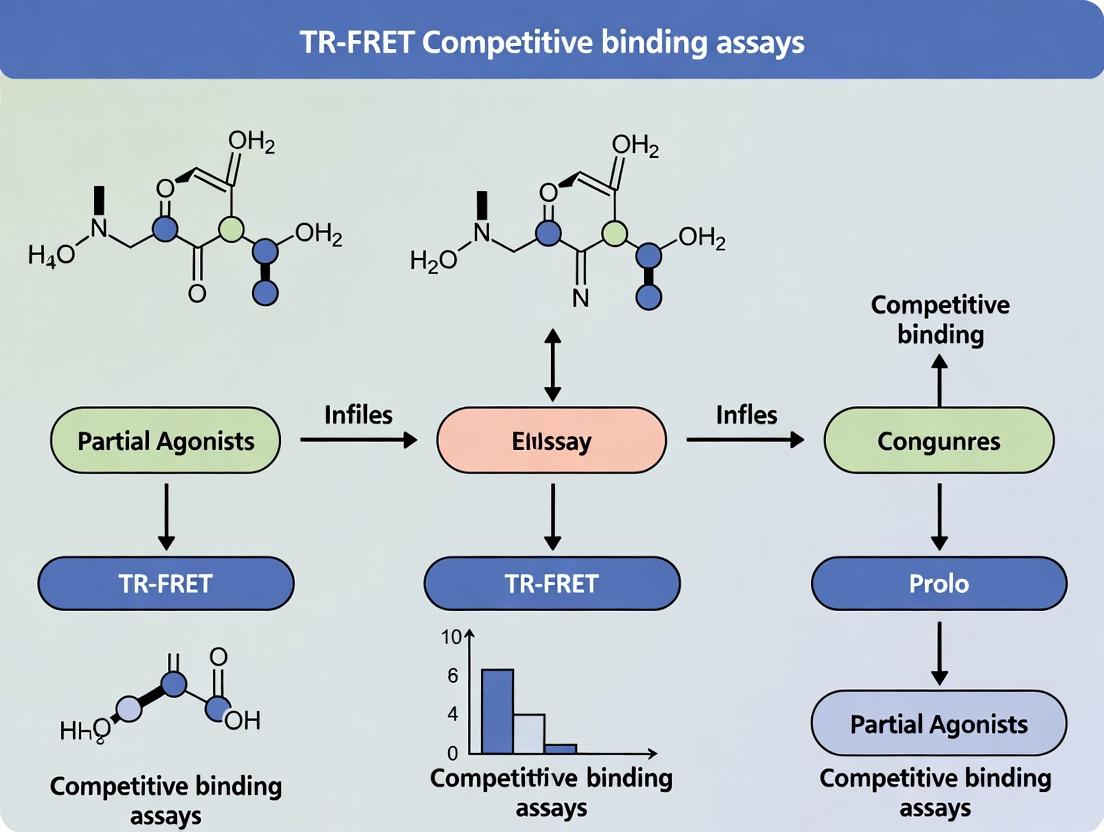
This comprehensive guide details the application of Time-Resolved Förster Resonance Energy Transfer (TR-FRET) competitive binding assays for the precise characterization of partial agonists.
TR-FRET Competitive Binding Assays: A Complete Guide for Profiling Partial Agonists in Drug Discovery
Abstract
This comprehensive guide details the application of Time-Resolved Förster Resonance Energy Transfer (TR-FRET) competitive binding assays for the precise characterization of partial agonists. We cover the foundational principles of TR-FRET technology, a step-by-step methodological workflow for assay development, critical troubleshooting and optimization strategies for complex partial agonist pharmacology, and rigorous validation approaches comparing TR-FRET to traditional techniques. Aimed at researchers and drug development professionals, this article provides actionable insights for accurately quantifying ligand affinity, efficacy, and receptor occupancy to advance GPCR and nuclear receptor drug discovery programs.
Understanding TR-FRET and Partial Agonism: Core Principles for Binding Assay Design
Within the context of a broader thesis on TR-FRET competitive binding assays for partial agonists research, this article delineates the dual-character nature of partial agonists. Partial agonists are ligands that bind to and activate a receptor, but elicit only a submaximal biological response (efficacy) compared to a full agonist. Their study is crucial in drug development for achieving nuanced therapeutic effects with improved safety profiles. This note details application protocols focusing on quantitative binding and functional assays to characterize these key pharmacological parameters.
Core Concepts & Quantitative Data
The behavior of a partial agonist is defined by two independent parameters: Binding Affinity (Kd or Ki, a measure of ligand-receptor binding strength) and Intrinsic Efficacy (ε, a measure of the receptor activation capability post-binding). The observed Functional Potency (EC50) in cellular assays is a composite of both.
Table 1: Characteristic Parameters of Receptor Ligands
| Ligand Type | Binding Affinity (Ki) | Intrinsic Efficacy (ε) | Maximal Response (Emax) |
|---|---|---|---|
| Full Agonist | High to Low (variable) | 1.0 (reference) | 100% |
| Partial Agonist | High to Low (variable) | 0 < ε < 1.0 | 10% - 90% of Full Agonist |
| Antagonist | High to Low (variable) | ~0.0 | 0% (inhibits agonist response) |
| Inverse Agonist | High to Low (variable) | Negative | Reduces constitutive activity |
Table 2: Example Data from a TR-FRET Competitive Binding Assay (Theoretical GPCR Target)
| Compound | IC50 (nM) | Ki (nM) | Modality (from functional assay) | Emax (% of Full Agonist) |
|---|---|---|---|---|
| Reference Full Agonist (A) | 5.0 | 2.5 | Full Agonist | 100% |
| Compound B | 2.0 | 1.0 | Partial Agonist | 45% |
| Compound C | 50.0 | 25.0 | Partial Agonist | 70% |
| Reference Antagonist (D) | 1.5 | 0.75 | Neutral Antagonist | 0% |
Experimental Protocols
Protocol 1: TR-FRET Competitive Binding Assay for Affinity Determination
Objective: Determine the binding affinity (Ki) of a test partial agonist by competing with a fluorescently labeled tracer ligand.
Materials: Target receptor membrane preparation, Europium (Eu)-labeled anti-GST antibody, GST-tagged tracer ligand, test compounds, TR-FRET assay buffer.
Procedure:
- Plate Setup: In a low-volume 384-well plate, serially dilute test compounds in DMSO, then in assay buffer.
- Reaction Mix: Prepare a master mix containing receptor membranes, Eu-antibody, and GST-tracer ligand in TR-FRET buffer.
- Incubation: Dispense the reaction mix into wells containing compound or controls (total binding, non-specific binding). Final assay volume: 20 µL.
- Incubation: Seal plate, incubate at room temperature for 60-120 minutes protected from light.
- Reading: Measure TR-FRET signal using a compatible plate reader (e.g., excitation: 337 nm, emission: 620 nm (Eu) and 665 nm (acceptor)). Calculate the ratio (665 nm / 620 nm) * 10,000.
- Analysis: Fit the normalized inhibition data to determine IC50. Calculate Ki using the Cheng-Prusoff equation: Ki = IC50 / (1 + [Tracer]/Kd_tracer).
Protocol 2: Functional cAMP Accumulation Assay for Efficacy & Potency
Objective: Determine the intrinsic efficacy (Emax) and functional potency (EC50) of a partial agonist.
Materials: Cells expressing the target GPCR, test compounds, cAMP assay kit (e.g., HTRF or BRET-based), stimulation buffer.
Procedure:
- Cell Preparation: Seed cells in a 384-well assay plate and culture overnight.
- Stimulation: Prepare serial dilutions of test agonists and reference compounds in stimulation buffer. Replace cell medium with compound solutions. Incubate for 30 minutes at 37°C.
- Cell Lysis & Detection: Lyse cells according to the cAMP detection kit protocol. Add Eu-cryptate-labeled anti-cAMP antibody and cAMP-d2 acceptor.
- Incubation & Read: Incubate for 60 minutes at room temperature. Read TR-FRET signal (excitation: 337 nm, emission: 620 nm & 665 nm).
- Analysis: Generate a cAMP standard curve. Convert sample signals to cAMP concentrations. Plot response vs. log[agonist] to determine EC50 and Emax (relative to a reference full agonist).
Visualizations
The Scientist's Toolkit
Table 3: Key Research Reagent Solutions for TR-FRET Partial Agonist Studies
| Item | Function in Research | Example/Note |
|---|---|---|
| Tagged Receptor (GST/His) | Purified or membrane-bound; provides target for binding assays. | GST-tag allows capture via Eu-anti-GST antibody in TR-FRET. |
| Fluorescent Tracer Ligand | High-affinity probe that competes with test compound for binding. | Must be characterized for its own Kd. Often labeled with a suitable acceptor (e.g., d2, Alexa Fluor 647). |
| Lanthanide-Labeled Antibody (Eu/Tb) | TR-FRET donor; long-lived emission enables time-resolved detection. | Eu-labeled anti-GST or anti-His antibody for indirect tracer labeling. |
| TR-FRET-Compatible cAMP Assay Kit | Quantifies functional GPCR activation via second messenger cAMP. | HTRF (cisbio) or LANCE (PerkinElmer) kits are industry standards. |
| Cell Line with Target GPCR | Engineered cell system for functional efficacy and potency assays. | Stable cell line with consistent, physiologically relevant receptor expression. |
| Reference Agonists/Antagonists | Pharmacological tools to validate assay performance and define scales. | Full agonist (Emax=100%), neutral antagonist (for blocking studies). |
| TR-FRET Microplate Reader | Instrument capable of time-resolved, dual-wavelength emission detection. | Equipped with appropriate lasers/filters (e.g., 337nm ex, 620/665nm em). |
Application Notes
Fundamental Principles
Time-Resolved Förster Resonance Energy Transfer (TR-FRET) combines the specificity of FRET with time-gated detection to eliminate short-lived background fluorescence. This is achieved using lanthanide chelate donors (e.g., Europium, Terbium), which have exceptionally long fluorescence lifetimes (microseconds to milliseconds). A time delay between excitation and measurement allows autofluorescence and compound interference (nanosecond lifetime) to dissipate, resulting in a vastly improved signal-to-noise ratio. The homogeneous, "mix-and-read" format eliminates separation steps, enabling high-throughput screening and robust quantification of biomolecular interactions in solution.
Competitive Binding Assays for Partial Agonist Research
Within the study of G Protein-Coupled Receptors (GPCRs) and other targets, TR-FRET competitive binding assays are pivotal for characterizing partial agonists. These compounds bind to the receptor but elicit a sub-maximal functional response. The assay quantifies the displacement of a fluorescently labeled tracer ligand by the test compound, providing direct binding affinity (Ki or IC50). Crucially, this binding data, when correlated with functional assay results, allows researchers to dissect binding efficiency from efficacy, a key parameter in partial agonist profiling and the development of drugs with tailored signaling bias.
Protocols
Protocol 1: Generic TR-FRET Competitive Binding Assay for a GPCR
Objective: Determine the binding affinity (IC50) of a test partial agonist for a purified or membrane-bound GPCR.
Key Research Reagent Solutions:
| Reagent | Function |
|---|---|
| Europium (Eu3+)-labeled Anti-GST Antibody | Donor fluorophore. Binds to GST-tagged receptor. |
| Fluorescently Labeled Tracer Ligand (e.g., Alexa Fluor 647) | Acceptor fluorophore. Binds to the receptor's orthosteric site. |
| GST-Tagged GPCR (Purified or in membrane prep) | Target protein with tag for donor antibody capture. |
| TR-FRET Assay Buffer | Optimized buffer (e.g., with EDTA, BSA, protease inhibitors) to maintain receptor stability and minimize non-specific binding. |
| Reference Agonist/Antagonist | Full competitor for validation of assay window. |
| Test Partial Agonists | Compounds for characterization. |
| 384-well Low Volume Microplate | Assay vessel compatible with plate readers. |
Methodology:
- Plate Preparation: In a 384-well plate, add 2 µL of serially diluted test compound (in DMSO, final concentration range typically 10^-5 to 10^-11 M) or control (buffer for total binding, reference compound for nonspecific binding).
- Receptor/Tracer Addition: Add 8 µL of a pre-mixed solution containing the GST-tagged GPCR and the fluorescent tracer ligand at their predetermined optimal concentrations (e.g., 1-5 nM receptor, tracer at ~ its Kd).
- Donor Addition: Add 10 µL of the Eu3+-labeled anti-GST antibody (at optimized dilution, e.g., 1-2 nM final).
- Incubation: Seal plate, protect from light, and incubate at room temperature for 2-6 hours (or as optimized) to reach equilibrium.
- Time-Resolved Detection: Read on a compatible microplate reader (e.g., PerkinElmer EnVision, BMG Labtech PHERAstar). Set excitation at ~337 nm (for Eu3+). Use a dual-emission delay (e.g., 50-100 µs) and integration time (e.g., 200-400 µs). Measure emission at 620 nm (donor) and 665 nm (acceptor).
- Data Analysis: Calculate the TR-FRET ratio: (Acceptor Emission at 665 nm / Donor Emission at 620 nm) * 10,000 (to give a convenient scale). Plot ratio vs. log[compound]. Fit data to a 4-parameter logistic model to determine IC50. Convert to Ki using the Cheng-Prusoff equation: Ki = IC50 / (1 + [Tracer]/Kd_Tracer).
Protocol 2: TR-FRET cAMP Accumulation Assay (Functional Correlate)
Objective: Measure the functional efficacy of the partial agonist via intracellular cAMP levels, complementing binding data.
Key Materials: cAMP Antibody (Eu3+-cryptate labeled), cAMP labeled with d2 acceptor, Cell lysate or purified cAMP, Lysis Buffer, Forskolin (for stimulation control).
Methodology:
- Cell Stimulation: Seed cells expressing target GPCR. Treat with test partial agonists, reference full agonist, and vehicle for a defined time (e.g., 30 min).
- Cell Lysis: Lyse cells according to kit manufacturer's instructions (e.g., Cisbio HTRF cAMP kit).
- Homogeneous Detection: Transfer lysate to assay plate. Add Eu3+-cryptate labeled anti-cAMP antibody and d2-labeled cAMP.
- Incubation & Read: Incubate 1 hour, then perform TR-FRET read as in Protocol 1.
- Analysis: Inverse TR-FRET signal correlates with cAMP concentration. Generate dose-response curves to determine EC50 and % efficacy relative to full agonist.
Table 1: Typical TR-FRET Assay Performance Metrics
| Parameter | Typical Range | Ideal Target |
|---|---|---|
| Assay Window (Z' factor) | 0.5 - 0.8 | > 0.5 for HTS |
| Signal-to-Background Ratio | 5:1 - 50:1 | > 10:1 |
| Donor Lifetime (Eu3+) | 500 - 1000 µs | N/A |
| Acceptor Lifetime (e.g., Alexa Fluor 647) | ~1 ns | N/A |
| Time-Gated Delay | 50 - 150 µs | Optimized per instrument |
| Coefficient of Variation (CV) | < 10% | < 5% |
Table 2: Example Data from a Partial Agonist Characterization Study
| Compound | Binding IC50 (nM) | Functional cAMP EC50 (nM) | Intrinsic Activity (% of Full Agonist) | Calculated Ki (nM) |
|---|---|---|---|---|
| Full Agonist (Ref) | 1.2 ± 0.3 | 0.8 ± 0.2 | 100% | 0.9 |
| Partial Agonist A | 5.5 ± 1.1 | 50.0 ± 5.0 | 65% | 4.2 |
| Partial Agonist B | 0.8 ± 0.2 | 10.0 ± 2.0 | 40% | 0.6 |
| Antagonist (Ref) | 2.0 ± 0.5 | No Response | 0% | 1.5 |
Diagrams
Within the broader thesis on probing partial agonist pharmacology, Time-Resolved Förster Resonance Energy Transfer (TR-FRET) competitive binding assays provide a homogeneous, robust, and high-throughput method for quantifying ligand-receptor interactions. Their efficacy hinges on three core components: the Donor, the Acceptor, and the Tracer. This application note details their function and provides protocols for assay development.
Core Components & Function
The Donor
A long-lifetime lanthanide chelate (e.g., Europium (Eu³⁺) or Terbium (Tb³⁺)) is excited, leading to a sustained emission. Its millisecond-scale fluorescence lifetime allows for time-gated detection, eliminating short-lived background fluorescence.
The Acceptor
A fluorophore that absorbs energy from the donor via FRET when in close proximity (<10 nm). Common acceptors include allophycocyanin (APC), Cy5, or d2. Its emission is the final, ratiometric readout.
The Tracer
A high-affinity, fluorescently labeled ligand (conjugated to either the donor or acceptor) that competes with unlabeled test compounds for the binding site. It is the critical probe for measuring competition.
Key Interaction Logic
Diagram 1: TR-FRET competitive binding interaction logic.
Table 1: Typical Lanthanide Donor and Acceptor Properties
| Component | Common Example | Excitation (nm) | Emission (nm) | Lifetime |
|---|---|---|---|---|
| Donor | Europium cryptate | 337 | 620 | ~1 ms |
| Donor | Terbium cryptate | 337 | 490, 545 | ~2 ms |
| Acceptor | APC | 650 | 660 | ~ns |
| Acceptor | Cy5 | 649 | 670 | ~ns |
| Acceptor | d2 (quencher) | N/A | N/A | N/A |
Table 2: Assay Performance Metrics
| Parameter | Typical Range | Optimal Target |
|---|---|---|
| Z'-Factor | 0.5 - 0.8 | >0.7 |
| Signal-to-Background | 5:1 - 50:1 | >10:1 |
| Assay Window (Delta F) | 100 - 300 RFU | >150 RFU |
| Tracer Kd | 0.1 - 10 nM | < Target Kd |
| Incubation Time | 1 - 24 hours | Equilibrium |
Detailed Protocol: TR-FRET Competitive Binding Assay
A. Reagent Preparation
- Buffer: Prepare assay buffer (e.g., 50 mM HEPES, pH 7.4, 100 mM NaCl, 0.5% BSA, 0.01% Tween-20). Filter (0.22 µm).
- Compound Plate: Serially dilute test compounds (partial agonists, full agonists, antagonists) in DMSO, then in assay buffer. Final DMSO ≤1%.
- Tracer Solution: Dilute donor- or acceptor-labeled tracer in buffer to a final concentration ~ its Kd (e.g., 1-5 nM).
- Receptor Solution: Prepare purified, tagged receptor or cell lysate expressing tagged receptor. Titrate to determine optimal concentration.
- Detection Solution: If using secondary labeling, prepare antibody conjugates (e.g., anti-tag-Eu³⁺ and anti-tag-APC). Pre-mix and dilute.
B. Assay Workflow
Diagram 2: TR-FRET competitive binding assay workflow.
- In a low-volume 384-well plate, add 5 µL of each test compound or control (buffer for total, cold ligand for nonspecific).
- Add 10 µL of the pre-mixed detection solution containing the receptor and tracer. For antibody-based detection, add 5 µL of receptor, then 5 µL of pre-mixed antibody-donor and tracer-acceptor.
- Seal plate, incubate in the dark at room temperature for 2-4 hours (or determined equilibrium time).
- Read on a compatible plate reader (e.g., PerkinElmer EnVision, BMG PHERAstar). Use time-gated settings:
- Donor excitation: 337 nm (laser) or ~340 nm (filter).
- Delay time: 50-100 µs.
- Donor emission (e.g., Eu³⁺): 615-620 nm, 100-500 µs window.
- Acceptor emission (e.g., APC): 660-665 nm, 100-500 µs window.
C. Data Analysis
- Calculate the TR-FRET ratio: (Acceptor emission / Donor emission) * 10⁴ (to give manageable numbers).
- Determine specific binding:
% Inhibition = 100 * [1 - (Ratio_sample - Ratio_nonspec) / (Ratio_total - Ratio_nonspec)]. - Fit % Inhibition vs. log[compound] to a four-parameter logistic model to determine IC₅₀.
- Convert IC₅₀ to Ki using the Cheng-Prusoff equation:
Ki = IC₅₀ / (1 + [Tracer]/Kd_tracer + [Receptor]/Kd_receptor).
The Scientist's Toolkit: Research Reagent Solutions
Table 3: Essential Materials for TR-FRET Competitive Binding Assays
| Item | Example Product/Type | Function |
|---|---|---|
| Lanthanide Donor Conjugate | Eu³⁺- or Tb³⁺-Chelate conjugated to Streptavidin or antibody | Long-lifetime FRET energy donor. |
| Fluorescent Acceptor | APC, Cy5, or d2 conjugated to Streptavidin or antibody | FRET energy acceptor; emits signal upon transfer. |
| Labeled Tracer | Target-specific ligand conjugated to biotin, acceptor, or donor. | Probes the binding site; competes with test compounds. |
| Tagged Receptor | His-tag, GST-tag, or SNAP-tag recombinant protein. | Allows for specific capture or labeling via antibodies. |
| TR-FRET Optimized Buffer | Commercial (e.g., Cisbio, PerkinElmer) or homemade with BSA/protease inhibitors. | Reduces nonspecific binding and stabilizes components. |
| Low-Fluorescence Microplate | White 384-well small volume plate (e.g., Corning, Greiner). | Maximizes signal collection, minimizes well-to-well crosstalk. |
| Plate Reader | Compatible TR-FRET/FD reader with laser excitation and time-gating. | Enables specific detection of long-lifetime FRET signal. |
Within the broader thesis on advancing competitive binding assays for partial agonist research, Time-Resolved Förster Resonance Energy Transfer (TR-FRET) emerges as a preeminent technology. Partial agonists, which elicit a sub-maximal biological response even with full receptor occupancy, present a unique challenge for characterization. Their study requires assays capable of detecting subtle shifts in equilibrium and conformational states with high precision. TR-FRET competitive binding assays excel in this context due to their superior sensitivity, broad dynamic range, and excellent signal-to-background (S/B) ratios, enabling robust quantification of affinity (Ki) and efficacy parameters critical for modern drug discovery.
Advantages of TR-FRET for Partial Agonist Profiling
Sensitivity and Low Interference
TR-FRET utilizes long-lived lanthanide fluorophores (e.g., Europium, Terbium) as donors, which emit after a time delay. This allows for temporal gating, eliminating short-lived background fluorescence from compounds, buffers, and biological samples. This exceptional sensitivity is crucial for detecting the weak signals often associated with partial agonist-induced conformational changes or low-affinity binding events.
Broad Dynamic Range
The ratiometric nature of TR-FRET (acceptor emission/donor emission) minimizes well-to-well variability from pipetting errors or quenching. This provides a large, stable dynamic range, essential for generating full concentration-response curves. Accurate determination of EC50 and intrinsic activity (α) for partial agonists depends on this reliability across multiple orders of magnitude of compound concentration.
High Signal-to-Background (S/B) Ratio
The combination of time-gating and ratiometric measurement drastically reduces background, yielding S/B ratios often exceeding 100:1 in well-optimized assays. This high S/B is fundamental for achieving a high Z’-factor, ensuring assay robustness and the reliable detection of subtle efficacy differences between full and partial agonists.
Quantitative Performance Data
The following table summarizes typical performance metrics of TR-FRET competitive binding assays compared to alternative methods in the context of GPCR partial agonist screening.
Table 1: Comparative Assay Performance for Partial Agonist Characterization
| Assay Parameter | TR-FRET Competitive Binding | Traditional Fluorescence Polarization (FP) | Scintillation Proximity Assay (SPA) |
|---|---|---|---|
| Sensitivity (Typical pIC50) | 8 - 11 | 6 - 9 | 7 - 10 |
| Dynamic Range (Fold Δ) | 50 - 200 | 10 - 50 | 20 - 80 |
| Typical S/B Ratio | 50:1 - 200:1 | 5:1 - 20:1 | 10:1 - 50:1 |
| Assay Volume (µL) | 10 - 20 | 50 - 100 | 50 - 100 |
| Compound Interference | Very Low | High | Low |
| Homogeneous (No-wash) | Yes | Yes | Yes |
| Key Benefit for Partial Agonists | Detects subtle competition & conformational shifts | Moderate throughput, lower cost | Radioactive, less adaptable to conformational assays |
Application Notes: TR-FRET Competitive Binding for a GPCR Partial Agonist
Objective: Determine the inhibitory constant (Ki) of a novel partial agonist (Compound X) against a labeled tracer for the β2-Adrenergic Receptor (β2AR).
Principle: A fluorescent tracer (e.g., red-fluorescent antagonist) binds to the receptor, which is tagged with a donor (e.g., Europium cryptate-conjugated antibody targeting a SNAP-tag). TR-FRET occurs when bound. Increasing concentrations of Compound X compete with the tracer, decreasing the TR-FRET signal. The data is fit to a competitive binding model to derive Ki.
Detailed Experimental Protocol
Protocol 1: TR-FRET Competitive Binding Assay for β2AR
I. Reagent Preparation
- Assay Buffer: Prepare HEPES-buffered saline (20 mM HEPES, 100 mM NaCl, pH 7.4) supplemented with 0.1% (w/v) BSA and 5 mM MgCl2. Filter sterilize (0.22 µm).
- SNAP-β2AR Membrane Preparation: Express SNAP-tagged β2AR in HEK293 cells, harvest, and prepare membrane fractions using differential centrifugation. Resuspend membranes in assay buffer. Determine optimal membrane concentration via signal window titration.
- Tracer Solution: Dilute a red-fluorophore (e.g., HTRF-labeled antagonist) in assay buffer to 2x the final desired Kd concentration (e.g., 2x Kd = ~4 nM).
- Donor Solution: Dilute Anti-SNAP-Europium Cryptate donor in assay buffer to a 2x working concentration (e.g., 2 nM).
- Compound Dilution: Serially dilute Compound X and reference controls (full agonist, antagonist) in DMSO, then further dilute in assay buffer to create a 4x concentration series (typically 11 points, 1:3 dilutions). Final DMSO ≤1%.
II. Assay Procedure (Homogeneous, 384-well format)
- Step 1: In a low-volume, white 384-well plate, add 5 µL of 4x compound dilution or control (buffer for total, unlabeled competitor for nonspecific).
- Step 2: Add 5 µL of the 2x SNAP-β2AR membrane suspension directly to each well.
- Step 3: Add 5 µL of the 2x donor (Anti-SNAP-EuCryptate) solution to each well.
- Step 4: Incubate plate for 30 minutes at room temperature to allow donor labeling.
- Step 5: Initiate binding by adding 5 µL of the 2x tracer solution to each well. Final volume = 20 µL.
- Step 6: Incubate plate in the dark for 1-2 hours at room temperature to reach equilibrium.
- Step 7: Read plate on a compatible TR-FRET microplate reader (e.g., PerkinElmer EnVision, BMG PHERAstar). Settings: Excitation: 337 nm; Delay: 50 µs; Integration: 200-400 µs; Read emissions at 620 nm (Donor) and 665 nm (Acceptor).
III. Data Analysis
- Calculate the TR-FRET ratio for each well: (Acceptor 665 nm Emission / Donor 620 nm Emission) * 10^4 (to give manageable numbers).
- Calculate % Inhibition: [1 - ((Ratiocompound - RatioNSB) / (RatioTotal - RatioNSB))] * 100.
- Plot % Inhibition vs. log10[Compound]. Fit data to a 4-parameter logistic (sigmoidal) model to determine IC50.
- Convert IC50 to Ki using the Cheng-Prusoff equation: Ki = IC50 / (1 + [Tracer]/Kd_Tracer).
Visualizing the Assay Principle and Pathway
TR-FRET Competitive Binding Workflow
The Scientist's Toolkit: Essential Research Reagent Solutions
Table 2: Key Reagents for TR-FRET Partial Agonist Assays
| Reagent / Material | Function & Role in Assay | Key Considerations |
|---|---|---|
| SNAP-tagged or CLIP-tagged GPCR | Enables specific, covalent labeling with lanthanide donor via a SNAP/CLIP substrate. Provides a universal platform for diverse targets. | Requires stable cell line generation; expression level must be optimized to avoid signal hook effect. |
| Anti-SNAP-Europium Cryptate | Long-lived TR-FRET donor. Binds specifically to SNAP-tag on receptor. | High stability and brightness; long Stokes shift minimizes direct acceptor excitation. |
| Fluorescent Tracer Antagonist/Agonist | TR-FRET acceptor that binds the active site. Competition with test compound modulates FRET signal. | Must have high affinity and selectivity. Red-shifted fluorophores (e.g., d2, Alexa Fluor 647) are ideal. |
| Low-Volume Microplate (White) | Assay vessel. White plates enhance signal collection by reflecting light. | 384-well or 1536-well formats for miniaturization; must be compatible with liquid handlers. |
| TR-FRET Capable Microplate Reader | Measures time-gated emissions at two wavelengths for ratiometric calculation. | Requires UV laser or LED (∼337 nm) and time-gated detection capabilities. |
| Reference Compounds (Full Agonist, Antagonist) | Used as assay controls to define window (max/min signal) and validate system pharmacology. | Well-characterized pharmacological tools (e.g., Isoprenaline and Propranolol for β2AR). |
| Cell Membrane Preparation | Source of the target receptor. Provides a more native environment than purified protein. | Homogeneity and protein concentration are critical for reproducibility. |
Within the context of developing TR-FRET competitive binding assays for partial agonists research, the selection of an appropriate detection format is critical. This decision hinges on balancing sensitivity, specificity, background signal, and experimental flexibility. This application note provides a detailed comparison between tagged receptor and antibody-based detection methodologies, focusing on their application in studying partial agonist interactions with G Protein-Coupled Receptors (GPCRs).
Comparative Analysis of Assay Formats
Table 1: Quantitative Comparison of Assay Formats for GPCR TR-FRET Binding Assays
| Parameter | Tagged Receptor Format | Antibody-Based Detection Format |
|---|---|---|
| Typical S/B Ratio | 10 - 50 | 5 - 20 |
| Z'-Factor | 0.6 - 0.9 | 0.5 - 0.8 |
| Assay Development Time | Longer (cloning/validation) | Shorter |
| Probe Size Impact | Higher (tag may affect binding) | Lower (antibody binds distal epitope) |
| Background Signal | Generally Lower | Can be higher due to non-specific binding |
| Specificity Control | High (tag-specific) | Dependent on antibody quality |
| Cost per Plate | $$ | $$$ (antibody cost) |
| Flexibility for Native Receptors | No (requires genetic modification) | Yes |
| Ideal Application | High-throughput screening, internalization studies | Native conformation studies, patient samples |
Table 2: Key TR-FRET Pair Characteristics for Competitive Binding Assays
| Component | Common Tag/Epitope | Donor Fluorophore | Acceptor Fluorophore | Optimal Excitation/Emission |
|---|---|---|---|---|
| Tagged Protein | SNAP-tag, CLIP-tag, HaloTag, GFP | Terbium (Tb) Cryptate | d2, fluorescein | ~340 nm / 495 & 520 nm |
| Antibody Target | FLAG, HA, Myc epitope | Europium (Eu) Cryptate | XL665, APC | ~337 nm / 620 & 665 nm |
| Ligand Probe | Biotin, small-molecule tag | Streptavidin-Tb | Fluorescent ligand | ~340 nm / 495 & 520 nm |
Detailed Experimental Protocols
Protocol 1: TR-FRET Competitive Binding Using a SNAP-Tagged GPCR
Objective: To measure the binding affinity (Ki) of a test partial agonist competing with a fluorescent ligand for a SNAP-tagged receptor.
Materials:
- HEK293 cells stably expressing SNAP-tagged GPCR of interest.
- SNAP-Lumi4-Tb substrate (Cisbio).
- Fluorescent agonist ligand (e.g., red-shifted dye conjugate).
- Test compounds (partial agonists).
- Assay buffer: HBSS, 0.1% BSA, 20 mM HEPES, pH 7.4.
- White, low-volume, 384-well microplate.
- Plate reader capable of TR-FRET measurement (e.g., PerkinElmer EnVision).
Procedure:
- Tag Labeling: Harvest cells and resuspend at 2-5 x 10^6 cells/mL in labeling buffer. Incubate with 100 nM SNAP-Lumi4-Tb substrate for 1 hour at 37°C under gentle agitation. Wash cells 3x with assay buffer to remove unreacted substrate.
- Plate Preparation: Dispense 5 µL of serially diluted test compound (in DMSO, final concentration typically 10 µM to 0.1 nM) into the assay plate. Include wells for total binding (DMSO only) and nonspecific binding (NSB, with 10 µM of unlabeled reference agonist).
- Cell and Probe Addition: Add 10 µL of labeled cells (final density ~10,000 cells/well) to each well. Immediately add 5 µL of the fluorescent ligand at its predetermined Kd concentration.
- Incubation: Centrifuge plate briefly and incubate for 60-120 minutes at room temperature or 4°C (to prevent internalization) in the dark.
- TR-FRET Reading: Read plate on a TR-FRET-capable reader. Standard settings: excitation at 337 nm (N₂ laser) or ~340 nm (flash lamp), delay time 50-100 µs, integration time 200-400 µs. Measure emission simultaneously at 620 nm (Tb donor) and 665 nm (acceptor).
- Data Analysis: Calculate the TR-FRET ratio (Acceptor Emission / Donor Emission) x 10^4. Normalize data: % Inhibition = 100 * [1 - (Ratiosample - RatioNSB)/(RatioTotal - RatioNSB)]. Fit normalized data to a four-parameter logistic model to determine IC50 and calculate Ki using the Cheng-Prusoff equation.
Protocol 2: TR-FRET Competitive Binding Using an Antibody-Based Detection
Objective: To measure the binding affinity of a test partial agonist for a native or epitope-tagged GPCR using a terbium-labeled anti-epitope antibody.
Materials:
- Cell membrane preparations expressing native or epitope-tagged GPCR.
- Anti-epitope antibody (e.g., anti-FLAG M1 or M2).
- Terbium cryptate-labeled anti-mouse IgG (Donor) or direct Tb-anti-epitope.
- Fluorescent ligand (acceptor-conjugated).
- Assay buffer (as above, possibly with added Ca2+ for M1 antibody).
- White, low-volume, 384-well microplate.
Procedure:
- Membrane Preparation: Prepare membranes from expressing cells via differential centrifugation. Determine optimal protein concentration via titration.
- Complex Formation: Pre-mix membranes with the anti-epitope antibody and the terbium-labeled secondary antibody (or use a pre-formed Tb-anti-epitope complex) on ice for 30 minutes. This forms the donor complex.
- Competition: In the assay plate, combine 5 µL of test compound dilution, 10 µL of the donor-membrane complex, and 5 µL of the fluorescent ligand (at Kd concentration). Include total and NSB controls.
- Incubation: Seal plate, incubate for 90-180 minutes at room temperature in the dark to allow equilibrium.
- TR-FRET Reading: Read as described in Protocol 1.
- Data Analysis: Analyze as in Protocol 1. Note that the signal is proportional to the proximity of the fluorescent ligand to the antibody-bound receptor.
Visualization of Assay Principles
Title: TR-FRET Assay Formats for Competitive Binding
Title: Decision Workflow for Assay Format Selection
The Scientist's Toolkit
Table 3: Essential Research Reagent Solutions for TR-FRET Competitive Binding Assays
| Reagent / Material | Function in Assay | Example Vendor/Product Notes |
|---|---|---|
| SNAP-Lumi4-Tb | Covalently labels SNAP-tagged receptors with a terbium cryptate donor for FRET. | Cisbio. Critical for tagged format. Stable signal. |
| HaloTag NanoBRET Ligand | Alternative tag system for labeling receptors with a fluorophore for binding assays. | Promega. Offers red-shifted options. |
| Anti-FLAG M1-Tb Cryptate | Pre-conjugated donor antibody for direct detection of FLAG-tagged receptors. | Cisbio, Revvity. Streamlines antibody-based format. |
| Fluorescent Agonist/Antagonist | Acceptor-labeled tracer ligand that competes with test compounds for the orthosteric site. | Tocris, Hello Bio, custom synthesis. Must have high affinity and brightness. |
| Tagged GPCR Stable Cell Line | Cells providing consistent, high-level expression of the modified receptor. | Generated in-house or via contract services (Eurofins, DiscoverX). |
| GPCR Membrane Preparation | Enriched source of native or overexpressed receptor for antibody-based formats. | PerkinElmer, Eurofins SignalChem. |
| Low-Volume 384-Well Plate | Optimized microplate for miniaturized assays, reducing reagent costs and enhancing signal. | Corning, Greiner, white, non-binding surface. |
| TR-FRET Compatible Microplate Reader | Instrument with pulsed excitation and time-gated detection to minimize autofluorescence. | PerkinElmer EnVision, BMG Labtech PHERAstar, Tecan SparkCyto. |
Step-by-Step Protocol: Developing a TR-FRET Competitive Binding Assay for Partial Agonists
Within the broader thesis investigating the mechanisms and quantification of partial agonist activity at G Protein-Coupled Receptors (GPCRs), Time-Resolved Förster Resonance Energy Transfer (TR-FRET) competitive binding assays serve as a critical tool. These assays enable the precise measurement of ligand-receptor affinity and the differentiation of binding kinetics for full agonists, partial agonists, and antagonists. The accuracy of these determinations hinges on optimal assay design, specifically the strategic selection of labeled tracers (competitors) and methods for receptor labeling. This application note details protocols and considerations for establishing robust TR-FRET competitive binding assays to support partial agonist research.
Core Principles & Assay Design
A TR-FRET competitive binding assay typically involves three key components:
- A purified, tagged receptor (e.g., SNAP-tag, HALO-tag, or His-tag).
- A fluorescently labeled ligand (the "tracer").
- An unlabeled test compound (e.g., partial agonist).
The receptor is labeled with a lanthanide donor (e.g., Terbium cryptate, Tb). The tracer is labeled with a suitable FRET acceptor (e.g., d2, Fluorescein). When the tracer binds the receptor, TR-FRET occurs. Introducing an unlabeled competitor displaces the tracer, reducing the FRET signal. The concentration-dependent reduction is used to generate inhibition curves and calculate IC50/Ki values.
Critical Design Choice: Tracer Selection The tracer must be a high-affinity ligand for the target receptor. For partial agonist studies, the ideal tracer is often a well-characterized antagonist. Using an antagonist tracer ensures that competition reflects purely affinity for the orthosteric site, uncoupling binding measurements from the conformational changes and efficacy nuances associated with competing an agonist tracer with a partial agonist.
Table 1: Comparison of Common TR-FRET Donor-Acceptor Pairs
| Donor | Acceptor | Donor Excitation (nm) | Donor Emission (nm) | Acceptor Emission (nm) | TR-FRET Signal (nm) | Approximate Range (Å) | Key Advantage |
|---|---|---|---|---|---|---|---|
| Terbium (Tb) Cryptate | d2 (XL665) | ~337 nm | 490, 545 nm | 665 nm | 665 nm | 50-100 | Large Stokes shift, long lifetime (>1ms), low background. |
| Europium (Eu) Cryptate | APC/Cy5 | ~337 nm | 620 nm | 665 nm (APC) / 670 nm (Cy5) | 665-670 nm | 50-100 | Similar to Tb, bright signal. |
| LanthaScreen Tb | Fluorescein | ~340 nm | 490, 545 nm | 520 nm | 520 nm | 30-60 | Shorter FRET distance, suitable for intramolecular assays. |
Table 2: Common Receptor Tagging Systems for TR-FRET
| Tag System | Labeling Donor | Covalent? | Typical Assay Format | Pros | Cons |
|---|---|---|---|---|---|
| SNAP-tag (~20 kDa) | Tb-conjugated Benzylguanine (BG) | Yes, irreversible | Receptor-N or C-terminal fusion | Stable signal, flexible labeling kinetics. | Larger tag may affect some receptors. |
| HALO-tag (~33 kDa) | Tb-conjugated Chloroalkane (CA) | Yes, irreversible | Receptor-N or C-terminal fusion | Very stable, high specificity. | Larger tag than SNAP. |
| His-tag (6xHis) | Anti-His Tb Cryptate Antibody | No, affinity-based | Receptor-N or C-terminal fusion | Small tag, minimal perturbation. | Requires antibody, potentially higher cost. |
Experimental Protocols
Protocol 1: Receptor Labeling with SNAP-Tag
Objective: To covalently label a SNAP-tagged GPCR expressed in a membrane preparation or on live cells with a Terbium cryptate donor.
Materials:
- SNAP-tagged receptor membrane preparation (e.g., 1-5 µg/well).
- SNAP-Lumi4-Tb (Terbium cryptate conjugated BG, Cisbio).
- Assay Buffer (e.g., PBS, HEPES-based with 0.1% BSA or 0.01% Pluronic F-127).
- Low-binding microcentrifuge tubes.
- Black, low-volume, 384-well microplate.
Procedure:
- Prepare Labeling Solution: Dilute SNAP-Lumi4-Tb in assay buffer to a 2X final concentration. The optimal concentration must be determined by titration (typically 10-100 nM final).
- Prepare Receptor: Thaw membrane preparation on ice. Dilute in assay buffer to a 2X final concentration.
- Labeling Reaction: In the wells of the assay plate, mix equal volumes (e.g., 10 µL each) of the 2X receptor and 2X SNAP-Lumi4-Tb solutions.
- Incubation: Cover plate and incubate in the dark at 4°C for 2 hours or at room temperature for 1 hour. Gentle shaking is optional.
- Proceed to Assay: The labeled receptor is now ready for the addition of tracer and competitor. Note: For live-cell assays, wash cells after labeling step.
Protocol 2: TR-FRET Competitive Binding Assay
Objective: To determine the binding affinity (Ki) of a partial agonist by competing with a fluorescent antagonist tracer for the labeled receptor.
Materials:
- Tb-labeled receptor (from Protocol 1).
- Fluorescent tracer (e.g., antagonist-fluorescein or antagonist-d2).
- Unlabeled test compounds (partial agonists, reference antagonists).
- Assay Buffer.
- Black, 384-well microplate.
- Multichannel pipettes.
- TR-FRET compatible microplate reader (e.g., BMG PHERAstar, Tecan Spark).
Procedure:
- Prepare Compound Plate: Serially dilute unlabeled test compounds in DMSO, then further dilute in assay buffer (typical final DMSO ≤1%). Create an 11-point, half-log dilution series.
- Prepare Tracer Solution: Dilute fluorescent tracer in assay buffer to a 2X
Kdconcentration (requires prior tracerKddetermination via saturation binding). - Plate Assembly (10 µL final/well):
- Step 1: Add 5 µL of compound dilution or buffer control (for total and nonspecific binding wells) to the assay plate.
- Step 2: Add 2.5 µL of the 2X fluorescent tracer solution to all wells.
- Step 3: Add 2.5 µL of the Tb-labeled receptor suspension to all wells.
- For Nonspecific Binding (NSB) Wells: Replace compound/tracer with buffer containing a high concentration (e.g., 10 µM) of unlabeled reference antagonist.
- Incubation: Cover plate, incubate in the dark at room temperature for 1-2 hours (or determined equilibrium time).
- TR-FRET Measurement: Read plate on a TR-FRET-capable reader using 337 nm excitation. Measure donor emission at 620 nm (or 490 nm) and acceptor emission at 665 nm (for d2) or 520 nm (for fluorescein).
- Data Analysis:
- Calculate the ratio: (Acceptor Emission / Donor Emission) * 10^4 (to get a manageable number).
- Normalize data: (Ratio - NSB Avg Ratio) / (Total Binding Avg Ratio - NSB Avg Ratio) * 100 = % Specific Binding.
- Fit normalized inhibition curve to a 4-parameter logistic model to determine IC50.
- Calculate Ki using the Cheng-Prusoff equation:
Ki = IC50 / (1 + [Tracer]/Kd_Tracer).
Mandatory Visualization
Diagram 1: TR-FRET Competitive Binding Assay Principle
Diagram 2: Experimental Workflow for Ki Determination
The Scientist's Toolkit
Table 3: Essential Research Reagent Solutions for TR-FRET Binding Assays
| Item / Reagent | Function in Assay | Example & Notes |
|---|---|---|
| Tagged Receptor | The assay target. Provides specific binding sites. | SNAP- or HALO-tagged GPCR membranes (Eurofins, PerkinElmer). Purified protein for biochemical assays. |
| Lanthanide Donor | Long-lifetime FRET donor. Minimizes background fluorescence. | SNAP-Lumi4-Tb (Cisbio), Anti-His-Tb (Cisbio), HaloTag-Tb (Promega). |
| Fluorescent Tracer | High-affinity ligand labeled with FRET acceptor. Reports on receptor occupancy. | Antagonist-red (d2/XL665) or Antagonist-green (Fluorescein). Custom synthesis often required. |
| Reference Ligands | Unlabeled compounds for validation. Define NSB and compete for QC. | Known high-affinity antagonist (for NSB), known cold competitor for tracer displacement. |
| TR-FRET Optimized Buffer | Maintains receptor stability, minimizes non-specific binding. | HEPES or PBS, pH 7.4, with 0.1% BSA or 0.01% Pluronic F-127. May require protease inhibitors. |
| Low-Volume Microplate | Platform for assay reaction and reading. | Black, 384-well, small volume (e.g., ProxiPlate, Cisbio) to reduce reagent use. |
| TR-FRET Plate Reader | Instrument capable of time-resolved, dual-emission detection. | BMG LABTECH PHERAstar, Tecan Spark, PerkinElmer EnVision. Must have 337 nm laser/Filter and dual-emission detection. |
Application Notes and Protocols
Within the context of a thesis focused on investigating partial agonists using Time-Resolved Förster Resonance Energy Transfer (TR-FRET) competitive binding assays, rigorous plate preparation and sample handling are paramount. These assays rely on precise, homogeneous signal detection to accurately quantify ligand-receptor interactions. Inconsistent evaporation and uneven thermal gradients across a microplate—collectively termed "edge effects"—can introduce significant data variability, compromising the quantification of subtle efficacy differences (Emax) and potency (EC50) critical for partial agonist characterization. This document details protocols to minimize these artifacts.
Quantitative Impact of Edge Effects and Evaporation
Neglecting edge effect mitigation leads to systematic errors. The following table summarizes typical data deviations observed in TR-FRET assays under suboptimal conditions.
Table 1: Impact of Edge Effects and Evaporation on TR-FRET Assay Parameters
| Condition | Coefficient of Variation (CV) Increase | Z'-Factor Reduction | Apparent EC50 Shift (vs. interior wells) | Typical Effect on Partial Agonist Profile |
|---|---|---|---|---|
| Uncontrolled Evaporation | 15-25% | >0.3 | Up to 2-fold | Inflated or suppressed Emax, altered curve steepness. |
| No Edge Buffering | 10-20% | 0.1-0.3 | 1.5 - 2.5-fold | Increased scatter in competitive binding curves, imprecise Ki. |
| Optimal Sealing & Buffering | <10% | Maintained >0.5 | <1.2-fold | Robust, reproducible determination of intrinsic activity. |
Detailed Protocols
Protocol 1: Preparation of Assay-Ready Plates with Perimeter Buffer
Objective: To pre-treat microplates to minimize evaporation and thermal transfer from the plate edges.
- Materials: Low-binding, 384-well microplate (white, flat-bottom); TR-FRET assay buffer; Non-reactive sealing foil or plate seal.
- Procedure: a. Designate the outermost perimeter wells (e.g., columns 1, 24, rows A, P in a 384-well plate) as "buffer wells." b. Pipette 35-50 µL of assay buffer into every perimeter buffer well. This volume should match or exceed the sample volume used in experimental wells. c. For experimental wells, add appropriate volumes of buffer, receptor, and tracer according to your binding assay protocol. d. Immediately after all liquid additions, apply a pre-cut, pierceable sealing foil using a plate roller to ensure a uniform, tight seal. Avoid adhesive seals that may introduce contaminants. e. Centrifuge the sealed plate at 300 × g for 1 minute to collect all liquid at the bottom of wells and eliminate bubbles.
Protocol 2: Sample Handling and Dispensing for Competitive Binding Assays
Objective: To ensure consistent compound and reagent delivery, minimizing time-based evaporation during plate setup.
- Materials: Electronic multichannel pipette or non-contact liquid dispenser; pre-diluted compound agonist/antagonist plates; TR-FRET detection mix (Europium cryptate-labeled antibody, fluorescent acceptor).
- Workflow: a. Prepare all reagents and compound dilutions in advance and equilibrate them to assay temperature (e.g., room temperature or 4°C). b. Use a reversed dispensing order: Start pipetting into the well of Column 23, Row O (for a 384-well plate), and finish at Column 2, Row B. This ensures that the time each well remains open is consistent and minimized. c. Dispense the TR-FRET detection mix as the final step, again using reversed order dispensing. d. Seal the plate immediately after the final addition as per Protocol 1, Step 2d. e. Incubate the plate in a temperature-controlled incubator away from air vents and under a covered lid or within a humidified chamber if a multi-day incubation is required.
Protocol 3: Validation of Homogeneity (Control Experiment)
Objective: To empirically confirm the absence of edge effects in your setup.
- Materials: As per standard TR-FRET assay. Include a reference partial agonist and a full agonist control.
- Procedure: a. Prepare a plate where every well contains an identical sample: a single concentration of a control compound (e.g., a known partial agonist at its EC80) in the full TR-FRET assay mix. b. Seal and incubate the plate as per Protocols 1 & 2. c. Read the plate using a TR-FRET-capable plate reader. d. Analysis: Plot the raw TR-FRET signal (Donor Emission / Acceptor Emission × 10⁴ or ratio) for each well position. Visually inspect and statistically compare (e.g., CV%) the signals from interior wells versus perimeter experimental wells. A successful mitigation strategy yields no positional signal pattern.
Diagrams
Diagram 1: TR-FRET Partial Agonist Binding Pathway
Diagram 2: Plate Prep Workflow to Minimize Artifacts
The Scientist's Toolkit: Essential Research Reagent Solutions
Table 2: Key Materials for Robust TR-FRET Assays
| Item | Function in Assay | Critical for Mitigating |
|---|---|---|
| Low-Binding, White Microplates (384-well) | Minimizes nonspecific adsorption of protein/peptides, maximizes signal reflection for detection. | Adsorption-related variability. |
| Pierceable, Clear Sealing Foils | Provides a vapor barrier to prevent evaporation while allowing access for acoustic/non-contact dispensing. | Evaporation, contamination. |
| Precision Liquid Handler (Non-contact) | Ensures accurate, reproducible dispensing of small volumes (2-5 µL) without cross-contamination. | Volumetric errors, bubble formation. |
| Humidified Incubator/Storage Box | Maintains high ambient humidity during long incubations, providing secondary protection against drying. | Evaporation (multi-day assays). |
| Assay Buffer with Carrier Protein (e.g., 0.1% BSA) | Reduces surface tension and adsorptive losses of reagents to plastic surfaces and pipette tips. | Adsorption, meniscus variability. |
| Plate Centrifuge with Microplate Rotor | Ensures all liquid is at the well bottom, eliminating bubbles and meniscus irregularities that affect reading. | Optical path inconsistencies. |
| TR-FRET-Compatible Lanthanide Donor & Acceptor | Provides the specific, long-lifetime FRET pair (e.g., Eu/Tb cryptate + d2/XL665) for time-resolved detection. | Assay signal specificity and S/N ratio. |
Within the broader context of developing TR-FRET competitive binding assays for partial agonists, the precise characterization of the tracer ligand is a critical prerequisite. The equilibrium dissociation constant (Kd) of the fluorescent or luminescent tracer quantifies its affinity for the target receptor, forming the essential baseline for all subsequent competitive binding experiments. This protocol details the establishment of a saturation binding curve to determine the Kd of the tracer, ensuring accurate interpretation of displacement data for partial agonist candidates.
Theory and Application
A saturation binding experiment measures specific binding at increasing concentrations of the tracer ligand while keeping the receptor concentration fixed. As the tracer concentration increases, binding sites become saturated. Analysis of this curve yields the Kd (the tracer concentration at which half the receptors are occupied) and the total receptor concentration (Bmax). An accurately determined Kd is vital for calculating the inhibitory constants (Ki) of unlabeled competitors in subsequent assays.
Key Quantitative Parameters:
| Parameter | Symbol | Description | Typical Range for TR-FRET Tracers |
|---|---|---|---|
| Equilibrium Dissociation Constant | Kd | Concentration of tracer at half-maximal specific binding. | 0.1 - 20 nM |
| Total Receptor Concentration | Bmax | Maximum number of specific binding sites. | Dependent on assay system |
| Non-Specific Binding | NSB | Binding not displaced by a high concentration of competitive ligand. | Should be <30% of total binding at Kd |
| Signal-to-Background Ratio | S/B | Ratio of total binding signal to non-specific binding signal. | >3 for robust assay |
Experimental Protocol: Saturation Binding for TR-FRET Tracers
Materials and Reagents
Research Reagent Solutions:
| Item | Function/Description |
|---|---|
| Purified Target Receptor (GPCR, Kinase) | The protein of interest, often tagged (e.g., His-tag, GST) for immobilization or detection. |
| TR-FRET Tracer Ligand | A high-affinity, fluorescently labeled ligand (e.g., europium (Eu) or terbium (Tb) cryptate-labeled). |
| Unlabeled High-Affinity Competitor | A well-characterized antagonist/agonist for defining non-specific binding (e.g., at 100x - 1000x its Ki). |
| TR-FRET Acceptor (if applicable) | e.g., anti-tag antibody conjugated to a suitable acceptor dye (XL665, d2) for proximity detection. |
| Assay Buffer | Physiological buffer (e.g., HEPES, PBS) with protease inhibitors, BSA (0.1%) to reduce non-specific binding. |
| Low-Volume Microplates | White, 384-well plates optimized for fluorescence measurements. |
| TR-FRET-Compatible Plate Reader | Instrument capable of exciting at ~340 nm and detecting emission at 615 nm (donor) and 665 nm (acceptor). |
Procedure
Day 1: Assay Setup and Incubation
- Prepare Tracer Dilution Series: Prepare a 12-point, 2x serial dilution of the TR-FRET tracer in assay buffer. The concentration range should span from well below to well above the estimated Kd (e.g., 0.01 nM to 50 nM).
- Define Binding Conditions: Prepare two sets of reaction mixtures in a master plate:
- Total Binding (TB): Receptor + varying concentrations of tracer.
- Non-Specific Binding (NSB): Receptor + varying concentrations of tracer + a saturating concentration of unlabeled competitor.
- Plate Assembly: Transfer equal volumes of the tracer dilutions to the assay plate. Add buffer to the NSB wells, and the unlabeled competitor to the NSB wells. Initiate the reaction by adding a fixed, low concentration of the receptor. Include wells for buffer-only (background) controls.
- Incubation: Seal the plate and incubate in the dark at the desired temperature (often 4°C or room temperature) for 3-16 hours to reach equilibrium.
Day 2: TR-FRET Measurement and Data Analysis
- Plate Reading: Using a TR-FRET plate reader, measure the time-resolved fluorescence at both donor (615 nm) and acceptor (665 nm) emission wavelengths.
- Calculate TR-FRET Ratio: For each well, calculate the acceptor emission (665 nm) divided by the donor emission (615 nm), then multiply by 10^4 to yield the TR-FRET ratio in milliFRET units (mFU).
- Data Processing: Subtract the average buffer-only background signal from all wells. Calculate Specific Binding for each tracer concentration:
Specific Binding = (TB_NSB-corrected) - (NSB_NSB-corrected). - Curve Fitting: Fit the specific binding (y-axis) versus the total tracer concentration (x-axis) to a one-site specific binding model (hyperbola) using non-linear regression analysis:
Y = (Bmax * X) / (Kd + X)Where Y = specific binding (mFU), X = tracer concentration, Bmax = maximum specific binding, Kd = equilibrium dissociation constant.
Data Presentation: Representative Results
| Tracer Conc. (nM) | Total Binding (mFU) | NSB (mFU) | Specific Binding (mFU) |
|---|---|---|---|
| 0.1 | 1250 | 400 | 850 |
| 0.2 | 2100 | 450 | 1650 |
| 0.5 | 3800 | 550 | 3250 |
| 1.0 | 5800 | 700 | 5100 |
| 2.0 | 7800 | 900 | 6900 |
| 5.0 | 9900 | 1400 | 8500 |
| 10.0 | 11000 | 2000 | 9000 |
| 20.0 | 11500 | 2800 | 8700 |
| Fitted Kd | 1.2 ± 0.3 nM | ||
| Fitted Bmax | 9200 ± 500 mFU |
Visualizing the Process and Context
Title: Saturation Binding Assay Workflow
Title: Thesis Context: Tracer Kd as Foundational Step
Title: Components of a Saturation Binding Curve
1. Introduction & Thesis Context Within the broader thesis on utilizing Time-Resolved Förster Resonance Energy Transfer (TR-FRET) competitive binding assays for partial agonist research, this protocol addresses a critical step: quantifying the binding affinity (Ki) and functional displacement efficacy of an unlabeled partial agonist. This experiment is foundational for understanding ligand-receptor interaction dynamics and quantifying relative efficacy (Emax) and potency (EC50) in a functional assay context, providing a direct link between binding and functional output.
2. Key Reagent Solutions & Materials Table 1: Essential Research Reagent Toolkit
| Item | Function & Specification |
|---|---|
| TR-FRET Tagged Receptor | Purified receptor protein with a terbium (Tb) or Eu cryptate donor tag. Enables distance-dependent FRET. |
| Fluorescently Labeled Tracer Ligand | High-affinity, full antagonist labeled with a compatible FRET acceptor (e.g., d2, Alexa Fluor 488). Serves as the probe for competition. |
| Unlabeled Partial Agonist (Test Compound) | The compound of interest. Serial dilutions are prepared for the competition curve. |
| Reference Compounds | Unlabeled full agonist and full antagonist for assay validation and curve normalization. |
| Assay Buffer | Optimized buffer (e.g., HEPES, pH 7.4) with BSA or other proteins to reduce non-specific binding. |
| TR-FRET-Compatible Microplate | Low-volume, black, 384-well plate to minimize signal crosstalk and evaporation. |
| Plate Reader | Capable of measuring time-resolved fluorescence at specific excitation/emission pairs (e.g., 337/620 nm for Tb, 665/620 nm for FRET). |
3. Core Experimental Protocol
3.1. Pre-experimental Setup
- Prepare assay buffer.
- Reconstitute and serially dilute the unlabeled partial agonist (typically 11 points, 1:3 or 1:10 dilutions, starting from 10x the expected Ki). Include a high-concentration reference compound for defining 100% inhibition and a buffer-only control for 0% inhibition.
- Prepare a working solution of the TR-FRET receptor and fluorescent tracer ligand in assay buffer at 2x their final optimal concentrations (determined in prior saturation/binding experiments).
3.2. Assay Procedure (384-well format)
- Plate Layout: Designate columns/wells for total binding (TB, no competitor), non-specific binding (NSB, with reference antagonist), and partial agonist dilution series (in triplicate).
- Dispense Competitor: Add 5 µL of each dilution of the unlabeled partial agonist, reference compounds, or buffer to appropriate wells.
- Add Receptor/Tracer Mix: Add 5 µL of the 2x receptor/tracer working solution to all wells. Final assay volume is 10 µL.
- Incubation: Seal plate, protect from light, and incubate at room temperature for 1-3 hours (or time to equilibrium, as determined).
- TR-FRET Measurement: Read plate using a compatible plate reader with TR-FRET settings.
3.3. Data Analysis
- Calculate normalized % inhibition for each well:
%Inhibition = 100 * [(Avg(TB) - RFU_sample) / (Avg(TB) - Avg(NSB))]. - Fit the partial agonist competition curve using a four-parameter logistic (4PL) nonlinear regression model to determine the IC50.
- Calculate the binding affinity (Ki) using the Cheng-Prusoff equation:
Ki = IC50 / (1 + [L]/Kd), where [L] is the tracer concentration and Kd is its dissociation constant for the receptor.
4. Quantitative Data Summary Table 2: Example Data from a Model Partial Agonist Competition TR-FRET Assay
| Parameter | Fluorescent Tracer (Control) | Reference Full Antagonist | Unlabeled Partial Agonist X |
|---|---|---|---|
| IC50 (nM) | 2.1 ± 0.3 (Kd) | 5.8 ± 0.9 | 15.3 ± 2.1 |
| Hill Slope | 1.1 ± 0.1 | 1.0 ± 0.1 | 0.9 ± 0.1 |
| Ki (nM) | - | 4.5 ± 0.7 | 12.1 ± 1.7 |
| % Max Inhibition (vs. Ref.) | 0% | 100% | 100% |
| Inferred Efficacy (Emax) | 0% (Antagonist) | 0% (Antagonist) | ~70% (vs. Full Agonist)* |
Note: Functional Emax requires a separate TR-FRET functional assay (e.g., cAMP or β-arrestin).
5. Visualizing Pathways & Workflows
1. Introduction & Thesis Context Within the broader research on characterizing partial agonists via TR-FRET competitive binding assays, precise instrument configuration is paramount. Time-Resolved Förster Resonance Energy Transfer (TR-FRET) leverages long-lifetime lanthanide fluorophores (e.g., Europium, Terbium) to eliminate short-lived background fluorescence. The accuracy of these measurements is critically dependent on optimizing the microplate reader's temporal gating parameters: the Delay (time between excitation and measurement start) and Integration Time (duration of signal acquisition). This application note details protocols for determining these settings to maximize the signal-to-noise ratio (SNR) and assay robustness for partial agonist research, where subtle efficacy differences are measured.
2. Key Principles: Delay and Integration Time
- Delay: A period post-excitation (typically 50-150 µs) allowing short-lived autofluorescence (<10 ns) and plastic/plate background to dissipate, leaving only the long-lived lanthanide signal.
- Integration Time: The window (typically 100-500 µs) over which the stabilized TR-FRET signal is collected. Longer integration increases signal but may also capture instrument noise.
3. Experimental Protocol: Systematic Optimization of Settings
A. Protocol: Determining Optimal Delay Time
- Objective: Identify the delay that minimizes background while preserving sufficient TR-FRET signal.
- Materials: TR-FRET assay control wells: Donor-only, Acceptor-only, Donor+Acceptor (positive control), Buffer-only (background).
- Method:
- Prepare the assay plate with control samples in triplicate.
- On the microplate reader (e.g., BMG LABTECH PHERAstar, PerkinElmer EnVision, Tecan Spark), set the integration time to a fixed, medium value (e.g., 200 µs).
- Configure a sweep experiment where the Delay Time is varied incrementally (e.g., 0, 50, 100, 150, 200, 300 µs).
- Read the plate at each delay setting.
- For each delay, calculate the Signal-to-Background Ratio (S/B) and Signal-to-Noise Ratio (SNR) for the Donor+Acceptor control.
- Data Analysis: The optimal delay is the point where S/B plateaus or SNR is maximized, indicating minimal background interference.
B. Protocol: Determining Optimal Integration Time
- Objective: Identify the integration window that maximizes SNR without saturating the detector.
- Materials: Same as Protocol A.
- Method:
- Using the optimal delay determined in Protocol A, fix the delay parameter.
- Configure a sweep experiment where the Integration Time is varied incrementally (e.g., 50, 100, 200, 400, 600, 800 µs).
- Read the plate at each integration setting.
- Calculate the net signal (Positive Control - Background), the standard deviation of the background, and the SNR (Net Signal / SD_Background) for each integration time.
- Data Analysis: Plot SNR vs. Integration Time. The optimal value is often at the knee of the curve, where increasing integration yields diminishing returns in SNR.
4. Data Presentation: Quantitative Optimization Results
Table 1: Effect of Delay Time on TR-FRET Assay Metrics (Fixed Integration: 200 µs)
| Delay Time (µs) | Donor+Acceptor Signal (counts) | Background (counts) | S/B Ratio | SNR |
|---|---|---|---|---|
| 0 | 45,000 | 15,000 | 3.0 | 25 |
| 50 | 42,000 | 1,200 | 35.0 | 110 |
| 100 | 40,500 | 650 | 62.3 | 145 |
| 150 | 39,800 | 580 | 68.6 | 152 |
| 200 | 39,200 | 550 | 71.3 | 148 |
| 300 | 37,000 | 530 | 69.8 | 135 |
Table 2: Effect of Integration Time on SNR (Fixed Optimal Delay: 150 µs)
| Integration Time (µs) | Net Signal (counts) | SD_Background | SNR |
|---|---|---|---|
| 50 | 8,900 | 95 | 94 |
| 100 | 18,500 | 132 | 140 |
| 200 | 39,220 | 185 | 212 |
| 400 | 78,100 | 265 | 295 |
| 600 | 116,500 | 325 | 358 |
| 800 | 154,000 | 420 | 367 |
Note: Data is illustrative. The "knee" for optimal integration is at ~200 µs, where SNR gain per time unit starts to decline.
5. The Scientist's Toolkit: Essential Research Reagents & Materials
| Item/Category | Example Product/Brand | Function in TR-FRET Competitive Binding |
|---|---|---|
| Lanthanide Donor | Terbium-cryptate (Cisbio), Europium chelate (PerkinElmer) | Long-lived donor fluorophore for time-gated detection. |
| Acceptor Fluorophore | d2 (Cisbio), XL665 (Cisbio), Alexa Fluor 647 | Acceptor that emits upon FRET from the donor. |
| Tagged Ligand | SNAP-Tag, CLIP-Tag, HaloTag ligand conjugated to lanthanide donor | Enables site-specific labeling of the target protein. |
| Reference Inhibitor | Unlabeled high-affinity competitor (e.g., known full antagonist) | Used to determine non-specific binding and full competition. |
| Assay Buffer | HEPES or PBS with 0.1% BSA, 0.01% Tween-20 | Provides physiological pH and reduces non-specific binding. |
| Enhancement Solution | (Not always needed for cryptates) | Used with some Europium chelates to amplify signal. |
| Low-Volume Microplate | 384-well, white, small volume (Corning, Greiner) | Maximizes signal intensity, minimizes reagent use. |
| Plate Sealer | Polyolefin sealing film | Prevents evaporation and contamination during incubation. |
6. Visualization of Pathways and Workflows
Diagram Title: TR-FRET Competitive Binding Assay Workflow
Diagram Title: Signal Timing in TR-FRET Measurement
Solving Common Challenges: Optimizing TR-FRET Assays for Complex Partial Agonist Pharmacology
Diagnosing Low Signal-to-Background (S/B) Ratios and Signal Quenching
Within TR-FRET competitive binding assays for partial agonist research, a high signal-to-background (S/B) ratio is critical for reliably quantifying ligand-receptor interactions and determining precise affinity (Kd) and inhibitory concentration (IC50) values. Low S/B ratios and signal quenching compromise data quality, leading to poor assay window and reduced statistical confidence. These issues are prevalent in assays involving GPCRs, kinases, and nuclear receptors, where compound interference, suboptimal reagent selection, or inappropriate buffer conditions are common culprits.
Common Causes and Diagnostic Framework
A systematic approach is required to diagnose the root cause. The primary categories of interference are summarized in Table 1.
Table 1: Primary Causes of Low S/B and Signal Quenching in TR-FRET Assays
| Cause Category | Specific Mechanism | Typical Effect on TR-FRET |
|---|---|---|
| Compound Interference | Inner Filter Effect (Absorption) | Quenches donor/acceptor fluorescence; reduces both signals. |
| Direct Fluorescence | Increases background, lowers S/B. | |
| Compound Aggregation | Non-specific quenching or binding. | |
| Chemical Quenching (e.g., Heavy Atoms) | Collisional quenching of lanthanide emission. | |
| Reagent & Assay Design | Suboptimal Label Choice/Position | Poor FRET efficiency. |
| Donor/Acceptor Concentration Ratio | Non-optimal ratio reduces signal. | |
| Label Degradation/Instability | Signal decay over time. | |
| Biological & Buffer | Non-specific Binding | High background. |
| High Protein/Detergent Concentration | Scattering or quenching. | |
| Buffer Components (e.g., reducing agents) | Quench cryptate emission. |
Experimental Protocols for Diagnosis
Protocol 1: Primary Interference Screen (Compound & Buffer)
Objective: To determine if test compounds or buffer components cause optical interference. Materials: White 384-well plate, TR-FRET reader, donor-labeled reagent (e.g., Tb-cryptate-antibody), acceptor-labeled reagent (e.g., d2-Streptavidin), assay buffer. Procedure:
- Prepare a solution containing only the donor reagent at its standard assay concentration (e.g., 1 nM Tb-cryptate).
- In separate wells, add this donor solution to:
- Well A: Buffer only (control).
- Well B: Buffer + highest concentration of test compound (in DMSO, match final assay %).
- Well C: Buffer + all other buffer additives (e.g., DTT, NaN3).
- Measure the donor-only signal (e.g., Tb @ 620 nm) using a time-resolved protocol.
- Repeat steps 1-3 with an acceptor-only solution.
- Repeat steps 1-3 with a donor + acceptor mixture (no biological binding). Analysis: A >10% reduction in the donor or acceptor signal in B or C vs. A indicates absorbance or quenching interference. A significant signal increase in the acceptor channel for the donor-only sample indicates compound fluorescence.
Protocol 2: TR-FRET Signal Deconvolution Assay
Objective: To dissect whether low S/B is due to low FRET signal or high background. Materials: As in Protocol 1, plus purified, labeled target protein (e.g., biotinylated receptor + streptavidin-d2) and its binding partner (e.g., Tb-cryptate-labeled ligand/antibody). Procedure:
- Set up the complete TR-FRET assay in three conditions:
- Total Signal Well: Donor reagent + Acceptor reagent + Target (saturated binding conditions).
- Background Well 1: Donor reagent + Acceptor reagent + Target + unlabeled competitor (e.g., 100x IC50 concentration of standard antagonist). This measures "specific" background.
- Background Well 2: Donor reagent + Acceptor reagent only (no target). This measures "reagent" background.
- Measure the TR-FRET ratio (Acceptor Emission / Donor Emission) for all wells. Analysis: Calculate Specific Signal = (Total Signal Ratio) - (Background Well 1 Ratio). Calculate Assay Window (Z') using standard formula. A low specific signal indicates poor FRET efficiency (reagent or target issue). High Background Well 1 indicates non-specific binding. High Background Well 2 indicates direct reagent interaction or impurity.
Protocol 3: Titration-Based Reagent Optimization
Objective: To identify suboptimal reagent concentrations as the cause of low S/B. Materials: Constant, limiting concentration of one component (e.g., 0.5 nM Tb-labeled ligand). Procedure:
- Hold the donor concentration constant.
- Titrate the acceptor-labeled reagent (e.g., receptor-d2) in a 1:2 serial dilution across a 16-point range, spanning 0.1 nM to 50 nM.
- Perform the binding assay at each point and plot the TR-FRET ratio vs. acceptor concentration. Analysis: The curve will plateau at the optimal acceptor concentration. Operating on the sub-linear part of the curve causes low signal. The optimal ratio is where (Signal - Background) is maximized, not necessarily the absolute signal peak.
Visualization of Pathways and Workflows
Diagnostic Decision Tree for Low S/B
TR-FRET Assay & Quenching Points
The Scientist's Toolkit: Key Research Reagent Solutions
Table 2: Essential Materials for Robust TR-FRET Assays
| Reagent/Material | Function & Role in Mitigating Low S/B |
|---|---|
| Tb-Cryptate or Eu-Chelate Donors | Long-lived donors resist compound-mediated short-lifetime fluorescence interference. Tb is less prone to quenching by halides than Eu. |
| XL665/d2/Acceptor Beads | Far-red emitting acceptors minimize overlap with compound auto-fluorescence. d2 is a stable organic dye. |
| Anti-Fluorescence/Quenching Reagents | Proprietary additives (e.g., LANCE Ultra Uplift) that reduce compound interference without affecting biology. |
| Low-Volume, Non-Binding Microplates | White plates enhance signal; non-binding surface reduces protein/peptide loss, stabilizing specific signal. |
| High-Purity, Low-Autofluorescence BSA | Reduces non-specific binding (lowers background). Must be screened for low TR-FRET background. |
| Alternative Tagging Systems | Switching tags (e.g., from GST to HaloTag) can change labeling chemistry and spatial orientation, improving FRET efficiency. |
| Reference Dye (e.g., Tb-only control) | Internal control for well-to-well variations in donor concentration and compound quenching of donor. |
| Time-Resolved Plate Reader | Equipped with dual PMTs for simultaneous 620 nm and 665 nm detection, essential for accurate ratio calculation. |
Addressing High CVs and Poor Curve Fitting in Competition Data
Within the broader context of developing robust TR-FRET competitive binding assays for the characterization of partial agonists, a critical challenge is the management of high coefficients of variation (CVs) and poor quality of competition curve fits. These issues compromise the accuracy and reliability of potency (IC50/Ki) determinations, directly impacting drug discovery efforts. This application note details systematic troubleshooting protocols and optimized methodologies to enhance data quality.
Analysis of Common Causes and Mitigation Strategies
The primary contributors to high CVs and poor curve fitting in TR-FRET competition assays are summarized below.
Table 1: Root Causes and Corresponding Solutions for Data Variability
| Root Cause Category | Specific Issue | Impact on CV/Curve Fit | Recommended Solution |
|---|---|---|---|
| Reagent & Plate | Low signal-to-noise (S/N) or signal-to-background (S/B) ratio | High baseline noise, poor curve definition | Titrate all assay components (donor/acceptor beads, tracer, receptor) to optimize S/N. |
| Tracer or ligand instability/non-specific binding | High well-to-well variability, inconsistent asymptotes | Include appropriate carrier proteins (e.g., 0.1% BSA), use fresh DMSO stocks, and validate tracer Kd. | |
| Edge effects or evaporation | Systematic positional error, plate pattern artifacts | Use low-evaporation seals, plate thermostats, and consider excluding outer wells. | |
| Liquid Handling | Inconsistent compound/reagent transfer | High replicate variability | Calibrate pipettes, use acoustic dispensing for compounds, and employ multichannel/repeating dispensers for bulk reagents. |
| Inefficient mixing after compound addition | Gradient effects, poor equilibration | Implement a mandatory post-addition mixing step (orbital shaking or gentle plate agitation). | |
| Protocol & Incubation | Non-equilibrium conditions | Shallow or incomplete curves, poor fit | Extend incubation time; validate time-to-equilibrium in pilot experiments. |
| Temperature fluctuations during incubation | Altered binding kinetics, increased variability | Use a pre-warmed, calibrated plate incubator, not a bench-top. | |
| Data Analysis | Inappropriate curve fitting model | Systematic fitting error, inaccurate IC50 | Use a 4-parameter logistic (4PL) model; validate need for a 5PL model for asymmetric curves. |
| Incorrect definition of top/bottom plateaus | Biased IC50 and Hill slope | Fix top (DMSO control) and bottom (high unlabeled competitor) based on control well means, not curve fitting estimates. |
Detailed Experimental Protocols
Protocol 1: Comprehensive Assay Optimization and Validation
Objective: To establish a robust TR-FRET competition assay with minimized CVs and optimal curve fitting characteristics.
Materials:
- Purified target protein (e.g., nuclear receptor, kinase).
- TR-FRET-compatible tracer ligand (fluorescently labeled).
- Anti-tag (e.g., Anti-GST, Anti-His) donor and acceptor beads/antibodies.
- Test compounds (full agonist, partial agonist, antagonist).
- Assay buffer (optimized with salts, reducing agents, carrier protein).
- Low-volume, non-binding surface 384-well microplates.
- Precision liquid handler (e.g., acoustic dispenser).
- Plate shaker and temperature-controlled incubator.
- TR-FRET-capable plate reader.
Procedure:
- Component Titration: Perform a checkerboard titration of the receptor, tracer, and TR-FRET detection reagents (donor/acceptor beads) in the presence of a high and zero competitor concentration. Select concentrations yielding a maximal Z'-factor >0.5 and a robust S/B ratio >5.
- Tracer Kd Verification: Perform a saturation binding experiment using the selected tracer concentration. Fit data to a one-site specific binding model to confirm the tracer's Kd aligns with literature/expected value.
- Equilibrium Time Course: In the final assay format, incubate a high, mid, and low concentration of a reference competitor. Measure TR-FRET signal at multiple time points (e.g., 30min, 1h, 2h, 4h, 6h) to determine the minimum incubation time required for signal stability.
- DMSO Tolerance Test: Serially dilute a reference compound in 100% DMSO, then dilute into assay buffer to create a concentration series with final DMSO levels from 0.1% to 2%. Assess impact on TR-FRET signal to define the maximum permissible DMSO concentration (typically ≤1%).
- Final Assay Protocol: a. Dispense 2 µL of compound in DMSO to plate via acoustic transfer (final DMSO 0.5%). b. Add 18 µL of premixed receptor and detection reagent in assay buffer. c. Critical Step: Seal plate and shake for 30 seconds at 1000 rpm. d. Pre-incubate for 30 minutes at assay temperature (e.g., 25°C). e. Add 5 µL of tracer prepared in assay buffer to initiate reaction. f. Critical Step: Seal, shake, and incubate in the dark for the predetermined equilibrium time. g. Read TR-FRET signal on a plate reader (e.g., Exc: 337nm, Em: 490nm & 520nm).
Protocol 2: Routine QC and Data Processing for High-Throughput Screening (HTS)
Objective: To implement daily quality controls ensuring consistent assay performance and reliable curve fitting.
Procedure:
- Plate Controls: Include on every assay plate: eight replicate wells of high control (DMSO only, Top), eight replicate wells of low control (saturating unlabeled competitor, Bottom), and a 16-point, 2-fold serial dilution of a reference compound for standard curve generation.
- Acceptance Criteria: Calculate the Z'-factor for each plate using the high and low control replicates. Plates with Z' < 0.4 must be repeated.
- Normalization: Normalize all compound well signals to the mean of the plate's high (0% inhibition) and low (100% inhibition) controls:
%Inhibition = 100 * (Mean High - Signal) / (Mean High - Mean Low). - Curve Fitting: Fit normalized data for the reference compound and test samples to a 4-parameter logistic model:
Y = Bottom + (Top - Bottom) / (1 + 10^((X - LogIC50) * HillSlope))Constrain the Top to 0% and Bottom to 100% inhibition based on control well means. - QC Metrics: For the reference compound, the fitted IC50 must fall within 2-fold of its historical geometric mean, and the CV of replicate IC50s across plates must be <20%.
The Scientist's Toolkit: Key Research Reagent Solutions
Table 2: Essential Materials for Robust TR-FRET Competition Assays
| Item | Function in Assay | Critical Consideration |
|---|---|---|
| Tag-Specific TR-FRET Detection Kit (e.g., Anti-GST Eu-Cryptate / Anti-His d2) | Enables homogeneous, no-wash detection of tagged protein-tracer binding. | Choose matched antibody pairs with minimal cross-reactivity; batch-test for optimal performance. |
| High-Affinity, High-Quality Tracer Ligand | The fluorescently labeled probe that competes with test compounds for the binding site. | Must have a confirmed Kd < 10 nM, high quantum yield, and minimal non-specific binding to plates or beads. |
| Ultra-Low Protein Binding 384-Well Plates (e.g., Corning #3820, Greiner #784900) | Minimizes loss of protein/tracer to plate surface, reducing variability. | Essential for low-concentration, high-sensitivity assays. Always validate plate type. |
| Non-Interfering Carrier Protein (e.g., Fatty-Acid Free BSA, 0.1%) | Stabilizes low-concentration proteins, reduces adsorption, and minimizes non-specific binding. | Must be screened for lack of effect on the specific protein-ligand interaction. |
| Acoustic Liquid Handler (e.g., Labcyte Echo) | Enables highly precise, contactless transfer of compound stocks in DMSO, eliminating dilution steps and pipetting error. | Primary tool for achieving CVs < 5% in compound addition. |
| Validated Reference Compound Set (Full agonist, partial agonist, antagonist) | Serves as internal controls for curve shape, plate-to-plate performance, and data normalization. | Pharmacological identity and potency must be well-characterized in orthogonal assays. |
Visualized Workflows and Relationships
Title: Troubleshooting Workflow for Competition Assay QC
Title: Competitive Binding Equilibrium in TR-FRET Assay
This application note is integral to a broader thesis investigating partial agonists using Time-Resolved Förster Resonance Energy Transfer (TR-FRET) competitive binding assays. A critical, yet often overlooked, experimental parameter is the concentration of the fluorescent tracer. Optimal tracer concentration is paramount to achieving a robust assay window (sensitivity) while minimizing the systematic error introduced by ligand depletion—a condition where a significant fraction of the tracer is bound to the target, distorting the apparent competition curve. This document provides a detailed protocol and framework for empirically determining this optimal concentration.
Theoretical Foundation & Key Considerations
The core challenge lies in the interplay between Signal-to-Noise Ratio (SNR) and the Law of Mass Action. High tracer concentrations yield a high total signal but can cause ligand depletion, especially at low competitor concentrations, leading to an overestimation of compound potency (shift in IC₅₀). Conversely, very low tracer concentrations avoid depletion but produce a poor assay window, compromising data quality and the reliable detection of weak binders.
A key metric is the fraction of tracer bound (f) in the absence of competitor. As a rule of thumb, f < 10% is considered safe from depletion effects, while f > 10% may require application of correction models.
Table 1: Impact of Tracer Concentration on Assay Parameters
| Tracer Concentration (nM) | Fraction Bound (f, %) | TR-FRET Ratio (ΔmΔ) | Signal-to-Noise Ratio | Observed IC₅₀ Shift (vs. f<10%) |
|---|---|---|---|---|
| 0.5 | ~5% | 80 | 8:1 | Reference |
| 1.0 | ~12% | 150 | 15:1 | 1.5-fold |
| 2.0 | ~25% | 220 | 18:1 | 3.2-fold |
| 5.0 | ~45% | 280 | 20:1 | >5-fold |
Table 2: Recommended Starting Tracer Concentrations by Target Class
| Target Class | Typical Kd Range of Tracers | Suggested Starting [Tracer] for Titration |
|---|---|---|
| Nuclear Receptors | 1-10 nM | 1 nM |
| Kinases (ATP-site) | 10-100 nM | 10 nM |
| GPCRs (Peptide) | 0.1-5 nM | 0.5 nM |
| Enzymes (Low nM) | 2-20 nM | 2 nM |
Experimental Protocol: Determining Optimal Tracer Concentration
Protocol 1: Tracer Saturation Binding (Determining Kd)
Objective: To accurately determine the dissociation constant (Kd) of the tracer for the target protein under exact assay conditions.
Materials: See "The Scientist's Toolkit" below. Procedure:
- Prepare a dilution series of the target protein in assay buffer (e.g., 0.1 nM to 30 nM, 2X final concentration).
- Prepare a constant, low concentration of the tracer (e.g., at or below its suspected Kd, 2X final concentration).
- In a low-volume, white assay plate, mix equal volumes (e.g., 10 µL each) of the protein and tracer solutions to initiate binding. Include wells with tracer only (for background) and a well with a known high-affinity competitor (for non-specific binding, NSB).
- Incubate in the dark for equilibrium (typically 1-2 hours at RT or 4°C).
- Measure the TR-FRET signal (e.g., 620 nm and 665 nm emissions upon 337 nm excitation).
- Data Analysis: Plot the background-subtracted 665 nm/620 nm ratio (or ΔF) against the protein concentration. Fit the data to a one-site specific binding model:
Y = Bmax * X / (Kd + X) + NSB. The derived Kd is essential for the next step.
Protocol 2: Tracer Concentration Titration at Fixed [Protein]
Objective: To find the tracer concentration that yields an optimal assay window while maintaining f < 10%.
Procedure:
- Select a fixed, physiologically relevant concentration of the target protein ([P]total). For competitive assays, this is often near the Kd of the tracer or lower.
- Prepare a serial dilution of the tracer (e.g., from 0.1x to 10x its Kd, 2X final concentration).
- Prepare the protein solution at 2X [P]total.
- In the assay plate, mix 10 µL of each tracer concentration with 10 µL of protein solution. Include tracer-only controls (total background) and wells with a saturating competitor (for NSB at each tracer point).
- Incubate and read as in Protocol 1.
- Data Analysis:
- Calculate Specific Signal = (Signal - NSB Signal).
- Calculate Fraction Bound (f) = Specific Signal / (Max Specific Signal at saturation) or using the Kd from Protocol 1: f = ([P]total / (Kd + [Tracer])) * ([Tracer] / (Kd + [Tracer])) for a single site.
- Plot Specific Signal vs. [Tracer]. The goal is to identify the [Tracer] where the signal is ≥80% of the maximum plateau value, but where the calculated f is ≤10%. This is your optimal concentration.
Visualization of Concepts
Diagram 1: Tracer Optimization Logic Flow
Diagram 2: TR-FRET Competitive Binding Components
The Scientist's Toolkit: Research Reagent Solutions
Table 3: Essential Materials for Tracer Optimization
| Reagent / Material | Function & Importance in Optimization |
|---|---|
| TR-FRET-Compatible Tracer | Labeled ligand (Donor or Acceptor conjugated). High affinity and photostability are critical. Must match the binding site of interest. |
| Purified Target Protein | Recombinant protein with an appropriate tag (e.g., His, GST, Fc) for acceptor/donor conjugation or capture. Purity affects NSB. |
| Anti-Tag Antibody (Acceptor/Donor) | Enables generic TR-FRET. Common pairs: Eu³⁺-anti-His Ab / d2-labeled Tracer, or LanthaScreen configurations. |
| Reference (Saturating) Competitor | A high-affinity, unlabeled ligand (full antagonist/inhibitor) to define non-specific binding (NSB) for accurate f calculation. |
| Low-Volume Microplate (384-well) | Minimizes reagent consumption during extensive titration experiments. Must have low fluorescence background. |
| Plate Reader with TR-FRET Capability | Equipped with pulsed excitation (e.g., laser or flash lamp) and time-gated detection to eliminate short-lived background fluorescence. |
| Assay Buffer with Additives | Must contain components (e.g., BSA, CHAPS, reducing agents) to stabilize protein and minimize non-specific interactions. |
Handling Non-Specific Binding and Compound Interference (Fluorescence, Absorption)
Within the broader research on characterizing partial agonists using TR-FRET competitive binding assays, the accuracy of data is paramount. Non-specific binding (NSB) and compound interference, through fluorescence or absorbance, represent significant sources of systematic error. These artifacts can obscure true pharmacological signals, leading to inaccurate potency (IC50/ Ki) and efficacy estimates. This document provides detailed application notes and protocols for identifying, quantifying, and mitigating these interferences to ensure robust assay development and data validation in partial agonist research.
Quantifying Interference Mechanisms
Key interference types and their quantitative impact on TR-FRET assays are summarized below.
Table 1: Common Compound Interference Mechanisms in TR-FRET Assays
| Interference Type | Typical Cause | Effect on TR-FRET Signal | Common Correction/Test |
|---|---|---|---|
| Inner Filter Effect | High compound absorbance at excitation/emission wavelengths. | Signal attenuation (quenching). | Measure absorbance at critical wavelengths; limit to A<0.1. |
| Direct Fluorescence | Compound fluoresces at donor or acceptor emission wavelengths. | Increased background, false signal. | Test compound alone with each reagent. |
| Compound Aggregation | Colloidal aggregates sequester protein target. | Non-specific inhibition, steep Hill slopes. | Add non-ionic detergent (e.g., 0.01% CHAPS). |
| NSB to Assay Components | Hydrophobic/charged compounds bind to beads or vessel. | Reduces free compound, skews competition curve. | Include control for binding to donor/acceptor beads alone. |
| Donor/Acceptor Quenching | Compound quenches fluorophore via energy transfer or collision. | Signal loss mimics inhibition. | Titrate compound into labeled species only. |
Experimental Protocols
Protocol 1: Comprehensive Interference Screening Plate
Purpose: To diagnostically identify the mechanism of interference for a test compound panel.
Materials:
- TR-FRET assay buffer (e.g., 50 mM HEPES, 100 mM NaCl, 0.1% BSA, pH 7.4)
- Donor and Acceptor reagents (e.g., anti-GST-XL665 and terbium-labeled anti-His antibody)
- Target protein and fluorescent tracer compound
- Test compounds at 10x highest test concentration (e.g., 100 µM)
- Black, low-volume 384-well plate
- Plate reader capable of time-resolved FRET measurements
Procedure:
- Plate Layout: Design a 384-well plate with the following control and test sections:
- Section A (Signal Control): Target + Tracer + Donor + Acceptor.
- Section B (Total Interference): Target + Tracer + Donor + Acceptor + Test Compound.
- Section C (Donor-only Check): Donor + Acceptor + Test Compound (No Target/Tracer).
- Section D (Acceptor-only Check): Acceptor + Test Compound (No Donor).
- Section E (Inner Filter Check): Prepare compound in buffer for absorbance reading.
Assay Assembly:
- Add 2 µL of test compound or control buffer to designated wells.
- Add 10 µL of premixed Target and Tracer (for Sections A & B).
- Add 10 µL of buffer (for Sections C & D).
- Incubate for 15 minutes at RT.
- Add 8 µL of premixed Donor and Acceptor reagents to all wells.
- Incubate for 60 minutes to 4 hours (per established assay) at RT protected from light.
Data Acquisition:
- Read TR-FRET signal (e.g., 615 nm and 665 nm emissions after 337 nm excitation).
- Read absorbance of Section E at 337 nm, 615 nm, and 665 nm.
Data Analysis:
- Calculate % Signal Change for each section relative to Section A controls.
- Flag compounds causing >20% signal change in Sections C, D, or with A > 0.1 in Section E.
Protocol 2: Mitigating NSB with Detergent and Carrier Proteins
Purpose: To reduce NSB and compound aggregation in competition assays.
Procedure:
- Prepare a dilution series of the test partial agonist in assay buffer.
- Split the dilution into three buffer conditions:
- Standard Buffer: As used in Protocol 1.
- Detergent-Supplemented: Standard Buffer + 0.01% CHAPS.
- Carrier-Augmented: Standard Buffer + 0.1% Fatty-Acid-Free BSA.
- Run the TR-FRET competitive binding assay in parallel for all three conditions.
- Compare the resulting competition curves. A rightward shift (higher IC50) and improved curve fit (Hill slope ~1.0) in detergent or BSA conditions indicate mitigation of aggregation or NSB.
- Validate that the carrier does not alter the pharmacology by testing a known standard.
Visualization of Workflows and Pathways
Diagram 1: Compound Interference Diagnosis Workflow
Diagram 2: TR-FRET Assay Principle & Interference Points
The Scientist's Toolkit
Table 2: Essential Reagent Solutions for Interference Mitigation
| Reagent/Material | Function in Assay | Role in Mitigating NSB/Interference |
|---|---|---|
| Time-Resolved Donor (e.g., Tb-chelate) | Long-lived donor fluorophore. | Enables time-gated detection, reducing short-lived compound autofluorescence. |
| Acceptor Fluorophore (e.g., XL665) | FRET acceptor with large Stokes shift. | Minimizes overlap with compound fluorescence. |
| Non-ionic Detergent (e.g., CHAPS, Tween-20) | Added to assay buffer (0.001-0.01%). | Disrupts compound aggregates, reduces hydrophobic NSB to plates/proteins. |
| Carrier Protein (e.g., Fatty-Acid-Free BSA) | Added to assay buffer (0.1%). | Binds lipophilic compounds, reducing NSB and preventing adhesion to surfaces. |
| AlphaScreen/TR-FRET Beads | Solid-phase capture reagents. | Consistent surface chemistry; testing binding to beads alone diagnoses NSB. |
| Low-Volume, Non-Binding Surface Plates | Assay microplate. | Minimizes passive compound adsorption to plastic. |
| Reference Inhibitor/Agonist | Well-characterized control compound. | Distinguishes specific pharmacological effect from interference artifacts. |
Strategies for Partial Agonists with Very High or Very Low Affinity (Ki)
Within competitive TR-FRET binding assays for partial agonist research, compounds exhibiting extreme Ki values (sub-nanomolar high affinity or micromolar/low micromolar low affinity) present distinct experimental and interpretative challenges. High-affinity partial agonists can be mistaken for full antagonists in simple binding studies, while low-affinity ligands may require impractically high concentrations, risking assay interference and nonspecific binding. This application note details optimized protocols and analytical strategies to accurately characterize such ligands within the broader thesis of TR-FRET-based GPCR partial agonist profiling.
Table 1: Experimental Challenges and Strategic Adjustments for Extreme Ki Ligands
| Ligand Affinity Profile | Key Challenge in TR-FRET Binding | Primary Strategic Adjustment | Critical Parameter to Re-optimize |
|---|---|---|---|
| Very High Affinity (Ki < 1 nM) | Rapid saturation; signal window compression; equilibrium times prolonged. | 1. Reduce tracer & receptor concentrations.2. Use lower-affinity, brighter tracer. | Incubation time (extend to ensure true equilibrium), tracer Kd. |
| Very Low Affinity (Ki > 10 µM) | Signal too weak at soluble concentrations; nonspecific binding dominates. | 1. Increase receptor concentration.2. Use higher-affinity tracer. | Assay tolerance to DMSO/solvent; detection of nonspecific binding. |
Table 2: Example Protocol Parameters for Standard vs. Adjusted Assays
| Component | Standard Protocol | High-Affinity Ligand Protocol | Low-Affinity Ligand Protocol |
|---|---|---|---|
| Receptor Conc. | 1 nM | 0.1 - 0.5 nM | 5 - 10 nM |
| Tracer Kd | ~5 nM | ~20 - 50 nM | ~1 nM |
| Ligand Incubation | 60 min @ RT | 120-180 min @ RT (or 4°C) | 60 min @ RT |
| [DMSO] Tolerance | ≤1% | ≤1% | May require ≤2% (validate) |
| Key Control | Cold control for NSB | Excess unlabeled tracer for NSB | Include vehicle control curve. |
Detailed Experimental Protocols
Protocol 1: TR-FRET Competitive Binding Assay for High-Affinity Partial Agonists
Objective: To accurately determine the Ki of a high-affinity partial agonist (Ki < 1 nM) using a Tag-lite or similar TR-FRET platform.
Materials: SNAP- or HaloTag-labeled GPCR cell membrane preparation; fluorescent tracer ligand (red-shifted); high-affinity test partial agonist; reference antagonist; Tag-lite labeling substrate (Lumi4-Tb or similar); assay buffer (e.g., HEPES, 0.1% BSA, protease inhibitors); low-volume 384-well plate; compatible TR-FRET plate reader.
Procedure:
- Receptor/Tracer Titration: Perform a preliminary experiment. Label membranes per manufacturer's protocol. Co-incubate serial dilutions of labeled membranes (0.1-2 nM) with a low concentration of tracer (e.g., 2x its Kd). Plot TR-FRET signal vs. receptor concentration. Select a receptor concentration yielding ~20% of maximal possible signal.
- Assay Setup: In a 384-well plate, add 5 µL of serially diluted test compound (in 2x final concentration, 12-point dilution, 1:3 steps) in assay buffer containing 2% DMSO.
- Reagent Addition: Add 10 µL of the pre-mixed detection solution containing the optimized low concentration of labeled membranes and the tracer (at ~3x its Kd for the chosen receptor concentration) in assay buffer.
- Incubation: Seal plate, protect from light, and incubate at room temperature for 3 hours to ensure equilibrium for high-affinity competitors.
- Reading & Analysis: Measure TR-FRET signal (e.g., 337 nm ex, 620 nm & 665 nm em). Calculate specific binding. Fit data to a one-site competitive binding model using software (e.g., GraphPad Prism) to determine Ki. Include a reference full antagonist control.
Protocol 2: Modifying Assay Sensitivity for Low-Affinity Partial Agonists
Objective: To enhance signal window for reliable Ki determination of low-affinity partial agonists (Ki > 10 µM).
Procedure:
- Signal Window Maximization: Titrate a higher-affinity tracer (Kd ~1 nM) against an increased concentration of labeled membranes (5-10 nM). Choose concentrations that yield a robust, stable signal-to-background ratio (>5:1).
- Nonspecific Binding (NSB) Assessment: Run a full curve for the test ligand at the standard (e.g., 1%) and a higher (e.g., 2%) DMSO concentration. Also, include wells with a large excess (100x Ki) of a known high-affinity antagonist to define NSB. Ensure the compound curve plateau aligns with the pharmacological NSB, not the solvent-induced baseline.
- Assay Setup: Add 5 µL of serially diluted test compound (in high-concentration stock to minimize solvent addition) to the plate.
- Reagent Addition: Add 10 µL of pre-mixed detection solution containing the high membrane concentration and high-affinity tracer.
- Incubation & Reading: Incubate for 1-2 hours at RT. Measure TR-FRET signal.
- Analysis: Fit data using a model accounting for ligand depletion if >10% of ligand is bound (unlikely at low affinity). Report Ki with the associated final DMSO concentration.
Visualizations
Title: Strategy for High-Affinity Ligands
Title: Strategy for Low-Affinity Ligands
Title: Generic TR-FRET Binding Protocol
The Scientist's Toolkit: Research Reagent Solutions
Table 3: Essential Materials for TR-FRET Studies of Extreme-Affinity Ligands
| Item | Function & Relevance to Extreme Ki Ligands | Example/Note |
|---|---|---|
| SNAP- or HaloTag-Labeled GPCR Membranes | Provides homogenous, tagged receptor source. Critical for adjusting receptor concentration precisely. | Commercial (Cisbio, Eurofins) or in-house prepared. |
| Lumi4-Tb or anti-SNAP-Tb Donor | Long-lived TR-FRET donor conjugated to receptor tag binder. Enables time-resolved detection, reducing background. | Essential for high-sensitivity detection with low component concentrations. |
| Fluorescent Tracer Ligands (Multiple Kd options) | Red-emitting ligand (e.g., Bodipy, d2) that binds orthosteric site. Having high- and low-affinity variants is key for adjusting assay range. | Select tracer Kd close to expected Ki of test ligand for optimal competition dynamics. |
| Reference Antagonists/Agonists | High-affinity, well-characterized ligands for defining 100% and 0% displacement controls. Vital for validating assay performance. | e.g., Atropine for muscarinic receptors, Propranolol for β-adrenoceptors. |
| Low-Volume Microplates (384-well) | White or black plates optimized for TR-FRET. Minimize reagent consumption for costly high-concentration low-affinity ligand tests. | Corning, Greiner, or PerkinElmer. |
| TR-FRET-Compatible Plate Reader | Equipped with pulsed excitation (e.g., 337 nm laser) and dual-emission detection. Must precisely measure low signal changes. | PHERAstar FSX, CLARIOstar, or EnVision. |
Validation and Comparative Analysis: Benchmarking TR-FRET Against Radiometric and Functional Assays
Within the broader thesis investigating the molecular pharmacology of partial agonists via TR-FRET competitive binding assays, establishing a direct correlation between TR-FRET-derived binding affinities (Ki) and classical radioligand binding parameters is paramount. This correlation validates the TR-FRET platform as a robust, non-radioactive alternative for accurate Ki determination, a critical parameter for characterizing the intrinsic binding affinity of partial agonists independent of their efficacy. Confirming that TR-FRET Ki values align with those from gold-standard radioligand saturation and competition experiments underpins all subsequent thesis work on efficacy and signaling bias, ensuring that observed functional differences stem from ligand-receptor dynamics post-binding, not from artifactual binding measurements.
Core Principles and Data Correlation
Time-Resolved Förster Resonance Energy Transfer (TR-FRET) binding assays utilize a fluorescently tagged ligand and a receptor tagged with a compatible FRET acceptor (e.g., SNAP/CLIP tags with fluorogenic substrates). The competitive binding experiment yields an IC50, which is converted to Ki using the Cheng-Prusoff equation: Ki = IC50 / (1 + [L]/Kd), where [L] is the concentration of the tracer ligand and Kd is its dissociation constant. The radioligand binding experiment uses the same equation. Therefore, correlation hinges on the accurate determination of the tracer's Kd via saturation binding in both systems.
The following table summarizes a representative correlative dataset for a model GPCR, the β2-Adrenergic Receptor (β2AR), using the antagonist alprenolol as a test compound.
Table 1: Correlation of Binding Parameters from TR-FRET and Radioligand Assays for β2AR
| Parameter | Radioligand Binding (³H-Dihydroalprenolol) | TR-FRET Binding (Fluorescent Tracer BODIPY-TMR-CGP-12177) |
|---|---|---|
| Tracer Kd (Saturation) | 0.41 ± 0.05 nM | 0.38 ± 0.07 nM |
| Alprenolol Ki (Competition) | 1.2 ± 0.2 nM | 1.4 ± 0.3 nM |
| Hill Slope (nH) | 1.01 ± 0.03 | 0.98 ± 0.05 |
| Assay Format | Membrane filtration | Homogeneous, in-solution |
| Incubation Time/Temp | 60 min / 25°C | 60 min / 25°C |
Experimental Protocols
Protocol A: Radioligand Saturation Binding for Kd Determination
Objective: Determine the Kd of the radiolabeled tracer on target receptor membranes.
- Prepare Membranes: Thaw and homogenize receptor-expressing cell membrane preparations in binding buffer (e.g., 75 mM Tris, 12.5 mM MgCl2, 1 mM EDTA, pH 7.4).
- Dilution Series: Prepare 8-12 concentrations of the radioligand (e.g., ³H-DHA) spanning from ~0.1x to 10x the expected Kd in duplicate tubes.
- Incubation: Add a fixed volume of membrane suspension (e.g., 10 µg protein) to each tube. Include non-specific binding (NSB) tubes containing a high concentration of unlabeled competitor (e.g., 10 µM propranolol). Bring total volume to 500 µL with buffer.
- Equilibrate: Incubate for 60 minutes at 25°C with gentle shaking.
- Separation: Rapidly filter contents through GF/B filters presoaked in 0.3% PEI using a cell harvester. Wash filters 3x with ice-cold wash buffer.
- Quantification: Transfer filters to scintillation vials, add cocktail, and count in a beta-counter.
- Analysis: Subtract NSB from total binding at each point. Fit specific binding data to a one-site specific binding model: Y = Bmax * X / (Kd + X).
Protocol B: TR-FRET Saturation Binding for Kd Determination
Objective: Determine the Kd of the fluorescent tracer on labeled, purified, or cell-surface receptors.
- Label Receptors: If using SNAP-tag receptors, label with acceptor substrate (e.g., SNAP-Lumi4-Tb) following manufacturer's instructions. Use intact cells or purified protein.
- Dilution Series: Prepare the fluorescent tracer ligand in 8-12 concentrations spanning its expected Kd in a low-volume, white assay plate.
- Incubation: Add the labeled receptor preparation to each well. Include NSB wells with unlabeled competitor. Homogeneous format requires no wash steps.
- Equilibrate: Incubate for 60-120 minutes at room temperature protected from light.
- Reading: Measure TR-FRET signal on a compatible plate reader (e.g., excitation: 337 nm, emission: 620 nm (Tb) & 665 nm (acceptor)). Calculate the acceptor/donor emission ratio.
- Analysis: Plot the TR-FRET ratio vs. tracer concentration. Subtract NSB. Fit data to the one-site specific binding model to derive Kd.
Protocol C: Competitive Binding for Ki Determination (Both Platforms)
Objective: Determine the Ki of an unlabeled test compound (e.g., a partial agonist).
- Prepare Components: For radioligand: prepare a fixed, near-Kd concentration of radioligand (e.g., 0.4 nM ³H-DHA). For TR-FRET: use a fixed concentration of fluorescent tracer at its Kd.
- Competitor Dilution: Prepare a serial dilution of the test compound (typically 11 points, 10 µM to 0.1 nM).
- Assay Assembly: In appropriate tubes/wells, combine: receptor source (membranes or labeled cells), fixed tracer concentration, and varying competitor concentration. Include total binding (no competitor) and NSB controls.
- Incubation & Measurement: Incubate to equilibrium (60 min, 25°C). For radioligand, filter, wash, and count. For TR-FRET, read plates directly.
- Analysis: Plot % specific binding vs. log[competitor]. Fit data to a four-parameter logistic model to obtain IC50. Calculate Ki using the Cheng-Prusoff equation with the previously determined tracer Kd and the concentration [L] used in this experiment.
The Scientist's Toolkit: Essential Research Reagent Solutions
Table 2: Key Reagents for Correlative Binding Studies
| Reagent / Solution | Function in Experiment |
|---|---|
| SNAP-tag or CLIP-tag Expression Construct | Enables site-specific, covalent labeling of the target receptor with TR-FRET donor or acceptor probes. |
| Lanthanide Donor (e.g., Lumi4-Tb, Europium Cryptate) | Provides long-lived, time-resolved fluorescence signal as FRET donor, reducing short-lived background. |
| Fluorescent Tracer Ligand (e.g., BODIPY-, TMR-, or d2-labeled) | High-affinity, cell-permeable (if needed) ligand that serves as the FRET acceptor in competitive binding. |
| Corresponding Radioligand (³H or ¹²⁵I-labeled) | High-specific-activity tracer for gold-standard binding validation and Kd determination. |
| Cell Membrane Preparation | Source of native or recombinant receptor protein for both assay types; ensures consistent protein context. |
| Polyethylenimine (PEI) Solution (0.3%) | Presoak for filters to reduce anionic binding of radioligand to filters, lowering background in filtration assays. |
| Homogeneous TR-FRET Assay Buffer | Optimized buffer (often HEPES-based with salts, BSA, protease inhibitors) that minimizes quenching and promotes stability. |
| Reference Antagonist/Agonist (e.g., Propranolol for β2AR) | Used to define non-specific binding and as a control for assay performance and Ki correlation. |
Visualization of Workflows and Relationships
Title: Validation Workflow for TR-FRET Ki in Partial Agonist Thesis
Title: Molecular Mechanism of TR-FRET Competitive Binding Assay
Within the framework of research on partial agonists using TR-FRET competitive binding assays, a critical next step is linking the measured binding affinity (Ki or Kd) to downstream functional responses. The binding event is merely the initial step; the functional efficacy and selectivity of a ligand are determined by its ability to modulate specific signaling pathways. This application note details the rationale and protocols for three cornerstone functional assays—cAMP accumulation, intracellular Ca2+ mobilization, and β-arrestin recruitment—that, when correlated with binding data, provide a multidimensional profile of compound action, essential for characterizing partial agonists.
The Functional Assay Triad: From Receptor Engagement to Cellular Response
cAMP Assay for Gαs or Gαi/o-Coupled GPCRs
Purpose: To quantify agonist-induced stimulation (Gαs) or inhibition (Gαi/o) of cyclic adenosine monophosphate (cAMP) production, a key second messenger.
Protocol: TR-FRET-based cAMP Detection
- Principle: A competitive immunoassay using cAMP-d2 (acceptor) and anti-cAMP antibody labeled with Europium cryptate (donor). Sample cAMP competes with cAMP-d2, decreasing TR-FRET signal.
- Materials: Cells expressing the target GPCR, agonist/partial agonist compounds, forskolin (for Gαi/o assays), TR-FRET cAMP kit (e.g., Cisbio), stimulation buffer, microplate reader capable of time-resolved FRET detection.
- Procedure:
- Seed cells in a low-volume, white 384-well plate and culture overnight.
- Prepare compound dilutions in stimulation buffer. For Gαi/o assays, include a fixed, EC80 concentration of forskolin in the buffer.
- Remove cell culture medium and add 5 µL of compound solution. Incubate for 30 minutes at 37°C.
- Simultaneously add 5 µL of lysis buffer containing the d2-labeled cAMP and Europium-cryptate-labeled anti-cAMP antibody.
- Incubate for 1 hour at room temperature.
- Read TR-FRET signal on a compatible plate reader (e.g., excitation at 337 nm, emission at 620 nm and 665 nm).
- Calculate the cAMP concentration using a standard curve and normalize data to % of maximal response (e.g., full agonist for Gαs, forskolin alone for Gαi/o).
Intracellular Ca2+ Flux Assay for Gαq-Coupled GPCRs
Purpose: To measure rapid, agonist-induced release of calcium ions (Ca2+) from intracellular stores, indicative of Gαq/11 pathway activation.
Protocol: Fluorometric Imaging Plate Reader (FLIPR) Assay
- Principle: Cells loaded with a calcium-sensitive, fluorescent dye exhibit increased fluorescence upon agonist-induced Ca2+ release.
- Materials: Cells expressing the target GPCR, FLIPR or FlexStation instrument, calcium-sensitive dye (e.g., Fluo-4 AM), assay buffer (HBSS with 20 mM HEPES, 2.5 mM probenecid), agonist compounds.
- Procedure:
- Seed cells in black-walled, clear-bottom 96- or 384-well plates.
- Next day, load cells with dye by replacing medium with dye-loading solution (1-5 µM Fluo-4 AM in assay buffer). Incubate for 1 hour at 37°C.
- Replace dye solution with fresh assay buffer.
- On the FLIPR, prepare compound plates with serial dilutions in assay buffer.
- Run the assay: measure baseline fluorescence for 10 seconds, then automatically add compound and record fluorescence kinetics for 2-5 minutes. Excitation: 488 nm, Emission: 510-570 nm.
- Analyze the peak fluorescence response (RFU) for each well. Plot normalized response (% of maximal agonist) vs. log[compound] to determine EC50 and Emax.
β-Arrestin Recruitment Assay
Purpose: To quantify ligand-induced recruitment of β-arrestin to the activated receptor, a measure of pathway engagement independent of G-proteins and indicative of potential biased signaling.
Protocol: Enzyme Fragment Complementation (EFC) or TR-FRET
- Principle (PathHunter EFC): The receptor is fused to a small enzyme fragment (ProLink), while β-arrestin is fused to a larger enzyme acceptor fragment. Recruitment forces complementation, forming active β-galactosidase, which is detected with chemiluminescent substrate.
- Materials: PathHunter cell line expressing the target GPCR-ProLink fusion, agonist compounds, detection reagents, white assay plates, luminescence plate reader.
- Procedure:
- Seed validation cells in 96-well plates and culture overnight.
- Prepare serial dilutions of test compounds in cell culture medium.
- Remove medium from cells and add 90 µL of compound solution. Incubate for 90-180 minutes at 37°C (kinetics are receptor-specific).
- Add 50 µL of PathHunter detection reagent and incubate for 1 hour at room temperature in the dark.
- Measure chemiluminescence signal (integration time: 0.5-1 second/well).
- Normalize data to % of maximal response induced by a reference agonist.
Quantitative Data Correlation Table
Table 1: Comparative Functional Profile of Reference Ligands and a Partial Agonist "X"
| Ligand | Binding Affinity (Ki, nM) From TR-FRET Binding | cAMP EC50 (nM) / Emax (% Full Agonist) | Ca2+ EC50 (nM) / Emax (% Full Agonist) | β-Arrestin EC50 (nM) / Emax (% Full Agonist) | Inferred Signaling Bias |
|---|---|---|---|---|---|
| Full Agonist A | 1.2 ± 0.3 | 2.1 ± 0.5 / 100% | 0.8 ± 0.2 / 100% | 3.5 ± 0.7 / 100% | Balanced |
| Antagonist B | 0.5 ± 0.1 | >10,000 / 0% | >10,000 / 0% | >10,000 / 0% | None |
| Partial Agonist X | 2.0 ± 0.4 | 5.5 ± 1.1 / 45% | 15.3 ± 3.2 / 80% | 50.1 ± 8.5 / 25% | Gq/Ca2+ bias |
Signaling Pathways and Workflow Diagrams
Diagram 1: GPCR Signaling Pathways to Functional Assays
Diagram 2: From Binding to Functional Profiling Workflow
The Scientist's Toolkit: Research Reagent Solutions
Table 2: Essential Materials for Functional GPCR Profiling
| Item | Function in Assays | Example Product/Category |
|---|---|---|
| TR-FRET cAMP Kit | Enables homogeneous, non-radioactive quantification of intracellular cAMP levels via competitive immunoassay. | Cisbio HTRF cAMP Gi/Gs kit, Revvity LANCE Ultra cAMP kit. |
| Calcium-Sensitive Dyes | Fluorescent indicators that increase emission intensity upon binding to free cytosolic Ca2+. | Fluo-4 AM, Calcium 5 dye (Molecular Devices). |
| β-Arrestin Recruitment Kit | Pre-engineered cell-based system for detecting ligand-induced β-arrestin interaction, often via enzyme complementation. | DiscoverX PathHunter, Cisbio Tag-lite β-arrestin. |
| GPCR-Expressing Cell Lines | Stably or transiently transfected cells providing the target receptor context; critical for assay relevance. | CHO-K1, HEK293 lines (e.g., from Eurofins DiscoverX, Thermo Fisher). |
| Time-Resolved Fluorescence Plate Reader | Instrument capable of exciting donors and measuring time-gated emission at specific wavelengths for TR-FRET and fluorescence intensity. | PerkinElmer EnVision, BMG Labtech PHERAstar, BioTek Synergy Neo2. |
| FLIPR/FlexStation System | Integrated fluidics and detection system for real-time kinetic measurement of fast Ca2+ flux responses. | Molecular Devices FLIPR Penta, FlexStation 3. |
| Reference Agonists/Antagonists | Well-characterized tool compounds for assay validation and data normalization (positive/negative controls). | Obtained from Tocris, Sigma-Aldrich, or the research literature. |
Application Notes
Within the framework of a broader thesis on TR-FRET competitive binding assays for partial agonist research, understanding probe dependence is critical for accurate pharmacological characterization. A partial agonist stabilizes a distinct active receptor conformation with lower efficacy compared to a full agonist. The affinity (Ki) of such a ligand can appear to vary depending on the molecular probe (tracer) used in the competitive binding assay, as different tracers themselves may have preferential affinity for specific receptor states.
This probe-dependent phenomenon is rooted in the extended allosteric ternary complex model and the concept of "ensemble bias." A tracer that is itself a partial agonist or an antagonist with state-selective affinity will compete differently with a test partial agonist for an ensemble of receptor conformations. Consequently, the measured inhibitory constant (Ki) is not an absolute value but a probe-relative measurement. Accurate interpretation of partial agonist affinity and mechanism requires systematic assessment using multiple tracers with known pharmacological profiles.
The following table summarizes hypothetical but representative data from a TR-FRET binding assay investigating a model partial agonist (Compound X) at the β2-Adrenergic Receptor (β2AR) using three different tracers.
Table 1: Apparent Ki of Compound X with Different Tracers in a β2AR TR-FRET Assay
| Tracer Name | Tracer Pharmacology | Tracer Kd (nM) | Apparent Ki of Compound X (nM) | Implication |
|---|---|---|---|---|
| ICI 118,551 | Inverse Agonist (prefers inactive state) | 0.7 | 15.2 ± 2.1 | Binding affinity to the inactive receptor population. |
| Alprenolol | Neutral Antagonist (state-independent) | 1.2 | 8.5 ± 1.3 | Measures an average affinity across states. |
| BI-167107 | Full Agonist (prefers active state) | 0.5 | 2.1 ± 0.4 | Binding affinity to the active, G protein-coupled state. |
Protocols
Protocol 1: TR-FRET Competitive Binding Assay for Probe Dependence Assessment
Objective: To determine the apparent Ki of a test partial agonist against a panel of fluorescent tracers with differing pharmacological profiles.
Key Research Reagent Solutions:
- Tagged GPCR: Purified SNAP-tagged or CLIP-tagged receptor (e.g., β2AR). Function: Ensures specific, covalent labeling for TR-FRET donor attachment.
- TR-FRET Donor Substrate: SNAP-Lumi4-Tb or CLIP-Lumi4-Tb. Function: Covalently labels the tagged receptor with a long-lifetime terbium cryptate donor.
- Fluorescent Tracer Panel: e.g., BODIPY FL-pindolol (partial agonist-like), Red antagonist (e.g., TAMRA-Methylscopolamine for muscarinic receptors), Green full agonist analog. Function: Compete with the test compound for the binding site; their fluorescence is quenched/donor emission is sensitized upon binding.
- Assay Buffer: HEPES-buffered saline with 0.01% BSA and potential additives (e.g., 1mM Ascorbic acid for aminergic receptors). Function: Maintains receptor stability and minimizes non-specific binding.
- Reference Compounds: Known unlabeled full agonist, neutral antagonist, and inverse agonist. Function: For validation of tracer pharmacology and assay controls.
Procedure:
- Receptor Labeling: Reconstitute the SNAP-tagged receptor in assay buffer. Incubate with a 2x excess of SNAP-Lumi4-Tb donor substrate for 90 minutes at 4°C in the dark. Remove excess donor using a size-exclusion desalting column.
- Tracer Titration (Kd Determination): For each fluorescent tracer, prepare a serial dilution in assay buffer. In a low-volume 384-well plate, mix labeled receptor with increasing concentrations of the tracer. Incubate for equilibrium (typically 60-120 min at RT).
- Competition Binding: Prepare a 11-point, 1:3 serial dilution of the test partial agonist and reference compounds. In the assay plate, combine a fixed concentration of labeled receptor (below Kd to maintain ligand depletion conditions), a fixed concentration of fluorescent tracer (approximately its Kd concentration), and the varying concentrations of competing compound.
- TR-FRET Measurement: Incubate plate to equilibrium (60-120 min at RT). Using a compatible plate reader (e.g., PerkinElmer EnVision, BMG PHERAstar), measure time-resolved fluorescence. Excite at 337 nm (for Tb). Record emission simultaneously at 620 nm (Tb donor emission) and the specific wavelength for the tracer's acceptor (e.g., 665 nm for Cy5, 520 nm for fluorescein).
- Data Analysis: Calculate the TR-FRET ratio (Acceptor Emission / Donor Emission * 10,000). For tracer Kd determination, fit the saturation binding curve to a one-site specific binding model. For competition curves, fit data to a four-parameter logistic equation to determine the IC50. Convert IC50 to apparent Ki using the Cheng-Prusoff equation: Ki = IC50 / (1 + [Tracer]/Kd(Tracer)).
Protocol 2: Validating Tracer Pharmacology via Reference Compounds
Objective: To pharmacologically profile each fluorescent tracer, confirming its state-preference. Procedure:
- Perform TR-FRET competitive binding (as in Protocol 1, step 3) for each tracer against a panel of reference ligands: a full agonist, a neutral antagonist, and an inverse agonist.
- Determine the apparent Ki for each reference ligand against each tracer.
- Analysis: A tracer's pharmacology is revealed by the rank order of Ki values for the reference ligands. An inverse agonist will have the lowest Ki (highest affinity) when competing against an inverse agonist-preferring tracer. A neutral antagonist will show similar Ki values across all tracers.
Diagrams
Application Notes
Within the broader thesis exploring TR-FRET competitive binding assays for partial agonist research, this case study demonstrates the application of a TR-FRET-based GTP binding assay to profile a panel of clinical β2-adrenergic receptor (β2-AR) partial agonists. The primary objective was to quantitatively compare their intrinsic efficacies and binding affinities in a cellular context, providing a functional rank order critical for understanding their clinical profiles.
Partial agonists stabilize distinct receptor conformations with lower efficacy for G-protein activation compared to full agonists. TR-FRET assays, utilizing labeled GTP analogs and G-protein subunits, offer a proximal, real-time measurement of G-protein activation, ideal for quantifying the subtle efficacy differences among partial agonists. This method surpasses traditional cAMP accumulation assays by providing a more direct and kinetic readout of the initial activation event.
Key findings from the profiling study are summarized in the table below. Data were normalized to the response of the full agonist isoproterenol (set at 100% efficacy) and vehicle control (0% efficacy). Apparent binding affinity (pEC50) and maximal efficacy (Emax) were derived from dose-response curves.
Table 1: Functional Profiling of Clinical β2-AR Partial Agonists via TR-FRET GTP Binding
| Compound (Clinical Name) | pEC50 ± SEM | Emax (% vs. Isoproterenol) ± SEM | Relative Intrinsic Efficacy (Classification) |
|---|---|---|---|
| Isoproterenol (Reference) | 8.12 ± 0.08 | 100.0 ± 2.1 | Full Agonist |
| Salmeterol | 9.05 ± 0.11 | 78.5 ± 1.8 | High Partial Agonist |
| Formoterol | 8.78 ± 0.09 | 85.2 ± 1.5 | High Partial Agonist |
| Salbutamol (Albuterol) | 6.33 ± 0.15 | 42.7 ± 2.3 | Low Partial Agonist |
| Vilanterol | 10.21 ± 0.14 | 71.3 ± 1.9 | High Partial Agonist (High Potency) |
| Indacaterol | 9.45 ± 0.12 | 82.4 ± 1.7 | High Partial Agonist |
The data reveal a clear spectrum of intrinsic efficacies. While Salmeterol and Vilanterol show high potency (pEC50), their maximal efficacies are sub-maximal, confirming their partial agonist nature. Salbutamol exhibits both lower potency and lower intrinsic efficacy. This TR-FRET profiling directly correlates with the known clinical onset and duration profiles of these bronchodilators.
Experimental Protocols
Protocol: TR-FRET-Based Gαs GTP Binding Assay for β2-AR Partial Agonist Profiling
Principle: This homogeneous, cell-based assay uses a terbium (Tb)-labeled anti-GTP antibody and a fluorescent GTP analog (BODIPY-FL-GTPγS). Upon agonist-induced GPCR activation, Gαs exchanges GDP for BODIPY-FL-GTPγS. The Tb-antibody binds to the labeled GTP, bringing the Tb donor and BODIPY acceptor into close proximity, generating a TR-FRET signal.
Materials (Research Reagent Solutions Toolkit):
- Table 2: Essential Research Reagents
Reagent/Material Function in Assay HEK-293T cells stably expressing human β2-AR Cellular system providing the target GPCR. Tb-anti-GTP antibody (Donor) Binds specifically to GTP analogs; Tb cryptate provides long-lived fluorescence for time-resolved detection. BODIPY-FL-GTPγS (Acceptor) Fluorescent, non-hydrolyzable GTP analog incorporated by activated Gα proteins. GTP Binding Assay Buffer (with GDP & Mg2+) Provides optimal ionic conditions and excess GDP to promote receptor-catalyzed nucleotide exchange. Reference Agonists (Isoproterenol) & Test Partial Agonists Pharmacological tools to stimulate the receptor and generate dose-response curves. Propranolol (Antagonist) Used for defining non-specific binding/signal in control wells. 384-well, low-volume, white assay microplates Optically optimal plate format for TR-FRET measurements. Plate reader capable of TR-FRET (e.g., ~340nm ex, 490nm & 520nm em) Instrument to excite the Tb donor and measure both donor (490nm) and FRET-acceptor (520nm) emission after a time delay.
Procedure:
- Cell Preparation: Harvest HEK-293T-β2-AR cells in log growth phase. Wash and resuspend in GTP Binding Assay Buffer at 2 x 10^6 cells/mL. Keep on ice.
- Compound Dilution: Prepare a 10-point, 1:3 serial dilution of each clinical partial agonist and the reference agonist (Isoproterenol) in assay buffer. Include a vehicle control (0% efficacy) and a reference antagonist control (10µM Propranolol + EC80 of Isoproterenol) for non-specific signal.
- Reaction Mixture: In a separate tube, prepare the detection mix containing Tb-anti-GTP antibody (final 1nM) and BODIPY-FL-GTPγS (final 50nM) in assay buffer.
- Plate Assembly (384-well plate):
- Add 5µL of compound dilution or controls to the assay plate.
- Add 10µL of cell suspension (20,000 cells) to each well.
- Incubate plate at room temperature for 30 minutes in the dark to allow agonist stimulation and initial nucleotide exchange.
- Add 5µL of the detection mix to each well, yielding a final volume of 20µL.
- Incubate the plate at room temperature for 90 minutes in the dark.
- TR-FRET Measurement: Read the plate on a compatible microplate reader using time-resolved FRET settings: Excitation at 340 nm, delay of 50-100 µs, then measure emission simultaneously at 490 nm (Tb donor) and 520 nm (BODIPY-FL acceptor).
- Data Analysis: Calculate the TR-FRET ratio as (Acceptor Emission at 520 nm / Donor Emission at 490 nm) x 10^4. Normalize data: Vehicle = 0%, Isoproterenol Max = 100%. Fit normalized dose-response curves using a four-parameter logistic (4PL) model to determine pEC50 and Emax values.
Visualizations
Within a broader thesis investigating the mechanistic profiling of partial agonists using TR-FRET competitive binding assays, selecting the optimal biophysical technique is critical. Each method offers distinct advantages and limitations for characterizing ligand-receptor interactions, particularly for discerning nuanced partial agonist behaviors.
Comparative Analysis of Techniques
Table 1: Comparison of Key Biophysical Techniques for Binding Studies
| Feature | TR-FRET | Fluorescence Polarization (FP) | Surface Plasmon Resonance (SPR) | Isothermal Titration Calorimetry (ITC) |
|---|---|---|---|---|
| Detection Principle | Time-resolved energy transfer | Change in molecular rotation | Change in refractive index | Heat change upon binding |
| Throughput | High (384/1536-well) | High (384-well) | Low to medium | Very Low |
| Label Requirement | Dual (Donor & Acceptor) | Single (Tracer) | Typically label-free | Label-free |
| Sample Consumption | Low (µL volumes) | Low (µL volumes) | Medium (µg of protein) | High (mg of protein) |
| Kinetics (kon/koff) | Indirect, possible | No, equilibrium only | Yes, direct measurement | No |
| Affinity Range (Kd) | pM - µM | nM - µM | pM - mM | nM - µM |
| Key Advantage | Homogeneous, low background, HTS compatible | Simple homogenous assay | Label-free, real-time kinetics & thermodynamics | Direct thermodynamic profile (ΔH, ΔS) |
| Key Limitation | Labeling can perturb system | Size-limited, tracer dependent | Surface immobilization artifacts | Low throughput, high material need |
| Suitability for Partial Agonist Studies | Excellent for competitive binding and ternary complex profiling in HTS format. | Good for straightforward competitive binding. | Excellent for detailed kinetic profiling (kon/koff) of purified receptors. | Excellent for complete thermodynamic characterization. |
Table 2: Suitability for Key Assay Types in Partial Agonist Research
| Assay Goal | Preferred Technique(s) | Rationale |
|---|---|---|
| High-Throughput Competitive Binding | TR-FRET, FP | Homogeneous, scalable, robust for large compound libraries. |
| Binding Kinetic Profiling | SPR, BLI | Direct measurement of on/off rates, crucial for understanding residence time. |
| Thermodynamic Profilation | ITC, SPR | Provides enthalpy/entropy breakdown, informs on binding forces. |
| Cellular/Complex Environment Binding | TR-FRET (cellular formats) | Retains physiological context with minimized autofluorescence. |
| Fragment Screening | SPR, NMR, ITC | Sensitive to weak interactions, label-free preferred. |
Detailed Experimental Protocols
Protocol 1: TR-FRET Competitive Binding Assay for GPCR Partial Agonists
Objective: Determine the binding affinity (Ki) of unlabeled test partial agonists by competing with a fluorescently labeled tracer ligand for a purified, tagged GPCR.
Research Reagent Solutions & Key Materials:
- Tagged GPCR: Purified receptor with N-terminal AviTag or SNAP-tag.
- TR-FRET Pair: Terbium (Tb) cryptate donor (e.g., anti-GST-Tb) and fluorescein (FL) or d2 acceptor.
- Labeled Tracer Ligand: High-affinity fluorescent antagonist/agonist (e.g., Fluorescein-Lysergic acid diethylamide for 5-HT receptors).
- Test Compounds: Unlabeled partial agonists and reference full agonist/antagonist.
- Assay Buffer: Low-autofluorescence buffer (e.g., 50 mM HEPES, pH 7.4, 100 mM NaCl, 0.1% BSA, 0.01% CHAPS).
- White, Low-Volume 384-Well Microplates: To minimize signal crosstalk.
- Plate Reader: Capable of TR-FRET (e.g., PerkinElmer EnVision, BMG PHERAstar).
Procedure:
- Receptor-Acceptor Complex Formation: Incubate the tagged GPCR with the acceptor-labeled anti-tag antibody (e.g., anti-SNAP-d2) at a predetermined optimal ratio (e.g., 1:2) in assay buffer for 1 hour at 4°C.
- Plate Preparation: Dispense 2 µL of serially diluted test compound (in DMSO, final DMSO ≤1%) or controls (100% Inhibition Control: saturating unlabeled ligand; 0% Inhibition Control: DMSO only) into the assay plate.
- Addition of Tracer and Complex: Add 4 µL of the pre-formed GPCR/acceptor antibody complex (at final concentration ~1-5 nM) followed by 4 µL of the fluorescent tracer ligand (at final concentration ~ its Kd). Centrifuge briefly.
- Equilibration: Seal plate and incubate protected from light for 2-4 hours at room temperature or 4°C to reach equilibrium.
- TR-FRET Measurement: Read the plate using a TR-FRET-capable reader. Typical settings: Excitation: 337 nm (laser) or ~340 nm (filter); Emission 1 (Donor): 620 nm, delay 50 µs, integration 200 µs; Emission 2 (Acceptor): 520 nm (for FL) or 665 nm (for d2), same time-gated settings.
- Data Analysis: Calculate the TR-FRET ratio (Acceptor Emission / Donor Emission * 10,000). Fit the dose-response data using a four-parameter logistic model to determine the IC50. Convert IC50 to Ki using the Cheng-Prusoff equation: Ki = IC50 / (1 + [L]/Kd), where [L] is tracer concentration and Kd is its affinity for the receptor.
Protocol 2: SPR Direct Binding Assay for Kinetic Analysis
Objective: Measure the real-time association (kon) and dissociation (koff) rates of a partial agonist binding to an immobilized receptor.
Key Materials: SPR instrument (e.g., Biacore, Nicoya), CMS Sensor Chip, Amine Coupling Kit, Running Buffer (e.g., HBS-EP+), Purified Target Protein.
Procedure:
- Surface Preparation: Activate a CMS sensor chip surface using EDC/NHS chemistry. Immobilize the purified receptor via amine coupling to a suitable resonance unit (RU) level (~5000-10000 RU). Deactivate remaining esters with ethanolamine.
- Ligand Preparation: Prepare a 2-fold dilution series of the partial agonist in running buffer (typically spanning 0.1-10 x estimated Kd).
- Kinetic Run: Prime the system with running buffer. Inject each concentration of analyte (partial agonist) over the receptor surface and a reference surface for 2-3 minutes (association phase), followed by a switch to running buffer for 5-10 minutes (dissociation phase). Regenerate the surface with a mild regeneration solution (e.g., 10 mM Glycine, pH 2.0) between cycles.
- Data Analysis: Subtract the reference flow cell signal. Fit the resulting sensograms globally to a 1:1 binding model using the instrument’s software to extract the association rate constant (kon), dissociation rate constant (koff), and calculate the equilibrium dissociation constant (KD = koff/kon).
Pathway and Workflow Visualizations
Titles: 1. GPCR Signaling & Binding Assay Context (99 chars). 2. TR-FRET Competitive Assay Protocol Steps (97 chars).
Title: Technique Selection Logic for Binding Studies (84 chars).
Conclusion
TR-FRET competitive binding assays represent a powerful, homogeneous, and sensitive platform for the detailed pharmacological profiling of partial agonists, a critical class of therapeutic agents. By integrating foundational understanding with robust methodological execution, targeted troubleshooting, and rigorous comparative validation, researchers can derive highly accurate affinity (Ki) and receptor occupancy data. This data is indispensable for informing structure-activity relationships (SAR) and predicting in vivo efficacy. The future of this technique lies in its adaptation to more complex systems—such as native tissues, receptor heteromers, and high-throughput screening for biased agonism—ultimately accelerating the discovery of safer and more effective partial agonist drugs with tailored therapeutic profiles.