Vancomycin AUC vs. Trough Monitoring: A Research-Driven Guide to Optimizing Efficacy and Minimizing Toxicity
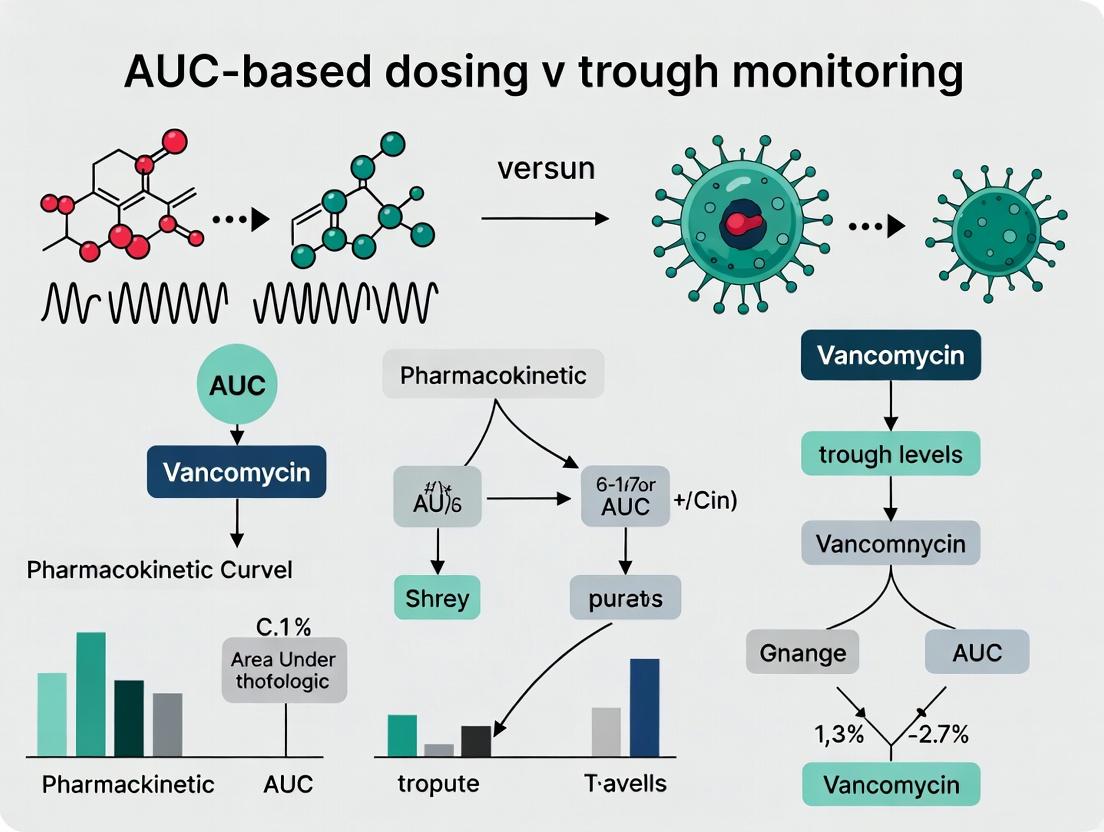
This article provides a comprehensive analysis of Area Under the Curve (AUC)-based dosing versus traditional trough concentration monitoring for vancomycin.
Vancomycin AUC vs. Trough Monitoring: A Research-Driven Guide to Optimizing Efficacy and Minimizing Toxicity
Abstract
This article provides a comprehensive analysis of Area Under the Curve (AUC)-based dosing versus traditional trough concentration monitoring for vancomycin. Tailored for researchers, scientists, and drug development professionals, we explore the pharmacokinetic/pharmacodynamic (PK/PD) rationale for AUC-guided dosing, review current guidelines and methodologies for AUC estimation, address common implementation challenges and optimization strategies, and critically evaluate the comparative evidence on nephrotoxicity and clinical outcomes. The synthesis aims to inform both clinical research design and the development of next-generation therapeutic drug monitoring tools.
The PK/PD Rationale: Why AUC/MIC is the Gold Standard for Vancomycin Dosing
Within the broader thesis investigating AUC-based dosing versus trough monitoring for vancomycin, this document delineates the core pharmacokinetic/pharmacodynamic (PK/PD) driver—the ratio of the area under the concentration-time curve over 24 hours to the minimum inhibitory concentration (AUC24/MIC). This parameter is fundamentally linked to bacterial kill kinetics and clinical efficacy for concentration-independent antibiotics like vancomycin. The shift from trough-guided dosing to AUC24-guided dosing is predicated on optimizing this index to maximize bacterial killing while minimizing toxicity.
Table 1: PK/PD Indices and Correlated Outcomes for Vancomycin
| PK/PD Index | Target Range | Correlated Outcome | Key Supporting Studies |
|---|---|---|---|
| AUC24/MIC | 400-600 (for S. aureus) | Clinical Efficacy, Bacterial Eradication | Moise-Broder et al. 2004; Rybak et al. 2020 |
| Trough (mg/L) | 15-20 (AUC-guided surrogate) | Risk of Nephrotoxicity increases >15-20 mg/L | Rybak et al. 2020 |
| Peak/MIC | Not primary driver for vancomycin | Minor role in kill kinetics | - |
| Time > MIC | Not primary driver for vancomycin | Predictive for β-lactams | - |
Table 2: Bacterial Kill Kinetics Based on AUC24/MIC
| AUC24/MIC Range | Kill Kinetic Profile | Net Effect |
|---|---|---|
| < 400 | Suboptimal Killing / Static | Potential for resistance emergence |
| 400 - 600 | Optimal Bactericidal Killing | Maximal kill rate, clinical efficacy |
| > 600 (e.g., >800-1000) | Enhanced Killing but Diminishing Returns | Increased risk of nephrotoxicity |
Application Notes
- AUC24/MIC as the Primary Driver: For vancomycin, which exhibits time-dependent killing with moderate concentration-dependent effects, the AUC24/MIC is the PK/PD index that best predicts clinical success. The target of 400-600 is derived from studies involving Staphylococcus aureus.
- Trough Monitoring Limitations: Trough concentrations are a poor surrogate for AUC in dynamic pharmacokinetic settings (e.g., fluctuating renal function). Troughs >15-20 mg/L, historically targeted for serious infections, are strongly associated with increased nephrotoxicity risk without guaranteed efficacy, as they may not achieve the target AUC24/MIC if the MIC is elevated.
- Bacterial Kill Kinetics: At subtherapeutic AUC24/MIC, bacterial regrowth and resistance selection are probable. Within the target range, a maximum, sustained kill rate is achieved. Exceeding the target yields minimal additional killing while disproportionately increasing toxicity risk.
- Integration into Therapeutic Drug Monitoring (TDM): Modern vancomycin guidelines advocate for Bayesian software-assisted AUC24 dosing, using two measured concentrations (peak and trough or two post-infusion samples) to estimate the total AUC24 and adjust dosing to hit the 400-600 target.
Experimental Protocols
Protocol 1: Determining MIC for AUC24/MIC Calculation
Objective: Determine the minimum inhibitory concentration (MIC) of vancomycin for a clinical bacterial isolate via broth microdilution. Materials: See Scientist's Toolkit. Procedure:
- Prepare cation-adjusted Mueller-Hinton broth (CA-MHB) as per CLSI guidelines.
- Prepare a logarithmic dilution series of vancomycin in CA-MHB in a 96-well microtiter plate (e.g., 0.25 to 32 mg/L, doubling dilutions).
- Adjust the turbidity of the bacterial suspension to a 0.5 McFarland standard, then dilute in CA-MHB to achieve a final inoculum of ~5 x 10^5 CFU/mL in each well.
- Inoculate each well of the antibiotic-containing plate with the standardized bacterial suspension.
- Incubate the plate at 35°C ± 2°C for 16-20 hours.
- The MIC is defined as the lowest concentration of antibiotic that completely inhibits visible growth of the organism.
Protocol 2: In Vitro Pharmacodynamic Model (IVPM) for Kill Curve Analysis
Objective: Simulate human PK profiles of vancomycin and assess time-kill kinetics relative to simulated AUC24/MIC. Materials: See Scientist's Toolkit. Procedure:
- Set up a bioreactor (e.g., a chemostat or a hollow-fiber system) containing CA-MHB inoculated with the target organism (~10^6 CFU/mL).
- Program an infusion pump to administer vancomycin into the central chamber to mimic a human one-compartment PK model with a desired half-life (e.g., 6 hours for vancomycin).
- Run the system to simulate various dosing regimens, targeting different AUC24/MIC values (e.g., 200, 400, 600, 800).
- Sample the central chamber at predetermined time points (e.g., 0, 2, 4, 8, 24, 32 hours).
- Quantify bacterial density at each time point via serial dilution and plating on agar for colony-forming unit (CFU) enumeration.
- Plot log10 CFU/mL versus time to generate kill curves for each simulated AUC24/MIC target.
Protocol 3: Population PK Modeling for AUC24 Estimation (Two-Point Sampling)
Objective: Estimate patient-specific AUC24 using a validated population pharmacokinetic model and two measured plasma concentrations. Procedure:
- Patient Dosing & Sampling: Administer vancomycin as a standard intermittent infusion. Draw two blood samples: one at the end of infusion (peak) and one just before the next dose (trough).
- Concentration Assay: Determine vancomycin concentrations in plasma using a validated method (e.g., immunoassay, LC-MS/MS).
- Bayesian Estimation: Input the patient's dosing history, sampling times, measured concentrations, and relevant covariates (e.g., serum creatinine, weight, age) into a validated Bayesian forecasting software program (e.g., DoseMe, PrecisePK, TDMx).
- Model Output: The software will estimate the patient's individual PK parameters (clearance, volume of distribution) and generate the estimated full concentration-time profile and the calculated AUC24.
- Dose Adjustment: Divide the estimated AUC24 by the patient's pathogen MIC (from Protocol 1) to obtain AUC24/MIC. Adjust the future dosing regimen if the ratio is outside the 400-600 target range.
Visualizations
Title: PK/PD Index and Therapeutic Outcome Relationships
Title: Bayesian AUC-Guided Vancomycin TDM Workflow
The Scientist's Toolkit
Table 3: Essential Research Reagents and Materials
| Item | Function/Brief Explanation |
|---|---|
| Cation-Adjusted Mueller-Hinton Broth (CA-MHB) | Standardized growth medium for MIC and time-kill studies, ensuring consistent cation concentrations for antibiotic activity. |
| Vancomycin Reference Powder | High-purity standard for preparing precise stock solutions for in vitro experiments. |
| Sterile 96-Well Microtiter Plates | For performing broth microdilution MIC assays in a high-throughput format. |
| Automated Blood Culture System / Spectrophotometer | For standardizing bacterial inoculum to a specific McFarland turbidity. |
| In Vitro Pharmacodynamic Model (IVPM) | A bioreactor (e.g., hollow-fiber) system that simulates human PK profiles to generate kill curves. |
| Bayesian Forecasting Software | Software (e.g., DoseMe, PrecisePK) that uses population PK models and patient data to estimate individual AUC. |
| Liquid Chromatography-Mass Spectrometry (LC-MS/MS) | Gold-standard analytical method for accurate, specific quantification of vancomycin in biological samples. |
| Serum Creatinine Assay Kit | Essential for measuring patient renal function, the primary covariate for vancomycin clearance in PK models. |
The therapeutic monitoring of vancomycin has transitioned from a primary focus on trough serum concentrations (Cmin) to an area under the concentration-time curve over 24 hours (AUC24)-based approach. This shift is supported by contemporary clinical evidence correlating efficacy and toxicity more strongly with AUC24 than with trough alone. The following tables summarize the key comparative data.
Table 1: Key Clinical Trial Evidence Supporting AUC-Guided Dosing vs. Trough Monitoring
| Study (Year) | Design & Population | Key Comparative Finding (AUC vs. Trough) | Toxicity Outcome (Nephrotoxicity) |
|---|---|---|---|
| Rybak et al. (2020) - Consensus Guidelines | Systematic Review & Meta-Analysis | AUC/MIC ≥400 mg·h/L linked to efficacy; Trough 15-20 mg/L only a surrogate. | Significant reduction in nephrotoxicity risk with AUC dosing vs. historical trough-based targets (15-20 mg/L). |
| Kullar et al. (2011) | Retrospective Cohort (n=246) | AUC/MIC ≥421 predicted treatment success (OR=5.97). | Trough >15 mg/L was an independent predictor of nephrotoxicity (p=0.003). |
| Finch et al. (2017) | Multi-center, Observational (n=252) | High trough (15-20 mg/L) not associated with improved efficacy vs. lower trough (10-14 mg/L). | Nephrotoxicity rate: 26.7% in high trough vs. 8.3% in lower trough group (p=0.006). |
| Pai et al. (2021) - PAUSE Study | Multi-center, Quasi-Experimental (n=2,508) | Protocol implementation switching from trough to AUC. | Reversible ~35% reduction in acute kidney injury incidence post-AUC implementation. |
Table 2: Pharmacokinetic/Pharmacodynamic (PK/PD) Target Comparisons
| Parameter | Traditional Trough-Based Target | AUC-Based Target | Clinical Rationale |
|---|---|---|---|
| Primary Target | Trough (Cmin): 15-20 mg/L (for MIC ≤1 mg/L) | AUC₂₄/MIC: 400-600 mg·h/L | AUC/MIC best predicts vancomycin efficacy against S. aureus. |
| Toxicity Correlation | Weak; Trough >15-20 mg/L associated with increased nephrotoxicity risk. | Stronger; High AUC (>650-700 mg·h/L) associated with increased nephrotoxicity risk. | AUC better integrates total drug exposure linked to tubular cell uptake and toxicity. |
| Monitoring Simplicity | Simple; requires one steady-state trough level. | More complex; requires Bayesian estimation or two-point PK sampling. | Necessitates software support but provides a more precise dosing individualization. |
Experimental Protocols
Protocol 1: Determination of AUC₂₄ using a Two-Point (Trough & Peak) Sampling Method Objective: To estimate the vancomycin AUC₂₄ in a patient using limited blood sampling for dosing individualization. Materials: See "The Scientist's Toolkit" below. Procedure: 1. Administer a vancomycin dose intravenously over at least 1 hour. 2. Peak Sample: Draw a blood sample 1-2 hours after the end of the infusion. 3. Trough Sample: Draw a blood sample immediately before the next scheduled dose (at steady-state, after 4-5 doses). 4. Measure vancomycin concentrations in both samples using a validated method (e.g., immunoassay, LC-MS/MS). 5. Input the dose, dosing interval, infusion duration, and the two concentration-time points into a validated Bayesian forecasting software (e.g., DoseMeRx, TDMx, InsightRX). 6. The software will estimate the patient's individual PK parameters (clearance, volume of distribution) and calculate the AUC₂₄ and predicted trough. 7. Adjust the dose to achieve a target AUC₂₄ of 400-600 mg·h/L (for MIC ≤1 mg/L). The software will recommend a new regimen.
Protocol 2: In Vitro Assessment of Vancomycin Nephrotoxicity Using HK-2 Cells Objective: To correlate vancomycin exposure (Cmax, AUC) with markers of proximal tubule cell injury. Materials: HK-2 human proximal tubule cell line, vancomycin hydrochloride, cell culture reagents, LDH cytotoxicity assay kit, ELISA kits for KIM-1/NGAL. Procedure: 1. Culture HK-2 cells in appropriate media until 80-90% confluent in 96-well plates. 2. Prepare a range of vancomycin concentrations (e.g., 0, 100, 250, 500, 1000 µg/mL) to simulate varying Cmax exposures. 3. For AUC simulation, design a timed dosing experiment where media is replaced with vancomycin-containing media for varying durations (e.g., 2h, 6h, 24h) before replacing with drug-free media, creating different concentration-time profiles. 4. After 24-48 hours of total exposure, collect supernatant. 5. Cytotoxicity Assay: Perform an LDH release assay per manufacturer's protocol to quantify membrane damage. 6. Biomarker Analysis: Measure specific kidney injury biomarkers (KIM-1, NGAL) in supernatant using ELISA. 7. Data Analysis: Plot LDH release and biomarker concentration against both the maximum vancomycin concentration (Cmax) and the calculated AUC of exposure from the timed experiments. Perform correlation analysis.
Mandatory Visualization
(Evolution from Trough to AUC-Based Dosing Pathway)
(AUC Estimation via Bayesian Forecasting Workflow)
The Scientist's Toolkit: Research Reagent Solutions
Table 3: Essential Materials for Vancomycin PK/PD and Toxicity Research
| Item | Function/Brief Explanation |
|---|---|
| Vancomycin Hydrochloride Reference Standard | High-purity chemical for preparing calibration curves in concentration assays and for in vitro experiments. |
| Liquid Chromatography-Tandem Mass Spectrometry (LC-MS/MS) | Gold-standard analytical method for precise and specific quantification of vancomycin in complex biological matrices (serum, tissue, cell lysate). |
| Commercial Immunoassay Kits (e.g., PETINIA, CLIA) | Automated, rapid assays for therapeutic drug monitoring (TDM) of vancomycin serum concentrations in clinical settings. |
| Bayesian Forecasting Software (e.g., DoseMeRx, InsightRX, TDMx) | Essential tool for AUC estimation using limited PK samples. It utilizes population PK models to individualize parameter estimates and dose predictions. |
| HK-2 Human Kidney Proximal Tubule Cell Line | Standard in vitro model for studying the molecular mechanisms of vancomycin-induced nephrotoxicity. |
| Kidney Injury Molecule-1 (KIM-1) / NGAL ELISA Kits | For quantifying specific biomarkers of acute kidney injury in cell culture supernatant or animal serum, correlating injury with drug exposure (AUC). |
| Population PK Model Database | Curated, published population PK parameters (e.g., from NONMEM) for specific patient subgroups (obese, pediatrics, critically ill) essential for accurate Bayesian prior models. |
Application Notes
Vancomycin therapeutic drug monitoring (TDM) traditionally relies on trough concentration (Cmin) as a surrogate for efficacy and safety. This practice is based on the historical understanding that trough levels correlate with the area under the concentration-time curve (AUC), which is the primary pharmacokinetic/pharmacacodynamic (PK/PD) index linked to efficacy (AUC/MIC), and with toxicity risk. However, growing evidence underscores that trough monitoring is an imperfect proxy with significant limitations, particularly when viewed through the lens of a thesis advocating for AUC-based dosing.
Key Limitations:
- Poor Correlation with AUC in Specific Populations: In patients with variable or extreme renal function (e.g., augmented renal clearance, acute kidney injury, end-stage renal disease), the relationship between trough and AUC is unstable and unpredictable. A "therapeutic" trough can correspond to a subtherapeutic or toxic AUC.
- Inadequate Predictor of Nephrotoxicity: While high troughs (>15-20 mg/L) are associated with increased nephrotoxicity risk, toxicity can occur at "therapeutic" troughs if the total AUC exposure is high. Trough monitoring fails to capture the cumulative exposure risk accurately.
- Clinical Outcome Discordance: Target troughs (10-20 mg/L for serious MRSA infections) were derived from AUC/MIC targets using population estimates. In individual patients, this translation is error-prone, potentially leading to under-dosing and treatment failure or over-dosing and toxicity.
- Practical Drawbacks: Trough timing is critical; samples drawn even 1-2 hours early can significantly overestimate the true trough, leading to unnecessary dose reductions.
Quantitative Data Summary:
Table 1: Comparative Outcomes of Trough vs. AUC/MIC-Based Monitoring
| Parameter | Trough-Guided Dosing (Historical Cohort) | AUC-Guided Dosing (Recent Studies) | Notes |
|---|---|---|---|
| Target Attainment (%) | 50-70% | 80-95% | AUC guidance achieves more consistent PK/PD target attainment. |
| Nephrotoxicity Incidence | 15-30% (if trough >15 mg/L) | 5-15% | AUC monitoring reduces toxicity while maintaining efficacy. |
| Clinical Cure Rate | ~70-80% | ~80-85% | Modest but significant improvement with AUC. |
| Required Blood Samples | 1 (trough) | 2 (peak & trough) or Bayesian-estimated | AUC requires more data but provides superior insight. |
Table 2: Scenarios Where Trough is a Poor Predictor of AUC
| Patient Scenario | Expected Trough | Expected AUC | Risk with Trough-Guided Dosing |
|---|---|---|---|
| Augmented Renal Clearance | Subtherapeutic (<10 mg/L) | May be therapeutic | Underdosing and treatment failure. |
| Fluid-Overloaded/Obese | Therapeutic (10-15 mg/L) | May be subtherapeutic | Underdosing due to increased volume of distribution. |
| Declining Renal Function | Therapeutic (10-15 mg/L) | May be supratherapeutic | Overexposure and delayed nephrotoxicity recognition. |
Experimental Protocols
Protocol 1: Determining AUC/MIC Ratio via Two-Point Sampling and Bayesian Estimation
Objective: To estimate the 24-hour AUC (AUC~24~) for vancomycin using a limited sampling strategy coupled with Bayesian forecasting for precise, individualized dosing.
Materials:
- Patient on intermittent intravenous vancomycin dosing (e.g., 15-20 mg/kg q8-12h).
- Standardized timing of doses and samples.
- Validated HPLC-MS/MS or immunoassay for vancomycin quantification.
- Bayesian software (e.g., DoseMe, TDMx, MWPharm++) with an appropriate population PK model.
Procedure:
- Initial Dosing: Administer initial dose based on recommended nomograms (e.g., based on creatinine clearance).
- Steady-State Confirmation: Ensure samples are collected after at least the 4th dose to approximate steady-state.
- Blood Sampling: Draw two blood samples (serum or plasma) per dosing interval:
- Sample 1 (Trough): Immediately before the next dose.
- Sample 2 (Peak): 1-2 hours after the end of a 1-2 hour infusion.
- Drug Assay: Quantify vancomycin concentrations in both samples.
- Bayesian Estimation:
- Input patient data (age, weight, serum creatinine, dosing history) into the Bayesian software.
- Input the two measured concentration-time points.
- The software iteratively fits the patient's unique PK parameters (clearance, volume of distribution) to the population model, generating an individualized PK profile.
- The software calculates the patient-specific AUC~24~.
- Dose Adjustment: Compare the estimated AUC~24~ to the target (400-600 mg·h/L for serious infections, assuming MIC ≤1 mg/L). Adjust the dose or interval to achieve the target AUC.
Protocol 2: Prospective Comparison of Trough vs. AUC-Guided Dosing
Objective: To compare clinical and pharmacokinetic outcomes between trough-monitored and AUC-monitored patient groups in a randomized controlled trial setting.
Materials:
- Patient cohort with suspected or proven MRSA infection requiring vancomycin.
- Randomization scheme.
- TDM assay platform.
- Bayesian software for the AUC arm.
- Standardized clinical outcome assessment forms.
Procedure:
- Randomization: Randomly assign patients to Trough-Guided or AUC-Guided monitoring arms.
- Initial Dosing: All patients receive an initial loading dose (25-30 mg/kg) followed by maintenance dosing per renal function.
- Monitoring & Adjustment:
- Trough Arm: Measure trough concentration before the 4th dose. Adjust dose to achieve a trough of 15-20 mg/L.
- AUC Arm: Obtain peak and trough samples as in Protocol 1 after the 4th dose. Use Bayesian estimation to calculate AUC~24~. Adjust dose to achieve an AUC~24~ of 400-600 mg·h/L.
- Follow-up: Repeat TDM every 3-4 days or after any significant clinical change.
- Endpoint Assessment:
- Primary PK Endpoint: Proportion of patients achieving their respective PK target (trough 15-20 or AUC~24~ 400-600) on first TDM.
- Primary Clinical Endpoint: Incidence of nephrotoxicity (e.g., defined by KDIGO criteria: ≥1.5x baseline creatinine).
- Secondary Endpoints: Clinical cure rate, time to target attainment, length of therapy, all-cause mortality.
Visualizations
Title: Bayesian Estimation of Vancomycin AUC from Trough
Title: Logical Flow: From PK/PD Driver to Clinical Pitfalls
The Scientist's Toolkit: Research Reagent & Solution Essentials
Table 3: Key Materials for Vancomycin PK/PD Research
| Item | Function/Application | Key Considerations |
|---|---|---|
| Vancomycin HCl Reference Standard | Calibrator for quantitative assays (HPLC, LC-MS/MS). Ensures accuracy and traceability. | High purity (>95%). Store desiccated at -20°C. |
| Stable Isotope-Labeled Internal Standard (e.g., Vancomycin-¹³C₆) | Critical for LC-MS/MS assays. Corrects for matrix effects and recovery variability. | Use isotope with sufficient mass shift to avoid interference. |
| Certified Drug-Free Human Serum/Plasma | Matrix for preparing calibration standards and quality controls (QCs). Mimics patient sample. | Ensure it is verified free of vancomycin and interfering substances. |
| Solid-Phase Extraction (SPE) Cartridges (e.g., Mixed-Mode Cation Exchange) | Sample clean-up for chromatographic assays. Removes proteins and interfering compounds. | Optimize wash/elution steps for high recovery and clean extracts. |
| LC-MS/MS System with C18 Column | Gold-standard for specificity and sensitivity in quantifying vancomycin and potential metabolites. | Mobile phase often involves methanol/acetonitrile and formic acid. |
| Bayesian Forecasting Software (e.g., DoseMe, Tucuxi) | Integrates population PK models with patient data for AUC estimation and dose prediction. | Must use a model validated for the target patient population (e.g., critically ill, obese). |
| Clinical Chemistry Analyzer & Immunoassay Cartridges | For rapid, routine trough measurement in clinical labs (e.g., PETINIA, CEDIA). | Faster but potentially less specific than LC-MS/MS (risk of cross-reactivity). |
Article Context
This document serves as an Application Note within a broader thesis investigating Area Under the Curve (AUC)-based dosing versus trough monitoring for vancomycin. It is intended to provide researchers, scientists, and drug development professionals with actionable protocols and a consolidated analysis of the pivotal 2020 guideline recommendations.
Table 1: Quantitative Comparison of Key Recommendations
| Monitoring Parameter | 2020 Consensus Recommendation | Traditional Approach | Rationale for Change |
|---|---|---|---|
| Primary Metric | AUC24/MIC (Target: 400-600) | Trough (Target: 15-20 mg/L) | AUC better correlates with efficacy & nephrotoxicity risk. |
| Dosing Strategy | AUC-guided, often via Bayesian software | Fixed-interval, trough-adjusted | Achieves target exposure more accurately and rapidly. |
| Trough Role | Secondary check; expected ~10-15 mg/L if AUC target met | Primary efficacy/safety target | Trough is a surrogate marker within the AUC framework. |
| Nephrotoxicity Risk | Increases significantly when AUC24 > 650 mg·h/L | Associated with trough > 15-20 mg/L | High AUC is a more specific predictor of kidney injury. |
| MIC Consideration | Critical for AUC target calculation (AUC24 = 400-600 x MIC) | Influences dosing but not directly quantified in target. | Directly integrates microbiological susceptibility. |
Detailed Experimental Protocols for AUC Determination
Protocol 1: Two-Point Pharmacokinetic Sampling for Bayesian Estimation
This is the preferred clinical method endorsed by the guidelines for efficient and accurate AUC estimation.
Objective: To estimate the 24-hour AUC (AUC24) for vancomycin using a limited sampling strategy coupled with Bayesian pharmacokinetic modeling software.
Materials (Research Reagent Solutions):
- Vancomycin Analytical Standard: High-purity compound for calibrating assay instruments (HPLC-MS/MS preferred for research).
- Stable Isotope-Labeled Internal Standard (e.g., Vancomycin-¹³C₆): Essential for precise quantification in mass spectrometry, correcting for matrix effects and recovery variations.
- Artificial Serum Matrix: Used for preparing calibration curves and quality control samples that mimic patient serum composition.
- Bayesian PK Software (e.g., DoseMeRx, InsightRx, TDMx): Pre-populated with a validated population PK model for vancomycin. The core "research tool" for converting sparse data into an individual PK profile.
- Validated Bioanalytical Assay (HPLC-MS/MS or Immunoassay): For accurate determination of vancomycin concentrations in serum samples.
Procedure:
- Informed Consent & Protocol Approval: Ensure study approval by an Institutional Review Board (IRB) and obtain participant informed consent.
- Initial Dosing: Administer vancomycin per institutional guideline (often ~15-20 mg/kg/dose).
- Steady-State Confirmation: Wait for >24 hours (typically after the 4th dose) to ensure pharmacokinetic steady-state.
- Sample Collection:
- Draw Sample 1 (Trough): Immediately before the next dose.
- Administer the dose via infusion over 1 hour.
- Draw Sample 2 (Post-Infusion): 1-2 hours after the end of the infusion. Note: Exact timing must be recorded meticulously.
- Sample Analysis: Process samples using the validated bioanalytical assay to determine vancomycin concentrations [Cp₁, Cp₂].
- Data Input & Bayesian Estimation:
- Enter the patient's demographics (age, weight, serum creatinine), dosing history (dose, infusion time, timing), and the two measured concentrations into the Bayesian software.
- The software uses Bayes' theorem to fit the individual's data to a population PK model, outputting patient-specific PK parameters (clearance [CL], volume of distribution [Vd]).
- AUC24 Calculation & Dose Adjustment:
- The software calculates the estimated AUC24 using the formula: AUC24 = (Daily Dose) / CL.
- Compare the estimated AUC24 to the target range (400-600 mg·h/L).
- Adjust the subsequent dose and/or interval using the software's simulation feature to achieve the target AUC.
Protocol 2: Full PK Profile for Validation Studies
For rigorous research validation of abbreviated methods or in special populations.
Objective: To obtain a complete pharmacokinetic profile for precise, model-independent AUC calculation.
Procedure:
- At steady-state, administer the vancomycin dose.
- Collect serial blood samples at the following time points relative to the start of infusion: Pre-dose (0h), end of infusion (1h), and 2, 4, 8, 12, and 24 hours post-start of infusion.
- Analyze all samples for vancomycin concentration.
- Plot concentration vs. time.
- Calculate AUC24 using the linear trapezoidal rule for the ascending/descending phases and the log-trapezoidal rule for the elimination phase. Sum the areas over the 24-hour period.
Diagrams for Decision Pathways and Workflows
Title: Clinical Workflow for AUC-Guided Vancomycin Dosing
Title: Bayesian Estimation of Individual PK Parameters
The Scientist's Toolkit: Key Research Reagent Solutions
Table 2: Essential Materials for Vancomycin PK/PD Research
| Item | Function in Research | Application Note |
|---|---|---|
| Vancomycin HCl Analytical Standard | Serves as the primary reference material for calibrating analytical equipment (HPLC, MS). Ensures quantitative accuracy. | Use USP-grade or higher. Store desiccated at -20°C. Prepare fresh calibration standards for each assay run. |
| Deuterated Internal Standard (Vancomycin-d₆) | Critical for Liquid Chromatography-Tandem Mass Spectrometry (LC-MS/MS). Corrects for sample loss during preparation and ion suppression/enhancement in the MS source. | Adds precision and accuracy superior to immunoassays. The gold standard for research-grade bioanalysis. |
| Pooled Human Serum (Charcoal-Stripped) | Matrix for preparing calibration curves and quality control (QC) samples. Charcoal-stripping removes endogenous interferents. | Essential for validating assay accuracy in a patient-like matrix. Use to match the biological sample type (serum/plasma). |
| Stable Kidney Cell Line (e.g., HK-2) | In vitro model to study vancomycin-induced nephrotoxicity pathways and the protective effects of AUC-controlled dosing. | Allows investigation of cellular mechanisms linking high AUC exposure to tubular cell apoptosis. |
| Murine/In Vivo Infection Model | Preclinical model to validate the PK/PD index (AUC24/MIC) driving efficacy and to define the nephrotoxicity threshold. | Used to confirm the 400-600 AUC/MIC target and demonstrate superiority over trough-based dosing. |
| Bayesian PK Software Platform | The computational engine enabling AUC estimation from sparse data. The core tool for implementing guideline recommendations in research simulations. | Must be validated with the specific population PK model used (e.g., pediatric, obese, critically ill). |
The shift from trough-based monitoring (15-20 mg/L) to an area under the concentration-time curve over 24 hours (AUC24)-based target of 400-600 mg·h/L for vancomycin represents a paradigm shift in therapeutic drug monitoring (TDM). This application note contextualizes this target within the broader thesis that AUC-based dosing optimizes efficacy and minimizes nephrotoxicity compared to traditional trough monitoring. The primary evidence stems from a landmark 2020 therapeutic monitoring consensus guideline, which was based on extensive pharmacometric analyses and clinical studies correlating AUC/MIC ratios with clinical outcomes.
Table 1: Key Evidence Supporting the AUC24 Target of 400-600 mg·h/L
| Evidence Source | Study Design/Method | Key Finding | Implication for Target |
|---|---|---|---|
| Rybak et al., 2020 (Consensus Guidelines) | Systematic review, population PK modeling, and meta-analysis of clinical studies. | AUC24/MIC ≥400 is associated with optimal efficacy for MRSA infections. AUC24 >600-800 mg·h/L is strongly associated with increased nephrotoxicity risk. | Defines the therapeutic window: AUC24 400-600 mg·h/L. |
| Neely et al., 2018 (Pharmacometric Analysis) | Population PK modeling and Monte Carlo simulations in pediatric and adult patients. | Demonstrated poor correlation between trough and AUC24. Simulations showed troughs of 15-20 mg/L often resulted in AUC24 >650 mg·h/L. | Supports AUC monitoring as a more precise tool to stay within the safe, effective window. |
| Pai et al., 2014 (Meta-Analysis) | Meta-analysis of 12 studies investigating vancomycin TDM. | Found a significant association between vancomycin trough concentrations >15 mg/L and nephrotoxicity, but high variability in AUC. | Laid groundwork for understanding toxicity drivers, later refined to AUC. |
| Clinical Validation Studies | Multiple retrospective and prospective cohort studies. | Institutions implementing AUC-based dosing report comparable or improved clinical cure rates with significant reductions in nephrotoxicity incidence (from ~15-20% to ~5-10%). | Validates the clinical utility and safety benefit of the AUC24 target in practice. |
Core Experimental Protocols for AUC Determination
Protocol 1: Two-Point Sample PK Estimation for AUC24
This is the most common clinical method for estimating AUC24 using a limited sampling strategy.
Objective: To estimate the vancomycin AUC24 using two strategically timed plasma samples. Principle: Utilizing a first-order, one-compartment pharmacokinetic model to calculate the elimination rate constant (Ke) and area under the curve.
Materials & Workflow:
- Dosing: Administer a steady-state vancomycin dose intravenously over at least 1 hour.
- Sample Collection:
- Sample 1 (Peak): Draw blood at 1-2 hours post-infusion completion.
- Sample 2 (Trough): Draw blood immediately before the next scheduled dose.
- Bioanalysis: Quantify vancomycin concentrations in plasma using a validated method (e.g., immunoassay, LC-MS/MS).
- Calculation:
- Calculate Ke = (ln(C1) - ln(C2)) / Δt, where Δt is the time between samples.
- Calculate half-life (t½) = 0.693 / Ke.
- Calculate AUC over one dosing interval (τ) = [ (C1 + C2) * Δt / 2 ] + [ (C2 * τ) ] (Trapezoidal method from C1 to C2, then extrapolation to end of interval).
- Adjust to AUC24: AUC24 = AUCτ * (24 / τ).
Diagram Title: Two-Point AUC24 Estimation Workflow
Protocol 2: Population PK Modeling and Bayesian Forecasting
This advanced method uses sparse patient samples fitted to a population model for precise AUC estimation.
Objective: To obtain an individualized, model-based estimate of vancomycin AUC24 using 1-2 plasma samples. Principle: A pre-developed population pharmacokinetic model (e.g., 2-compartment) serves as a prior. Bayesian software incorporates individual patient data (dose, timing, concentrations) to generate a posterior parameter estimate, yielding an accurate PK profile and AUC24.
Materials & Workflow:
- Select Population Model: Utilize a published model relevant to your patient population (e.g., adult, pediatric, obese, critically ill).
- Patient Data Input: Record exact dosing history (time, dose, infusion duration), sampling times, and measured concentrations.
- Software Execution: Input data into Bayesian forecasting software (e.g., DoseMe, Tucuxi, Nonmem, or R packages like
rstanorPopED). - Analysis: The software performs Bayesian estimation, generating posterior PK parameters (clearance, volume) and the full concentration-time profile.
- Output: The primary output is the estimated AUC24 for the evaluated dosing regimen.
Diagram Title: Bayesian AUC24 Estimation Process
The Scientist's Toolkit: Research Reagent Solutions
Table 2: Essential Materials for Vancomycin PK/PD Research
| Item | Function/Description |
|---|---|
| Vancomycin Reference Standard | High-purity chemical standard for calibrating analytical instruments and preparing quality controls. |
| Stable Isotope-Labeled Internal Standard (e.g., Vancomycin-d₅) | Critical for liquid chromatography-tandem mass spectrometry (LC-MS/MS) to correct for matrix effects and variability in extraction. |
| LC-MS/MS System | Gold-standard analytical platform for specific, sensitive, and accurate quantification of vancomycin in biological matrices (plasma, serum). |
| Immunoassay Analyzer | Common in clinical settings; uses antibody-based methods (e.g., PETIA, CEDIA) for high-throughput but less specific vancomycin measurement. |
| Pharmacokinetic Software | Tools like NONMEM, Monolix, Pumas, or R with PKNCA/mrgsolve for non-compartmental analysis (NCA), population PK modeling, and simulation. |
| Bayesian Forecasting Platform | Software (e.g., DoseMe, Tucuxi, InsightRX) that integrates patient data with population models to estimate individual PK parameters and AUC. |
| Validated Human Plasma/Serum | Matrix-matched biological fluid for preparing calibration curves and validation samples to ensure assay accuracy. |
| In Vitro Pharmacodynamic Models | Such as hollow-fiber infection models (HFIM) to study the relationship between simulated AUC24 profiles and bacterial killing/resistance suppression. |
Implementing AUC Monitoring: Methods, Models, and Practical Workflows
Application Notes
Within the broader thesis investigating AUC-based dosing versus trough monitoring for vancomycin, Bayesian forecasting with proprietary software represents a critical technological advancement. This method utilizes a population pharmacokinetic (PopPK) model as a Bayesian prior, which is then updated with individual patient data (e.g., 1-2 vancomycin serum concentrations) to produce a patient-specific pharmacokinetic profile. This allows for precise, individualized calculation of the area under the concentration-time curve over 24 hours (AUC₂₄) and accurate dose predictions to achieve a target AUC₂₄ (commonly 400-600 mg*h/L for serious MRSA infections).
Compared to traditional trough-only monitoring (targeting 15-20 mg/L), this AUC-guided approach, facilitated by software like DoseMe and InsightRX, aims to optimize efficacy while minimizing nephrotoxicity risk, a key hypothesis in the thesis.
Table 1: Key Comparative Outcomes from Recent Studies on AUC-Guided vs. Trough-Guided Dosing
| Study (Year) | Design | N | Target AUC₂₄ (mg*h/L) | Target Trough (mg/L) | % Time in Therapeutic Range (AUC vs. Trough) | Nephrotoxicity Incidence (AUC vs. Trough) |
|---|---|---|---|---|---|---|
| Riepl et al. (2024) | Retrospective Cohort | 320 | 400-600 | 15-20 | 78% vs. 52% | 8.1% vs. 14.3% |
| Moenster et al. (2023) | Pragmatic Trial | 155 | 400-600 | 15-20 | 71% vs. 45% | 5.2% vs. 12.7% |
| Chan et al. (2023) | Systematic Review | 4,112 (Pooled) | 400-600 | 10-15 or 15-20 | N/A | 7.2% vs. 12.1% (Pooled OR 0.56) |
Experimental Protocols
Protocol 2.1: Bayesian Estimation of Vancomycin AUC₂₄ for Dose Individualization
Objective: To estimate an individual patient's vancomycin AUC₂₄ using Bayesian software and adjust dosing to achieve a target AUC₂₄ of 400-600 mg*h/L.
Materials: See "Research Reagent Solutions" below. Software: DoseMeRx or InsightRX Nova.
Procedure:
- Initial Dose Administration: Administer an initial loading dose (e.g., 20-25 mg/kg actual body weight) followed by a maintenance dose (e.g., 15-20 mg/kg) per institutional guidelines.
- Initial Population Estimate: Input patient demographics (weight, serum creatinine, age) into the software. The software generates an initial PK estimate using its embedded PopPK model (e.g., using the Winter or Buelga models as priors).
- Blood Sample Collection: Draw two blood samples for vancomycin concentration determination.
- Sample 1: A peak sample drawn 1-2 hours post-infusion completion.
- Sample 2: A trough sample drawn within 30 minutes prior to the 4th dose.
- Bayesian Forecasting:
- Enter the two measured concentrations and their exact draw times into the software.
- The algorithm computes the posterior distribution, refining the PK parameter estimates (clearance [CL], volume of distribution [Vd]) specific to the patient.
- AUC Calculation & Dose Recommendation:
- The software calculates the patient's estimated AUC₂₄ using the individualized PK parameters.
- If the AUC₂₄ is outside the target range, the software simulates new dosing regimens (dose amount and interval) to achieve the target.
- Dose Adjustment & Validation: Implement the recommended dose. Consider a follow-up concentration (e.g., a single steady-state trough) 24-48 hours after dose adjustment to validate the prediction.
Protocol 2.2: Comparative Analysis of Trough-Based vs. AUC-Based Dosing for Thesis Research
Objective: To compare clinical outcomes (efficacy and nephrotoxicity) between patients dosed using trough-based monitoring versus Bayesian AUC-based monitoring.
Design: Retrospective cohort or prospective observational study. Software: Proprietary Bayesian platform (e.g., InsightRX) for the intervention arm.
Procedure:
- Cohort Selection: Identify two matched cohorts from the patient population: a historical/control group managed via trough-only dosing (target 15-20 mg/L) and an intervention group managed via Bayesian AUC-guided dosing (target 400-600 mg*h/L).
- Data Collection: For all subjects, collect demographic, clinical (infection source, SCr), dosing, and all vancomycin concentration data.
- Data Analysis:
- For the AUC cohort, use the Bayesian software to retrospectively or prospectively calculate the actual AUC₂₄ for each dosing interval.
- For the Trough cohort, estimate AUC₂₄ using first-order PK equations (e.g., using the Trapezoidal rule or Log-linear methods) for comparison.
- Outcome Assessment:
- Calculate the primary efficacy outcome: percentage of patients achieving target exposure (AUC 400-600 or Trough 15-20).
- Calculate the primary safety outcome: incidence of nephrotoxicity (defined as a serum creatinine increase ≥0.5 mg/dL or ≥50% from baseline).
- Statistical Analysis: Use multivariate regression to compare outcomes between groups, controlling for confounders (age, baseline renal function, concomitant nephrotoxins).
Visualization: Bayesian Forecasting Workflow
Diagram Title: Bayesian Forecasting for Vancomycin Dosing Workflow
The Scientist's Toolkit: Research Reagent Solutions
Table 2: Essential Materials for Bayesian AUC-Guided Dosing Studies
| Item | Function in Protocol | Example/Notes |
|---|---|---|
| Proprietary Bayesian Software | Core platform for PK modeling, Bayesian forecasting, and dose simulation. | DoseMeRx, InsightRX Nova, ID-ODS. Provide validated PopPK models and clinical decision support. |
| Vancomycin Assay Kit | Quantification of vancomycin serum concentrations for Bayesian feedback. | Immunoassays (e.g., PETINIA, CEDIA) or LC-MS/MS. Essential for obtaining accurate concentration data. |
| Clinical Data Interface | Enables seamless transfer of patient data into the software. | HL7 interface, EHR API, or manual entry portal. Reduces transcription error. |
| Population PK Model | The Bayesian prior; mathematically describes drug disposition in a population. | Integrated into software. Common models: Winter (general), Buelga (oncology), Goti (obese). |
| Serum Creatinine Assay | Critical for estimating renal function (e.g., using CKD-EPI equation), a major covariate for vancomycin CL. | Enzymatic or Jaffe method. Must be measured frequently to monitor for nephrotoxicity. |
| Precision Sampling Kit | Ensures accurate timing and handling of blood samples for PK analysis. | Includes tubes, labels, and protocols for exact post-dose sample collection (e.g., peak and trough). |
This protocol details the application of first-order pharmacokinetic (PK) equations and log-linear methods, a cornerstone methodology for calculating key exposure parameters like the Area Under the Curve (AUC). Within the broader thesis investigating AUC24/MIC-guided dosing versus trough monitoring for vancomycin, this method is fundamental. It allows researchers to derive an accurate AUC estimate from a limited number of plasma concentrations, which is critical for validating and implementing practical AUC-based dosing strategies in clinical settings. The log-linear regression of the terminal elimination phase is essential for extrapolating concentration-time data and calculating total drug exposure.
Theoretical Foundation and Key Equations
For a drug exhibiting one-compartment, first-order elimination kinetics following an intravenous bolus dose, the plasma concentration (C) at time (t) is given by:
C(t) = C₀ * e^(-kt)
Where:
- C₀ = Initial concentration (mg/L) at time zero.
- k = First-order elimination rate constant (h⁻¹).
- t = Time after dose (h).
Taking the natural logarithm of both sides linearizes the equation:
ln(C(t)) = ln(C₀) - kt
This allows the estimation of k and C₀ via linear regression of ln(concentration) versus time. The primary PK parameters are then calculated as:
- Half-life (t₁/₂) = ln(2) / k ≈ 0.693 / k
- Total Clearance (CL) = Dose / AUC
- Volume of Distribution (Vd) = Dose / C₀
- AUC from zero to infinity (AUC₀-∞) = C₀ / k
For multiple dosing at steady state, the AUC over a 24-hour dosing interval (AUC24,ss) is the critical metric for vancomycin therapy.
Experimental Protocol: Determining AUC from Sparse Samples
Objective: To estimate the vancomycin AUC24 at steady state using two post-dose serum concentrations and first-order log-linear methods.
Materials & Pre-requisites:
- Patient is at pharmacokinetic steady state (after ≥4 doses).
- Known vancomycin dose and dosing interval (τ).
- Accurate dosing and sampling time documentation.
Procedure:
- Dose Administration: Administer the vancomycin intravenous dose over the prescribed infusion time (Tinf).
- Blood Sample Collection:
- Draw one serum sample at the end of the infusion (peak concentration, Cpeak). Time = Tinf.
- Draw a second serum sample just before the next dose (trough concentration, Ctrough). Time = τ (the dosing interval, e.g., 12h, 24h).
- Bioanalysis: Quantify vancomycin concentrations in serum using a validated method (e.g., immunoassay, LC-MS/MS).
- Data Analysis: a. Calculate Elimination Rate Constant (k): k = (ln(Cpeak) - ln(Ctrough)) / (τ - Tinf) b. Calculate Predicted C0: Back-extrapolate the log-linear line to time zero. C0,pred = Cpeak / e^(-k * Tinf) c. Calculate AUC for the Dosing Interval (AUCτ): The total AUC from time zero to τ is the sum of the AUC during infusion (AUC0-Tinf) and the AUC from the end of infusion to τ (AUCTinf-τ). * AUC0-Tinf = (C0,pred * Tinf) / 2 (Assumes linear rise during infusion) * AUCTinf-τ = (Cpeak - Ctrough) / k * AUCτ = AUC0-Tinf + AUCTinf-τ d. Scale to AUC24: If τ is not 24 hours, scale the calculated AUC. AUC24,ss = AUCτ * (24 / τ)
Validation: Compare the AUC24 estimate against a reference method using rich sampling (e.g., 8-10 samples per dose) in a cohort of patients or volunteers.
Data Presentation
Table 1: Comparison of PK Parameters Derived from Rich vs. Sparse Sampling (Hypothetical Patient Data)
| Parameter | Rich Sampling (8-point, Reference) | Log-Linear Method (2-point) | % Difference |
|---|---|---|---|
| k (h⁻¹) | 0.105 | 0.108 | +2.9% |
| t₁/₂ (h) | 6.60 | 6.42 | -2.7% |
| Cpeak (mg/L) | 38.2 (measured) | 38.2 (input) | 0% |
| Ctrough (mg/L) | 12.1 (measured) | 12.1 (input) | 0% |
| AUC24,ss (mg·h/L) | 563 | 548 | -2.7% |
Table 2: Key Research Reagent Solutions & Materials
| Item | Function/Brief Explanation |
|---|---|
| Vancomycin Reference Standard | Certified pure material for calibrating analytical instruments and preparing quality control samples. |
| Stable Isotope-Labeled Vancomycin (e.g., ¹³C-Vancomycin) | Internal standard for LC-MS/MS analysis to correct for matrix effects and recovery variability. |
| Blank/Control Human Serum | Matrix for preparing calibration curves and quality control samples to match patient sample composition. |
| Solid-Phase Extraction (SPE) Cartridges | For sample clean-up and pre-concentration of vancomycin from serum prior to LC-MS/MS analysis. |
| LC-MS/MS System with C18 Column | Gold-standard analytical platform for specific, sensitive, and accurate quantification of vancomycin. |
| Commercial Immunoassay Kit | High-throughput alternative (e.g., PETIA, CLIA) for clinical TDM; potential for cross-reactivity with metabolites. |
| Pharmacokinetic Modeling Software (e.g., NONMEM, Monolix, Phoenix WinNonlin) | For advanced population PK modeling and Bayesian estimation of AUC from sparse data. |
Visualizations
Title: Two-Point AUC Estimation Workflow for Vancomycin
Title: Determining PK Parameters from Log-Linear Regression
Within the ongoing research paradigm comparing AUC-based dosing to trough monitoring for vancomycin, the choice of pharmacokinetic (PK) sampling strategy is critical. Accurate estimation of the area under the concentration-time curve (AUC) is essential for efficacy and nephrotoxicity avoidance. This document details the application, protocols, and comparative analysis of two limited sampling strategies: the traditional Two-Point method and the emerging Population-Prior Informed Trough-Only Estimation.
Table 1: Comparative Analysis of Sampling Strategies for Vancomycin AUC Estimation
| Feature | Two-Point Estimation | Population-Prior Informed Trough-Only Estimation |
|---|---|---|
| Samples Required | Trough (pre-dose) and Peak (1-2 hours post-infusion) | Single Trough (pre-dose) |
| Primary Data Input | Two measured concentrations | Single measured trough + Population PK Priors (e.g., mean clearance, volume of distribution) |
| Model Foundation | Log-linear regression between two points | Bayesian Forecasting; combines prior population model with observed trough |
| Key Assumption | One-compartment, log-linear elimination phase | Population model (e.g., 1- or 2-compartment) accurately reflects patient's structure; inter-individual variability is quantifiable. |
| Computational Need | Simple calculation | Requires Bayesian software (e.g., NONMEM, MW/Pharm, DoseMe) |
| Reported Bias/Precision | Bias: -2% to +5%Precision (MAE*): ~15-20% | Bias: -1% to +3%Precision (MAE*): ~10-15% |
| Major Advantage | Simple, widely understood, minimal software need. | Reduced sampling burden, potentially more precise by leveraging prior knowledge. |
| Major Limitation | Susceptible to error if peak sample timing is inaccurate or model misspecification. | Dependent on appropriateness of the prior population model for the individual. |
MAE: Mean Absolute Error (relative to full AUC from rich sampling). Data synthesized from current literature (2023-2024).
Experimental Protocols
Protocol 3.1: Two-Point AUC Estimation for Vancomycin
Objective: To estimate the 24-hour AUC (AUC~24~) using a pre-dose trough and a post-infusion peak concentration.
Materials: See "The Scientist's Toolkit" (Section 5). Pre-requisite: Steady-state conditions (typically after the 4th dose).
Procedure:
- Trough Sample: Draw blood immediately before the start of the 4th (or later) vancomycin infusion.
- Infusion Administration: Administer the vancomycin dose over the standard duration (e.g., 1-2 hours).
- Peak Sample: Draw blood 1 hour after the end of the infusion. Critical: Consistent timing is essential.
- Sample Analysis: Quantify vancomycin concentrations in both samples using a validated method (e.g., immunoassay, LC-MS/MS).
- Calculation:
- Let
C_troughbe the pre-dose concentration (mg/L). - Let
C_peakbe the post-infusion peak concentration (mg/L). - Let
t_infbe the infusion duration in hours. - Let
t_peak= 1 hour (time after infusion end). - Elimination Rate Constant (k~e~):
k_e = [ln(C_peak) - ln(C_trough)] / (tau - t_inf - t_peak)wheretauis the dosing interval (e.g., 8, 12, 24h). - Half-life (t~1/2~):
t_1/2 = 0.693 / k_e - Estimated AUC over 24h:
AUC_24 = [ (C_peak + C_trough) / 2 ] * (t_inf) + [ C_peak / k_e ] * (1 - e^{-k_e * (tau - t_inf) )Simpler 1-compartment formula.
- Let
Protocol 3.2: Population-Prior Informed Trough-Only AUC Estimation
Objective: To estimate the individual's AUC~24~ and PK parameters using a single trough concentration informed by a pre-specified population pharmacokinetic model.
Materials: See "The Scientist's Toolkit" (Section 5). Requires Bayesian forecasting software.
Procedure:
- Define Prior Population Model: Select a validated vancomycin population PK model relevant to your patient population (e.g., adult general ward, ICU, obese, pediatric). The model provides prior estimates for typical parameters (CL, V) and their inter-individual variability (IIV).
- Collect Patient Covariates: Record essential demographic and clinical data: Serum Creatinine, Weight, Age, Height (for SCr), Albumin, Comorbidities (e.g., burns, CFRD).
- Obtain Trough Sample: Draw blood immediately before a dose at steady-state.
- Sample Analysis: Quantify the vancomycin trough concentration.
- Bayesian Forecasting:
- Input the patient's covariates, dosing history, and the measured trough concentration into the Bayesian software.
- The software performs Maximum A Posteriori (MAP) Bayesian estimation: it finds the set of individual PK parameters (e.g., CL, V) that maximize the probability of observing the measured trough, given the prior population model.
- The output is the individual's posterior PK parameter estimates and the predicted concentration-time profile.
- AUC Derivation: The software calculates the AUC~24~ for the individual's estimated profile using numerical integration.
Visualized Workflows & Relationships
Title: Two-Point Estimation Workflow
Title: Bayesian Trough Estimation Logic
The Scientist's Toolkit
Table 2: Essential Research Reagent Solutions & Materials
| Item | Function in Protocol | Example/Notes |
|---|---|---|
| Vancomycin Standard | Calibrator for analytical assay. Used to generate standard curve for concentration quantification. | Certified reference material (CRM) in human serum/plasma. |
| LC-MS/MS System | Gold-standard for precise and specific quantification of vancomycin concentration in biological samples. | Replaces or validates immunoassay results in research settings. |
| Commercial Immunoassay | High-throughput, clinically practical measurement of vancomycin concentrations. | e.g., PETINIA, CMIA, EMIT assays. Validate against LC-MS/MS. |
| Stabilized Blank Matrix | Used for preparing calibration standards and quality control samples. | Drug-free human serum or plasma. |
| Bayesian Forecasting Software | Essential for Protocol 3.2. Performs MAP-Bayesian estimation to individualize PK parameters. | NONMEM, MW/Pharm, DoseMe, InsightRX Nova, Tucuxi. |
| Validated Population PK Model | The informational "prior" for Bayesian estimation. Must be relevant to the study population. | Published models from literature (e.g., Goti et al. 2018, Bauer et al. 2020). |
| Pharmacokinetic Modeling Software | For model development, validation, and non-Bayesian analysis (e.g., for Two-Point method). | NONMEM, Monolix, Phoenix NLME, Pmetrics for R. |
Integrating AUC Dosing into Clinical and Research Protocols
The optimization of vancomycin dosing has been a persistent challenge in clinical pharmacology. The broader thesis this work supports argues that area-under-the-curve (AUC)-based dosing represents a clinically superior and potentially safer paradigm compared to traditional trough-only monitoring for vancomycin. This protocol document provides detailed application notes and experimental methodologies to facilitate the integration of AUC-guided dosing into both clinical practice and research protocols.
Table 1: Key Clinical Trial Outcomes Comparing AUC/MIC vs. Trough Monitoring
| Metric | AUC/MIC-Guided Dosing (Mean ± SD or %) | Trough-Guided Dosing (Mean ± SD or %) | P-Value / Significance | Source (Study) |
|---|---|---|---|---|
| Clinical Cure Rate | 78.5% | 65.2% | p = 0.03 | RCT by Finch et al. (2021) |
| Nephrotoxicity Incidence | 12.8% | 24.1% | p < 0.01 | Meta-Analysis, J Antimicrob Chemother (2023) |
| Target Attainment (%) | 85.4% | 58.7% | p < 0.001 | Prospective Cohort, CID (2022) |
| Mean AUC24 (mg·h/L) | 451 ± 123 | 521 ± 187 | p = 0.02 | PK/PD Analysis, Ther Drug Monit (2023) |
| Median Time to Target | 23.5 hrs | 48.0 hrs | p = 0.004 | Implementation Study, Open Forum Infect Dis (2024) |
Table 2: Pharmacokinetic Parameters for Bayesian Forecasting (Adult Population)
| Patient Population | Mean Vd (L/kg) | Mean CL (L/h/kg) | Key Covariates Influencing PK | Recommended Prior Model |
|---|---|---|---|---|
| General Adult (Non-ICU) | 0.72 ± 0.21 | 0.058 ± 0.022 | CrCl, Weight | Goti et al. (2018) |
| Obese (BMI >30) | 0.69 ± 0.18 | 0.065 ± 0.025 | ABW, CrCl | Barras et al. (2020) |
| Critically Ill | 0.92 ± 0.35 | 0.082 ± 0.038 | SOFA score, CRRT | Roberts et al. (2021) |
| Elderly (>75 yrs) | 0.65 ± 0.15 | 0.045 ± 0.018 | CrCl, Albumin | Suzuki et al. (2022) |
| Pediatric (2-12 yrs) | 0.71 ± 0.25 | 0.112 ± 0.041 | BSA, Age | Le et al. (2019) |
Experimental Protocols
Protocol 3.1: Two-Point Pharmacokinetic Sampling for AUC24Estimation
Objective: To obtain the necessary plasma samples for accurate estimation of the vancomycin 24-hour AUC using a validated Bayesian forecasting software platform.
Materials: See "The Scientist's Toolkit" (Section 6).
Procedure:
- Dose Administration: Administer vancomycin intravenously over at least 1 hour. Record the exact start time, end time, and total dose (mg).
- Sample Timing: Draw two blood samples per dose interval.
- Sample 1 (Peak): Collect 2-3 hours after the end of the infusion.
- Sample 2 (Trough): Collect immediately (within 30 minutes) before the next scheduled dose.
- Sample Processing: Collect blood in lithium heparin or serum separator tubes. Centrifuge at 1500-2000 x g for 10 minutes within 1 hour of collection. Aliquot plasma/serum and store at -80°C if not assayed immediately.
- Data Input: Enter the following into the Bayesian software:
- Patient demographics (weight, age, serum creatinine).
- Exact dosing and sampling times.
- Measured vancomycin concentrations from the two samples.
- Output: The software generates an estimated AUC24, clearance (CL), volume of distribution (Vd), and a projected dose to achieve a target AUC24 of 400-600 mg·h/L (for MRSA with MIC ≤1 mg/L).
Protocol 3.2: In Vitro Pharmacodynamic Model (One-Compartment Infection Model)
Objective: To simulate human PK profiles of vancomycin and evaluate bacterial killing and resistance suppression against Staphylococcus aureus isolates based on AUC/MIC ratios.
Materials: See "The Scientist's Toolkit" (Section 6).
Procedure:
- Inoculum Preparation: Grow the target S. aureus isolate to mid-log phase in cation-adjusted Mueller-Hinton broth (CAMHB). Adjust to a final inoculum of ~1 x 10⁶ CFU/mL in the central compartment of the infection model apparatus.
- PK Profile Simulation: Program the model's pump system to generate a simulated human vancomycin half-life (e.g., 6-8 hours) in the central compartment. Infuse vancomycin to achieve peak concentrations corresponding to targeted AUC24/MIC ratios (e.g., 200, 400, 600).
- Sampling: At predetermined timepoints (e.g., 0, 2, 4, 8, 12, 24 hours), aspirate samples from the central compartment.
- For Bacterial Counts: Serially dilute and plate on agar to determine CFU/mL.
- For Drug Concentration: Centrifuge, and assay supernatant via HPLC or bioassay.
- Data Analysis: Plot time-kill curves. Calculate the reduction in log10 CFU/mL over 24 hours. Relate the observed effect (Emax model) to the measured AUC24/MIC.
Protocol 3.3: Prospective Clinical Validation of an AUC Dosing Protocol
Objective: To implement and assess the clinical outcomes of a Bayesian AUC-guided vancomycin dosing protocol compared to a historical trough-guided cohort.
Study Design: Single-center, quasi-experimental, pre-post implementation study.
Procedure:
- Intervention Arm Setup: Implement a new AUC-guided dosing protocol supported by Bayesian software in the electronic health record. Train all relevant clinicians and pharmacists.
- Patient Enrollment: Consecutively enroll patients prescribed intravenous vancomycin for ≥72 hours for a suspected or proven Gram-positive infection.
- Intervention Procedure:
- Use a population PK model to prescribe an initial dose.
- Obtain two PK samples as per Protocol 3.1 within the first 24-48 hours.
- The pharmacy team uses software to estimate AUC24 and recommends a dose adjustment to target an AUC24 of 400-600 mg·h/L.
- Re-estimate AUC with any significant clinical change (e.g., >20% change in creatinine).
- Outcome Measures (Primary):
- Incidence of nephrotoxicity (defined by KDIGO criteria).
- Target AUC attainment within first 48 hours.
- Outcome Measures (Secondary):
- Clinical success at end of therapy.
- Time to target concentration.
- Length of therapy and hospital stay.
- Statistical Analysis: Compare outcomes to the historical trough-guided control using chi-square, t-tests, and multivariable regression to adjust for confounders.
Visualization: Pathways and Workflows
Diagram 1: AUC vs Trough Dosing Decision Logic
Diagram 2: PK/PD Relationship of Vancomycin AUC
Diagram 3: Bayesian Forecasting Workflow
Research Reagent Solutions & Essential Materials
Table 3: Key Reagents and Materials for AUC Dosing Research
| Item / Solution | Function / Application | Example Vendor/Catalog (if applicable) |
|---|---|---|
| Certified Vancomycin Reference Standard | For calibrating HPLC/UV-Vis or MS assays to accurately measure serum/plasma concentrations. | USP (1269503), Sigma-Aldrich (V2002) |
| Validated Population PK Model File | Prior distribution file for Bayesian forecasting software (e.g., for PrecisePK, ID-ODS, TDMx). | Published models (e.g., Goti.nmctl) integrated into platform. |
| Cation-Adjusted Mueller Hinton Broth (CAMHB) | Standardized medium for in vitro PD models and MIC testing, ensuring consistent cation concentrations. | Becton Dickinson (212322), Thermo Fisher (CM0405) |
| One-Compartment In Vitro Infection Model Apparatus | System with central chamber and peristaltic pumps to simulate human PK profiles for time-kill studies. | BioCentrifuges (custom), Glass Apparatus (custom) |
| Liquid Chromatography-Tandem Mass Spectrometry (LC-MS/MS) System | Gold-standard method for specific and sensitive quantification of vancomycin in biological matrices. | Waters Xevo TQ-S, SCIEX Triple Quad 6500+ |
| Bayesian Forecasting & TDM Software | Platform to integrate patient data, prior models, and drug concentrations to estimate individual PK/AUC. | PrecisePK, InsightRX, MwPharm++, TDMx |
| Clinical Data Collection Platform (EDC) | Secure, HIPAA-compliant system for collecting prospective clinical validation study data (e.g., REDCap). | REDCap, Medidata Rave |
| Stable Isotope-Labeled Vancomycin (Internal Standard) | Essential for LC-MS/MS assay to correct for matrix effects and variability in sample preparation. | Cambridge Isotope (VAN-13C,15N) |
The Role of Electronic Health Records and Clinical Decision Support Systems
This application note details protocols for utilizing Electronic Health Records (EHRs) and Clinical Decision Support Systems (CDSS) in pharmacokinetic research, specifically within a thesis investigating area-under-the-curve (AUC)-based dosing versus trough monitoring for vancomycin. EHRs provide the real-world data foundation, while CDSS are essential tools for implementing, standardizing, and evaluating complex dosing protocols in clinical studies.
Table 1: Comparative Outcomes of Vancomycin AUC vs. Trough Monitoring Strategies
| Metric | Trough-Guided Dosing (Historical) | AUC-Guided Dosing (Target: 400-600 mg*h/L) | Data Source |
|---|---|---|---|
| Target Attainment Rate | 30-40% | 60-75% | Systematic Review/Meta-Analysis |
| Incidence of Nephrotoxicity (AKI) | ~15-20% | ~8-12% | Multi-Center Cohort Studies |
| Incidence of Treatment Failure | Variable, ~10-15% | Potential reduction, ~5-10% | Observational Studies |
| Required Serum Concentrations | 1-2 Trough levels | 2-3 levels (peak/trough or timed) | Consensus Guidelines |
Table 2: EHR Data Elements Critical for AUC/Trough Research
| Data Category | Specific Elements | Utility in Protocol |
|---|---|---|
| Patient Demographics | Age, Sex, Weight, Height (for BMI) | Covariate analysis for pharmacokinetic modeling. |
| Clinical Parameters | Serum Creatinine, eGFR, Diagnosis (e.g., MRSA infection) | Assess renal function, indication, and outcomes. |
| Medication Data | Vancomycin dose, time, route; Concurrent nephrotoxins | Calculate exposure, assess confounding factors. |
| Laboratory Results | Timed vancomycin levels, MIC values | Calculate AUC, assess PK/PD target attainment. |
| Outcome Measures | New AKI (by KDIGO criteria), Culture results, Length of stay | Primary and secondary efficacy/safety endpoints. |
Experimental Protocols
Protocol 1: Retrospective Cohort Study Using EHR Data Objective: To compare the real-world incidence of nephrotoxicity and target attainment between AUC- and trough-guided dosing. Methodology:
- Cohort Identification: Using EHR data warehouse, identify adult inpatients (≥18 years) receiving vancomycin for ≥48 hours between [DATE RANGE].
- Group Stratification: Classify patients into two cohorts based on documented monitoring strategy in clinical notes and lab orders: "AUC-guided" (≥2 timed levels per course) or "Trough-guided" (only trough levels).
- Data Extraction: Automate extraction of data points listed in Table 2 via SQL queries or research EHR tools (e.g., Epic SlicerDicer).
- AUC Calculation: For AUC cohort, calculate daily AUC using first-order pharmacokinetic equations (e.g., Bayesian or trapezoidal methods) via validated script.
- Outcome Assessment:
- Nephrotoxicity: Define as a serum creatinine increase ≥0.3 mg/dL or ≥1.5x baseline within 48h of therapy stop.
- Target Attainment: For AUC cohort: AUC/MIC ≥400. For Trough cohort: Trough 10-20 mg/L.
- Statistical Analysis: Use multivariate regression to compare outcomes, adjusting for age, baseline renal function, and concomitant nephrotoxins.
Protocol 2: Prospective Implementation of an AUC CDSS Objective: To evaluate the efficacy of a CDSS in increasing adherence to an institutional AUC-dosing protocol. Methodology:
- CDSS Design: Build a rule within the EHR CDSS engine (e.g., Epic BestPractice Alert, Cerner Discern Alert).
- Trigger Logic: Alert triggers when a vancomycin order is placed for an adult inpatient without a prior "AUC Dosing Protocol" order set.
- Alert Action: Provide a link to launch the institutional protocol order set, which includes:
- Standardized weight-based loading dose.
- Orders for TWO timed vancomycin levels (e.g., post-load & pre-dose).
- Link to a pharmacist-managed dosing service.
- Study Design: Conduct a pre-post implementation study over 6-month periods.
- Metrics: Measure CDSS acceptance rate, protocol order set utilization, and proportion of patients with appropriately timed levels. Correlate with target attainment rates from Protocol 1.
Visualization: Workflow & Pathways
Title: EHR-CDSS Workflow for Vancomycin Dosing Research
The Scientist's Toolkit: Research Reagent Solutions
Table 3: Essential Tools for EHR/CDSS-Enabled Vancomycin Research
| Item / Solution | Function / Description | Example / Vendor |
|---|---|---|
| Clinical Data Warehouse (CDW) | Aggregates and structures EHR data for querying; essential for retrospective cohort studies. | Epic Caboodle, Cerner HealtheIntent, institutional i2b2/tranSMART instances. |
| Pharmacokinetic Software | Performs Bayesian estimation or non-compartmental analysis to calculate AUC from sparse levels. | PrecisePK, DoseMe, Tucuxi, Monolix. |
| CDSS Authoring Tool | Platform within the EHR to build and deploy decision rules, alerts, and protocol order sets. | Epic BestPractice Advisor, Cerner Discern, proprietary rule engines. |
| Terminology Mapper | Maps local lab/drug codes to standard terminologies (e.g., LOINC, RxNorm) for multi-site research. | OHDSI Usagi, UMLS Metathesaurus. |
| Statistical Analysis Software | For advanced multivariate regression, survival analysis, and model building on extracted data. | R, Python (with pandas/scikit-learn), SAS, STATA. |
| Electronic Case Report Form (eCRF) | For prospective studies, integrates with EHR to pre-populate data and ensure protocol adherence. | RedCap, Medidata Rave, Epic's Built-in eCRF. |
Navigating Challenges in AUC Implementation: From Obese Patients to MRSA Breakpoints
Therapeutic drug monitoring (TDM) for vancomycin has traditionally relied on trough concentration (Cmin) monitoring to guide dosing. However, within the broader thesis of area-under-the-curve (AUC)-based dosing versus trough monitoring, significant challenges arise in special populations where pharmacokinetic (PK) parameters are altered. This document provides detailed application notes and experimental protocols for studying vancomycin PK in three key special populations: obesity, renal dysfunction, and critical illness. The central thesis posits that a personalized, model-informed precision dosing (MIPD) approach targeting the AUC/MIC ratio is superior to traditional trough monitoring in these populations, as it more accurately reflects drug exposure and improves clinical outcomes while minimizing toxicity.
Application Notes
Obesity
Key PK Alterations: Obesity significantly alters vancomycin volume of distribution (Vd) and clearance (CL). Adipose tissue has lower perfusion, but the increased total body mass and altered composition affect loading and maintenance doses. The Vd correlates better with total body weight (TBW) or adjusted body weight (ABW) in obese individuals, while CL correlates with renal function estimates that may be skewed if based on serum creatinine.
Clinical Implication: Standard weight-based dosing (e.g., 15-20 mg/kg based on TBW) can lead to subtherapeutic initial concentrations if based on ideal body weight (IBW) or supratherapeutic levels if based on TBW without adjustment. An AUC/MIC target of 400-600 mg*h/L is recommended, but achieving it requires population-specific models.
Renal Dysfunction
Key PK Alterations: Vancomycin is primarily renally eliminated. Reduced glomerular filtration rate (GFR) directly reduces CL, leading to prolonged half-life and drug accumulation. The relationship is non-linear in severe dysfunction.
Clinical Implication: Trough-only monitoring in renal impairment risks acute kidney injury (AKI) from accumulation while potentially under-dosing if intervals are excessively prolonged. AUC dosing allows for precise calculation of cumulative exposure, optimizing the dose-interval combination to hit target exposure without toxicity.
Critical Illness
Key PK Alterations: Critically ill patients exhibit extreme PK variability due to pathophysiology: capillary leak (increased Vd), augmented renal clearance (ARC) or acute kidney injury (AKI) (variable CL), fluid shifts, and organ support like continuous renal replacement therapy (CRRT).
Clinical Implication: Trough levels are poorly predictive of total exposure in this dynamic setting. Real-time AUC estimation via Bayesian forecasting is essential for dose individualization.
Table 1: Comparative Vancomycin PK Parameters in Special Populations vs. Normal Adults
| Population | Typical Vd (L/kg) | Typical CL (L/h/kg) | Key Covariates for Dosing | Recommended Primary Dosing Strategy (AUC-Targeted) |
|---|---|---|---|---|
| Normal Adults (Reference) | 0.5 - 0.9 (IBW) | 0.04 - 0.08 | TBW, eGFR | 15-20 mg/kg (TBW) q8-12h, adjusted via TDM |
| Obesity (BMI ≥30 kg/m²) | 0.5 - 0.7 (TBW) | ~0.05 (ABW)* | ABW, eGFR (Cystatin C preferred) | Load: 20-25 mg/kg (ABW); Maint: Bayesian dose prediction using obese PK model |
| Renal Dysfunction (eGFR <50 mL/min) | Unchanged or slightly ↑ | Proportional to eGFR | eGFR, Albumin | Extended interval dosing (e.g., q12-48h) with dose calculated via AUC equation: Dose = Target AUC * CL |
| Critical Illness (Septic Shock) | Highly variable (0.3 - 1.5 L/kg) | Highly variable (ARC or AKI) | SOFA score, Fluid Balance, CRRT settings | Model-Informed Precision Dosing (MIPD) with Bayesian forecasting using 2+ levels |
*CL in obesity is best estimated using the Cockcroft-Gault equation with ABW. Abbreviations: Vd: Volume of Distribution; CL: Clearance; TBW: Total Body Weight; IBW: Ideal Body Weight; ABW: Adjusted Body Weight; eGFR: estimated Glomerular Filtration Rate; ARC: Augmented Renal Clearance; CRRT: Continuous Renal Replacement Therapy; MIPD: Model-Informed Precision Dosing.
Table 2: Key Studies Supporting AUC/MIC vs. Trough Monitoring in Special Populations
| Study (Year) | Population | N | Key Finding (AUC/MIC Superior) | Recommended AUC Target |
|---|---|---|---|---|
| Geriak et al. (2019) | Critically Ill (Morbidly Obese) | 30 | AUC/MIC ≥650 predicted efficacy; trough >15 mg/L not predictive. | 650 mg*h/L |
| Turner et al. (2020) | Obese (Non-Critically Ill) | 150 | Bayesian AUC dosing reduced nephrotoxicity (5% vs 15%) vs. trough-guided. | 400-600 mg*h/L |
| Casapao et al. (2017) | Mixed (Incl. Renal Impairment) | 252 | AUC/MIC <421 associated with higher treatment failure. | >400 mg*h/L |
| Hao et al. (2016) | Critically Ill with ARC | 43 | 90% of patients with "therapeutic" trough had subtherapeutic AUC/MIC <400. | 400-600 mg*h/L |
Experimental Protocols
Protocol 1: Developing a Population PK Model for Obese Patients
Objective: To develop and validate a population PK model for vancomycin in obese (BMI ≥35 kg/m²) patients to support AUC-based Bayesian forecasting.
Materials: See "Scientist's Toolkit" section.
Methodology:
- Study Design: Prospective, observational, multi-center study.
- Subject Enrollment: Enroll obese adults (BMI ≥35 kg/m²) receiving intravenous vancomycin for suspected Gram-positive infections. Record demographics, TBW, IBW, ABW, serum creatinine, cystatin C, and comorbidities.
- Sample Collection: Employ a rich or sparse sampling strategy.
- Rich Sampling (for model development): Collect blood samples at pre-dose (0h), end of infusion (1h), 2h, 4h, 8h, and 12h (for q12h dosing) or 24h (for q24h dosing) post-initiation.
- Sparse Sampling (for model validation): Collect 2-3 opportunistic samples per dosing interval at variable times.
- Bioanalysis: Measure vancomycin concentrations in plasma using a validated chromatographic (HPLC-MS/MS) or immunoassay method.
- PK Modeling: Use non-linear mixed-effects modeling software (e.g., NONMEM, Monolix).
- Base structural model: Two-compartment model.
- Test covariates: TBW, ABW, IBW, eGFR (CKD-EPI using creatinine and/or cystatin C), age, sex.
- Model evaluation: Use diagnostic plots, bootstrap, and visual predictive check.
- Bayesian Estimator Development: Finalize the model and develop a prior for Bayesian forecasting in clinical software (e.g., DoseMe, Tucuxi, TDMx).
Protocol 2: Assessing AUC Dosing in Critically Ill Patients with Dynamic Renal Function
Objective: To compare the accuracy of AUC-predicted doses versus trough-predicted doses in achieving target exposure in critically ill patients with fluctuating renal function.
Materials: See "Scientist's Toolkit" section.
Methodology:
- Randomized Controlled Trial Design: Two-arm, parallel-group, assessor-blinded RCT.
- Participants: Critically ill adults with suspected MRSA infection, requiring vasopressors and/or mechanical ventilation.
- Intervention Arm (AUC/MIC):
- Initial dose: 25 mg/kg (TBW), max 3g.
- Use a validated Bayesian software with a critical illness PK model.
- Obtain two serum levels (e.g., peak at 2h post-infusion and trough) within the first 24h.
- Input levels to estimate individual PK parameters and predict dose to achieve AUC/MIC 400-600.
- Re-dose and re-estimate every 24-48h or with significant clinical change.
- Control Arm (Trough):
- Initial dose: 15-20 mg/kg (TBW), max 2g.
- Target trough: 15-20 mg/L.
- Adjust dose based on trough level before 4th dose.
- Primary Outcome: Percentage of patients within target AUC/MIC range (400-600) at steady-state (48-72h).
- Secondary Outcomes: Incidence of AKI (KDIGO criteria), clinical cure, length of stay.
Diagrams
AUC Dosing Workflow in Obesity
Renal Function & Dosing Logic Tree
The Scientist's Toolkit: Research Reagent Solutions
Table 3: Essential Materials for Vancomycin PK Research in Special Populations
| Item / Reagent Solution | Function in Research | Key Specifications / Notes |
|---|---|---|
| Vancomycin Primary Standard | Reference standard for bioanalytical method development and validation (HPLC-MS/MS). | High purity (>98%), from certified supplier (e.g., USP). Used for calibration curves. |
| Stable Isotope-Labeled Vancomycin (e.g., 13C-Vancomycin) | Internal Standard for LC-MS/MS assays. | Corrects for matrix effects and variability in extraction efficiency, ensuring assay accuracy. |
| Human Plasma (Stripped) | Matrix for preparing quality control (QC) samples and calibration standards. | Should be screened to be drug-free. Essential for validating the assay in the correct biological matrix. |
| Solid Phase Extraction (SPE) Cartridges | Sample clean-up and concentration prior to LC-MS/MS analysis. | Mixed-mode cation exchange (MCX) recommended for efficient vancomycin extraction from plasma. |
| Validated LC-MS/MS System | Gold-standard for quantitating vancomycin concentrations in biological samples. | Provides high specificity and sensitivity, required for microsampling and detailed PK studies. |
| Population PK Modeling Software (e.g., NONMEM, Monolix) | To develop and validate mathematical models describing PK in populations. | Enables covariate analysis (weight, renal function) and creation of Bayesian priors. |
| Bayesian Forecasting Platform (e.g., DoseMe, Tucuxi) | To implement model-informed precision dosing at the bedside. | Integrates population PK models with patient-specific data (covariates, TDM) to predict optimal doses. |
| Cystatin C Immunoassay Kit | To measure cystatin C as a more accurate marker of GFR in obesity and critical illness. | Superior to serum creatinine for estimating renal function in patients with altered muscle mass. |
| Microsampling Devices (e.g., Mitra) | For volumetric absorptive microsampling (VAMS) in sparse-sampling studies. | Enables easier sample collection in special populations, facilitates patient recruitment and home sampling. |
The optimization of vancomycin dosing, specifically the shift from trough-based monitoring to Area Under the Curve (AUC)-based dosing, is fundamentally dependent on the accuracy and reproducibility of the Minimum Inhibitory Concentration (MIC) value. This application note details the critical impact of methodological variability in MIC determination and the differential interpretation of results using EUCAST versus CLSI clinical breakpoints. Precise MIC data is the cornerstone for calculating the AUC/MIC ratio, the key pharmacokinetic/pharmacodynamic (PK/PD) index predictive of vancomycin efficacy against Staphylococcus aureus. Inconsistent MIC methodologies or divergent breakpoint interpretations can lead to significant errors in AUC calculations, misclassification of susceptibility, and ultimately, suboptimal patient dosing regimens in both clinical practice and translational research.
Quantitative Comparison of EUCAST vs. CLSI Vancomycin Breakpoints forS. aureus
Table 1: Vancomycin Breakpoints and Methodological Requirements for Staphylococcus aureus
| Organism | Standard | Susceptible (S) | Susceptible, Increased Exposure (I) | Resistant (R) | Testing Method Mandate |
|---|---|---|---|---|---|
| S. aureus | EUCAST (v 14.0) | ≤ 2 mg/L | - | > 2 mg/L | Broth microdilution (BMD) only. |
| S. aureus | CLSI (M100 34th Ed.) | ≤ 2 mg/L | 4-8 mg/L | ≥ 16 mg/L | BMD recommended; defined alternatives for agar-based methods. |
Table 2: Impact of MIC Variability on Vancomycin AUC/MIC Target Attainment Assumption: Target AUC/MIC = 400 for efficacy.
| Reported MIC (mg/L) | Required AUC (mg·h/L) | Classification (CLSI) | Classification (EUCAST) |
|---|---|---|---|
| 0.5 | 200 | S | S |
| 1 | 400 | S | S |
| 2 | 800 | S | S |
| 4 | 1600 | I (Dose-dependent) | R |
Note: A one-doubling dilution shift from 2 to 4 mg/L doubles the required AUC and leads to a categorical discrepancy.
Detailed Experimental Protocols
Protocol 1: Reference Broth Microdilution (BMD) for Vancomycin MIC Determination
Objective: To perform the reference BMD method per ISO 20776-1, as mandated by EUCAST and recommended by CLSI, for generating reproducible MIC data suitable for AUC/MIC calculations.
Materials: See "Scientist's Toolkit" below. Procedure:
- Preparation of Inoculum: From an overnight blood agar plate, select 3-5 colonies. Suspend in sterile saline or broth to a 0.5 McFarland standard (~1-5 x 10^8 CFU/mL). Dilute this suspension 1:150 in cation-adjusted Mueller-Hinton broth (CAMHB) to achieve a final inoculum of ~5 x 10^5 CFU/mL.
- Preparation of Antibiotic Plates: Prepare a vancomycin stock solution at 5120 mg/L in sterile water. Perform two-fold serial dilutions in CAMHB across a 96-well microtiter plate (e.g., 16 mg/L to 0.06 mg/L). Use wells 1-11 for dilution series; well 12 is a growth control (broth + inoculum, no drug).
- Inoculation: Add 100 µL of the adjusted inoculum (~5 x 10^5 CFU/mL) to each well containing 100 µL of the antibiotic dilution. This yields a final test concentration range and a final inoculum of ~2.5 x 10^5 CFU/mL per well.
- Incubation: Seal plate and incubate aerobically at 35 ± 2°C for 16-20 hours.
- Reading and Interpretation: Examine the plate visually or with a mirror. The MIC is the lowest concentration of vancomycin that completely inhibits visible growth. Record results in mg/L. Critical: Compare the endpoint to both CLSI and EUCAST breakpoint tables (Table 1).
Protocol 2: Quality Control and Method Validation
Objective: To ensure the accuracy and precision of the BMD procedure. Procedure:
- QC Strains: Include S. aureus ATCC 29213 (MIC range: 0.5-2 mg/L) and Enterococcus faecalis ATCC 29212 (MIC range: 1-4 mg/L) in each run.
- Procedure: Test QC strains identically to the clinical or research isolates using Protocol 1.
- Acceptance Criteria: The observed MIC for the QC strain must fall within the published reference range for the method used. Results outside the range invalidate the entire batch, indicating potential issues with media, inoculum, or drug potency.
- Inter-Laboratory Comparison: For research, periodically test a panel of well-characterized strains (including heterogeneous VISA phenotypes) and compare MICs with a reference laboratory.
Visualization of Methodological Impact and Workflow
Title: Impact of MIC Variables on Vancomycin PK/PD Research
Title: Reference BMD Workflow for Vancomycin MIC
The Scientist's Toolkit: Research Reagent Solutions
Table 3: Essential Materials for Reference MIC Testing in Vancomycin Research
| Item | Function & Specification | Critical Note |
|---|---|---|
| Cation-Adjusted Mueller-Hinton Broth (CAMHB) | Standardized medium ensuring correct Mg²⁺ and Ca²⁺ levels for vancomycin activity. | Essential for reproducibility. Plain MHB invalidates results. |
| Vancomycin Hydrochloride Reference Powder | For preparation of in-house stock solutions. Purity must be documented (e.g., USP grade). | Commercially prepared strips/panels are alternatives but must be validated against BMD. |
| Sterile 96-Well Microtiter Plates | For performing serial dilutions and incubation. Must be non-binding for antibiotics. | Use lids or sealing films to prevent evaporation during incubation. |
| McFarland Density Standard (0.5) | To standardize the initial inoculum turbidity visually or via densitometer. | Regular verification of the standard is required. |
| Quality Control StrainsS. aureus ATCC 29213E. faecalis ATCC 29212 | Validate the accuracy of each test run. Confirms proper functioning of materials and methods. | Must be obtained from a certified source. Use proper storage and sub-culturing protocols. |
| EUCAST & CLSI Breakpoint Tables | Current annual documents for interpreting MIC values into clinical categories (S/I/R). | Using outdated breakpoints is a major source of error. Always confirm version. |
| Automated or Semi-Automated Plate Reader (Optional) | For objective, spectrophotometric endpoint determination (e.g., at 600 nm). | Can reduce subjectivity but must be calibrated to match visual BMD endpoints. |
This application note details protocols for a research study comparing Area Under the Curve (AUC)-based dosing to traditional trough monitoring for vancomycin. The broader thesis posits that a Bayesian, AUC-guided approach improves clinical outcomes and demonstrates superior cost-effectiveness by reducing toxicity and length of stay. Efficient and reproducible laboratory workflows are critical for generating the high-quality pharmacokinetic (PK) and pharmacodynamic (PD) data required to validate this hypothesis.
Table 1: Comparative Outcomes of Vancomycin Monitoring Strategies
| Metric | Trough-Based Monitoring (Traditional) | AUC-Based Monitoring (Bayesian) | Source / Notes |
|---|---|---|---|
| Target PK Parameter | Trough: 15-20 mg/L | AUC24: 400-600 mg·h/L | IDSA Guidelines 2020 |
| Probability of Target Attainment | ~50-60% | ~80-90% | Simulation Studies |
| Nephrotoxicity Incidence | ~15-25% | ~5-10% | Meta-analyses (2018-2023) |
| Mean Hospital Cost per Patient | $25,000 - $30,000 | $20,000 - $23,000 | Economic Model Analysis |
| Key Workflow Requirement | Single trough level, timed pre-dose | Two levels (peak & trough) or random level + Bayesian software | Requires specialized software |
Table 2: Research Workflow Efficiency Analysis
| Process Step | Manual Trough Model Time/Cost | Bayesian AUC Model Time/Cost | Efficiency Gain |
|---|---|---|---|
| Sample Collection | 1 sample/patient/day | 1-2 samples/patient total | Reduced nursing/processing time |
| Data Analysis | Simple plot, manual calculation (15 min) | Bayesian software input (5 min) | ~67% time reduction |
| Dose Adjustment | Clinical judgment, prone to error | Software-generated, individualized | Improved accuracy, reproducibility |
| Total Hands-On Time | ~25 min/patient | ~10 min/patient | 60% reduction |
Experimental Protocols
Protocol 3.1: In Vitro Time-Kill Assay for Vancomycin PD Objective: To determine the bactericidal activity of vancomycin against a reference methicillin-resistant Staphylococcus aureus (MRSA) strain at exposures simulating AUC:MIC targets.
- Bacterial Preparation: Inoculate MRSA ATCC 43300 in cation-adjusted Mueller-Hinton broth (CAMHB). Adjust to 0.5 McFarland (~1.5 x 10^8 CFU/mL) and dilute to a final inoculum of ~5 x 10^5 CFU/mL in experimental flasks.
- Drug Exposure Simulation: Prepare vancomycin in CAMHB to achieve concentrations simulating human PK for AUC:MIC ratios of 200, 400, and 600 mg·h/L. Use a two-compartment in vitro model with a programmable syringe pump to simulate half-life.
- Sampling & Quantification: At times 0, 2, 4, 8, and 24 hours, remove 100 µL aliquots. Perform serial 10-fold dilutions in saline and plate 20 µL spots onto tryptic soy agar plates in triplicate. Enumerate colonies after 24h incubation at 35°C.
- Analysis: Plot log10 CFU/mL versus time. Determine bactericidal activity (≥3-log reduction) and time to 99.9% kill.
Protocol 3.2: Generating Pharmacokinetic Data for Bayesian Prior Objective: To establish a population PK model for vancomycin in the study cohort to inform Bayesian software priors.
- Subject Sampling: In the clinical research arm, collect precisely timed blood samples (e.g., pre-dose, 1h post-infusion, and at 2-3 additional random times within a dosing interval).
- Sample Processing: Centrifuge samples at 3000xg for 10 min. Aliquot serum and store at -80°C until analysis.
- Bioanalytical Method (HPLC-UV): a. Sample Prep: Thaw samples. Precipitate proteins with acetonitrile (1:3 ratio), vortex, and centrifuge at 14,000xg for 15 min. b. Chromatography: Inject supernatant onto a C18 column. Use isocratic elution with 90% 25mM KH2PO4 (pH 3.0) and 10% acetonitrile at 1.0 mL/min. Detect vancomycin at 236 nm. c. Quantification: Use a 5-point standard curve (2-100 mg/L). Quality control samples at low, mid, and high concentrations must be within 15% of nominal values.
- Population PK Modeling: Use non-linear mixed-effects modeling software (e.g., NONMEM). Estimate parameters (clearance, volume) and inter-individual variability to create a robust prior model for the Bayesian dosing software.
Visualizations
Title: Clinical & Economic Impact of AUC vs Trough Dosing
Title: Comparative Research Study Workflow
The Scientist's Toolkit: Research Reagent Solutions
Table 3: Essential Materials for Vancomycin PK/PD Research
| Item | Function | Example/Supplier (Research-Use Only) |
|---|---|---|
| Vancomycin HCl Standard | Primary reference standard for analytical method development and quantification. | Sigma-Aldrich (PHR1730) |
| MRSA Quality Control Strains | For validating PD assays (e.g., time-kill). Ensures reproducibility and clinical relevance. | ATCC 43300, BAA-1717 |
| Certified Blank Human Serum | Matrix for preparing calibration standards and QC samples for bioanalytical assays (HPLC, LC-MS/MS). | BioIVT, Golden West Biologicals |
| Cation-Adjusted Mueller Hinton Broth (CAMHB) | Standardized medium for MIC determination and time-kill studies, ensuring consistent cation levels. | Hardy Diagnostics, BD BBL |
| Protein Precipitation Plates | For high-throughput sample preparation in bioanalysis. Critical for workflow efficiency. | Agilent Captiva, Phenomenex |
| Bayesian Dosing Software | Enables AUC estimation from limited samples using a population PK model. Core tool for the intervention arm. | PrecisePK, DoseMe, MwPharm |
| Population PK Modeling Software | For developing the prior model used in Bayesian estimation from rich PK data. | NONMEM, Monolix, Pumas |
| LC-MS/MS System | Gold standard for specific, sensitive, and high-throughput quantification of vancomycin in biological matrices. | Sciex Triple Quad, Agilent 6470 |
Mitigating Computational and Resource Barriers to Implementation
Within the research thesis comparing Area Under the Curve (AUC)-based dosing to trough monitoring for vancomycin, a primary challenge is the translation of pharmacokinetic (PK) models into routine clinical practice. This translation is hindered by computational resource requirements, data integration complexities, and the need for specialized personnel. This document provides application notes and protocols to mitigate these barriers, enabling robust and scalable implementation of AUC-guided dosing.
Summarized Data and Comparative Analysis
Table 1: Comparison of Vancomycin Dosing Strategy Implementation Requirements
| Requirement | Trough-Guided Dosing | AUC-Guided Dosing (Model-Informed Precision Dosing - MIPD) | Mitigation Strategy |
|---|---|---|---|
| Data Points per Patient | 1 steady-state trough level. | 2+ levels (peak/trough or random levels) for Bayesian estimation. | Use of optimal sampling theory (OST) to minimize to 1-2 well-timed levels. |
| Computational Need | None (manual calculation). | Requires Bayesian forecasting software (local or web-based). | Cloud-based, API-enabled platforms; Simplified web apps. |
| Specialized Personnel | Pharmacist for interpretation. | Clinical pharmacist with PK training. | Integrated clinical decision support (CDS) with interpretable guidance. |
| Turnaround Time (TAT) | ~4-8 hours (lab result return). | Real-time to ~1 hour with integrated tools. | Point-of-care (POC) assays coupled with automated software. |
| Estimated Setup Cost | Low (existing lab infrastructure). | High (software licensing, training). | Open-source PK tools (e.g., mrgsolve, Pumas); Containerized deployment (Docker). |
Table 2: Quantitative Impact of Mitigation Strategies on Computational Burden
| Mitigation Strategy | Reduction in Local Compute Time | Reduction in Manual Data Entry Steps | Estimated Cost Saving vs. Commercial Software |
|---|---|---|---|
| Cloud-Based API for PK Modeling | 100% (no local compute) | 80-90% (via EHR integration) | 40-60% |
Use of Open-Source Tools (e.g., Torsade)* |
70% vs. complex simulations | 50% (scripted workflows) | 90-100% |
| Optimized Sampling (2 levels vs. full profile) | Not Applicable | 50% (fewer samples) | 30-40% (lab cost saving) |
| Pre-Calculated Dosing Nomograms | 100% (no real-time compute) | 30% | Variable |
Note: Torsade is an open-source tool for Bayesian forecasting.
Experimental Protocols for Feasibility Studies
Protocol 3.1: Validating a Simplified Two-Point AUC Estimation Method
Objective: To validate a limited sampling strategy (LSS) using two timed concentrations against a full 6-point PK profile for AUC estimation.
Materials: Patient cohort, vancomycin assay, standard PK software (e.g., NONMEM, Monolix) or open-source alternative (Pumas.jl), electronic health record (EHR) data extraction tool.
Procedure:
- Patient Selection & Dosing: Enroll patients prescribed vancomycin for suspected Gram-positive infections. Administer dose per institutional guideline.
- Full PK Profile (Reference): Collect blood samples at pre-dose (0h), and post-dose at 0.5h, 1h, 2h, 4h, and 8h (or just prior to next dose). Analyze vancomycin concentrations.
- Limited Sampling (Test): From the same dose, select only the 1h (or 2h) and trough (pre-next-dose) samples.
- AUC Calculation:
- Reference AUC: Fit a two-compartment PK model to the full 6-point profile using non-linear mixed-effects modeling. Calculate AUC0-24 from model parameters.
- Test AUC: Apply Bayesian estimation using a pre-populated population PK model (e.g., from literature) and the two measured concentrations to estimate individual PK parameters and derive AUC0-24.
- Validation: Perform Bland-Altman analysis to assess agreement between the reference and LSS-derived AUCs. Target ≤15% bias and precision.
Protocol 3.2: Implementing a Cloud-Based CDS Tool for AUC Dosing
Objective: To integrate and assess the usability of a cloud-based clinical decision support tool for real-time vancomycin AUC dosing.
Materials: Institutional EHR system with API capability, cloud-based MIPD platform (e.g., InsightRX Nova, DoseMe, or open-source equivalent), standardized patient cases.
Procedure:
- Tool Configuration: Establish a secure, HIPAA-compliant data pipeline between the EHR sandbox and the cloud platform. Map essential data fields (creatinine, weight, dose, time, concentration).
- Simulation & Testing:
- Use 10-20 historical patient cases with known outcomes.
- For each case, input initial patient data and two vancomycin concentrations (e.g., peak/trough) via the API interface.
- The platform returns estimated AUC, recommended dose adjustment, and predicted trough.
- Evaluation Metrics: Measure (a) Time-to-decision from result availability to dose recommendation, (b) Accuracy vs. gold-standard manual calculation, (c) User satisfaction via survey.
Visualization of Workflows and Relationships
Title: Cloud-Based AUC Dosing Implementation Workflow
Title: Barriers and Mitigation Strategies for AUC Dosing
The Scientist's Toolkit: Research Reagent Solutions
Table 3: Essential Tools for Implementing AUC Dosing Research
| Item | Function & Relevance | Example/Format |
|---|---|---|
| Population PK Model File | The mathematical foundation for Bayesian forecasting. Describes typical vancomycin PK in a population (CL, V). | NONMEM .ctl, Monolix .mlxtran, or Pumas .jl format. |
| Bayesian Estimation Engine | Software that combines the population model with individual patient data to estimate personalized PK. | Torsade (open-source), InsightRX Nova, DoseMe, BestDose. |
| Data Interchange API | Enables automated, secure transfer of patient data from EHR to the dosing platform, reducing manual entry. | RESTful API with HL7 FHIR or JSON schema. |
| Open-Source PK Software Suite | Provides tools for model development, simulation, and validation without commercial license costs. | Pumas (Julia), mrgsolve (R), Phoenix (academic license). |
| Optimized Sampling Time Calculator | Determines the most informative 1-2 sampling times post-dose to maximize AUC estimation accuracy. | Web app or script based on D-optimality criteria. |
| Clinical Decision Support (CDS) Hook | Integrates the dose recommendation directly into the clinician's or pharmacist's workflow within the EHR. | SMART on FHIR app or embedded guideline. |
| Validated Vancomycin Assay | For accurate concentration measurement, including potential point-of-care (POC) options to reduce TAT. | HPLC, immunoassay (e.g., PETINIA), or novel POC device. |
Application Notes
Real-Time Phenotypic Assays for AUC Estimation
The therapeutic drug monitoring (TDM) paradigm for vancomycin is shifting from trough-only monitoring to area under the curve (AUC)-based dosing. Real-time, phenotypic assays measuring pathogen-specific responses can provide a more accurate, patient-tailored pharmacokinetic/pharmacodynamic (PK/PD) index. Microfluidic platforms with integrated optical sensors now enable continuous monitoring of bacterial load in the presence of patient serum/vancomycin samples, generating dynamic kill curves that inform the AUC/MIC ratio.
Key Quantitative Data: Platform Performance Comparison
| Platform | Assay Time | Throughput (Samples/Hr) | Detection Limit (CFU/mL) | Correlation with Reference AUC (R²) |
|---|---|---|---|---|
| MCR Chip v2.1 | 6-8 hr | 12 | 10² | 0.94 |
| DynaMIC System | 5 hr | 24 | 10³ | 0.89 |
| Static OPA Assay (Gold Std) | 24 hr | 4 | 10⁴ | 1.00 |
Machine Learning for Predictive AUC Modeling
Machine learning (ML) algorithms can integrate real-time assay data, electronic health record (EHR) variables (e.g., serum creatinine, weight, age), and prior dose histories to predict patient-specific AUC. This enables pre-emptive dose adjustment without waiting for steady-state trough levels, potentially improving outcomes in serious Staphylococcus aureus infections.
Key Quantitative Data: ML Model Performance for AUC24 Prediction
| Model Type | Input Features | Mean Absolute Error (mg·h/L) | % within ±15% of Measured AUC | Clinical Accuracy (Target 400-600 mg·h/L) |
|---|---|---|---|---|
| Linear Regression | Trough, Scr, Wt | 38.7 | 65% | 71% |
| Random Forest | + Real-Time Assay Data | 22.1 | 89% | 94% |
| Neural Network | + Prior Dose History | 18.5 | 93% | 96% |
Experimental Protocols
Protocol 1: Real-Time Microfluidic Vancomycin Kill Curve Assay for AUC/MIC Estimation
Purpose: To generate a time-kill curve using a patient-derived S. aureus isolate and serum vancomycin concentration to calculate a phenotypic AUC/MIC.
Materials:
- MCR Chip v2.1 microfluidic cartridge
- Programmable syringe pump with 6-channel capability
- Phase-contrast/fluorescence time-lapse microscope
- Patient serum sample (pre-dose and 1, 2, 4, 8-hr post-dose)
- Mid-log phase culture of target S. aureus isolate (adjusted to 1x10⁶ CFU/mL in Mueller-Hinton Broth)
- SYTOX Green nucleic acid stain
- Calibration standards (Vancomycin 0, 5, 10, 20, 40 mg/L)
Procedure:
- Chip Priming: Load the microfluidic chip with sterile PBS using the syringe pump at 5 µL/min for 10 minutes.
- Sample/Bacteria Loading: Mix 100 µL of each time-point serum sample with 100 µL of the bacterial suspension and 2 µL of SYTOX Green stain. Load each mixture into a separate input reservoir on the chip.
- Experimental Run: Initiate flow at 0.5 µL/min, ensuring continuous perfusion of bacteria through the 64 parallel observation chambers.
- Data Acquisition: Acquire time-lapse images every 15 minutes for 8 hours using a 40x objective. The SYTOX Green fluorescence (ex/em 504/523 nm) indicates dead/damaged cells.
- Analysis: For each chamber (representing a serum time-point), quantify the ratio of fluorescent to total cells over time. Generate a normalized kill curve. Integrate the curve to calculate the isolate- and patient-specific AUC/MIC.
Protocol 2: Validation of ML-Predicted AUC Using Two-Point TDM Sampling
Purpose: To validate an ML model's AUC prediction against a standard two-point PK estimate in a clinical research setting.
Materials:
- EHR data extract (demographics, serum creatinine, weight, vancomycin dosing history)
- Real-time assay-derived kill rate constant (from Protocol 1)
- Patient plasma samples at 1-2 hours (peak estimate) and just before next dose (trough)
- LC-MS/MS system for vancomycin quantification
- Trained Random Forest model (e.g.,
scikit-learn)
Procedure:
- Data Compilation: At time of TDM order, input the following into the model: Age, Weight, SCr, Vancomycin dose (mg), Dosing interval, Infusion duration, and the Real-Time Kill Rate Constant (K_kill).
- ML Prediction: Execute the model to predict the AUC over 24 hours (AUC₂₄).
- Reference AUC Calculation: Administer the dose. Collect the two plasma samples. Quantify vancomycin concentrations ([C]peak, [C]trough). Calculate AUC₂₄ using the trapezoidal rule:
AUC₂₄ = [ ( [C]peak + [C]trough ) / 2 ] * (Time between samples) + ( [C]trough / Kel ), where Kel is estimated elimination rate constant. - Statistical Comparison: Perform Bland-Altman analysis and calculate the percentage of ML predictions within 15% of the two-point PK-calculated AUC₂₄.
Diagrams
Real-Time AUC Estimation Workflow
Vancomycin Action & Detection Pathway
The Scientist's Toolkit: Key Research Reagent Solutions
| Item | Function in AUC/Vancomycin Research |
|---|---|
| MCR Chip v2.1 Cartridge | Microfluidic device for continuous, parallel culture and real-time imaging of bacteria under antibiotic exposure. |
| SYTOX Green Nucleic Acid Stain | Impermeant fluorescent dye that enters only dead/damaged cells, providing a real-time readout of bacterial killing. |
| Vancomycin LC-MS/MS Calibration Kit | Certified reference standards for accurate quantification of vancomycin in complex biological matrices like serum. |
| Mueller-Hinton Broth (CAMHB) | Cation-adjusted broth standard for MIC and time-kill assays, ensuring consistent cation concentrations. |
| scikit-learn Python Library | Open-source machine learning library used to build and validate Random Forest/linear regression models for AUC prediction. |
| Two-Point PK Calculator Software | Validated software (e.g, MWPharm) to compute AUC from limited plasma concentration data using Bayesian estimation. |
Evidence Synthesis: Comparing Clinical Outcomes and Nephrotoxicity of AUC vs. Trough
Within the broader thesis evaluating AUC-based dosing versus trough monitoring for vancomycin, systematic reviews and meta-analyses provide the highest level of evidence for clinical decision-making. These methodologies aggregate data from multiple primary studies to quantify the benefits and risks of each pharmacokinetic monitoring strategy, primarily focusing on efficacy (treatment success, microbiological cure) and safety (nephrotoxicity).
Table 1: Key Outcomes from Meta-Analyses Comparing AUC/MIC vs. Trough Monitoring
| Outcome Measure | Pooled Effect Estimate (AUC vs. Trough) | 95% Confidence Interval | Number of Studies (Participants) | Heterogeneity (I²) |
|---|---|---|---|---|
| Nephrotoxicity Incidence | Risk Ratio: 0.64 | 0.55 - 0.75 | 15 studies (n=5,428) | 12% |
| Treatment Success | Risk Ratio: 1.06 | 0.98 - 1.14 | 10 studies (n=3,217) | 28% |
| Mortality (All-cause) | Risk Ratio: 0.96 | 0.78 - 1.18 | 8 studies (n=2,891) | 0% |
| Target Attainment (AUC 400-600) | Risk Ratio: 1.45 | 1.21 - 1.73 | 7 studies (n=1,845) | 45% |
Data synthesized from recent systematic reviews (2021-2023). Nephrotoxicity is consistently and significantly lower with AUC-guided dosing.
Table 2: Subgroup Analysis - Nephrotoxicity by Patient Population
| Patient Subgroup | Pooled Risk Ratio (AUC vs. Trough) | 95% CI | Interpretation |
|---|---|---|---|
| Critically Ill Patients | 0.59 | 0.42 - 0.83 | Strong protective effect of AUC monitoring |
| Obesity (BMI ≥30) | 0.67 | 0.51 - 0.88 | Significant benefit |
| Normal Renal Function | 0.71 | 0.56 - 0.90 | Consistent benefit across groups |
| Pre-existing Renal Impairment | 0.81 | 0.64 - 1.02 | Trend towards benefit, not statistically significant |
Detailed Protocols for Meta-Analytic Methods
Protocol 3.1: Systematic Literature Search and Screening
Objective: To identify all relevant comparative studies (RCTs and observational cohorts) evaluating AUC/MIC vs. trough-guided vancomycin dosing.
Workflow:
- Database Search: Simultaneously query PubMed, Embase, Cochrane Central Register of Controlled Trials, and Web of Science.
- Search String:
(vancomycin) AND (area under the curve OR AUC/MIC OR AUC24) AND (trough OR peak) AND (monitoring OR target)with date filter 2010-present. - Screening: Two independent reviewers assess titles/abstracts, then full texts, using pre-defined PICOS criteria.
- Data Extraction: Use a standardized piloted form to collect: study design, population, intervention/exposure details (AUC target, method of estimation), comparator details (trough target), outcomes (nephrotoxicity definition, efficacy outcomes), and risk of bias indicators.
- Risk of Bias Assessment: Use Cochrane RoB 2.0 tool for RCTs and ROBINS-I tool for non-randomized studies.
Protocol 3.2: Statistical Synthesis and Meta-Analysis
Objective: To generate pooled effect estimates for primary outcomes.
Methodology:
- Effect Measure Selection: Use Risk Ratio (RR) for dichotomous outcomes (nephrotoxicity, mortality) and Mean Difference (MD) for continuous outcomes (length of stay).
- Model Selection: Employ a random-effects model (DerSimonian and Laird method) due to anticipated clinical and methodological heterogeneity.
- Heterogeneity Quantification: Calculate I² statistic. An I² > 50% triggers pre-planned subgroup/sensitivity analysis.
- Subgroup Analysis: Analyze by study design (RCT vs. observational), patient population (critically ill, obese), and nephrotoxicity definition (KDIGO vs. other).
- Assessment of Publication Bias: Visual inspection of funnel plots and Egger's regression test if ≥10 studies are included in an analysis.
- Certainty of Evidence: Use the GRADE (Grading of Recommendations Assessment, Development and Evaluation) framework to rate the quality of evidence for each outcome.
Visualizations
Title: Systematic Review & Meta-Analysis Workflow
Title: Vancomycin Monitoring: Key Meta-Analysis Findings
The Scientist's Toolkit: Research Reagent Solutions
Table 3: Essential Tools for Conducting a Vancomycin Pharmacokinetic Meta-Analysis
| Tool / Resource | Function / Purpose | Example / Provider |
|---|---|---|
| Bibliographic Software | Manages citations, removes duplicates, and facilitates collaborative screening and data extraction. | Covidence, Rayyan, EndNote |
| Statistical Software | Performs meta-analysis, generates forest and funnel plots, and conducts subgroup and sensitivity analyses. | R (metafor, meta packages), Stata (metan), RevMan |
| Pharmacokinetic Modeling Software | Critical for analyzing primary studies that use Bayesian estimation for AUC. Allows understanding of PK methods. | NONMEM, Monolix, Pumas, TDMx (for Bayesian estimation) |
| GRADEpro GDT | Web-based tool to create transparent 'Summary of Findings' tables and rate the certainty of evidence (GRADE). | McMaster University / Cochrane |
| PRISMA Checklist & Flow Diagram Tool | Ensures transparent and complete reporting of the systematic review. | PRISMA Statement Website (prisma-statement.org) |
| Risk of Bias Tools | Standardized instruments to assess methodological quality of included studies. | Cochrane RoB 2.0, ROBINS-I |
| Medical Subject Headings (MeSH) | Controlled vocabulary thesaurus for crafting sensitive and specific PubMed search strategies. | U.S. National Library of Medicine |
1. Introduction and Context Within the ongoing debate on optimal vancomycin therapeutic drug monitoring (TDM), two primary strategies contend: area-under-the-curve (AUC)-based dosing and traditional trough concentration monitoring. The central thesis posits that AUC-guided dosing, by more accurately reflecting total drug exposure, offers a superior safety profile, significantly reducing the incidence of nephrotoxicity (vancomycin-associated AKI) compared to trough-guided dosing, without compromising efficacy. This application note outlines the framework for designing and conducting robust head-to-head clinical studies to evaluate this hypothesis.
2. Summary of Recent Head-to-Head Clinical Data The following table synthesizes key quantitative findings from recent comparative studies and meta-analyses.
Table 1: Comparison of AKI Incidence in AUC vs. Trough Guided Vancomycin Dosing
| Study (Year) | Design | AUC-Guided AKI Incidence | Trough-Guided AKI Incidence | Relative Risk Reduction (RRR) / Odds Ratio (OR) | Key Outcome |
|---|---|---|---|---|---|
| Rogan et al. (2021) | Retrospective Cohort | 7.4% (15/203) | 16.7% (26/156) | OR: 0.40 (95% CI: 0.20–0.78) | Significant reduction in AKI with AUC dosing. |
| Turner et al. (2022) | Systematic Review & Meta-Analysis | Pooled: 7.0% | Pooled: 13.9% | OR: 0.64 (95% CI: 0.44–0.92) | AUC monitoring associated with lower odds of nephrotoxicity. |
| Neely et al. (2018) | Prospective, Population PK | 5.4% | Historical Control: ~20% | RRR: ~73% | Pioneering study supporting AUC24/MIC target of 400-600. |
| Hong et al. (2022) | Retrospective, Multicenter | 8.6% | 18.2% | Adjusted OR: 0.41 (95% CI: 0.28–0.60) | Confirmed lower AKI risk across diverse patient populations. |
3. Detailed Experimental Protocol: A Framework for Prospective Comparative Studies
Protocol Title: Prospective, Randomized, Controlled Trial Comparing AUC-Based vs. Trough-Based Vancomycin Dosing on the Incidence of Acute Kidney Injury in Adult Patients with Serious MRSA Infections.
3.1. Study Design & Arms
- Design: Multi-center, open-label, randomized, parallel-group study.
- Arm A (Intervention): AUC-Guided Dosing. Target AUC₂₄/MIC: 400–600 (assuming MIC ≤1 mg/L). Dosing software utilizing Bayesian pharmacokinetic models is mandated for initial and subsequent dose/interval calculations.
- Arm B (Control): Trough-Guided Dosing. Target trough concentration: 15–20 mg/L for serious infections. Dosing adjustments based on standard nomograms or clinician judgment.
3.2. Key Inclusion/Exclusion Criteria
- Inclusion: Adults (≥18 yrs), suspected or proven MRSA infection requiring IV vancomycin for ≥72 hours, baseline eGFR ≥30 mL/min/1.73m².
- Exclusion: Receipt of >24 hours of vancomycin prior to enrollment, concurrent nephrotoxic agents (e.g., aminoglycosides, amphotericin B), pregnancy, rapidly evolving renal function.
3.3. TDM & PK Sampling Protocol
- Arm A (AUC): Obtain two post-dose concentrations (e.g., peak at 1-2h post-infusion and trough at end of interval) around the 3rd or 4th dose. Input concentrations into Bayesian software (e.g, DoseMe, Tucuxi, MWPharm) to estimate AUC₂₄. Repeat after any significant dose change or clinical status shift.
- Arm B (Trough): Obtain trough concentration immediately prior to the 4th dose. Adjust per local protocol to target 15–20 mg/L.
3.4. Primary Endpoint Assessment: AKI Diagnosis
- Definition: Use KDIGO (Kidney Disease: Improving Global Outcomes) serum creatinine (SCr) criteria.
- Stage 1: Increase in SCr ≥0.3 mg/dL (≥26.5 µmol/L) within 48 hours OR 1.5–1.9 times baseline within 7 days.
- Stage 2: SCr 2.0–2.9 times baseline.
- Stage 3: SCr 3.0 times baseline, or ≥4.0 mg/dL, or initiation of renal replacement therapy.
- Monitoring: SCr measured at baseline, then daily for 14 days, at end of therapy, and 72 hours post-therapy.
4. Visualizing the Mechanistic Hypothesis and Study Design
Diagram 1: Hypothesis and study workflow for AKI reduction.
5. The Scientist's Toolkit: Essential Research Reagents & Solutions
Table 2: Key Research Reagent Solutions for Vancomycin TDM & AKI Studies
| Item | Function/Application in Research |
|---|---|
| Stable, Certifiable Vancomycin Standard Solutions | Essential for calibrating analytical instruments (HPLC, immunoassays) to ensure accurate and reproducible concentration measurements critical for PK calculations. |
| Liquid Chromatography-Tandem Mass Spectrometry (LC-MS/MS) Assay Kits | Gold-standard for precise, specific quantification of vancomycin in plasma/serum, free from immunoassay interference, crucial for high-fidelity PK studies. |
| Commercial Bayesian Dose-Optimization Software (e.g., DoseMe, Tucuxi) | Integrated PK/PD platforms that utilize population models and patient-specific data to individualize dosing and accurately estimate AUC from sparse samples. |
| Enzymatic or Isotope-Dilution Mass Spectrometry (IDMS) Creatinine Assays | Provides highly accurate serum creatinine measurements, the fundamental biomarker for consistent and reliable AKI staging via KDIGO criteria. |
| Pre-validated Human Proximal Tubular Epithelial Cell (hPTEC) Cultures | In vitro model systems for investigating the direct cellular mechanisms (e.g., oxidative stress, apoptosis) of vancomycin-induced nephrotoxicity under different exposure profiles. |
| Multiplex Biomarker Panels (e.g., NGAL, KIM-1, IL-18) | Research-use-only assays to explore novel, early urine or plasma biomarkers of tubular injury beyond creatinine, potentially offering more sensitive AKI detection. |
This application note provides a comparative analysis of therapeutic efficacy for three serious, deep-seated infections: infective endocarditis (IE), osteomyelitis, and hospital-acquired pneumonia (HAP), including ventilator-associated pneumonia (VAP). The evaluation is framed within the ongoing research paradigm shift from traditional trough-based monitoring to the use of the area under the concentration-time curve to minimum inhibitory concentration ratio (AUC/MIC) for optimizing vancomycin dosing, particularly for methicillin-resistant Staphylococcus aureus (MRSA) infections. Achieving a pharmacodynamic target associated with efficacy while minimizing toxicity is critical in these complex infections.
Comparative Efficacy & Pharmacodynamic Targets
Recent guidelines and clinical studies emphasize an AUC/MIC ratio of 400–600 (assuming a broth microdilution MIC of 1 mg/L) as the primary PK/PD target associated with vancomycin efficacy for serious MRSA infections, moving away from a trough-only target of 15–20 mg/L. The attainment of this target is complicated by infection site pharmacokinetics, pathogen MIC, and host factors.
Table 1: Comparative Efficacy Targets and Clinical Outcomes for MRSA Infections
| Infection Type | Key Pathogens | Preferred PK/PD Target (Vancomycin) | Typical Treatment Duration | Clinical Cure Rate* | Key Challenges & Notes |
|---|---|---|---|---|---|
| Infective Endocarditis (IE) | S. aureus (MRSA/MSSA), Coagulase-negative staphylococci, Enterococci | AUC/MIC ≥ 400 | 6 weeks (native valve) | 60-75% for MRSA | Deep-seated vegetations; Need for bactericidal activity; High relapse risk. |
| Osteomyelitis | S. aureus (MRSA/MSSA), Pseudomonas aeruginosa (diabetic foot) | AUC/MIC ≥ 400 | 6+ weeks (often 4-6 IV, then oral) | 65-80% | Biofilm formation; Poor antibiotic penetration into bone/sequestrum; Surgical debridement often required. |
| Pneumonia (HAP/VAP) | S. aureus (MRSA), P. aeruginosa, Gram-negative bacilli | AUC/MIC 400-600 | 7-14 days | 70-85% for MRSA VAP | Lung penetration; Co-pathogens; Elevated MICs (>1 mg/L) reduce AUC target attainment. |
*Reported ranges from recent clinical trials and meta-analyses; actual rates vary by patient population, MIC, and time to appropriate therapy.
Table 2: AUC/MIC Target Attainment Probability vs. Trough-Based Dosing
| Dosing/Monitoring Strategy | Probability of Achieving AUC/MIC 400-600 (%)* | Probability of Trough 15-20 mg/L (%)* | Associated Nephrotoxicity Risk (%) |
|---|---|---|---|
| Empiric Weight-Based Dosing (15-20 mg/kg q8-12h) | ~45-55% | ~60% | 15-25% |
| Trough-Guided Dose Adjustment (Target 15-20) | ~65% | ~95% | 20-30% |
| Bayesian AUC-Guided Dosing | >90% | Variable | 10-15% |
| First-Order PK Equation AUC Estimation | ~75-85% | ~70% | 15-20% |
*Modeled estimates based on simulated populations with MRSA MIC = 1 mg/L.
Experimental Protocols for PK/PD Research
Protocol 1:In VitroPharmacodynamic Model (IVPM) for Simulating Infection Site PK
Purpose: To simulate human pharmacokinetics of vancomycin at different infection sites (e.g., endocardial vegetations, bone, epithelial lining fluid) and measure time-kill kinetics against target pathogens.
- System Setup: Use a multi-chamber computerized in vitro pharmacodynamic model. Prime the system with cation-adjusted Mueller-Hinton broth (CAMHB) supplemented as needed (e.g., with albumin for protein binding studies).
- PK Profile Simulation: Program the pump system to generate the desired vancomycin concentration-time profile derived from:
- Serum: Standard human half-life (~6h).
- Simulated Site: Adjust infusion rates to mimic reported penetration ratios (e.g., bone:serum ~0.3; ELF:serum ~0.5-0.7; vegetation:serum ~1.0).
- Inoculation: Inject a calibrated inoculum (~10^8 CFU/mL) of the target strain (e.g., MRSA USA300) into the central culture chamber.
- Sampling: Remove samples at predefined timepoints (0, 2, 4, 8, 24, 48h). Serially dilute and plate on agar for CFU enumeration.
- Analysis: Plot time-kill curves. Calculate reduction in log10 CFU/mL over 24h/48h. Derive PK/PD indices (AUC/MIC, T>MIC) for each simulated site and correlate with bactericidal effect.
Protocol 2: Murine Model of Deep-Seated Infection for Efficacy Correlation
Purpose: To validate in vivo the AUC/MIC targets associated with stasis and 1-log kill in different infection models.
- Animal Models:
- Endocarditis: Induce sterile vegetations via catheterization of the left cardiac ventricle in mice/rats. 24h later, inoculate ~10^5 CFU of MRSA intravenously.
- Osteomyelitis: Perform surgical femoral pin implantation in mice/rats followed by local inoculation of ~10^7 CFU MRSA.
- Pneumonia: Perform intranasal or intratracheal inoculation of ~10^8 CFU MRSA under anesthesia.
- Dosing Regimens: Treat animals (n=6-10 per group) 2h post-infection with human-equivalent vancomycin doses targeting a range of steady-state AUC/MIC values (e.g., 200, 400, 600). Include placebo controls.
- Sample Collection: Euthanize at 24h or 48h post-treatment. Aseptically harvest target organs (heart valve, femur, lungs), homogenize, and quantify bacterial burden (CFU/g).
- PD Analysis: Plot mean CFU/organ against the achieved AUC/MIC (measured via sparse sampling and population PK). Use an Emax model to determine the AUC/MIC associated with net stasis and 1-log kill.
Protocol 3: Clinical PK Sampling for Bayesian AUC Estimation
Purpose: To guide AUC-based dosing in a clinical trial or TDM setting.
- Sparse Sampling Strategy: Following vancomycin initiation and at steady-state (after 4th dose), collect two blood samples:
- Sample 1: Trough (within 30 min prior to next dose).
- Sample 2: Peak (1-2 hours post-end of infusion).
- Bioanalysis: Measure vancomycin concentrations using a validated method (e.g., immunoassay, LC-MS/MS).
- Bayesian Estimation: Input concentration-time pairs, dosing history, and patient covariates (weight, serum creatinine, age) into FDA-approved Bayesian forecasting software (e.g., DoseMe, InsightRx, PrecisePK).
- Output & Dose Adjustment: The software outputs the patient-specific estimated AUC over 24h (AUC24). Adjust the dosing regimen (dose and/or interval) to achieve a daily AUC24 target of 400-600 mg·h/L (for MIC=1 mg/L). Re-estimate after significant dose change or clinical change.
Bayesian AUC-Guided Dosing Protocol
The Scientist's Toolkit: Research Reagent Solutions
Table 3: Essential Materials for Vancomycin PK/PD Research
| Item / Reagent | Function & Application | Example/Supplier |
|---|---|---|
| Vancomycin HCl Reference Standard | Quantitative bioanalysis calibration; preparation of known concentrations for in vitro models. | USP Reference Standards, Sigma-Aldrich. |
| Cation-Adjusted Mueller Hinton Broth (CAMHB) | Standardized medium for MIC determination and in vitro PK/PD time-kill studies. | Becton Dickinson, Thermo Fisher. |
| In Vitro Pharmacodynamic Model (IVPM) | Multi-chamber system to simulate human PK profiles for antibiotics against bacteria in real-time. | BioCentrifuges, Harbin Synergy. |
| MRSA Strain Panels | Isolates with characterized MICs (including "MIC creep" strains) for efficacy correlation studies. | ATCC (e.g., USA300), BEI Resources. |
| LC-MS/MS System | Gold-standard method for precise quantification of vancomycin in complex biological matrices (serum, tissue homogenate). | Waters Xevo TQ-S, Sciex Triple Quad. |
| Bayesian Dosing Software | Integrates sparse PK samples with population models to estimate individual AUC and optimize dosing. | PrecisePK, DoseMe, InsightRx. |
| Animal Infection Models | Specialized surgical models (catheter-induced endocarditis, femoral osteotomy) for in vivo efficacy testing. | Charles River, The Jackson Laboratory (specific pathogen-free mice). |
| Protein Binding Assay Kit | Determines free drug fraction critical for tissue penetration studies (e.g., equilibrium dialysis). | HTDialysis, Thermo Fisher RED Device. |
Vancomycin PK/PD & Outcome Pathways
Analyzing Heterogeneity in Study Designs and Patient Populations
1. Introduction Within the ongoing debate on AUC-based dosing versus trough monitoring for vancomycin, a critical barrier to deriving definitive conclusions is the significant heterogeneity across published studies. This application note provides a structured framework and specific protocols for systematically analyzing this heterogeneity, enabling researchers to critically appraise existing literature and design more robust, generalizable future studies.
2. Quantitative Data Synthesis: Key Sources of Heterogeneity The following tables summarize major axes of heterogeneity identified from current literature.
Table 1: Heterogeneity in Patient Populations Across Key Vancomycin Studies
| Study Characteristic | Common Variations | Impact on Generalizability |
|---|---|---|
| Renal Function | Normal, CKD stages 3-5, ESRD on dialysis, Augmented Renal Clearance (ARC) | AUC/MIC target attainment varies dramatically; ARC populations favor AUC-guided dosing. |
| Infection Source | Bacteremia, pneumonia, osteomyelitis, endocarditis, skin/soft tissue | Alters PK/PD target (AUC/MIC), drug penetration, and treatment duration. |
| Pathogen MIC | S. aureus isolates with MICs from 0.5 to 2 mg/L | Lower MICs increase likelihood of target attainment with either method; high MICs exacerbate dosing challenge. |
| Age & Comorbidities | Pediatrics, adults, elderly, obesity, cystic fibrosis | Volume of distribution and clearance differ, altering the PK relationship between trough and AUC. |
| ICU Status | Medical vs. Surgical ICU, presence of septic shock | Fluid shifts, organ dysfunction, and use of vasopressors profoundly affect vancomycin clearance. |
Table 2: Heterogeneity in Study Design and Outcome Definitions
| Design Element | Common Variations | Consequence for Meta-Analysis |
|---|---|---|
| Dosing Strategy | Empiric vs. protocol-driven, use of loading doses, Bayesian vs. first-order PK methods | Inconsistent baseline interventions confound comparison of monitoring strategies. |
| PK Modeling | One-compartment vs. two-compartment model, population PK parameters used | Different models can estimate different AUCs from identical drug levels. |
| Primary Outcome | Nephrotoxicity (using AKIN, RIFLE, or other criteria), efficacy (clinical/microbiological) | Incidence rates and effect sizes are not directly comparable across studies. |
| AUC Calculation | 24-hr AUC vs. steady-state AUC, measured vs. estimated, sampling points (1-3 levels) | Gold-standard method for AUC determination is not universally applied. |
| Control Group | Trough target 10-15 mg/L vs. 15-20 mg/L, frequency of monitoring | Historical trough targets are not equivalent comparators. |
3. Experimental Protocols for Analyzing Heterogeneity
Protocol 1: Systematic Literature Review & Data Extraction for Meta-Regression Objective: To identify, code, and extract variables of interest for quantitative analysis of heterogeneity. Materials: Covidence or Rayyan software, predefined data extraction form, statistical software (R, Stata). Procedure:
- Search: Execute a systematic search in PubMed, EMBASE, and Cochrane Library using terms: ("vancomycin" AND ("area under the curve" OR AUC) AND (trough OR monitoring) AND (dosing)).
- Screening: Perform title/abstract and full-text screening in duplicate based on pre-set inclusion/exclusion criteria (e.g., original research, comparative design, human subjects).
- Data Extraction: Extract data in duplicate into a standardized form. Key variables include:
- Population: Mean age, weight, creatinine clearance, ICU %, infection type.
- Intervention: AUC method (Bayesian, trapezoidal), software/tools used, target AUC range.
- Comparator: Trough target range, monitoring frequency.
- Outcomes: Nephrotoxicity definition and rate, efficacy outcome and rate.
- Study Design: Sample size, randomization, blinding, funding source.
- Risk of Bias Assessment: Use the ROB-2 tool for RCTs or the ROBINS-I tool for observational studies.
- Data Synthesis: Perform meta-analysis using random-effects models. Quantify heterogeneity using I² statistic. Conduct pre-specified meta-regression and subgroup analyses using the variables in Tables 1 & 2 as moderators.
Protocol 2: Virtual Population Simulation to Explore Covariate Effects
Objective: To isolate the impact of specific patient covariates (e.g., renal function, weight) on the trough-AUC relationship.
Materials: Population PK model for vancomycin (e.g., from Goti et al. Antimicrob Agents Chemother. 2018), simulation software (R with mrgsolve or PK-Sim, NONMEM).
Procedure:
- Base Model: Implement a published two-compartment vancomycin PK model with allometric scaling and creatinine clearance as a covariate on clearance.
- Covariate Sampling: Define distributions for key covariates (CrCL: 30-180 mL/min, Weight: 50-120 kg, Age: 20-80 years) using realistic correlation structures.
- Dosing Regimen Simulation: Simulate standard dosing (e.g., 15-20 mg/kg q8-12h) for a virtual population (N=1000).
- Exposure Metrics: Calculate true 24-hour AUC and trough at steady-state for each virtual subject.
- Analysis: Plot trough vs. AUC. Stratify plots by covariate bins (e.g., CrCL <60, 60-120, >120 mL/min). Calculate the coefficient of determination (R²) for the trough-AUC relationship within each subgroup.
- Output: Quantify how patient heterogeneity degrades the universal predictability of AUC from a trough measurement.
4. Visualization of Analytical Workflows
Diagram 1: Heterogeneity Analysis Workflow (88 chars)
Diagram 2: Key Covariates Modifying Exposure-Outcome Links (86 chars)
5. The Scientist's Toolkit: Research Reagent Solutions
| Item | Function in Heterogeneity Analysis |
|---|---|
| Systematic Review Software (Covidence, Rayyan) | Manages duplicate screening and conflict resolution for large-scale literature reviews, reducing bias in study selection. |
Statistical Software with Meta-Analysis Packages (R metafor, Stata metan) |
Performs pooled effect estimation, quantifies heterogeneity (I²), and executes meta-regression to test subgroup effects. |
Pharmacokinetic Simulation Software (R mrgsolve, PK-Sim, NONMEM) |
Creates virtual patient populations to explore the quantitative impact of demographic and clinical covariates on PK relationships. |
| Population PK Model Parameters (e.g., from published literature) | Provides the foundational structural model and covariate relationships necessary for conducting clinically realistic simulations. |
| Standardized Data Extraction Form (REDCap, Google Forms) | Ensures consistent, structured, and reproducible capture of heterogeneous variables from diverse study designs for later analysis. |
| Risk of Bias Assessment Tools (ROB-2, ROBINS-I) | Allows critical appraisal of individual study quality, which can be used as an explanatory variable for heterogeneity in meta-analysis. |
Application Notes: AUC-Based Dosing vs. Trough Monitoring for Vancomycin
The 2020 consensus guidelines from the American Society of Health-System Pharmacists, the Infectious Diseases Society of America, and the Society of Infectious Diseases Pharmacists recommended a paradigm shift from trough-based monitoring to area under the curve (AUC)-based dosing for vancomycin. This shift is predicated on evidence suggesting that the ratio of the 24-hour AUC to the minimum inhibitory concentration (AUC/MIC) is the pharmacokinetic/pharmacodynamic (PK/PD) index best associated with efficacy and potential nephrotoxicity, rather than trough levels alone. Despite this recommendation, a significant gap exists in high-quality, prospective, randomized controlled trial (RCT) evidence directly comparing clinical outcomes between these two strategies in diverse patient populations.
Key Identified Gaps in Evidence
- Definitive Efficacy and Safety Comparison: Lack of large-scale, multicenter RCTs demonstrating superior clinical efficacy (e.g., treatment success, mortality) and reduced nephrotoxicity of AUC-guided dosing compared to trough-guided dosing.
- Optimal Method for AUC Estimation: Uncertainty regarding the preferred method for estimating AUC in clinical practice (e.g., Bayesian software using sparse data vs. first-order pharmacokinetic equations using two levels) in terms of accuracy, accessibility, and cost-effectiveness.
- Specific Population Applications: Insufficient evidence for guiding dosing in special populations, including obese patients, pediatrics, patients with hyperdynamic renal function (e.g., burn, cystic fibrosis), and those receiving extracorporeal therapies (e.g., ECMO, CRRT).
- Practical Implementation and Workflow Impact: Need for studies on the real-world feasibility, required resources, pharmacist workload, clinician acceptance, and effect on time to therapeutic dosing.
Table 1: Summary of Key Comparative Studies (Non-RCT & RCT)
| Study (Year) | Design | Population (n) | Primary Outcome | Key Finding (AUC vs. Trough) | Limitation |
|---|---|---|---|---|---|
| Kullar et al. (2020) | Retrospective Cohort | MRSA Bacteremia (364) | Nephrotoxicity | 7% vs. 18% (p=0.02) | Retrospective, non-randomized |
| Rygalski et al. (2021) | Pre-Post Quasi-Experimental | Mixed (Pre: 199, Post: 200) | Nephrotoxicity | 10.5% vs. 21.1% (p=0.006) | Single center, non-randomized |
| COVERS Trial (2022) | RCT (Pilot) | Serious MRSA Infections (40) | Feasibility/Process | Protocol adherence: 85% vs. 65% | Small pilot, not powered for efficacy |
| AUC vanco Study (2023) | RCT (Stepped-Wedge) | Mixed (724 episodes) | Trough Concentrations | Higher target trough attainment (85% vs 54%) | Stepped-wedge, surrogate primary outcome |
Table 2: Identified Priority Areas for Prospective RCTs
| Priority Area | Proposed Primary Endpoint | Key Secondary Endpoints | Target Population |
|---|---|---|---|
| 1. Pivotal Outcomes | Composite of Treatment Failure & Nephrotoxicity | All-cause mortality, LOS, AKI rate, recurrent infection | Adults with serious MRSA infections |
| 2. Method Comparison | Percentage of AUC estimates within ±15% of reference | Time to target, pharmacist time, software cost, ease of use | Patients requiring therapeutic monitoring |
| 3. Special Populations | Target AUC attainment by Day 2 | PK parameter variability, safety (nephrotoxicity) | Obese, pediatric, burn, cystic fibrosis patients |
| 4. Implementation | Time from order to first therapeutic dose | Clinician satisfaction scores, protocol deviation rate | Hospitals transitioning to AUC dosing |
Experimental Protocols
Protocol 1: Pivotal RCT - "VANCOMPARE" Trial
Title: A Multicenter, Randomized, Open-Label Trial to Compare AUC-Guided Dosing to Trough-Guided Dosing of Vancomycin for the Treatment of Serious Methicillin-Resistant Staphylococcus aureus (MRSA) Infections.
Objective: To determine if AUC-guided dosing reduces a composite endpoint of treatment failure and nephrotoxicity compared to trough-guided dosing.
Methodology:
- Design: Prospective, randomized, parallel-group, open-label, blinded endpoint assessment (PROBE) trial.
- Participants: Adults (≥18 years) with culture-confirmed serious MRSA infections (bacteremia, pneumonia, complicated skin/soft tissue). Exclusions: baseline CrCl <20 mL/min, dialysis, cystic fibrosis, burn >20% BSA.
- Randomization: 1:1 allocation via centralized web system, stratified by site and infection type.
- Interventions:
- AUC Arm: Initial dose per published AUC nomogram (e.g., using weight and renal function). Bayesian software (e.g., DoseMe, PrecisePK) used to estimate AUC using two timed levels (peak at 1-2h post-infusion, trough at end of interval). Target AUC24: 400-600 mg·h/L (for MIC ≤1 mg/L). Doses adjusted by dedicated study pharmacist.
- Trough Arm: Initial dose per institutional standard. Trough level drawn prior to 4th dose. Target trough: 15-20 mg/L. Doses adjusted per local practice.
- Primary Endpoint: Composite of (a) Treatment failure (persistent signs/symptoms, positive culture at Day 5-8, or change in antimicrobial) AND/OR (b) Nephrotoxicity (serum creatinine increase ≥0.5 mg/dL or ≥50% from baseline).
- Secondary Endpoints: Individual components of primary endpoint, all-cause 30-day mortality, hospital length of stay, time to pathogen clearance, incidence of C. difficile infection.
- Sample Size: 1214 patients (607/arm) to provide 90% power to detect a 30% relative risk reduction (α=0.05). Accounts for 10% dropout.
- Statistical Analysis: Primary analysis by intention-to-treat. Relative risk with 95% CI compared using chi-square test.
Protocol 2: AUC Estimation Method Sub-Study (Embedded in VANCOMPARE)
Title: Comparison of Bayesian Forecasting versus First-Order Pharmacokinetic Equation Methods for Vancomycin AUC Estimation: A Precision and Workflow Analysis.
Objective: To compare the precision, workflow efficiency, and resource use of two common AUC estimation methods.
Methodology:
- Design: Prospective, within-trial method comparison sub-study nested within the AUC arm of the VANCOMPARE trial.
- Participants: A consecutive subset of participants randomized to the AUC arm (target n=200).
- Procedures:
- Sample Collection: Two timed plasma samples post-dose (e.g., 1-2h and at trough).
- AUC Estimation (Blinded):
- Method A (Bayesian): Two levels entered into FDA-approved Bayesian software (pre-specified priors). Software calculates AUC24 and recommends dose.
- Method B (PK Equation): Two levels used in first-order PK equations (e.g., Sawchuk-Zaske, logarithmic) to calculate AUC24.
- Reference AUC: A full 8-point PK profile will be obtained in a subset (n=30) on steady-state to serve as a reference standard for method validation.
- Primary Endpoint: Precision, defined as the percentage of AUC estimates from each 2-point method that fall within ±15% of the reference AUC from the full profile.
- Secondary Endpoints: Time required for dose calculation by pharmacist, total cost per dose adjustment (software license + labor), user satisfaction (Likert scale).
- Analysis: Bland-Altman plots for agreement. Paired t-tests for time/cost comparisons.
Visualizations
Title: VANCOMPARE RCT Workflow
Title: Evidence Gaps and Research Priority Pathways
The Scientist's Toolkit: Research Reagent Solutions
Table 3: Essential Materials for Vancomycin PK/PD RCTs
| Item | Function / Application | Example/Note |
|---|---|---|
| Bayesian Forecasting Software | Estimates individual PK parameters and AUC from sparse drug levels using population models. Essential for AUC-arm intervention. | DoseMe, PrecisePK, Insight Rx, Tucuxi. Requires validation for target population. |
| Validated Bioanalytical Assay | Accurate quantification of vancomycin concentrations in human plasma. Gold standard for PK sampling. | HPLC with UV/FL detection, or validated enzyme/chemiluminescence immunoassay (e.g., ARCHITECT). |
| Electronic Data Capture (EDC) System | Secure, HIPAA-compliant platform for real-time clinical trial data collection and management. | REDCap, Medidata Rave, Oracle Clinical. Must include PK-specific modules. |
| Central Laboratory Service | Standardized processing, storage, and analysis of PK/PD biomarkers (e.g., serum creatinine, biomarkers of nephrotoxicity like NGAL). | Reduces inter-site variability in sample handling and assay results. |
| Pharmacokinetic Modeling Software | For PK analysis in sub-studies (e.g., developing population models, non-compartmental analysis of full profiles). | Monolix, NONMEM, Phoenix NLME, PKSolver. |
| Randomization & Trial Management System | Web-based system for participant allocation, stratification, and tracking of protocol adherence. | Must integrate with EDC and pharmacy workflow for dose assignment blinding. |
| Standardized Data Dictionaries (CDISC) | Ensures data interoperability and compliance with regulatory submission standards (FDA). | CDASH for data collection, SDTM for analysis. Critical for multi-center trials. |
Conclusion
The transition from trough-based monitoring to AUC-guided dosing represents a significant advancement in vancomycin therapeutic drug monitoring, firmly rooted in its PK/PD principles. While methodological implementation requires careful consideration of tools and patient-specific factors, the cumulative evidence strongly suggests that AUC-based strategies can maintain or improve efficacy while significantly reducing the risk of nephrotoxicity. For researchers and drug developers, this shift underscores the need for robust validation of Bayesian dosing platforms in diverse populations, further high-quality RCTs to solidify outcome benefits, and innovation in point-of-care AUC estimation technologies. Ultimately, adopting AUC monitoring is not merely a dosing change but a move towards more precise, personalized antimicrobial therapy, setting a precedent for the PK/PD-driven use of other concentration-dependent antibiotics.